

Denver Starlink installer, Nationwide Installation Techs, (877) 309-1050. Professional, insured technicians serving Denver and the surrounding metro. If your kit is already on site, same-day service is often available. Residential installs start at $385.
Most of this city has a fast wire at the kerb, and most of the people who book us have one. What brings them to us is a hail corridor that is hard on anything mounted to a roof, a mile of altitude, and properties the single wire was never going to cover. Xfinity cable reaches roughly 99% of Denver addresses, and fiber of one kind or another reaches about half the city, split between Quantum Fiber and Google Fiber, with coverage claims varying enough between sources that the honest thing is to give you the range rather than the flattering end of it.
Check your own street number on speedtest.net rather than a coverage map, because fiber build lines in this city do not follow neighbourhood boundaries and the block either side of yours may be a different answer. What brings people to us is rarely that nothing else exists. It is a bill that keeps climbing, a provider they are done arguing with, an outage that took a working day with it, or a lot with a garage, a carriage unit or a shop on it that the wire was never going to reach.
Hail Is What This City Does to Anything Mounted on a Roof
Colorado averages roughly 94 hail events a year and carries the highest per-capita hail loss in the country, around $30 per person per year, with roughly $151 million in statewide losses annually. The Front Range sits in the heart of the corridor that runs from Texas up to South Dakota and produces more severe hail than anywhere else in the country. Seven of Colorado’s ten costliest hailstorms on record have hit the Denver metro, and the worst of them did $2.3 billion of damage in 2017. If you have owned a house here for a decade, you have almost certainly had a roof inspected after a storm, and quite possibly replaced.
Here is the part worth knowing before you spend money, and it is a fact rather than an opinion. The Starlink Standard specification sheet does not publish a hail rating. We pulled all eight pages of the vendor’s own sheet and searched them. The words “hail” and “impact” do not appear anywhere on it. What the sheet does give is an IP67 Type 4 environmental rating, and that covers dust and water getting in, not something hitting the panel at speed. So anyone who tells you the dish is rated for Denver hail is telling you something the manufacturer has not said.
What we can tell you is what we control. The dish is a flat panel weighing 6.4 pounds that sits at whatever angle the sky requires, and how it is mounted decides whether a storm moves it. We set the mast plumb so the panel is not fighting its own tilt, we seal every penetration properly, and we clip the cable tight the whole way so nothing has slack to whip in the downdraft that arrives with the stones. If a panel does take a hit hard enough to matter, a mount that was done properly means you are replacing a panel and not a section of roof deck.
A Mile of Altitude Changes the Sun, the Cold and the Wind
Denver sits at 5,280 feet, and altitude changes three things that matter to hardware bolted outdoors.
The first is ultraviolet exposure. There is measurably less atmosphere overhead here than at sea level, and this city gets a great deal of sun, which is hard on cable jacketing, on sealant and on anything plastic left in the open for years. We route and clip cable so it is supported rather than sagging under its own weight in the heat, and we use sealant properly rather than as a cosmetic bead, because a seal that fails in year three on a south-facing slope is a seal that was applied thinly in year one.
The second is cold. The specification sheet lists an operating range of -22°F to 122°F. Denver’s all-time record low is -29°F, set in January 1875, and even the modern-station record of -25°F from December 1990 sits below what the equipment is rated to run in. In an ordinary cold snap the dish is fine and its snow melt function keeps the panel clear at up to 1.5 inches an hour. In a genuinely extreme one it can pause until the temperature comes back inside its rated range. That is a property of the hardware and not of how it was installed, and you should know it before you buy rather than after.
The third is wind. The sheet rates the antenna operational at 96 kph or more, which is 60 mph or more, and publishes no survival figure at all. Out on the plains side of the metro that rating is rarely tested. West of the city, where the ground starts climbing toward Golden and Evergreen, downslope windstorms off the Front Range are a different matter, and what fails in that wind is the mount rather than the dish. That is why fascia boards get checked before anything goes into them and why ballast weights get tied down with metal tie-wire rather than simply stacked.
What a Denver Starlink Installer Reaches Across the Metro
We work the City and County of Denver and out into the ring around it. North to Westminster and Thornton, northeast to Commerce City, east to Aurora, south to Englewood, Littleton and Centennial, west to Lakewood and Wheat Ridge, northwest to Arvada, and on out to Golden and Evergreen where the ground starts climbing into the foothills and the job changes character.
That last distinction is worth drawing. Inside the city the work is mostly close-set lots, mature street trees on the older grid, and rowhouses and duplexes where the neighbour’s second storey sits closer to the panel’s line than it looks from the yard. Out toward the foothills the sky opens up but the wind gets serious and the drives get longer. Both are ordinary work for us. The mount changes, the survey changes, and the price does not change because of the drive. If you are outside that ring, the rest of Colorado is covered on the same terms.
Class 4 Roofs, Flat Roofs and the Mounts That Suit Them
Denver’s roof stock is more varied than most cities we work, and the mount follows the roof rather than the other way round.
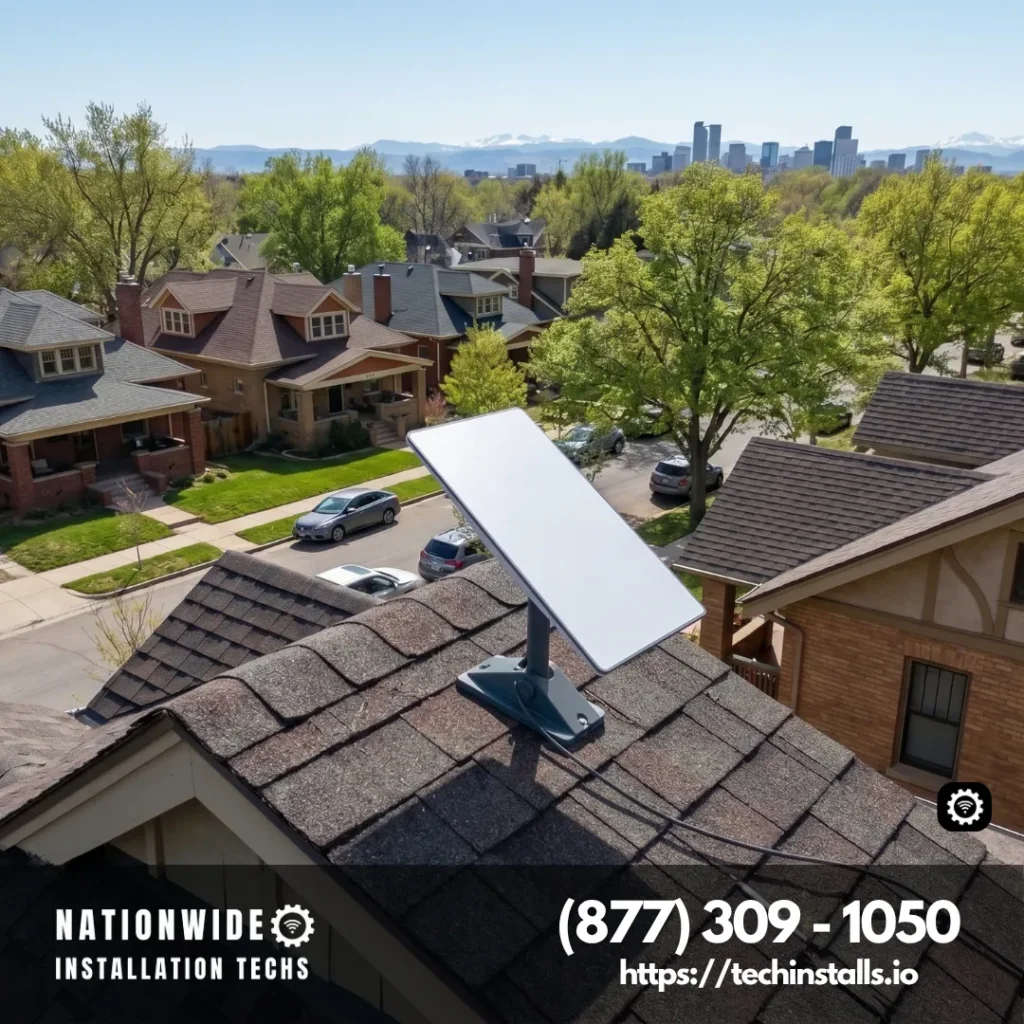
- Sloped asphalt shingle, which is the majority case, takes the pivot mount. It bolts to the slope with a circular pivot disc between two splayed feet that brings the mast to true vertical on any pitch, and it goes high on the roof plane immediately below the ridge or straddling the ridge cap so the panel clears everything on the roof. Roof sealant goes in and around every pilot hole, around the full base edge of the mount, and over every exposed bolt head.
- Class 4 impact-resistant shingle takes the same pivot mount and the same sealing standard. A great many Colorado homes carry a Class 4 roof because many carriers offer a 20 to 30% premium discount for one, worth roughly $200 to $600 a year on a typical metro home. We are installers, not your insurer, and we will not tell you what your policy does or does not permit. What we will say is that the sealing standard we apply is the same one we would apply to a roof nobody paid extra for, and if you want it documented in photographs before we leave, ask and we will.
- Any metal roof does not get drilled, ever, standing seam or otherwise. Our standard is explicit about it: we never drill into a metal roof, and the documented answer is a non-penetrating ballasted mount held down by pavers, cinder block caps or standard red bricks. If the property also happens to have a sound fascia board with nothing obstructing the mast, a standard wall mount is another way to keep every fixing off the roof, but that is a separate mount with its own conditions rather than the stated remedy for metal.
- Flat and low-slope roofs, common on the commercial stock and on some of the newer infill, take the non-penetrating ballasted mount as well. The guide states plainly that it works for both flat and pitched roofs, and it is also the right answer any time an owner wants no penetration at all. On the roof the cable is held with flex or roofing tape rather than clips; clips are for the wall run.
- No fascia board, or gutters and a wide eave in the way, takes the under eave mount, whose horizontal arm bolts to the wall below the soffit and reaches past the gutter with the mast at its outer end. The dish still has to sit above the roof line or the roof itself becomes the obstruction.
Cable entry is drilled from the inside out, within four feet of an outlet and two to three inches below the outlet’s centre, so the entry sits low on the wall. There is a full drip loop below it with the cable rising into a flush sealed grommet, and a white brush wall plate on the inside rather than a bare hole.
Rowhouses, Carriage Units and Properties With More Than One Building
A good share of our Denver work is not a single dish on a single house.
The city has a lot of lots with a garage, a carriage unit, an ADU or a shop on them, and a lot of small commercial properties with a second building across a yard. Running a wire between them means trenching, which in a city with this much frost depth and this much buried utility is slow, expensive and sometimes not permitted at all.
A point-to-point wireless bridge puts a small radio on each building and links them without digging. It is normally faster to install and considerably cheaper than a buried run, and it is the answer we reach for most often on a Denver property with two roofs on it. Where the coverage problem is inside a single building rather than between two, mesh networking is the cheaper fix, and we will say so.
Xfinity, Quantum Fiber and Google Fiber Already Reach Most of This City
We would rather give you the real picture than sell against it.
Xfinity cable reaches roughly 99% of Denver addresses. Quantum Fiber has built substantially across the city, with published coverage estimates ranging from about half of street addresses to about three quarters depending on the source, and Google Fiber is here as well. Taken together, fiber of some kind reaches somewhere around 52 to 53% of residences. That is a genuinely well-served city by national standards, and if a symmetrical gigabit line is available at your address at a price you like, it is a strong product.
What that picture does not cover is the rest of the reasons people call us, and they are ordinary ones. A second connection that fails independently of the wire and the grid, which matters if your work does not stop when the block goes dark. A property with buildings the wire was never going to reach. A bill that has gone up every year and a provider you have finished negotiating with. A move into a place where the build has not arrived yet and there is no date on it. None of those is solved by a coverage map showing green.
Insurance, Warranty and the Numbers Behind the Quote
Residential installs start at $385. What moves the number from there is the work itself: which mount your roof requires, how high the mast has to be, how long and awkward the cable run is, and whether a second building needs covering. A virtual site survey is free and reads the sky over your roof before anyone gets on a ladder. An on-site survey is $199 if you want someone physically at the property first.
You will have the figure before any work starts. We do not quote on the roof.
We carry general liability insurance and our technicians are experienced and insured, which matters more on a steep Denver roof in February than it does in a mild climate. We are an independent installer: you own the hardware and you hold the Starlink account. We do not sell you the service plan, we do not open the account for you, and we do not take a cut of your monthly bill. What we sell is the install. What a Starlink install actually costs is broken down in full elsewhere on the site if you want the detail before you call.
Jobs We Turn Down, and Who You Should Call Instead
- We do not drill metal roofs. Not for a discount, not because you asked nicely. Our written standard says we never drill into a metal roof and to use a non-penetrating mount instead, and that is what happens, or the job does not get done by us.
- We do not do roof repair. If your deck is soft, if there is existing storm damage, or if the shingles are at the end of their life, get a roofer first. Mounting hardware to a roof that is about to be replaced wastes your money twice, and in this city that is a live risk rather than a hypothetical one.
- We do not assess hail damage or handle insurance claims. We are not adjusters and we will not pretend to be. If a storm has been through, your roofer and your carrier come before us.
- We do not sell you the Starlink service plan or open the account. You own the hardware and hold the account. We handle the install.
- We will not drill a roof on a tenant’s say-so. If you rent, written permission from the owner comes first, and in a city with as much rental and condo stock as this one that includes an HOA where one applies.
Denver Starlink Installer: Frequently Asked Questions
The manufacturer has not published a hail rating, and we are not going to invent one. We pulled all eight pages of the Starlink Standard specification sheet and the words “hail” and “impact” do not appear on it anywhere. The sheet gives an IP67 Type 4 rating, which covers dust and water ingress rather than impact. What we control is the mount: mast plumb, every penetration sealed, cable clipped tight so nothing whips. If a panel does take a bad hit, a proper mount means you are replacing a panel rather than repairing a roof.
Usually, yes. The specification sheet lists an operating range of -22°F to 122°F, and Denver’s all-time record low is -29°F, set in January 1875. The modern-station record, -25°F in December 1990, is below the rated floor as well, so the bottom of that range is genuinely reachable here rather than hypothetical, though it is rare. In an ordinary cold snap the dish runs fine and its snow melt function clears the panel at up to 1.5 inches an hour. In a genuinely extreme one it can pause until the temperature comes back inside the rated range. That is the hardware, not the install.
Not the mount, no. It is the same pivot mount on the same sloped shingle. What it changes is how much the sealing matters to you, because you paid extra for that roof and many Colorado carriers discount 20 to 30% on the premium for it. Every pilot hole, the full base edge and every exposed bolt head gets sealed as standard on any roof we touch. If you want photographs of the sealed mount before we leave, say so when you book and you will have them.
Yes, and usually without drilling anything. A non-penetrating ballasted mount holds by weight, using pavers, cinder block caps or red bricks, and it works on flat and pitched roofs alike. The panel sits low and close to the roof on a short stalk rather than up a tall pole. If wind is a concern we tie the weights to the mount with metal tie-wire.
Cable at a fixed address is a strong product on price for the download speed, so it is worth comparing before you commit. Plenty of people go ahead regardless, usually for one of two reasons: they want a second connection that fails independently of the wire and the grid, or the property has a garage, an ADU or a shop that the wire was never going to cover.
Yes, and trenching across a Denver lot is usually the wrong way to do it. A point-to-point wireless bridge puts a small radio on the house and another on the garage and links them without digging anything up. It is faster to install and considerably cheaper than a buried run, and it does not involve a permit or a frost-depth trench.
No. Residential pricing starts at $385 whether you are on the grid in the city or up a canyon road. What moves the number is the work: the mount your roof needs, mast height, the cable run, and whether a second building is involved. Wind is a bigger factor in the mount specification up there than it is on the plains side, which can change the mount but does not change the call-out.
Sometimes, and the first step is written permission from the owner or the HOA rather than from the building manager in passing. Depending on what the sky looks like from your unit, a balcony rail position, a wall mount, or a non-penetrating ballasted mount that puts no hole in anything can all work. What we will not do is put a fixing into a roof or a facade on a tenant’s say-so alone.
About Nationwide Installation Techs
Nationwide Installation Techs LLC is a professional, insured satellite installation company operating in all 50 states, with over 3,000 installations completed and a 4.9-star Google rating from 90+ reviews. Our experienced technicians cover residential, commercial, RV and marine installations, along with mesh networking, point-to-point bridges and on-site repair. We are an independent installer: you own your hardware and hold your own service account, and our crews handle the mounting, sealing and setup.
Serving Denver, the surrounding metro and the rest of Colorado, plus every other state listed on our locations we serve page. Call (877) 309-1050.
Contact a Denver Starlink Installer
Nationwide Installation Techs LLC
- Phone: (877) 309-1050
- Email: support@techinstalls.io
- Free Quote: Contact Us Form
Connectivity News & Updates

Residential Starlink Installation — Nationwide and Insured
Residential Starlink installation starting at $385, nationwide. Nationwide Installation Techs...

Expert Starlink Installation for Yachts and Boats
Starlink installation for yachts and boats, nationwide. Nationwide Installation Techs...

Professional Starlink Installation for Cars and Trucks
Starlink installation for cars and trucks, nationwide. Nationwide Installation Techs...

Denver Starlink Installer — Same-Day Service When Your Kit Is On Site
Denver Starlink installer, Nationwide Installation Techs, (877) 309-1050. Professional, insured...
Disclaimer: Nationwide Installation Techs LLC is an independent business and has no affiliation or official connection with Starlink, SpaceX, or any of their subsidiaries or affiliates. We are not associated with, authorized, endorsed, or sponsored by these companies in any capacity. For official information, please visit the Starlink and SpaceX websites at www.starlink.com and www.spacex.com. The names “Starlink,” “SpaceX,” and any related trademarks, logos, or imagery are the exclusive property of their respective owners.
Any references to “certified” or “certification” on this website refer exclusively to Nationwide Installation Techs LLC’s proprietary in-house technician certification program. This training and certification process was developed by our company based on the experience and installation methods of professional technicians who have collectively completed more than 3,000 successful Starlink installations while maintaining an overall 4.9-star customer review rating. It is not affiliated with, issued by, approved by, or endorsed by Starlink, SpaceX, or any of their affiliates.