

Logan Starlink installer, Nationwide Installation Techs, (877) 309-1050. Professional, insured technicians serving Logan and Cache County. If your kit is already on site, same-day service is often available. Residential installs start at $385.
Cache Valley is a bowl with a university in the middle of it. That means most of Logan already has a wire, and a good share of the roofs in town belong to a landlord. Both of those are reasons to say no, and we say them first. Give us the street number and tell us whether you own the roof, and you will get an honest read before you spend anything with us. That takes a few minutes and costs nothing. The work that is genuinely ours starts where the pavement thins: the dry-farm ground on the north-west bench, the canyon addresses east and south of town, and the shops and barns that sit further from the road than the house does.
Cable is reported at roughly 96% of Logan city, with several fiber options layered on top, so at a fixed address inside the grid a wire will normally beat satellite on price, latency and upload. Run a test on speedtest.net at your own street number rather than trusting a neighbourhood coverage map, then get a quote for that exact address.
The Dish Melts Its Own Snow, and That Is a Power Question
Most city pages open with a mounting problem. This one opens with a wattage, because in Cache Valley the winter question people actually ask is not whether the dish keeps working. It does. The question is what it costs to keep it working.
The Gen 3 Standard panel has a heater and clears snow off its own face. The published draw for the Standard kit is 75 to 100 watts, and a panel that is melting sits at the top of that band rather than the bottom. On grid power in Providence that is a rounding error on the bill. On a cabin running off a battery bank up Logan Canyon it is the whole design problem, and it is the reason we ask about your power source before we ask about your roof. A 100-watt continuous load through a long January night is a different battery than a 75-watt one, and the answer changes what we recommend and sometimes whether we recommend anything at all.
The second winter fact matters more and almost nobody is told it. The Gen 3 Standard is not motorized. It does not tip itself to a better angle when the weather turns. Whatever tilt we set at the mount is the tilt it holds in February, which makes the mount angle the single decision that determines whether wet snow slides off the face or sits on it. Set too flat and you have built a shelf. Set with the face pitched properly and gravity does most of the work the heater would otherwise have to do, which quietly lowers the power draw all winter.
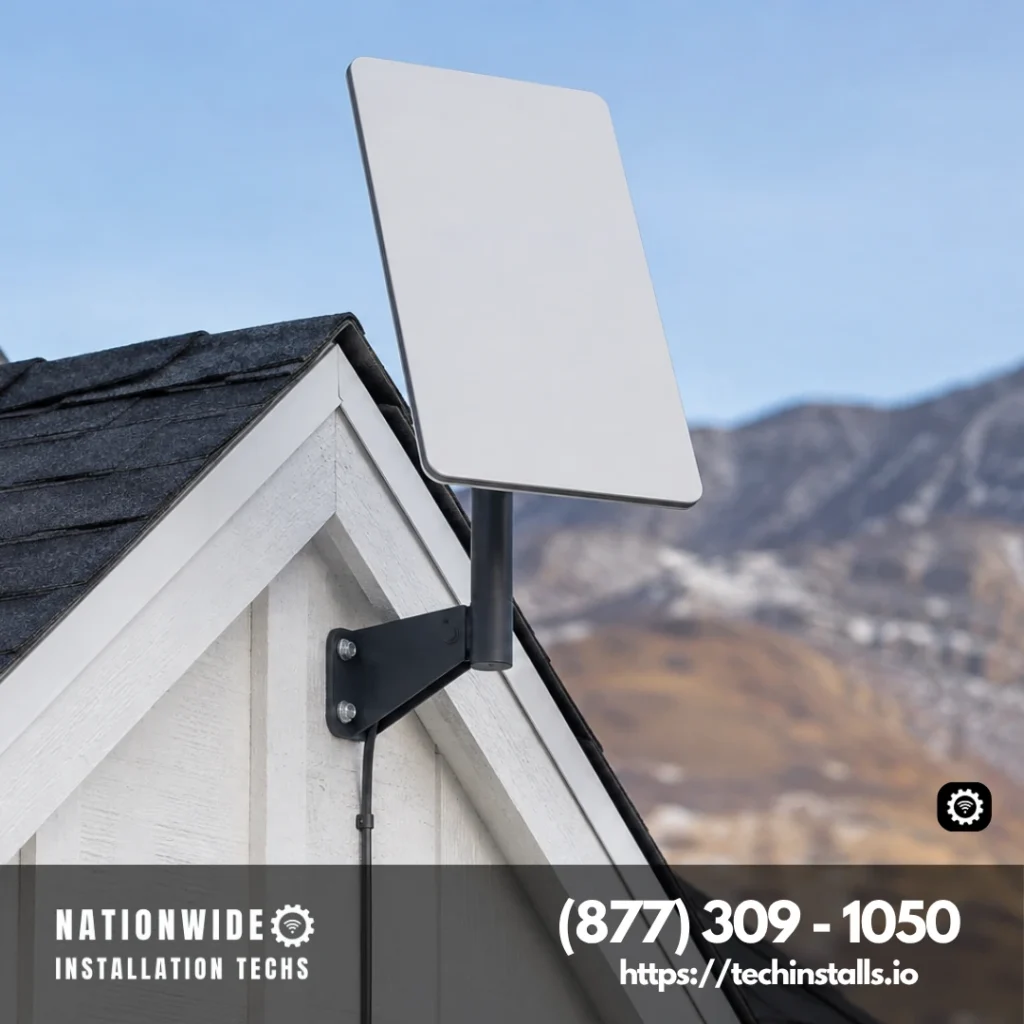
That is also why we care where the panel sits relative to the roof. A standard wall mount goes on the gable end at the rake near the peak, its flat angled blade fixed to the fascia board with exactly two bolts, one top and one bottom, and a short mast rising from it at a true vertical, no pitch in any direction. The panel finishes comfortably above the ridge with open sky over it. A dish mounted plumb but sitting level with or below the roofline turns your own house into the obstruction and throws away a large part of what the hardware can do. Where the fascia is out of square, two to four stainless washers behind a bolt bring the mast back to true. Where the eave is too wide or there is no fascia to catch, an arm bolted square to the wall below the soffit reaches past the gutter with a plumb mast at its outer end. Where nothing may be drilled at all, or the roof is standing-seam metal, a non-penetrating ballasted mount holds by weight and is tied off against wind.
Whatever the mount, the cable runs down the mast, along the roof edge to the gutter, down the wall clipped tight with no sag, forms a drip loop and enters through the wall through a sealed grommet low down near outlet height. It never crosses a roof plane, and in ice-dam country that is not a matter of tidiness. On completion we run a speed test at the router and give you the number.
One thing we will not do is put the panel where snow sliding off your roof lands on it. On a steep metal roof in Hyrum or Avon that is a real force, not a theoretical one, and it has taken mounts off walls. Sometimes the correct answer is the gable end the snow does not shed toward, even if the cable run is forty feet longer.
Cache Valley Is a Bowl, and the Rim Takes Part of Your Sky
Logan sits on a valley floor with the Wellsville Mountains on the south-west and a high wall of country to the east, and that geometry does something to satellite sightlines that flat-country customers never have to think about. Logan Peak stands 6.2 miles east-south-east of the city centre. The Mount Naomi Wilderness begins about 12 miles to the north-east. Neither of those is an obstacle to a dish in town, because a ridge ten miles away sits very low in your sky. What does matter is the ground within a few hundred yards of the house.
The addresses where this bites are the ones tucked into a canyon mouth or set against the bench. A property partway up Blacksmith Fork, 7.8 miles south-south-east on SR 101, has canyon wall rising close on both sides, and the usable window is a strip rather than a dome. The same is true up Left Hand Fork, in the draws above Avon and Paradise, and along the Logan Canyon Scenic Byway east of town, where the road is in a slot for most of its first several miles. In those places the survey is not a formality. It decides whether there is a job.
Height and position are the only levers, and on a canyon lot position is usually the bigger one. The useful move is often not a taller mast on the house but a different structure altogether: the barn on the open side of the yard, the shop at the top of the drive, the corner of the property that sits out of the shadow. Where the building with sky and the building with people are not the same building, a point-to-point wireless bridge carries the connection across the gap, and on Cache County acreage that is frequently the whole solution rather than a bolt-on.
Out on the north-west bench the problem inverts. At Clarkston, Newton, Trenton and Cornish there is nothing in the way at all, and the constraint stops being sky and starts being distance: the house is a long way from the road, the shop is a long way from the house, and the cable run is what sets the price.
Logan Starlink Installer Range, Cutler Reservoir to the Top of Logan Canyon
In and around the city we cover 84321, 84322, 84341 and 84318, which takes in Logan, the university bench, North Logan and Hyde Park. South along SR 165 on the east bench we work Providence at 84332, River Heights, Millville at 84326, Nibley, Hyrum at 84319, Paradise at 84328 and Avon, and up Blacksmith Fork Canyon on SR 101 as far as the Hardware Ranch road, 15.5 miles east-south-east. North on US 91 and SR 218 we cover Smithfield at 84335, Richmond at 84333 and Lewiston at 84320, and we carry on over the state line to Franklin and Preston in Idaho, 19.8 and 25.3 miles north.
West and north-west is the farm ground and we go all of it: Benson, Amalga, Petersboro at 84325, Young Ward and College Ward at 84323, Mendon and Wellsville on SR 23, Cache Junction at 84304, Newton at 84327, Clarkston at 84305, Trenton at 84338 and Cornish at 84308, out past Cutler Reservoir and along the Valley View Highway toward Tremonton, 17.1 miles west.
East up US 89 we take the canyon addresses toward Tony Grove and Beaver Mountain, 14.9 and 22.1 miles north-east, and over the summit to Garden City and the Bear Lake shore, 27.2 and 30.9 miles out. South through Sardine Canyon we run the same rates to Brigham City, 17.8 miles south-south-west.
If you are elsewhere in Utah we still come, and the rest of the states we operate in are on our locations we serve page.
What a Logan Job Costs, and the Three Documents Behind the Price
Residential starts at $385. Commercial is $750 per site and drops to $650 per site at three or more. RV and mobile is $650, marine is $750. A virtual site survey is free. An on-site survey is $199.
What moves the number in Cache Valley is rarely the dish. It is roof pitch and height, whether the mount can reach a fascia board or has to go under a wide eave, whether the roof is metal and therefore cannot be drilled, and above all the length of the cable run. A tight gable mount on a single-storey house in Nibley and a run from a barn roof at Clarkston back to a farmhouse two hundred feet away are not the same job and should not be the same price. Our cost breakdown page sets out the rest of it.
Three things are worth asking any installer to produce before you book, because all three are easy to supply and awkward to invent.
- $1M general liability insurance, certificate available on request
- 1-year workmanship warranty plus 3 months of support
- A 4.9-star Google rating from 90+ reviews, and the review count matters as much as the number
Alongside those: more than 3,000 installations completed across all 50 states, background-checked technicians, and 72-hour typical scheduling with same-day service when the kit is already on site. Worth doing before you book: run a check at speedtest.net so you have a real number from your current connection to compare against afterwards.
Half of Logan Is Somebody Else's Roof
Utah State enrolled about 29,831 students in autumn 2025. Logan city holds roughly 56,477 people. Those two numbers are the most important thing on this page for anyone living within walking distance of campus, because they mean a very large share of the housing here is rented, and a rented roof is not ours to put a bolt through.
We will not drill a roof, a fascia board or an exterior wall on a property the occupant does not own, and we will not take a tenant’s word that the landlord is fine with it. Get it in writing. With written permission from the owner we will do the work properly and seal it properly. Without it, the honest answer is that a ballasted mount on a balcony or a patio, where the lease allows and where there is sky, is the only version of this we will install, and in a lot of student housing there is neither the sky nor the lease clause. Managed apartment complexes are almost always a no.
The same logic covers the wider city. Cable reaches around 96% of Logan, several fiber options overlay it, and at a fixed address in town a wire is the better product on every measure that matters. If you are in a house near campus with cable at the kerb, you do not need us. Get a quote for your own street number, because coverage maps are drawn at the neighbourhood level and the truth is at the property level.
And if your roof is straightforward and you are comfortable on a ladder, you may not need an installer at all. Starlink sells its own installation at checkout through OnTech for around $199, free on the MAX plan, and for an easy pitched-shingle mount that is the cheaper and correct answer. We are worth paying for when the job is awkward: a tall or steep roof, a metal roof that must not be drilled, a canyon lot where position is the whole problem, a long run out to a shop or a barn, or a winter install where the mount angle has to be right the first time.
We Do Not Shovel Roofs, and Four Other Limits
We do not clear snow from roofs, and we do not climb a roof loaded with it. In a Cache Valley winter that is a safety line rather than a preference, and it means some jobs booked in January get done in March. We would rather tell you that when you call than send a technician to a roof that cannot be walked.
We are not roofers. We do not repair, replace or re-cover a roof, and we will not mount on one that is failing. Ice damming along the eaves is ordinary here and a soffit that has been wet for three winters is a conversation with a roofer, not with us. We do not drill metal roofs at all, which in this valley comes up constantly on shops and outbuildings, and the answer there is a ballasted mount or a different structure.
We are not electricians. We do not run new mains circuits, and on an off-grid cabin we will advise on the load the panel puts on your system but we do not design, install or modify the system itself. We do not sell service plans, because you hold your own account and own your own hardware. And we do not cut trees, which matters less here than in some places but still comes up on the canyon lots. We are an independent installer and are not affiliated with, endorsed by, or acting for Starlink or SpaceX.
Frequently Asked Questions
No, and please do not. The panel has a heater and clears its own face. What we would rather you check from the ground is whether snow sliding off the roof has landed on the mount, and whether the cable is still clipped where we left it. If the connection is down after a heavy fall, that is usually a buried cable clip or an obstruction that was marginal in summer, not the panel giving up.
It does not. The inversion is a temperature and air-quality problem, not a radio one, and haze in the valley air is invisible to the frequencies this hardware uses. Heavy wet snow falling in the air can cause a brief dip while it is actually falling. Weeks of trapped cold and grey do nothing at all.
Only with the owner’s written permission, and even then only in a way that does not put a hole in somebody else’s building. On most rentals near campus that leaves a ballasted mount on a balcony or patio if the lease allows and if there is sky, and quite often one of those two is missing. Managed complexes are almost always a no. Ask the landlord before you buy hardware, not after.
Usually none. Cable reaches around 96% of Logan and at a fixed address a wire wins on price, latency and upload. The primary reasons people still call us are a shop or a barn the wire does not reach, a property past the end of the service footprint, or an RV, or people are unhappy with how often their current providers lose service.
It changes the conversation before the job. The Standard kit draws 75 to 100 watts and sits toward the top of that when it is melting snow off itself, which is a meaningful continuous load on a small bank in January. We will ask what your system is before we quote, and we will tell you if we think the answer is a bigger battery rather than a bigger mast.
Ground rising close behind a house removes part of the sky, and that is a survey question rather than a quote question. On bench and canyon-mouth lots the fix is usually position rather than height: a different gable, an outbuilding on the open side, or a bridge link from a structure that has sky to the one that does not. Book the free virtual survey and we will look before anyone spends money.
Yes, in two ways. We keep the mount and the cable entry out of the path of an ice dam and away from where meltwater tracks back under the shingles, and we will not fix an arm under a soffit that has already been soaked for several winters. If the eave is sound, an under-eave arm is fine. If it is not, the mount is not the first problem on that house.
We do not drill it. A standing-seam or corrugated roof gets a non-penetrating ballasted mount that holds by weight and is tied off against wind, which works on flat and pitched roofs alike. If the shop is the building with sky and the house is the building with people, the cleaner answer is often a bridge link between the two rather than a long cable run across the yard.
About Nationwide Installation Techs, Your Logan Starlink Installer
Nationwide Installation Techs LLC is a professional, insured satellite installation company operating in all 50 states, with over 3,000 installations completed and a 4.9-star Google rating from 90+ reviews. Our experienced technicians cover residential, commercial, RV and marine installations, along with mesh networking, point-to-point bridges and on-site repair. We are an independent installer: you own your hardware and hold your own service account, and our crews handle the mounting, sealing and setup.
Serving Logan, Cache County and the rest of Utah, plus every other state listed on our locations we serve page. Call (877) 309-1050.
Contact a Logan Starlink Installer
Nationwide Installation Techs LLC
- Phone: (877) 309-1050
- Email: support@techinstalls.io
- Free Quote: Contact Us Form
Connectivity News & Updates

Residential Starlink Installation — Nationwide and Insured
Residential Starlink installation starting at $385, nationwide. Nationwide Installation Techs...

Expert Starlink Installation for Yachts and Boats
Starlink installation for yachts and boats, nationwide. Nationwide Installation Techs...

Professional Starlink Installation for Cars and Trucks
Starlink installation for cars and trucks, nationwide. Nationwide Installation Techs...

Starlink Ethernet Adapter Guide: Picking the Right One for Your Setup
Only one current Starlink router needs the Ethernet adapter —...
Disclaimer: Nationwide Installation Techs LLC is an independent business and has no affiliation or official connection with Starlink, SpaceX, or any of their subsidiaries or affiliates. We are not associated with, authorized, endorsed, or sponsored by these companies in any capacity. For official information, please visit the Starlink and SpaceX websites at www.starlink.com and www.spacex.com. The names “Starlink,” “SpaceX,” and any related trademarks, logos, or imagery are the exclusive property of their respective owners.
Any references to “certified” or “certification” on this website refer exclusively to Nationwide Installation Techs LLC’s proprietary in-house technician certification program. This training and certification process was developed by our company based on the experience and installation methods of professional technicians who have collectively completed more than 3,000 successful Starlink installations while maintaining an overall 4.9-star customer review rating. It is not affiliated with, issued by, approved by, or endorsed by Starlink, SpaceX, or any of their affiliates.