

Rockport Starlink installer, Nationwide Installation Techs, (877) 309-1050. We put insured technicians on the Live Oak Peninsula, from the Aransas Bay waterfront across to Copano and out through Lamar and Fulton. Where the hardware is already on the property, we can frequently have it finished that afternoon. A residential Starlink install starts at $385. Our Rockport commercial Starlink installs start at $750, with discounts for 3+ business locations, and additional discounts for 12+ locations. Mobile Starlink installation in Rockport starts at $650, with discounts available for 3+ vehicles and for those with mobile fleets, and additional discounts for 12+ vehicles. Our boat Starlink installations start at $750. All of our installs include a 1-year quality of workmanship guarantee, by insured, local technicians. We have a 4.9-star Google rating with 110+ reviews. Serving Rockport, TX and all other surrounding areas! Contact us for a free quote and virtual site survey today!
Rockport sits on the Live Oak Peninsula between Aransas Bay and Copano Bay, low and flat and surfaced in sand and dark clay, which means most of the sky here is genuinely open. There are no hills, the live oaks have been sheared flat by the onshore wind for a century, and the tallest thing on a lot is usually the house next door. The arc the dish actually wants is the northern one, and out here very little stands high enough to close it — which is why a tree line to the south of the house rarely enters into the decision at all. The obstruction survey is rarely the hard part of a Rockport job. The hard part is everything the salt and the wind do to the mount after we leave.
What brings people to us here is the address the wired build never reached: a place out on the Lamar Peninsula where the line stops, a fish camp or a shop that one drop was never going to serve, or a second connection that stays up when the wind takes the poles down. Log whatever you have now with a Speedtest.net reading and take another once we have driven away; the difference between the two readings is what you are paying for.
Salt Air Is Working on the Mount Before the First Storm Arrives
The specification sheet has nothing to say about this and it is the thing that decides whether a Rockport install is still sound in five years.
Salt-laden air is on this hardware constantly, not occasionally. A house three streets back from Aransas Bay still gets it, because the onshore breeze carries it inland all day. The dish itself is sealed and the manufacturer handles that end. The mount is ours, and a mount is a collection of fasteners, brackets and a cable entry, all of which are exactly the things salt goes after first.
What that changes about the work:
- Stainless or coated fasteners, not whatever came in the box. A plated screw on a coastal roof is a rust stain in a year and a loose bracket in three. This is not an upgrade we sell you, it is the default here.
- Dissimilar metals get separated. Aluminum bracket, steel screw and salt water is a battery, and galvanic corrosion will eat the softer metal without anybody touching it. Where the mount needs two metals in contact, they get isolated.
- The cable entry is sealed properly and it faces down. Salt air plus a poorly formed drip loop is how water tracks along a cable and into a wall cavity. The loop hangs below the entry so water leaves the cable instead of following it.
- Roof penetrations are the last resort, not the first option. Every hole is a maintenance item on this coast. Where a non-penetrating mount will carry the load we use one, which is the same answer the roof type usually gives us anyway.
None of that adds a day to the job. It is a set of decisions made before anyone opens a ladder, and it decides whether the mount fades into the background or somebody has to climb back up to it.
Harvey Came Ashore Here, and the Roofs Are Younger Than the Storm
On 25 August 2017 Hurricane Harvey made landfall at Rockport as a Category 4 with 130 mph sustained winds and a measured gust of 145 mph. Nearly a decade later that single fact still shapes what we find on a roof here.
A large share of Rockport’s roofs are newer than 2017, because they had to be. That is good news for an install in almost every respect. The decking is sound, the fasteners are modern, the shingles are not at the end of their life, and there is usually documentation of what was done. A new roof is the easiest roof to mount to properly.
It also means two things are true more often here than anywhere else we work:
- A lot of properties are on their second roof and their owner remembers what the first one cost. Nobody in this town needs persuading that a hole in a roof is a decision. When we say we would rather use a non-penetrating mount, that lands differently in Aransas County than it does inland.
- There is paperwork attached to the rebuild. Which is the next section, and it is the part most installers never mention.
It is worth having the manufacturer’s own figures to hand. Starlink’s Standard specification gives the antenna an operating rating of 96 kph and upward, roughly 60 mph. Harvey was double that operational rating and then some. So the position to take is that a named storm is not a wind-rating problem, it is a take-it-down problem, and the mount is what has to still be there afterwards. We build the mount to stay; the dish is four bolts and ten minutes when a system is in the Gulf.
What a Windstorm Certificate Means for Anything Bolted to Your Roof
Aransas County is one of the fourteen first-tier coastal counties served by the Texas Windstorm Insurance Association, alongside Nueces, San Patricio, Refugio, Calhoun and the rest of the coast. In those counties windstorm coverage is tied to a Certificate of Compliance from the Texas Department of Insurance, the WPI-8, and that certificate regime covers structures built, altered, repaired or added to since 1 January 1988.
Here is what we will and will not tell you about that.
We will tell you the regime exists, that Aransas County is inside it, and that it is a live question for anybody putting hardware on a coastal roof. We will not tell you whether a satellite mount is inside or outside the scope of your particular certificate, because TDI publishes no plain ruling on it, and inventing one on your behalf is not something we will do. Ask your windstorm agent or TDI before anybody drills your roof. The inquiry is free, and taking it in that sequence saves trouble later.
What we can do is make the question smaller. A non-penetrating mount does not put a hole in the building envelope, which is the part the certificate is about. On most Rockport roofs that is the mount we would choose anyway, for salt reasons and for roof-age reasons. Where a penetrating mount is genuinely the only option, you will know that before we start and you will have had the chance to make the call.
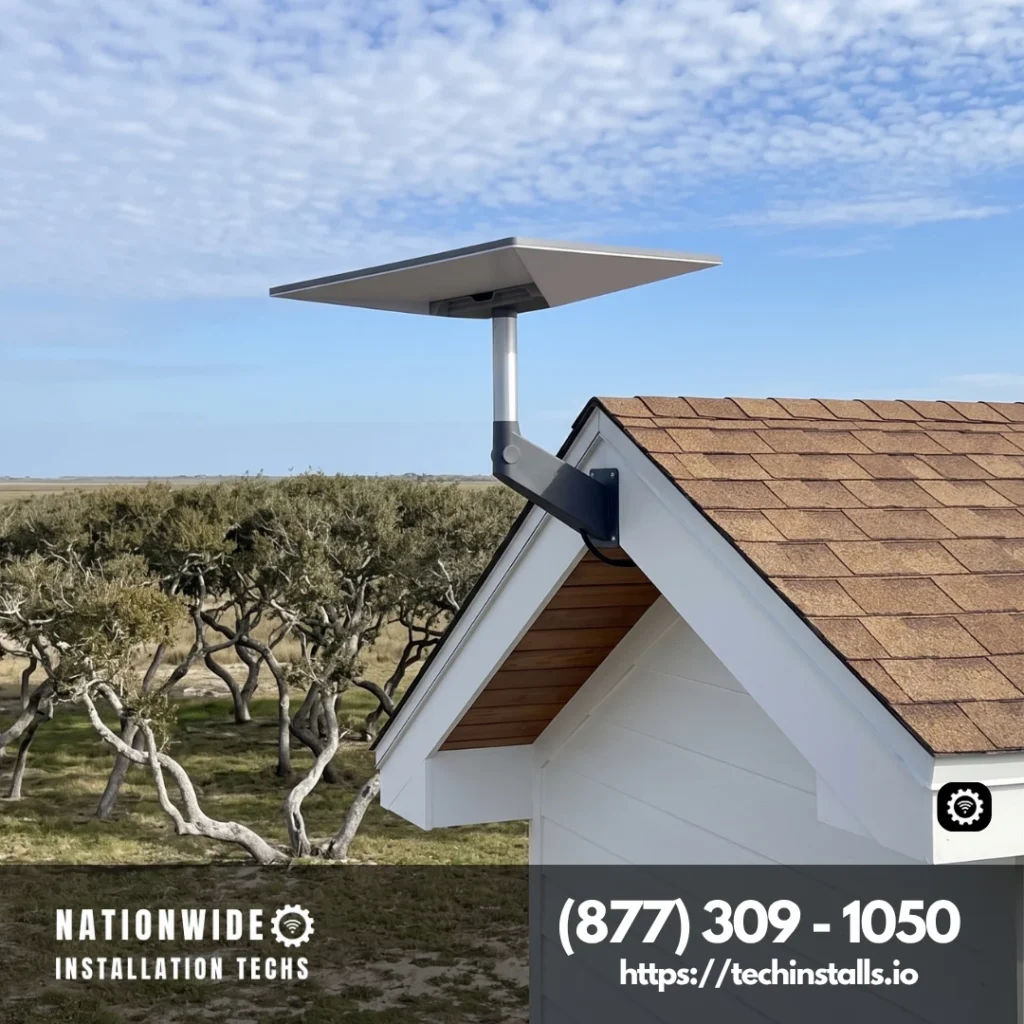
Between the two there is a third route worth knowing about. Where the house has a usable gable end, a standard wall mount bolts to the fascia board at the rake, two bolts, mast plumb, panel clear above the ridge, so the fixing goes into trim rather than through the roof covering and the roof surface is never broken. Whether that sits inside your certificate is the same question as before and the same phone call, and we will still tell you what we did and how.
A Rockport Starlink Installer Covers Both Sides of Copano Bay
A Rockport Starlink installer working this county is crossing water most days. Fulton is three miles north and effectively the same town. Lamar sits nine miles north across the Copano Bay causeway on the peninsula, which is a fifteen-minute drive for a distance you could shout across.
Off the peninsula the ring opens out. Aransas Pass is ten miles south-west and Ingleside fourteen, both in San Patricio County. Port Aransas is thirteen miles south on Mustang Island, reached by the ferry. Bayside is eleven miles west-north-west and Woodsboro twenty-two north-west, both Refugio County, with the town of Refugio itself twenty-four miles north-west. Portland is nineteen miles west-south-west, Gregory sixteen and Taft twenty-one, all San Patricio. Corpus Christi is twenty-eight miles south-west across the Nueces County line.
East of Rockport there is no next town, because east of Rockport is Aransas Bay, then San José Island, then the Gulf. That is not a coverage gap. It is simply what is there.
Mileage is never part of the bill. The price answers to the work waiting at the far end — what the roof will carry, how much mast the obstruction demands, the route and difficulty of the cable, and whether a second structure has to be brought in. Beyond the county line the rest of Texas runs on identical terms.
Winter Texan RV Parks Book in October and Leave in March
Rockport runs on a seasonal calendar and the install work follows it. The RV parks along Highway 35 and out toward Fulton fill in autumn and empty in spring, and a coach that is parked for five months is a different job from one that moves every weekend.
For a seasonal site the questions are these. Is the dish going on the coach or on the ground? A ground stand on a concrete pad is usually the better answer for a rig that is not moving, because it keeps weight and holes off the roof and it comes off the pad in minutes when you pull out in March. Where does the cable run so that nobody trips over it and the awning still works? And where does the router live, which on a coach means somewhere it will not cook behind a south-facing window in April.
For a fish camp or a shop building the questions are different again. These are often metal roofs, and we do not drill metal roofs, so a ballasted non-penetrating mount, or a wall mount on a lower elevation, is the answer. If the building has no power at all, that is a real conversation and not a no: the dish averages 75 to 100 watts, which is a number you can hand to whoever sizes a battery and a panel for you. Sizing it is not our trade, but giving you the figure is.
Where a property has more than one building, and around here that is usually a house, a shop and a fish house or a boat lift down on the water, one dish is rarely the question. The question is how to carry one connection across the yard. Trenching a waterfront lot is slow, and in this sand it is slower than people expect. A point-to-point wireless bridge mounts a small radio at either end and joins the buildings with nothing buried between them; across two or three structures that is usually the entire job.
Where you are renting rather than owning, the owner’s consent has to be in writing before anything else happens and we will ask to see it — there is more on this in our notes on rental and short-term properties.
Wired in Town, Thin Out on the Peninsula and the County Roads
Here is what the coverage actually looks like, because where your address sits on that map decides what kind of job yours is.
AT&T Fiber reaches a little over half of Rockport addresses, with the aggregators putting it at about 57% of the city, and Spectrum cable covers fewer than that, roughly 41%. Those percentages originate with broadband aggregators, and they are estimates that shift from one source to the next — so read any one figure as a rough signal, never as a statement about your particular street. Nobody disputes the broad shape of it: wired service is concentrated inside the city limits, and where both are on offer fiber usually costs less. What brings people here to us is rarely speed.
That is not the whole map. Aransas County outside Rockport and Fulton is a different picture, and the peninsula, the bay-side lots and the properties off the county roads are exactly where the wired build thins out. People with fiber already terminated in the wall call us for a quite separate reason, and speed has nothing to do with it: cable and satellite go down for entirely unrelated causes, and that single fact is the whole case for Starlink as a backup connection on a coastline with a long history of losing poles.
Heat, incidentally, is not the constraint here that it is in a desert city. Starlink gives the Standard an operating band of -30°C to 50°C, that is -22°F up to 122°F, and a Rockport July averages a high around 91°F. The top of that range is not what your install has to worry about. The wind and the salt are.
What the Quote Covers, and What Moves It
A house starts at $385, and everything above that figure is driven by what the job turns out to involve — the type of mount the roof will accept, the amount of mast needed to clear, how far and how badly the cable has to travel, and whether anything beyond the main building has to be brought online too. Nothing is charged for the virtual survey, which reads the sky above the roof before anyone unstraps a ladder. Where you would rather have somebody walk the site in person first, that costs $199, and on a peninsula lot with a broken tree line it occasionally earns its keep.
You get the price before any tool leaves the van. Nothing is costed from up a ladder, and running out to Lamar or down to Aransas Pass adds nothing to it.
The company carries general liability cover and the technicians who turn up are experienced ones. Where we sit in the transaction is worth being blunt about: the dish is bought in your name, the plan is billed to you by Starlink, and not a cent of that monthly figure comes back to us. Fitting it is the entire service. Should you want the numbers laid out before you ring, the full cost of a Starlink install is itemised on its own page.
The Roofs and the Jobs We Say No To
- We do not drill metal roofs. Standing seam and R-panel are everywhere along this coast because they hold up against salt, and a lag bolt through one undoes exactly the thing you paid for. Our procedure routes those roofs to a ballasted base that sits on the surface under its own weight, or to a wall lower down. There is no version of the job where we put a hole in your panel.
- We do not do roof repair. Decking that flexes underfoot, or shingles curling at the edges, is a roofer’s call and it has to come before we show up. Hardware anchored into a roof with one season left gets pulled at tear-off, and the second mount lands on your invoice.
- We do not certify anything for windstorm purposes. We are not a TDI-appointed inspector and we will not tell you your install is compliant. We will tell you what we did and how, and the certificate conversation is between you, your agent and the Department.
- Panel work and battery sizing stay with your electrician. Ours is one number: the Standard dish pulls 75 to 100 watts continuous. Pass it to whoever specs the inverter or the battery bank, which around here is often a boat or an RV, and that is the whole of what we contribute to it.
- The service plan is not something we resell. The kit and the plan come straight from Starlink and stay in your name. Our side of the arrangement is the mount, the aim and the cable.
- A renter cannot sign off on a hole in someone else’s building. Where the place is leased, the person named on the deed authorizes it in writing before a drill leaves the van, and that paperwork reaches us ahead of the visit.
Rockport Starlink Installation Questions
Often yes. If the kit is already on site same-day service is frequently available, and most jobs book inside a week either way. Tell us the roof type when you call, because a metal roof on a fish camp changes the mount and a house on piers changes the access, and both change how long we need on site. Residential installs start at $385.
Stainless or coated fasteners, as the default here rather than as an upgrade we sell you. Where two different metals have to meet they get isolated, because an aluminum bracket, a steel screw and salt water make a battery and galvanic corrosion will eat the softer metal without anybody touching it. We also prefer a non-penetrating mount wherever the roof allows one, since on this coast every hole is a maintenance item.
Ask your windstorm agent or the Texas Department of Insurance before anybody drills, and we mean that literally. Aransas County is one of the fourteen first-tier coastal counties, and the WPI-8 certificate regime covers structures built, altered, repaired or added to since 1 January 1988. No plain ruling from TDI exists on whether a satellite mount sits inside that scope, and we are not prepared to invent one for you. What we can do is use a non-penetrating mount, which does not break the building envelope at all and is what we would choose here anyway.
A good many do. Fiber is normally cheaper of the two, and there is no argument to be had about that. What brings people to us is that the two technologies fail independently of each other, and this coastline has a long history of losing poles. That is a second connection rather than a replacement, and whether you want one is your call rather than ours.
Yes, and the distance costs you nothing. Lamar lies roughly nine miles north across the Copano Bay causeway. What sets the figure is the job itself once we get there: the roof’s capacity to take a mount, the mast height the sightline calls for, the cable’s run and its awkwardness, and whether more than one building has to end up connected.
Yes. For a rig that is parked for five months a ground stand on a concrete pad is usually the better answer than putting anything on the coach roof, because it keeps weight and holes off the roof and it lifts out again in March. We route the cable so it does not foul the awning or trip anybody, and the router goes somewhere it will not cook behind glass in April.
Yes, marine work is part of what we do. A boat is its own problem: the mount has to take motion as well as wind, and salt exposure is constant rather than occasional, so fastener choice and sealing matter more again than they do on a roof. Call and describe the vessel and where it sits and we will tell you what the job looks like.
Take it down. Starlink lists an operating wind figure for the Standard beginning at 96 kph, roughly 60 mph, and lists no survival number whatever, which puts a named storm well past anything the spec sheet will vouch for. Harvey made landfall here at 130 mph sustained. Four bolts and about ten minutes takes the dish off. What stays behind is the mount, specified to still be standing afterwards, so the dish returns to the identical bracket, plumb, and nobody has to get back on the roof a second time.
About Nationwide Installation Techs
Nationwide Installation Techs LLC is an insured satellite installer working in every one of the fifty states, with more than 3,000 completed jobs on the books, alongside a 4.9-star Google rating from 110+ reviews. Coastal houses, commercial premises, trailered boats and motorhomes are all ordinary work here, as are mesh coverage, shore-to-outbuilding links and the repair of installs that did not survive their first season. We never touch your Starlink account. The dish and the plan are registered to you; the bracket, the sealant, the cable run and the alignment are on us.
You will find Aransas County under locations we serve, alongside Starlink installation across Texas on terms that do not vary. Call (877) 309-1050.
Contact a Rockport Starlink Installer
Nationwide Installation Techs LLC
- Phone: (877) 309-1050
- Email: support@techinstalls.io
- Free Quote: Contact Us Form
Connectivity News & Updates

Details About the Starlink Holiday Subscriber Growth Push
The Starlink holiday subscriber growth push is SpaceX’s plan to...


South Padre Island Starlink Installer — Same-Day Service When Your Kit Is On Site
Hurricane Dolly's 94 mph gust was recorded just north of...
Disclaimer: Nationwide Installation Techs LLC is an independent business and has no affiliation or official connection with Starlink, SpaceX, or any of their subsidiaries or affiliates. We are not associated with, authorized, endorsed, or sponsored by these companies in any capacity. For official information, please visit the Starlink and SpaceX websites at www.starlink.com and www.spacex.com. The names “Starlink,” “SpaceX,” and any related trademarks, logos, or imagery are the exclusive property of their respective owners.
Any references to “certified” or “certification” on this website refer exclusively to Nationwide Installation Techs LLC’s proprietary in-house technician certification program. This training and certification process was developed by our company based on the experience and installation methods of professional technicians who have collectively completed more than 3,000 successful Starlink installations while maintaining an overall 4.9-star customer review rating. It is not affiliated with, issued by, approved by, or endorsed by Starlink, SpaceX, or any of their affiliates.