

Moreno Valley Starlink installer, Nationwide Installation Techs, (877) 309-1050. Professional, insured technicians serving Moreno Valley and Riverside County. If your kit is already on site, same-day service is often available. Residential installs start at $385.
Most of this city has a wired option, and most of the people who book a Moreno Valley Starlink installation already have one. They are switching, or they are adding a second line, and either way the roof is the reason it needs doing properly. Frontier runs fiber across roughly three-quarters to four-fifths of Moreno Valley depending on which FCC collection you read, at speeds up to 7 Gbps, and Spectrum cable reaches almost every address in the city. Those are the numbers, and they are worth knowing before you spend anything. Check your own street number on speedtest.net rather than a neighbourhood coverage map, because the build edge here runs mid-block in places.

What brings people to us is rarely that nothing else exists. It is a bill that went up again, a provider they have finished arguing with, an outage that cost a working day, or a house where the connection has to reach a casita, a shop or a second unit that the wire was never going to get to. Add the addresses out toward the Badlands and the hill lots above Reche Canyon Road where the build genuinely did stop, and that is the work.
Concrete Tile Decides This Job Before Anyone Opens a Ladder
Moreno Valley incorporated in 1984 and most of the housing went up in the two decades after, which in this part of the Inland Empire means concrete or clay barrel tile on a very large share of the roofs. Tile changes the whole job, and it changes it before anyone gets a ladder off the van.
We do not drill tile. Not as a preference, and not as something we can be talked into on the day. A cracked tile is a roof leak and a repair bill, and it is entirely avoidable, so the mount goes somewhere else. There are two documented ways to do that and we will tell you which one your roof is getting during the survey. The first is a non-penetrating ballasted mount, which sits on the surface and holds by weight, and which works on flat and pitched roofs alike. The weights are pavers, cinder block caps or standard red bricks, and where wind is a factor they are tied to the mount with metal tie-wire rather than left to sit. The second, where a gable end is available and the panel needs to clear the ridge, is a standard wall mount on the fascia at the rake, two bolts, top and bottom, with stainless washers behind them to shim a board that is out of square. That keeps every fixing off the tile entirely.
Composition shingle still exists here, mostly in the older pockets and on some of the newer infill, and on shingle the default is the pivot mount bolted to the slope with its base following the pitch so the short mast still stands plumb. Every pilot hole, the full base edge and every exposed bolt head gets sealed. Whatever the roof is doing underneath it, the mast ends up vertical and the cable never crosses a roof plane.
The Wind Goes After the Mount, Not the Dish
The Starlink Standard specification sheet gives one wind figure and it is worth reading carefully. Operational: 96 kph or more, which is 60 mph or more. There is no survival rating printed on that sheet at all. That is not a scare story, it is just the published limit, and it explains where the risk in a Moreno Valley install actually sits.
This city is at the western mouth of the pass. When a Santa Ana event sets up, gusts through the mountain passes across Southern California run into the 50 to 70 mph band, and the exposed lots on the north and east sides of town feel it first. What we see fail in that wind is never the antenna. It is a ballast mount that was placed but not tied, a wall mount bolted into a fascia board that had already gone soft, or a cable run left with enough slack to whip against the stucco until it chafes through. So the ballast gets tie-wired, the fascia gets checked before anything goes into it, and the cable is clipped every twelve to eighteen inches, tight and straight, with a drip loop before the sealed grommet.
Heat is the thing people ask about and it is the smaller problem. The published operating ceiling is 122°F. Moreno Valley’s all-time record is 118°F, so ambient temperature has never put the hardware outside its rating here. What a run of 110 degree afternoons does find is a lazy install: an unsealed bolt head, a slack cable lying across a hot roof surface, or a router shut in a garage that hits 130 degrees by four in the afternoon.
Whatever the mount, the connection has to reach the rest of the property, and on a lot here the building that needs it is often not the house. A casita, a converted garage, a workshop or a second unit is a point-to-point wireless bridge job rather than a trenching job, and a radio on each building beats cutting a driveway open every time.
Our Starlink Installation Services Reach Beyond Moreno Valley
Inside the city we cover the whole grid, from the north end above Sunnymead Boulevard down through the Cottonwood and Alessandro corridors to the Edgemont side and the neighbourhoods around March, across ZIPs 92551, 92553, 92555 and 92557.
Beyond the line we work in two counties. West to Riverside at nine miles, Rubidoux at eleven, and Woodcrest and Mead Valley on the south-west side. North across into San Bernardino County: Grand Terrace and Loma Linda at eight miles, Redlands at nine, Colton at ten. East to Calimesa at eleven, Yucaipa at thirteen, Beaumont at fifteen, Cherry Valley at fifteen and Banning at twenty. South to Perris at eleven, Nuevo at eleven, Lakeview at ten, Homeland at fifteen and on to San Jacinto and Hemet at around nineteen. Further south again we have a Murrieta Starlink installer page covering that end of the county. Beyond Riverside County we cover the rest of California and every state on our locations we serve page.
Insurance, Warranty and the Numbers Behind the Quote
An hour on the roof is the visible part of what a Moreno Valley Starlink installer does. What separates a job that is still sound in year five from one that leaks or works loose is everything around it, and these are the figures you can hold us to:
- Over 3,000 installations completed, in all 50 states.
- $1M liability insurance, and technicians who are background-checked.
- A 1-year workmanship warranty on the install, plus 3 months of support afterwards.
- 72-hour typical scheduling, and same-day when your kit is already sitting at the property.
- A 4.9-star Google rating from 90+ reviews, which you can read before you call us.
- Free virtual site survey. An on-site survey is $199 and is credited against the work if you book. We will never call an in-person visit complimentary, because it is not.
- Residential from $385, commercial $750 per site and $650 each at three or more sites, mobile and RV from $650, marine from $750. The full breakdown is on our Starlink installation cost page.
Frontier and Spectrum Already Reach Most of This City
Here is the coverage picture, stated plainly so you can decide with it rather than around it.
Frontier fiber reaches roughly three-quarters to four-fifths of Moreno Valley at speeds up to 7 Gbps. Spectrum cable reaches almost every address. On raw price per megabit for ordinary household use, a wire at a fixed address is hard to beat, and if you are happy with what you have then you are already sorted.
People switch anyway, and they switch for reasons that have nothing to do with coverage maps. The promotional rate ended and the real one arrived. Support took three calls and a technician window that nobody turned up to. The service drops in the afternoon and has done for months. Those are ours, and the install is the same quality job whether you are replacing a wire or adding to one.
The other half of our work here is the properties where the wire is not the whole answer. A tile roof that must not be drilled. A two-storey mount where the panel has to clear a ridge to see south. A cable run from a roof to a unit at the back of a lot. More than one building on the property. Sealing that has to survive a hundred degree summer and a pass wind in the same year. Those are the jobs we are built for, and they are the reason a professional install is worth paying for rather than doing from a ladder on a Saturday.
If your kit is a Standard on a simple single-storey shingle roof and you are comfortable up a ladder, Starlink sells its own install at checkout through OnTech for around $199, free on the MAX plan, and that is worth a look for a straightforward job. If you would rather have a professional Moreno Valley Starlink installation, tell us and we will book it.
And if what you actually want is not a replacement at all but a line that stays up when the other one does not, that is a different purchase and a good one. We do a lot of Starlink as a backup connection alongside an existing wire, particularly for people working from home and for small businesses where a day offline costs more than the hardware.
Jobs We Turn Down, and Who You Should Call Instead
Part of doing this properly is being clear about what is not ours. A Moreno Valley Starlink installer should say that before the work starts rather than after, so here is the list:
- We do not do tree work. No trimming, no removal, no exceptions. If the only fix is taking a limb off a eucalyptus or a pepper tree, we will tell you and you can decide.
- We do not repair or replace roofs, and we do not replace cracked tile. If a technician gets up there and finds a roof at the end of its life, we stop and say so rather than adding a mount to it.
- We do not run new electrical circuits. Cable entry, a drip loop, a sealed grommet and an interior wall plate are ours. A new outlet is an electrician’s.
- We do not sell you the Starlink service plan or open the account. You own the hardware and hold the account. We handle the install.
- We will not drill a roof on a tenant’s say-so. If you rent, written permission from the owner comes first, and that is not a formality.
Frequently Asked Questions
That is the normal answer here and it does not stop the job. A non-penetrating ballasted mount sits on the surface and holds by weight, and it works on flat and pitched roofs alike, so nothing goes through the tile at all. Where a gable end is available we can also put a standard wall mount on the fascia at the rake, which keeps every fixing off the roof surface. Check your association’s rules on visible equipment as well as on penetrations, because those are two separate paragraphs in most Moreno Valley CC&Rs.
No. The published operating range runs to 122°F and the all-time record here is 118°F, so ambient heat has never taken the hardware out of specification in this city. What heat does find is a poor install. Sealant that was applied thin, a bolt head left bare, a cable with enough slack to lie against a hot roof surface, or a router shut in an unventilated garage. Those are the failures we see after a bad August, and none of them are the dish.
The specification sheet lists the antenna as operational at 96 kph or more, which is 60 mph or more, and publishes no survival figure. So the honest answer is that the mount is what we engineer for, not the antenna. On a ballasted mount the weights get tied to the frame with metal tie-wire rather than left sitting. On a wall mount we check the fascia board before anything goes into it and shim it with stainless washers if it is out of square. And the cable gets clipped tight the whole way, because a run with slack in it is the thing that chafes through in a wind event.
Fiber at a fixed address is genuinely strong on price and upload, so it is worth a look before you commit, and if you would rather go that route just let us know. Plenty of people go ahead anyway, for two reasons. One is that they want a second line that fails independently, which matters if a day offline costs money. The other is that the property needs more than one building covered, and that is a job either way.
Yes, and a trench is usually the wrong way to do it. A point-to-point wireless bridge puts a small radio on the house and another on the casita and links them without cutting the driveway or the yard open. Same approach for a converted garage, a workshop or a second unit, and it is normally cheaper and a great deal faster than digging.
Often, but get written permission from the owner or the management company before we come out. A balcony rail, a wall position, or a ballasted mount that puts no hole in anything can all work depending on what the sky looks like from that side of the building. What we will not do is put a fixing into someone’s roof on a tenant’s say-so.
It changes the run and it changes the labour, and both are in the quote before anyone starts. The cable comes off the back of the panel, down the mast, along the roof edge to the gutter, then down the wall on clips every twelve to eighteen inches, tight and straight, with a drip loop before the sealed grommet. The entry goes near outlet height, which on a two-storey job usually means the run is longer than people expect. You will have that figure up front.
No. Residential pricing starts at $385 whether you are off Perris Boulevard or fifteen miles east toward Beaumont. What moves the number is the work itself: the mount type your roof forces, mast height, how long and how awkward the cable run is, and whether a second building needs covering. You will have that figure before anyone gets on a ladder.
About Nationwide Installation Techs
Nationwide Installation Techs LLC is a professional, insured satellite installation company operating in all 50 states, with over 3,000 installations completed and a 4.9-star Google rating from 90+ reviews. Our experienced technicians cover residential, commercial, RV and marine installations, along with mesh networking, point-to-point bridges and on-site repair. We are an independent installer: you own your hardware and hold your own service account, and our crews handle the mounting, sealing and setup.
Serving Moreno Valley, Riverside County and the rest of California, plus every other state listed on our locations we serve page. Call (877) 309-1050.
Contact a Moreno Valley Starlink Installer
Nationwide Installation Techs LLC
- Phone: (877) 309-1050
- Email: support@techinstalls.io
- Free Quote: Contact Us Form
Connectivity News & Updates

Moreno Valley Starlink Installer — Same-Day Service When Your Kit Is On Site
What brings people to us is rarely that nothing else...

Starlink Ethernet Adapter Guide: Picking the Right One for Your Setup
Only one current Starlink router needs the Ethernet adapter —...
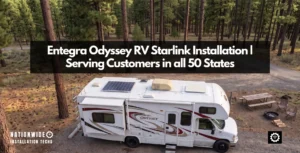
Expert Entegra Odyssey RV Starlink Installation | Serving Customers in all 50 States
Mounting Starlink on an Entegra Odyssey means working around a...
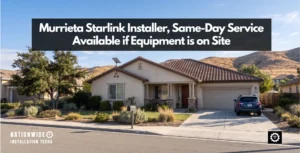
Murrieta Starlink Installer — Same-Day Service When Your Kit Is On Site
Murrieta Starlink installer, Nationwide Installation Techs, (877) 309-1050. Professional, insured...
Disclaimer: Nationwide Installation Techs LLC is an independent business and has no affiliation or official connection with Starlink, SpaceX, or any of their subsidiaries or affiliates. We are not associated with, authorized, endorsed, or sponsored by these companies in any capacity. For official information, please visit the Starlink and SpaceX websites at www.starlink.com and www.spacex.com. The names “Starlink,” “SpaceX,” and any related trademarks, logos, or imagery are the exclusive property of their respective owners.
Any references to “certified” or “certification” on this website refer exclusively to Nationwide Installation Techs LLC’s proprietary in-house technician certification program. This training and certification process was developed by our company based on the experience and installation methods of professional technicians who have collectively completed more than 3,000 successful Starlink installations while maintaining an overall 4.9-star customer review rating. It is not affiliated with, issued by, approved by, or endorsed by Starlink, SpaceX, or any of their affiliates.