

Rankin Starlink installer, Nationwide Installation Techs, (877) 309-1050. Professional, insured technicians serving Rankin, Illinois and Vermilion County. If your kit is already on site, same-day service is often available. Residential installs start at $385, and an on-site survey is $199.
Rankin is a village of 495 people sitting at about 722 feet on flat black farm ground in Butler Township, in the north west corner of Vermilion County. There is no ridge, no canyon and no hillside. From the edge of the village the ground runs out to the horizon in every direction, broken only by a treeline around a farmstead and the occasional grain leg. The obstruction survey is almost never the hard part of a Rankin job. What is the hard part is that the village and the section roads around it are two different broadband markets, and the wind out here treats a pole mount as a structure rather than a bracket.
Check your own address on speedtest.net rather than a coverage map before you decide anything, because the answer genuinely changes at the village line.
The Village Has Fiber. The Section Roads Mostly Do Not.
Rankin is two broadband markets inside one ZIP code, and knowing which one your address sits in tells you what kind of job yours is going to be.
Inside Rankin, there is a real wired option. The Vermilion County Broadband Feasibility Report dated 18 November 2024 lists Conxxus as providing service in Potomac, Armstrong, Bismark and Rankin, and records the company claiming 1,214 fiber passings at 5/5 Gbps across its county network, with Ookla-measured speeds around 393 down and 364 up. That is a genuinely fast wired option, and on latency fiber does win. Plenty of people on those streets still call us anyway, usually over price, an outage record they are tired of, or because they want a second line that does not fail for the same reasons the first one does.
The picture changes as soon as you leave the village. The same report counts, across Vermilion County as a whole, 1,267 locations unserved at under 25/3 Mbps and 3,020 underserved between 25/3 and 100/20, out of 36,416 total passings. Those are not evenly spread. They are the farms, the acreages and the houses on the section roads, which is most of Butler Township by area and very little of it by address count. The report’s own economics explain why: it puts density in the unserved and underserved parts of the county at around six homes and businesses per mile of constructed fiber. That is the number that decides whether a build ever reaches your road, and at six per mile it usually does not without a grant behind it.
So the split is clean and it is worth saying out loud:
- On a village street with Conxxus fiber available: you have a real choice. Some people stay on fiber, some switch because of what they are paying or how a fault gets handled, and some add a dish as a second line that does not go down for the same reasons.
- On a section road, a farmstead or an acreage: the wired map most likely stops short of you, the grant-funded build is a maybe rather than a date, and this is the ground we are actually here for.
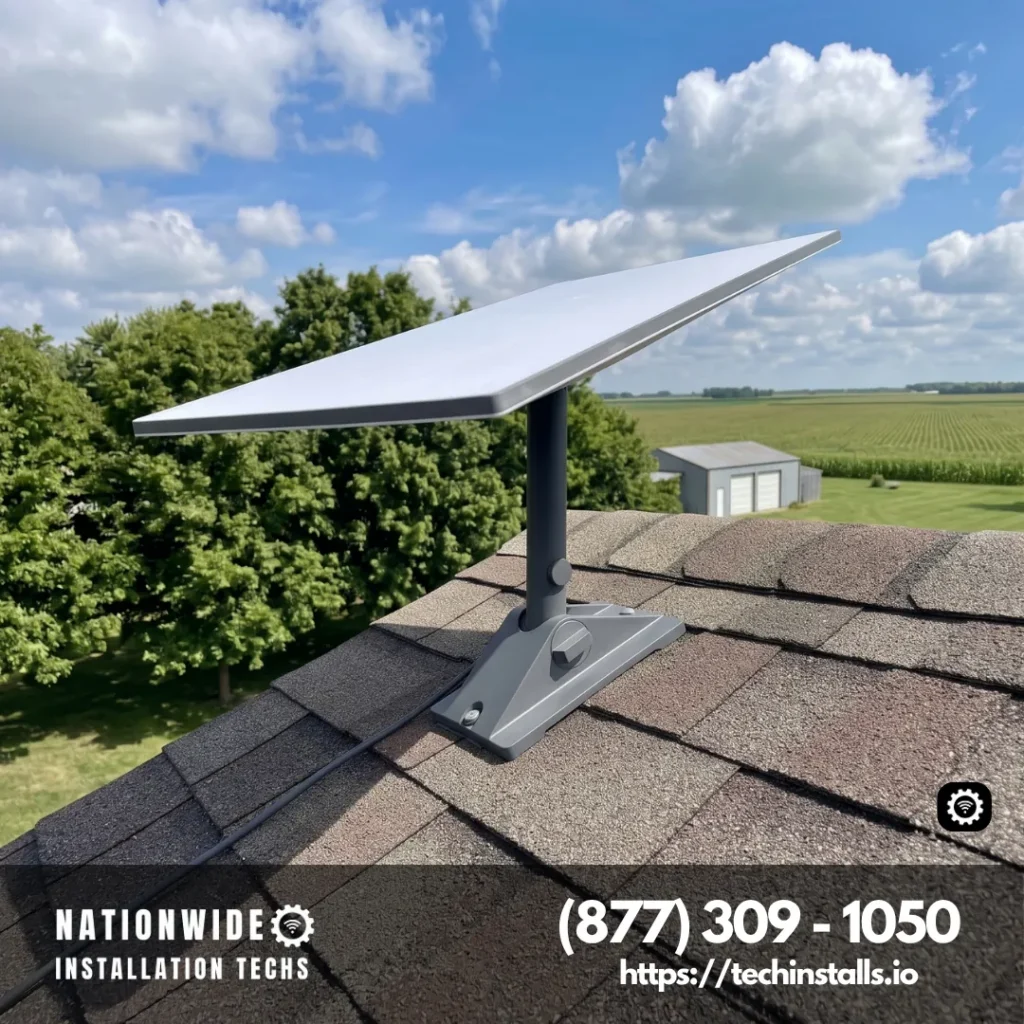
Either way the install is the same work: the roof decides the mount, the sky decides the position, and the run to where you actually sit decides most of the rest.
Wind Is the Load That Decides a Rankin Mount
Everything about this landscape that makes the sky easy makes the wind hard.
There is nothing upwind of a Butler Township farmstead. No hills, no forest, no city. Whatever is moving across the prairie arrives at your building at full strength, and it arrives from a different direction in February than it does in June. On a wooded lot in the eastern part of the state a mount is sheltered by everything around it. Here it is the tallest new thing on the property apart from the bins.
What that changes about the work:
- A pole gets braced for the span it actually has, not the span on the box. The longer the mast the more leverage the wind has on the base, and the base is where a badly specified mount fails. Where height is genuinely needed we say so and we build for it.
- Ridge and eave mounts get fixed into structure. Not into sheathing, not into a single rafter edge. On a farm building that often means we are looking for purlins rather than trusses, and finding them takes longer than the drilling does.
- The cable gets secured far more often than it would in town. A cable that is loose in a prairie wind saws through its own jacket at every fixing point over a couple of seasons. The run is clipped at short intervals and it is not left to swing.
- We do not drill a metal roof to solve a wind problem. Most of the shop and machine-shed roofs out here are steel, and steel roofs get a non-penetrating mount held by weight and tied to the structure. That is our written standard and it does not bend.
None of this is exotic. It is the difference between a mount that is still plumb after three winters and one somebody has to go back up for in year two.
Grain Bins, Machine Sheds and the Run Out to Them
The second half of a farm job is almost never the dish. It is getting the connection from wherever the dish makes sense to wherever you actually need it.
A typical Butler Township place is a house, a shop, a machine shed and a bin site, spread across several hundred feet of yard, and the buildings that need a connection are frequently not the building with the best sky. The house has the power and the router. The shop has the people. The bin site has the monitoring and the cameras and no obvious way to reach it.
Trenching across a farmyard is possible and it is usually the wrong answer. You are cutting through ground that carries equipment traffic, and you are committing to a route that has to be re-cut the next time anything changes. A point-to-point wireless bridge does the same job with two small radios and clear line of sight between them, which on flat ground you almost always have.
What we look at on a yard like that:
- Where the dish gets the cleanest northern sky with the shortest sensible cable run to power.
- Which building is the natural hub, which is usually the house or the office rather than the building furthest from the road.
- What the bridge has to clear. On this ground the answer is normally a bin or a shed roof rather than terrain, and the fix is height at one end rather than a longer link.
- Whether the far end needs its own small access point or just a wired drop.
That is the part of a Rankin install that takes the planning. The dish itself is the straightforward half.
A Rankin Starlink Installer Works Three County Lines at Once
A Rankin Starlink installer working out of this village crosses two county lines before most of the drive is done, because Butler Township sits close to the corner where Vermilion, Iroquois and Ford Counties meet.
Inside Vermilion County, Armstrong is eleven miles south, Hoopeston twelve miles east and Potomac twelve miles south east. North into Iroquois County, Cissna Park is seven miles, Claytonville eight and Wellington twelve and a half. West into Ford County, Clarence is four miles and Paxton ten and a half.
Clarence is worth a mention of its own. It is four miles west and it is in a different county from Rankin, which is the kind of thing that only matters when somebody is working out who covers them. We cover both, and the county line does not change what you pay.
What changes the price is the work at the far end of the drive: which mount the building requires, whether a mast is needed, how long and awkward the cable run is, and whether a second building has to be brought in on a bridge. Past these three counties, the rest of Illinois is covered the same way.
Harvest Is a Deadline and a Rankin Starlink Installer Books Around It
Farm country runs on a calendar and the install work has to fit inside it. There is no point us turning up with a ladder during the two weeks somebody has been waiting for all year.
The pattern in Butler Township is predictable enough to plan against. Spring planting and autumn harvest are the windows where nobody has an afternoon spare and the yard is full of equipment that has to keep moving. Between them, and again over winter, there is room to do the job properly rather than quickly. If you are thinking about a connection for the coming season, the quiet part of the year is when to call, not the busy part.
The reason it matters more than convenience is that a lot of what people want the connection for is time-critical:
- Machine and yield data coming off equipment wants somewhere to go at the end of a run, and it wants it at the field or the shed rather than after the drive back.
- Grain moisture, bin monitoring and fan control are only useful if you can see them from the house at two in the morning, which means the bin site has to be genuinely on the network rather than nominally on it.
- Agronomy, marketing and the paperwork side happen on a laptop in the office during the exact weeks when the office is empty and everybody is in the field.
None of that changes the hardware. It changes the sequencing. We would rather do a bin-site bridge link in July than promise one in the first week of October, and we will say so when you call.
Ice Is the Load Nobody Budgets For
Wind gets talked about here. Ice is the one that quietly does the damage.
An east central Illinois winter delivers freezing rain as well as snow, and freezing rain is the worse case for anything mounted above a roofline. Snow largely sheds off a tilted flat panel. Ice does not. It accumulates on the panel, on the mast and on the cable at the same time, and it adds a load in a direction the mount was not necessarily braced for, on a lever arm that is longer than anybody pictures when the hardware is sitting on the ground.
There is a second effect that matters more than the first. Ice loads the cable as well as the antenna, and a cable that is carrying ice pulls at its entry point and its clips. That is the mechanism behind most of the winter callbacks we see in this part of the state, and it is prevented at install time rather than fixed afterwards, by clipping at short intervals, by forming the drip loop properly and by not leaving a long unsupported vertical run.
On the dish itself, the antenna has a built-in melt function and it will keep itself clear of snow in normal use. That is a feature of the hardware, not of the mount. The mount has to hold whatever the melt function has not dealt with, which on a freezing-rain night is all of it.
When the Power Goes Out, the Dish Is Not the Problem
The severe weather that reaches Butler Township is not subtle. On 17 November 2013 the tornado that struck Gifford crossed into Vermilion County about three miles north north east of Penfield and tracked north east across the rural north west of the county, causing roughly $2.5 million of damage on the Vermilion County portion of its path alone. That is this corner of the county. More recently the National Weather Service confirmed a tornado with 80 mph winds touching down a mile west of Hoopeston.
The practical consequence for a connection is almost always power rather than hardware. A dish that is properly mounted rides out a great deal, and it comes back on its own when the electricity returns. What does not come back on its own is a router in a house with no power.
So if the reason you are calling is resilience, the honest advice is to put the money in the right place:
- The mount and the cable entry are the parts that have to survive the weather, and those are ours.
- Power continuity is what keeps you online during the outage, and that is a generator or a battery, sized by whoever does your electrical work. We will tell you the dish averages 75 to 100 watts so you can hand that number over. We do not do electrical work and we do not size systems.
- A second path matters if the connection is load-bearing for a business. That is the backup connection conversation, and on a farm with a village fiber drop at the office it can run the other way round from what you would expect, with fiber primary and satellite standing by.
What Moves the Price on a Job Out Here
Residential installs start at $385 and an on-site survey is $199. What moves it from there, on this ground specifically:
- Mount type. A standard roof mount or eave mount on an asphalt-shingled farmhouse is the base case. A non-penetrating ballasted mount on a steel shop roof is more work, because it has to be built and weighted rather than bolted.
- Height. Not usually needed here for sky reasons, occasionally needed to clear a bin or a shed for a bridge link.
- Cable run length and difficulty. A hundred-foot run through a modern farmhouse is not the same job as a hundred-foot run through a hundred-year-old one with no accessible cavity.
- Second building. A bridge link adds hardware at both ends and alignment time. It is usually still cheaper and always less disruptive than trenching a yard.
- Access. If the working area is genuinely awkward or the roof needs equipment we would not otherwise bring, that is priced before we start rather than discovered on the day.
We quote the job, not the drive. Full detail on what goes into a figure is on the installation cost page. Rental and second-property situations are covered under tiny homes and rural rentals.
The Roofs and the Jobs We Turn Down
- We do not drill metal roofs. Not on a house, not on a shop, not on a machine shed, not for a discount. Non-penetrating mount instead, or the job does not get done by us.
- We do not do roof repair. If the deck is soft or the shingles are finished, get a roofer first. Mounting hardware to a roof that is about to be replaced spends your money twice.
- We do not do electrical work, wire a generator or size a battery bank. We will give you the 75 to 100 watt figure and that is where our part stops.
- We do not sell the Starlink service plan or open the account. You own the hardware and hold the account. We handle the install.
- We will not drill a roof on a tenant’s say-so. If you rent, written permission from the owner comes first and we will need to see it.
Frequently Asked Questions
Regularly, and usually for one of three reasons: what they are paying, how a fault gets handled when something breaks, or wanting a second line that does not fail for the same reasons the first one does. On the facts, the Vermilion County Broadband Feasibility Report of 18 November 2024 lists Conxxus serving Rankin and records 1,214 fiber passings at 5/5 Gbps, with Ookla measuring around 393 down and 364 up. That is a strong wired option and fiber does win on latency. Whether it wins for you depends on price, reliability and what the connection has to do, and that is your call rather than ours.
Completely different, and this is the ground we are actually here for. The same county report counts 1,267 locations unserved at under 25/3 Mbps and 3,020 underserved between 25/3 and 100/20, out of 36,416 total passings, and those are not spread evenly. They are the farms and acreages on the section roads. The report puts density in those parts of the county at about six homes and businesses per mile of constructed fiber, which is the number that decides whether a build ever reaches your road. At six per mile it usually does not without a grant behind it.
No, and we would rather not. Trenching a working farmyard means cutting through ground that carries equipment traffic and committing to a route you have to re-cut the next time anything changes. A point-to-point wireless bridge does the same job with two small radios and clear line of sight between them, which on ground this flat you almost always have. What we look at is which building is the natural hub, usually the house or the office, and what the link has to clear, which here is normally a bin or a shed roof rather than terrain.
Bracing that was specified for the span it actually has, not the span on the box. There is nothing upwind of a Butler Township farmstead, so whatever is moving across the prairie arrives at full strength, and the mount is the tallest new thing on the property apart from the bins. Ridge and eave mounts go into structure rather than into sheathing, which on a farm building often means finding purlins rather than trusses. The cable gets clipped at short intervals, because a cable left loose in prairie wind saws through its own jacket at every fixing point.
Ice is the load that does the damage here, more than snow. An east central Illinois winter delivers freezing rain as well as snow, and freezing rain is the worse case for anything above a roofline. Snow largely sheds off a tilted panel and the antenna has a melt function that keeps itself clear in normal use. Ice does not shed. It loads the panel, the mast and the cable at the same time, on a longer lever arm than people picture. That is prevented at install time by clipping at short intervals and not leaving a long unsupported vertical run.
On a non-penetrating mount held down by weight and tied to the structure, which is our written standard and it does not bend. We do not drill metal roofs, not on a house, not on a shop, not on a machine shed, and not for a discount. Most of the shop and machine-shed roofs out here are steel, so this comes up on a lot of Rankin jobs. It costs more than a bolted mount because it has to be built and weighted rather than fixed, and it is the right answer on that roof.
Across three counties, and the drive does not change what you pay. North into Iroquois County, Cissna Park is seven miles, Claytonville eight and Wellington twelve and a half. Inside Vermilion County, Armstrong is eleven miles south, Hoopeston twelve east and Potomac twelve south east. West into Ford County, Clarence is four miles and Paxton ten and a half. What changes the price is the work at the far end: the mount the building requires, the cable run, and whether a second building has to come in on a bridge.
The dish will. A properly mounted terminal rides out a great deal and comes back on its own when the electricity returns. What does not come back on its own is a router in a house with no power, so if resilience is the reason you are calling, the money goes into power continuity rather than into the dish. That is a generator or a battery, sized by whoever does your electrical work. We will tell you the dish averages 75 to 100 watts so you can hand that number over. We do not do electrical work and we do not size systems.
About Nationwide Installation Techs
Nationwide Installation Techs LLC is a professional, insured satellite installation company operating in all 50 states, with over 3,000 installations completed and a 4.9-star Google rating from 90+ reviews. Our experienced technicians cover residential, commercial, RV and marine installations, along with mesh networking, point-to-point bridges and on-site repair. We are an independent installer: you own your hardware and hold your own service account, and our crews handle the mounting, sealing and setup.
Serving Rankin, Vermilion County and the rest of Illinois, plus every other state listed on our locations we serve page. Call (877) 309-1050.
Contact a Rankin Starlink Installer
Nationwide Installation Techs LLC
- Phone: (877) 309-1050
- Email: support@techinstalls.io
- Free Quote: Contact Us Form
Connectivity News & Updates

Residential Starlink Installation — Nationwide and Insured
Residential Starlink installation starting at $385, nationwide. Nationwide Installation Techs...

Expert Starlink Installation for Yachts and Boats
Starlink installation for yachts and boats, nationwide. Nationwide Installation Techs...

Chicago Starlink Installer — Same-Day Service When Your Kit Is On Site
Chicago Starlink installer, Nationwide Installation Techs, (877) 309-1050. Professional, insured...

Professional Starlink Installation for Cars and Trucks
Starlink installation for cars and trucks, nationwide. Nationwide Installation Techs...
Disclaimer: Nationwide Installation Techs LLC is an independent business and has no affiliation or official connection with Starlink, SpaceX, or any of their subsidiaries or affiliates. We are not associated with, authorized, endorsed, or sponsored by these companies in any capacity. For official information, please visit the Starlink and SpaceX websites at www.starlink.com and www.spacex.com. The names “Starlink,” “SpaceX,” and any related trademarks, logos, or imagery are the exclusive property of their respective owners.
Any references to “certified” or “certification” on this website refer exclusively to Nationwide Installation Techs LLC’s proprietary in-house technician certification program. This training and certification process was developed by our company based on the experience and installation methods of professional technicians who have collectively completed more than 3,000 successful Starlink installations while maintaining an overall 4.9-star customer review rating. It is not affiliated with, issued by, approved by, or endorsed by Starlink, SpaceX, or any of their affiliates.