

Baytown Starlink installer, Nationwide Installation Techs, (877) 309-1050. Insured technicians working the bay side of Harris County, from the Goose Creek streets out to the Cedar Bayou waterfront and across the line into Chambers. Where the kit is already sitting in the garage the job usually goes in the same day. Starlink install for houses start at $385. Starlink installation for businesses starts at $750, with discounts for 3+ commercial locations. Car, truck, RV Starlink installation in Baytown starts at $650, with discounts available for 3+ vehicles and mobile fleets. Marine installs such as yachts and boats, starts at $750. Every install we perform comes with a 1-year quality of workmanship guarantee, by professional, local, insured technicians. 4.9-star Google rating with 100+ reviews. Serving Baytown, TX and all surrounding areas!
Baytown sits on the north shore of Galveston Bay where the San Jacinto runs out past the ship channel, and the ground here is as flat as it gets. That makes the part of the job most people worry about, whether the dish can see the sky, almost a non-issue. What actually decides a Baytown install is the building it is going on and the air it has to live in afterwards. What Starlink settles in Baytown is the waiting. There is no queue for a build to reach your street, no depending on a line strung from the same poles as everybody else’s, and no argument with a provider about a lot out past the bayou that never made it onto their map.
The kit ships, we mount it, and the house is online inside the same week. Run a speed test the day you order and run it again once the technician packs up, because that gap is the entire case and it is the one number worth keeping. Most weeks here that is a house on a newly platted street, a second building out on an acre, a rig or a hull that moves, and the households on rotating plant shifts who cannot be the ones offline at four in the morning. Order the kit from Starlink, then spend the shipping window on the free virtual survey, so the mount is settled before the box reaches your door.
Flat Ground, Open Sky, and Why the Building Decides the Job
There is no terrain here to speak of. Baytown sits a few feet above sea level, the horizon is broken by refinery stacks and the Fred Hartman bridge rather than by hills, and the dish looks north over ground that offers it almost nothing to clear. On a majority of addresses the sightline question is settled in under a minute from the satellite view.
So the survey shifts to the structure. Is the roof asphalt shingle or is it metal, which a good many shops and newer builds here are. Is there a second building, a garage or a shop across the yard, that needs covering as well. How far is it from a sensible mount position to the room where somebody actually sits. Those are the questions that set the price on a Baytown job, and they are all answerable before anyone drives out.
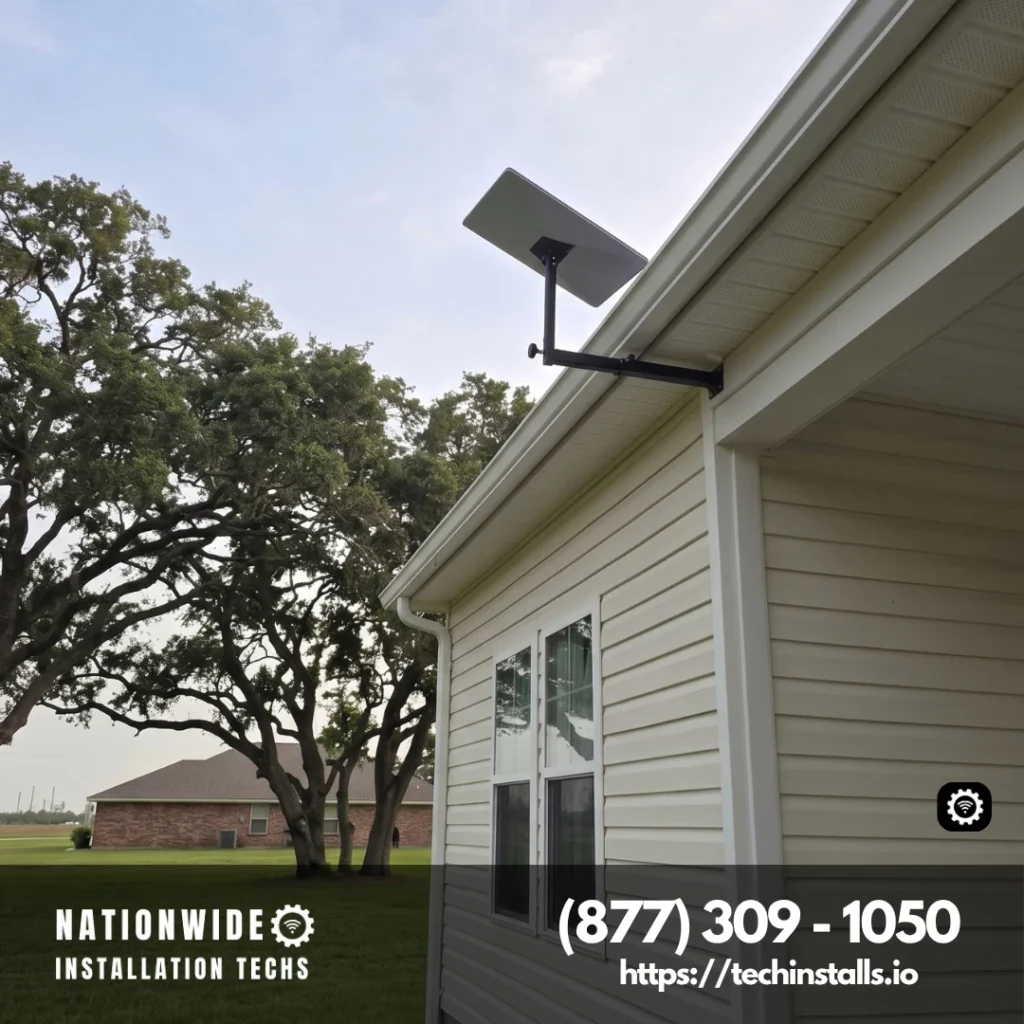
On most houses here the dish ends up under the eave rather than on the roof. An arm fixed up into the soffit framing carries the panel out past the gutter line with the whole northern sky in front of it, and on ground this flat that is all the height the job needs. It keeps the cable run short, because the wall is where the cable was coming in anyway. It keeps the roof shut, which counts for something on a coast where roofs get replaced after storms and where every sealed hole is working against nine months of heat. And it leaves the dish somewhere a person can reach off a stepladder on the morning a named storm turns toward the bay. The roof mount is the fallback, for the houses where eave height does not clear — a two-story neighbor, a close fence line, or the oaks.
Live oaks are the one obstruction worth walking for. The older streets around Goose Creek carry mature canopy that has had decades to spread, and on a tight lot under two big oaks the answer is often a mount on the garage or the far corner of the house rather than the obvious spot above the living room.
Slab Floors and Brick Veneer: Where the Cable Comes In
Almost everything here is built on a slab. There is no crawlspace to run a cable through and no basement to land it in, which settles the entry method before we look at anything else: the cable comes through an exterior wall, low down, in the room that will end up holding the router.
The wall itself is usually brick veneer over a timber frame, and the two behave very differently. The veneer is a skin with an air gap behind it; the frame carrying the load sits further in. A mount fixed to the brick alone is fixed to a facing, so where a wall mount is the right answer the fasteners are set to reach the structure behind it with the opening made watertight at the point it passes through the face, not merely where a finger can reach.
The penetration is drilled from inside out so the technician chooses the exit point rather than accepting whatever the wall offers, the sleeve goes in and gets closed up, and the cable is looped below the entry so gravity takes the water off it instead of letting it track inward. Indoors the run terminates behind a wall plate. Nothing about bringing a cable in involves cutting the roof.
Bay Humidity Is Harder on Fixings Than People Expect
This is brackish water, not open Gulf, and the salt load in the air is milder than it is down the coast. What Baytown has instead is humidity that barely lets up, nine months of heat, and a petrochemical plume that is part of the local air. The combination is unkind to hardware in a slower, less obvious way than surf spray.
What it changes about the work is small and it is not negotiable. Fixings are stainless or coated, never whatever was in the carton. Where two different metals have to touch they get isolated, because damp plus dissimilar metal is a slow electrical cell and the softer one loses. The cable entry faces down and the loop is formed properly, because in this climate a lazy drip loop is the thing that eventually puts water inside a wall.
None of that lengthens the appointment. It is decided before a ladder comes off the van, and it is the difference between a mount nobody thinks about again and one somebody is back up a ladder looking at in three years.
Shift Work, Plant Contractors and the Case for a Second Line
Baytown works around the plants, and that shapes what people need from a connection more than any technical consideration does. Rotating shifts mean somebody in the house is asleep at an odd hour and somebody else is online. Contractors working a turnaround are logging in from home at hours when a helpdesk is shut. A line going down at four in the afternoon is an inconvenience; the same outage at four in the morning, for somebody who has to be at the gate by six, is a different matter.
The case for a second connection here has nothing to do with speed. Wired service and satellite fail for unrelated reasons, so the odds of both being down together are small. Where a household or a small operation genuinely cannot be offline, we build the changeover so it happens on its own rather than leaving somebody to go hunting for a cable in the dark. Flag it as a standby line when you ask for a price, and it gets engineered that way rather than retrofitted.
Where a property runs to more than one building, which around here often means a house, a shop and something down by the water, the answer is rarely a second subscription. One connection and a point-to-point wireless bridge across the yard covers the lot.
Where a Baytown Starlink Installer Drives
Inside the city we work everywhere, from the older streets around Goose Creek out to the newer subdivisions on the north side and down to the waterfront lots along Cedar Bayou.
Around it the range runs from Highlands and Crosby in the north, northeast to Mont Belvieu, Old River-Winfree, Dayton and Liberty, east to Beach City and Anahuac, south to Seabrook and Kemah, southwest through La Porte and Deer Park, and west to Channelview. Crossing a county line costs nothing and neither does the distance; the price answers to the work at the far end, not the drive.
A good share of the boats here live on private lifts rather than in a marina, and a hull that trailers to the ramp needs a different specification from one that stays in the water. We set the mount up for however the boat is kept, whether that is a lift, a slip or a trailer.
Turnarounds bring a lot of people into town who do not live here, and a fair number of them arrive in a coach and park it for the length of the job. Between those stays and the residents who keep a motorhome alongside the house, there is steady work in RV Starlink installation, and the test of one of those jobs is not the picture on the screen but whether the coach can pull out onto the highway afterwards with nothing working itself loose.
Then there is everything that operates out of a vehicle. A contractor covering the plants along 146 and the interstate spends the day moving from gate to gate, and Starlink installation for cars and trucks is scoped one vehicle at a time — what the roof will accept, how the cable reaches the cab, what the electrical system can spare. For a company running a dozen trucks out of one yard, the job looks different: every roof gets surveyed the same way, so what sits under vehicle four does not have to be relearned on vehicle twelve. That consistency, not any one install, is what Starlink installation for mobile fleets is built to deliver.
What the Quote Covers and What Moves It
A house starts at $385 and most Baytown addresses stay there. Inside it sit the bracket and its weatherproofing, the cable with the sealed entry it travels through, a router sited to suit how the rooms are really used, the dish aimed, and a measured result handed over before the van pulls away.
What lifts it is structure or distance: a floor plan that stretches far enough to need more cable than usual, a second node to reach a room above the garage, a bridge link out to a shop or a dock building, or a metal roof that moves the mount onto a wall. Reading your sky remotely costs nothing. Putting somebody on the property to walk it beforehand is $199. From a signed-off survey the usual wait for a technician runs to about seventy-two hours, and it collapses to the same day more often than not when the kit is already indoors.
The number is agreed before a tool comes out. You buy the hardware and the plan from Starlink and both stay in your name; nothing you pay them monthly comes to us. The full detail of what an install actually costs is set out elsewhere on the site.
Work We Turn Down
- No fastener goes through a metal roof. Standing seam and R-panel are common on shops and newer builds around here, and a lag through the panel undoes the thing that makes it last. Those jobs go to a ballasted base carried by its own weight, or onto a wall below. There is more on mounting on metal roofs elsewhere on the site.
- Roofing is not our trade. Decking that moves underfoot or shingles at the end of their life need a roofer before we arrive, otherwise the bracket comes off at tear-off and gets paid for twice.
- Slate and clay tile are outside our standard. The approved mounts assume asphalt, framing, masonry or a flat deck, and anyone offering to drill a tile roof is improvising on it.
- Electrical and solar sizing belong to somebody licensed. The figure we can give you is the load: a Standard dish draws 75 to 100 watts running. Pass that to whoever specs the system.
- Permission to drill comes from the owner. On a rented property the written consent arrives before the appointment is set, not on the morning.
Baytown Starlink Installation Questions
Usually inside a week, and same-day happens often when the hardware has already arrived and there is room in the schedule. Mounting, cabling and activation all belong to one visit. If the courier has not been yet we book the first date after it lands.
Yes, just not through the panel. A ballasted mount sits on the surface under its own weight and nothing penetrates, or the dish goes onto a wall or gable below the roofline. Both are standard work and neither costs extra on an ordinary house.
Through an outside wall, low, in the room that will end up holding the router. It is drilled from indoors outward so the exit point is chosen rather than accepted, sleeved and sealed at the surface, with a drip loop underneath and a brush plate inside. We do not open the roof to run a cable.
Possibly not. The dish looks north, so what matters is which side the canopy sits on rather than how much of it there is. On the older Goose Creek streets the usual answer is a mount on the garage or at the far corner of the house. The free virtual survey settles it before anyone drives out.
Not the dish, which is sealed and the manufacturer’s problem. It works on the mount: fasteners, brackets and the cable entry. We use stainless or coated fixings as the default here, isolate dissimilar metals, and form the drip loop properly. That is what keeps a mount sound rather than merely installed.
It is, provided you can power it. The dish and router will run off a modest battery or a generator, and because the failure modes are unrelated it frequently stays up when the wired service does not. Take the dish down if a named storm is coming into the bay; four bolts and about ten minutes, and the mount stays put for it to go back onto.
Yes, and on a property with outbuildings that is the usual shape of the job. One dish where the sky is best, then a bridge link to the second building, which is one subscription rather than two and no trench across the yard.
- Our residential Starlink installations in Baytown start at $385 and include dish mounting, sealed cable installation, and router setup, with final pricing influenced by mounting requirements, cable length, access, and overall complexity.
- Commercial installations are $750 per site, or $650 per site for three or more business locations.
- Mobile setups for RVs and vehicles start at $650. We also offer discounts for anyone in need of Starlink installation for their mobile fleets.
- Our Starlink installation services for yachts and boats in Baytown start at $750.
Every quote is reviewed and approved upfront, so your pricing is clear before scheduling and never changes afterward. The virtual survey is free, an on-site one is $199, and the quote is fixed before work starts.
About Nationwide Installation Techs
Nationwide Installation Techs LLC is a professional, insured satellite installation company operating in all 50 states, with over 3,000 installations completed and a 4.9-star Google rating from 100+ reviews. Our experienced technicians cover residential, commercial, RV and marine installations, along with mesh networking, point-to-point bridges and on-site repair. We are an independent installer: you own your hardware and hold your own service account, and our crews handle the mounting, sealing and setup.
Serving Baytown, Harris County and the rest of Texas Starlink installation, plus every other state listed under locations we serve. Call (877) 309-1050.
Reach a Baytown Starlink Installer
Nationwide Installation Techs LLC
- Phone: (877) 309-1050
- Email: support@techinstalls.io
- Free Quote: Contact Us Form
Everything Else We Install Around Baytown:
Connectivity News & Updates

Starlink Installation for Construction Sites — Local, Insured Techs
Starlink installation for construction sites, in all 50 states, from...

San Antonio Starlink Installer — Same-Day Service When Your Kit Is On Site
In San Antonio the paperwork usually decides the mount before...

Thor Four Winds Starlink Installation | We Come To You
Thor Four Winds Starlink installation means working around a domed...

Austin Starlink Installer — Same-Day Service When Your Kit Is On Site
Austin Starlink installer, Nationwide Installation Techs, (877) 309-1050. Professional, insured...
Disclaimer: Nationwide Installation Techs LLC is an independent business and has no affiliation or official connection with Starlink, SpaceX, or any of their subsidiaries or affiliates. We are not associated with, authorized, endorsed, or sponsored by these companies in any capacity. For official information, please visit the Starlink and SpaceX websites at www.starlink.com and www.spacex.com. The names “Starlink,” “SpaceX,” and any related trademarks, logos, or imagery are the exclusive property of their respective owners.
Any references to “certified” or “certification” on this website refer exclusively to Nationwide Installation Techs LLC’s proprietary in-house technician certification program. This training and certification process was developed by our company based on the experience and installation methods of professional technicians who have collectively completed more than 3,000 successful Starlink installations while maintaining an overall 4.9-star customer review rating. It is not affiliated with, issued by, approved by, or endorsed by Starlink, SpaceX, or any of their affiliates.