

Redding Starlink installer, Nationwide Installation Techs, (877) 309-1050. Insured technicians work the whole Sacramento River corridor here, from the rebuilt west-side tracts out through Palo Cedro, Anderson and up the arm of Shasta Lake. Kit already sitting in the garage usually means we finish the same day. Residential Starlink installation starts at $385. Our commercial Starlink installations start at $750, with discounts for 3+ business locations. Mobile Starlink installation in Redding starts at $650, with discounts available for 3+ vehicles and for those with mobile fleets. Our boat and yacht Starlink installations start at $750. All of our installs include a 1-year quality of workmanship guarantee, by insured, local technicians. We have a 4.9-star Google rating with 100+ reviews. Serving Redding, CA and all surrounding areas!
Redding sits at the top of the Sacramento Valley with the floor of it running flat to the south and the Trinity and Cascade country closing in everywhere else. That geography decides the survey. The sky the dish needs is the northern arc, and in this town the northern arc is frequently the one with a ridge standing in it — Shasta Bally west, the Bella Vista ground rising east, the lake country climbing away north. A stand of oak on the south fence line can be left entirely out of the arithmetic; one ponderosa off the north corner of the lot decides the whole job. That is the part people get backwards most often here.
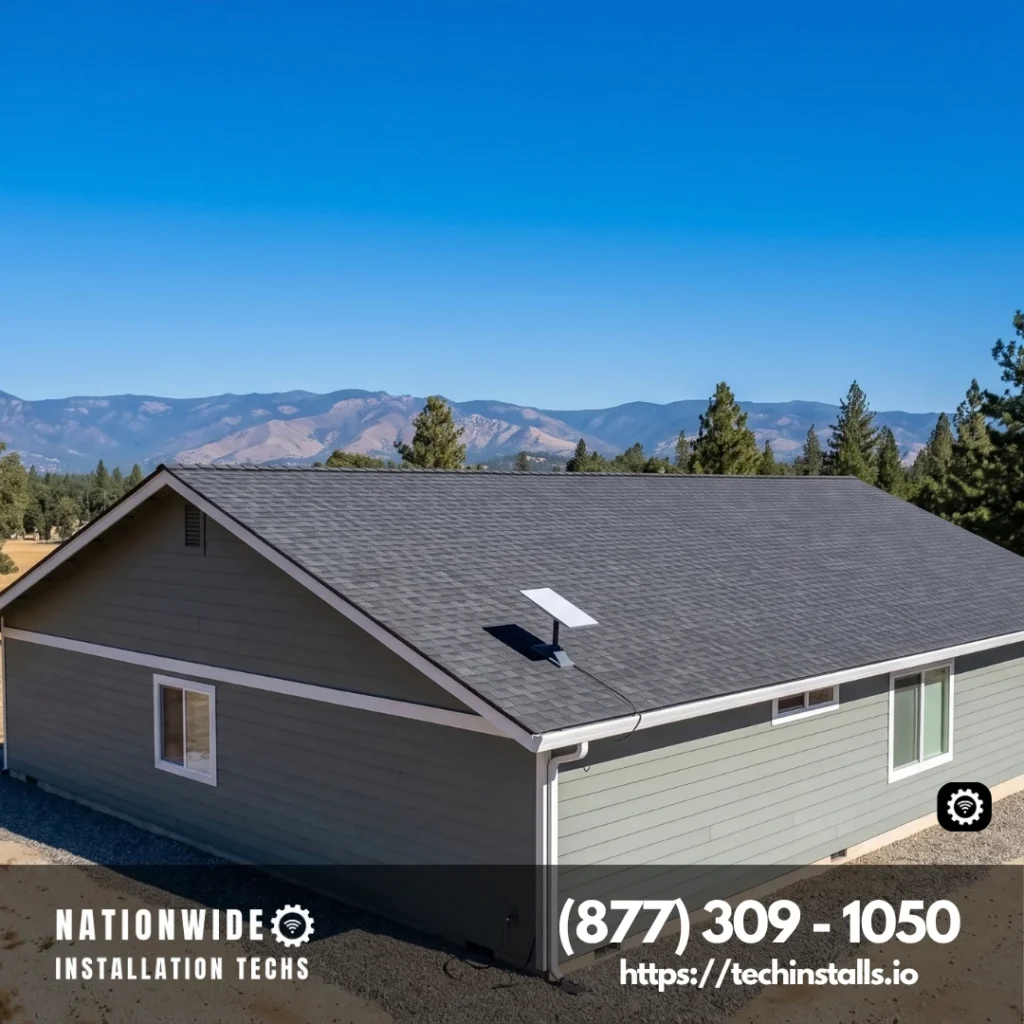
The addresses that call us are the ones the wired build ran out of money before reaching: a place up a private road off Highway 299, a river-bar property where the cable stops at the last mailbox, or a second line for a household that watched the poles go down in 2018 and has not felt easy about a single connection since. Take a Speedtest.net reading now and another after our van has gone; the distance between those two numbers is the whole of what you are paying for.
The Carr Fire Is Still the First Thing a Redding Roof Tells You
On 26 July 2018 the Carr Fire came into Redding from the west, out of the country near Whiskeytown Lake about five miles away. It took 1,079 homes, burned 229,651 acres across Shasta and Trinity counties, killed eight people, and at its worst spun up a fire whirl clocked near 143 mph. Containment came on 30 August. Seven years on, that fire is still the single most useful thing to know about a Redding roof.
The practical consequence is that a large share of the housing stock on the west side is newer than the fire, and newer here does not only mean sounder. It means built to a different rulebook. A roof put back after 2018 in this county went on under wildland-urban interface rules, so what is over your head is almost certainly Class A rated, the vents are ember-resistant by design, and the eaves and the soffits were detailed to keep burning debris out of the structure.
For us that cuts two ways at once.
- The deck is in good order and the fasteners are modern. A mount lands properly on a roof like this and the photographs we take of every fixing go into a file that actually matches the building.
- The assembly is engineered, and an unplanned hole is a change to it. An ember-resistant roof works as a system rather than as a surface. Opening it without thinking about what the opening does is how a compliant roof quietly stops being one.
So on the rebuilt stock our first question is not where the best sky is. It is whether we can reach that sky without putting anything through the covering at all.
Class A Above You, and Where a Mount Is Allowed to Land
Here is the part we will be exact about, including the edges of it we cannot answer for you.
Much of Shasta County sits inside a designated wildland-urban interface, and construction there answers to California’s ignition-resistant requirements — historically Chapter 7A of the Building Code, now consolidated into the 2025 California Wildland-Urban Interface Code, Title 24 Part 7, in force from 1 January 2026. Class A roof assemblies and ember-resistant venting are settled requirements under it.
Separately there is Zone 0, the ember-resistant strip immediately against the structure, created by SB 63. The statute is real. The detailed material rules that will sit underneath it were still moving through state rulemaking as this was written, and Cal Fire had published no confirmed commencement for the existing-building timeline.
What that means when a van turns up at your house: we will tell you exactly what we are proposing to fix and where, and you or your building department decide whether it needs a permit. We are not a plans examiner and we will not tell you an install is code-compliant. Asking your local fire district before anybody drills is free, and the sequence saves a great deal of bother.
What we can do is shrink the question until it often disappears. A ballasted mount standing on its own weight puts nothing through a Class A assembly. A standard wall mount takes two bolts into framing at a gable end, below the roof line entirely, so the covering is never broken. On a lot of Redding roofs one of those two is the better answer on the engineering alone, before anyone raises the code at all.
A Hundred and Nineteen Degrees, Three Short of the Ceiling
On 6 July 2024 the thermometer at Redding read 119°F, beating the 118°F this town had already touched in 1971, 1981 and 1988. An ordinary July here runs highs of 95 to 99°F for weeks together.
Set that beside what the manufacturer publishes. The Standard’s environmental limits are stated as -30°C at the low end and 50°C at the high end — 122°F in the units most people here think in. Redding’s hottest day ever recorded landed three degrees under that ceiling. Not past it — the hardware is rated for this valley — but there is no comfort in the margin, and it changes where things go.
What we do about it costs nothing and is simply a matter of thinking before mounting:
- The router does not live behind south-facing glass. That is the single most common reason a Redding system gets flaky in August, and it has nothing whatever to do with the dish.
- Cable is routed out of standing afternoon sun where the run allows it. UV and 110-degree surface heat are hard on a jacket over years, and a shaded foot of run costs nothing at the time.
- Dark roof surfaces run far above air temperature. Equipment laid flat on one is sitting somewhere considerably hotter than the forecast, which is worth remembering before anything gets set down on the shingle.
A Redding Starlink Installer Covers Shasta County and Both Lines Beyond It
A Redding Starlink installer covers a good deal of ground, because Shasta County is large and mostly empty. Shasta Lake is six miles north-north-east and Bella Vista eight to the east-north-east. Palo Cedro sits eight miles east-south-east, Happy Valley the same distance south-south-west, and Igo ten to the south-west.
Anderson lies eleven miles south-south-east, Millville twelve east, Cottonwood fourteen south-south-east, and French Gulch fifteen to the north-west. Further out the ring reaches Lakehead, twenty-two miles due north at the head of the lake; Whitmore, twenty-four east; and Shingletown, twenty-eight east-south-east on the shoulder of the Cascades. Red Bluff is twenty-nine miles south-south-east over the Tehama County line, Weaverville thirty west-north-west in Trinity County, and Burney forty-three east-north-east.
Getting there is not billed to you. The figure answers to the work at the far end — what the roof will take, how much mast the ridge line forces on us, where the cable has to go and how unpleasant that route is, and whether a shop or a second dwelling has to come online as well. The rest of California is quoted on the same terms.
Up the Canyons the Wired Map Simply Stops
Outside the city limits the map changes completely, and so does the job.
Up the canyons and along the river bars the wired build simply stops, and it stops abruptly rather than tapering. That is most of our work here. The obstruction is rarely the sky in general; it is one ridge or one line of conifer in the northern quarter, and the fix is usually position rather than height. A detached garage, a barn, a bank above the house — somewhere on the property there is generally a spot with the arc open, and the real question becomes how to get the signal back to where people actually sit.
Where that distance is awkward, trenching is not the only answer and out here it is seldom the best one. Ground in this county turns to cobble and decomposed granite without warning. A point-to-point wireless bridge puts a small radio at each end and carries the link across with nothing buried at all.
Off-grid properties are ordinary work rather than an exception. The number you will want is that the Standard dish averages 75 to 100 watts continuous — hand that to whoever sizes your battery bank and array. Specifying the power system is not our trade; supplying the figure it turns on is.
Where the place is rented, the owner’s written consent reaches us before a drill leaves the van, and our notes on rental and short-term properties set out how that works.
Served in Town, and Why People With Fiber Still Ring
Inside Redding itself a wired connection is available at most addresses, and where fiber has reached a street it is generally the cheaper monthly bill of the two. We will not pretend otherwise.
People on those streets still call us, and speed is not the reason. A buried or aerial network and a satellite network fail for completely unrelated causes, which is the entire argument for Starlink as a backup connection in a county that has watched fire take out infrastructure inside a single afternoon. A second path that does not share a pole with the first is worth something here in a way it is not everywhere.
Push past the city boundary, though, and the argument changes shape. On the county roads and up the canyons the question stops being which service is cheaper and becomes whether there is a service at all.
What the Quote Covers, and What Moves It
Residential work opens at $385. Everything above that figure is the job telling you what it is: the mount the roof will actually accept, how much mast the ridge line forces on us, the length and difficulty of the cable route, and whether anything beyond the main house needs bringing online. Reading the sky above the roof is done remotely, at no charge, and it happens before anybody loads a ladder. Should you prefer a technician on the ground looking at it in person, that is $199, and on a canyon lot with a broken skyline it frequently pays for itself twice over.
The figure is agreed before any tool comes out of the van. Nothing is priced from the top of a ladder, and the run out to Burney or down to Red Bluff adds nothing to it. Most jobs go on the calendar within roughly seventy-two hours, and where the kit has already been delivered and nothing awkward turns up in the survey, we can often do it that same day.
The company carries general liability cover and the people who arrive have done this many times. Where we sit in the transaction is worth stating plainly: the dish is bought in your name, Starlink bills you directly for the plan, and not one cent of that monthly figure returns to us. The installation is the whole of what we sell. Where you want every figure laid out before picking up the phone, we break down what a Starlink install costs on a page given over to nothing else.
The Roofs and the Jobs We Turn Down
- Steel panel is off limits to a drill. The shops and equipment barns across this county are roofed in it precisely because an unbroken sheet turns away both ember and weather, and a fastener through the flat of one trades a forty-year roof for a leak that announces itself in the first wet November. Over a steel building the dish goes onto a weighted base that fixes to nothing, or onto framed wall below the roof line. That one is not open to negotiation.
- Roofing itself is a different trade and a different ladder. Spongy sheathing or lifting tabs want a roofer up there before we are, and the order is a money question rather than a courtesy: anchor a mount beneath a covering that comes off next spring and the work gets bought twice, with the second purchase falling to you.
- Nothing we do is a compliance sign-off. Plans examiners work for your building department, not for us. We will hand you an exact account of what was fastened and where it sits, and what that means under the WUI rules is a conversation between you and the county.
- Brush, limbs and defensible space are somebody else’s license. We will not cut back so much as a branch to open a sightline. Nor does anything of ours ever go onto a trunk: a tree travels in wind and a mount does not, so the two of them part company and the install is finished.
- Anything on the electrical side belongs to your electrician. No arrays get sized here, no inverters specified, no panel opened. The one thing we can put into that calculation is what the antenna actually asks for — 75 to 100 watts, pulled steadily rather than in bursts — and beyond handing over that number we are out of it.
- There is no subscription to buy from us, because we do not sell one. You open the account with Starlink directly and the equipment is invoiced to you. That monthly charge never passes through this company at any point. We are paid once, for what happens on the building.
- Consent has to come from whoever holds the deed. A lease does not carry the right to open another person’s roof. So on a rented property we want the owner’s authorization in writing, and we want it in hand ahead of the visit rather than produced on the doorstep.
Redding Starlink Installation Questions
Not if we do not open it, which is our preference on a rebuilt roof anyway. An ember-resistant assembly works as a system, so the sensible move is a ballasted mount that stands on its own weight, or a wall mount that takes two bolts into framing at the gable and never touches the covering. If a penetrating mount turns out to be the only way to reach the sky, you will hear that before we begin and the decision is yours to make.
It is inside the rating, but not by much. Starlink specifies the Standard from -30°C to 50°C, which tops out at 122°F, and Redding’s record is 119°F. The dish is built for this valley. What we watch is the router rather than the antenna — put it behind a south-facing window and it will misbehave in August for reasons nothing to do with the sky, so it goes somewhere ventilated and out of direct sun.
Usually not, though it is the direction that matters, which surprises people. The dish wants the northern arc, so a ridge or a conifer line to the north is the one that counts while the same obstruction due south can be ignored entirely. The answer is more often a different position than a taller mast — a detached garage, a barn, higher ground behind the house — with the link carried back indoors afterwards. That gets answered by the no-charge remote survey, well ahead of anyone being dispatched.
Yes, and the mileage is not on the invoice. Igo is about ten miles south-west. What sets the price is what we find when we get there: the mount the roof will take, the mast height the skyline demands, the cable route and how much of a nuisance it proves, and whether a second structure has to come online too.
Not through it. We do not put fasteners into metal roofing, because the hole undoes the weathertightness and the warranty that made the panel worth buying. On a steel building the answer is a non-penetrating ballasted base sitting on the surface under its own weight, or a mount on a wall below the roof line. Both are ordinary work.
The Standard dish averages 75 to 100 watts continuous. That is the number to give whoever sized your system, and it is the honest whole of what we can tell you — we do not size arrays or specify inverters. Plenty of off-grid places around this county run one without difficulty once the draw is accounted for.
Around seventy-two hours is typical. If your kit has already arrived and the virtual survey comes back clean, same day is often available. Tell us the roof covering when you ring — shingle, steel and tile each send the job down a different route, and that changes how long we need on site.
As a second connection, often yes; as a replacement, probably not, and we would rather say so. Fiber is usually cheaper month to month and we are not going to argue otherwise. The case for adding satellite here is that the two fail independently, and this is a county where infrastructure has been lost in an afternoon. Whether that redundancy is worth the outlay is your call to make, not ours.
About Nationwide Installation Techs
The account stays yours, and that is worth putting first because most people assume it works the other way round. Starlink sells you the equipment, Starlink bills you for the plan, and none of that passes through Nationwide Installation Techs LLC at any stage. We are paid for the work done on the building and nothing else.
The company is insured, works in all fifty states, and has more than 3,000 finished installs behind it at a 4.9-star Google rating from 100+ reviews. An ordinary week takes in roofs, commercial premises, coaches and boats, along with mesh coverage, a link out to a shop or a second dwelling, and a fair amount of putting right what did not survive somebody else’s first winter.
Shasta County appears under locations we serve, next to Starlink installation across California on terms that do not shift from one town to the next. Call (877) 309-1050.
Contact a Redding Starlink Installer
Nationwide Installation Techs LLC
- Phone: (877) 309-1050
- Email: support@techinstalls.io
- Free Quote: Contact Us Form
The Various Starlink Installation Services We Offer in Redding:
Connectivity News & Updates

Starlink Installation for Construction Sites — Local, Insured Techs
Starlink installation for construction sites, in all 50 states, from...

Thor Four Winds Starlink Installation | We Come To You
Thor Four Winds Starlink installation means working around a domed...

City of Industry Starlink Installer — Same-Day Service When Your Kit Is On Site
City of Industry Starlink installer, Nationwide Installation Techs, (877) 309-1050....

Palm Desert Starlink Installer — Same-Day Service When Your Kit Is On Site
Palm Desert Starlink installer, Nationwide Installation Techs, (877) 309-1050. Professional,...
Disclaimer: Nationwide Installation Techs LLC is an independent business and has no affiliation or official connection with Starlink, SpaceX, or any of their subsidiaries or affiliates. We are not associated with, authorized, endorsed, or sponsored by these companies in any capacity. For official information, please visit the Starlink and SpaceX websites at www.starlink.com and www.spacex.com. The names “Starlink,” “SpaceX,” and any related trademarks, logos, or imagery are the exclusive property of their respective owners.
Any references to “certified” or “certification” on this website refer exclusively to Nationwide Installation Techs LLC’s proprietary in-house technician certification program. This training and certification process was developed by our company based on the experience and installation methods of professional technicians who have collectively completed more than 3,000 successful Starlink installations while maintaining an overall 4.9-star customer review rating. It is not affiliated with, issued by, approved by, or endorsed by Starlink, SpaceX, or any of their affiliates.