

Tacoma Starlink installer, Nationwide Installation Techs, (877) 309-1050. From Point Defiance and the North End down to Spanaway, west across the Narrows to Gig Harbor and east into the Puyallup Valley, our technicians are insured and on the road across Pierce County every week. With the kit already at the house, we usually wrap up on the day of the visit. Residential installs start at $385. Businesses pay $750 per location, or $650 each once there are three or more. Vehicle installs for RVs, trucks and vans start at $650, with a discount for three or more or for a fleet, and boats and yachts start at $750. Our one-year workmanship guarantee comes with all of it, alongside a 4.9-star Google rating and 100+ reviews from customers. Serving Tacoma, WA and the whole South Sound.
Three things decide how a Tacoma install goes: which way the hill under the house faces, how old the house is, and how wet the roof has been since October. The city climbs away from Commencement Bay and the Narrows, so a good share of its homes sit on slopes. The North End and Stadium streets hold many houses built in the early 1900s, with plaster walls and roof lines that have seen several re-roofs. And roughly 41 inches of rain a year, spread over something like 146 days, leaves the shaded side of a roof damp for months. None of that stops a job. All of it shapes one.
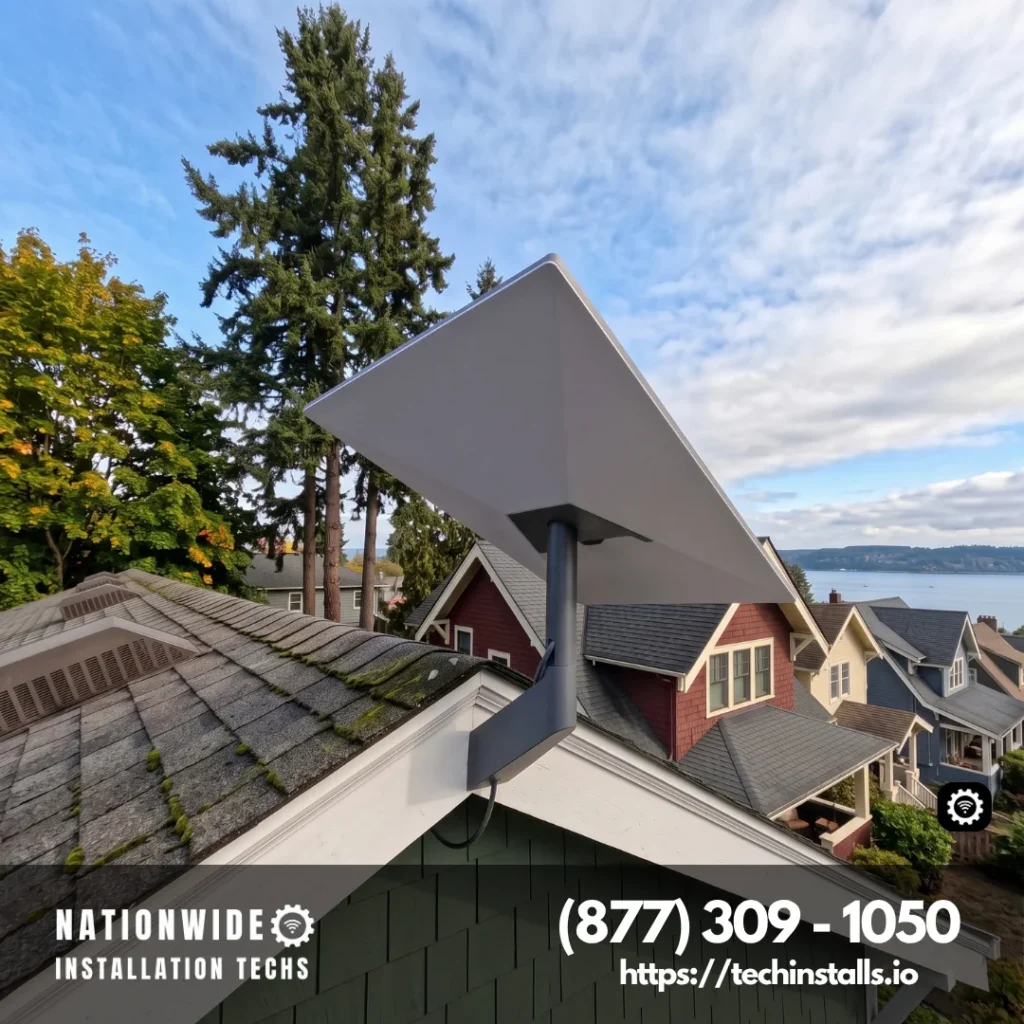
Starlink gives a Tacoma household a connection that does not wait on anybody’s construction schedule or ride on the same overhead lines a windstorm brings down. You order the kit, we fit it, and the house is on the new service within the week. Run a quick speed test now and repeat it on the day we finish, and keep both numbers; the change between them is your install. Our typical week here is a North End house with the dish tucked on the fascia, a rental in Lakewood or Parkland, a boat in a Gig Harbor slip, and a few acres on the Key Peninsula that the wired build has not reached. Get the order in, and while the box is on its way we can do the free virtual survey, so the mount is chosen before delivery day.
Which Way the Hill Faces Decides the Survey
The dish looks north. In Tacoma that turns the first question of every survey into a question about the hill.
Much of the North End, and Ruston beside it, falls away toward Commencement Bay and the open water beyond, so a roof there often has nothing but sky and Puget Sound in the direction the dish needs. Those are some of the easiest sightlines in the county.
Move up and over the crest, into the South End, the East Side or out toward Spanaway, and the view the owner enjoys often points the other way, with the northern arc crossed by the neighbor’s roof and a row of tall conifers. That is where the survey earns its keep: it tells us whether the dish clears from high on the main roof, needs a taller mast, or belongs on a garage or shop at the back of the lot with a bridge to the house.
Moss Grows on the Side the Dish Looks At
A roof plane that faces north gets the least sun of any surface on the house, stays wet the longest after each storm, and grows the thickest moss. It is also, very often, the plane the dish wants. So a Tacoma pivot mount is frequently going onto the one part of the roof that never quite dries.
- We seal onto sound shingle. The base goes high on the plane just below the ridge, and every pilot hole, the full edge of the base and each exposed bolt head gets sealant. Moss and grit under that bead would defeat it, so the footprint of the mount has to be clean shingle before anything is fixed.
- Moss treatment is a roofer’s job. If the shingle under the moss is lifting, curled or soft, that roof needs attention first, and we will say which mount avoids it in the meantime.
- The wall is often the better answer. A standard wall mount on the fascia board at a gable end, with the dish sitting comfortably above the roof line, keeps every fixing off the damp plane altogether.
- The cable is dressed for rain. Clips hold the run at twelve to eighteen inch intervals so it cannot sag, and just below the wall entry it dips into a U before climbing into a sealed grommet, so rain drips off the bottom of the U rather than tracking inside.
Century-Old Houses, Plaster Walls and the Cable Route
The North End, Stadium and Hilltop hold a lot of houses from the early twentieth century. Many of them have lath-and-plaster walls, basements rather than slabs, and framing that does not always sit where a modern stud finder expects it.
Getting the cable inside is where that shows. We drill the entry from inside the room outward, keep it low, place it no more than about four feet from a power outlet and slightly under it, and trim it with a brush wall plate so there is no raw hole. In an older house we look first for a route through the basement or an existing chase, because a new hole in old plaster is easy to crack and slow to patch.
Some of these streets are also inside city historic districts, among them the North Slope and the Wedge. The city’s general rule is that exterior work visible from the street on a contributing property goes through design review with the Landmarks Preservation Commission, while in the residential districts work that needs no building permit is generally exempt. Check with the city’s historic preservation office before you book; we will put the planned mount and its location in writing either way, and a position at the back of the house usually settles the question.
Slips on the Foss, Point Defiance and Gig Harbor
Tacoma is a working harbor, and plenty of the boats around it are lived on or used year round: the slips on the Foss Waterway, the marina at Point Defiance, and the moorage in Gig Harbor. Salt water changes a boat or yacht Starlink install in ways a roof never does.
Every fixing is stainless, because anything else stains and then fails in the Sound’s air. The mount is chosen for a hull that moves, not for a building that does not. The cable enters through a sealed fitting that can still be opened later when something needs service, and power comes from the house battery bank rather than the engine start battery. We will ask whether the boat stays in its slip, cruises up to the San Juans for the summer, or comes out on a trailer, because each of those puts a different load on the mount.
West of the Narrows: Fox Island and the Key Peninsula
West of the Narrows Bridge the picture changes. Pierce County’s own broadband work counted about 2,800 homes and business locations on the Gig Harbor Peninsula, Fox Island, the Key Peninsula and the islands beyond that were unserved or underserved, and new builds are still arriving faster than the wire.
Properties out there are often several buildings on a wooded acreage: the house, a detached garage or shop, and sometimes a cabin for guests. We put one dish wherever it can see past the firs, and carry the connection to the other buildings over a point-to-point wireless bridge instead of a trench through roots and wet ground. Where the power is solar or a generator, budget 75 to 100 watts running continuously for a Standard dish, and give that figure to whoever sizes the system.
From Ruston to Roy, the Pierce County Map for a Tacoma Starlink Installer
Across the city itself we cover Tacoma from end to end. Close in, Fife lies under four miles to the east, Fircrest and University Place four to five miles west-south-west, Browns Point four miles north across Commencement Bay, and Ruston five miles to the north-west.
Next come Parkland six miles south, Lakewood six south-west, and Federal Way seven north-east over the King County line. Edgewood is seven east, Puyallup eight east-south-east, Fox Island eight due west, Gig Harbor nine north-west over the bridge, and Steilacoom nine south-west.
Farther out, Sumner and Bonney Lake run ten to thirteen miles east-south-east, Spanaway ten south, Auburn eleven east-north-east, and South Hill and Frederickson eleven to the south-east and south-south-east. DuPont is fourteen south-west, Orting fifteen south-east, Graham sixteen south-south-east and Roy seventeen south-south-west. Across the Thurston County line, Lacey and Olympia sit twenty-three and twenty-six miles to the south-west.
How far we drive has no effect on the price. The job at the address sets it, the same way it does everywhere else we work in Washington.
Click!, Fiber and Why a Second Line Still Makes Sense
The city’s own utility built the Click! cable network, which Rainier Connect has operated since April 2020 under a long-term agreement, and other providers run cable and fiber across much of town. Where fiber reaches the house, it is fast and it has the lower latency.
People with those options still book us, usually for one of three reasons. The monthly price. The experience of waiting days for a repair visit. Or wanting a connection with no shared weak point, so a tree across the overhead lines in a November blow does not take the whole household offline, which is the point of running Starlink as a second line. Which of those weighs most is up to you, and the survey puts real figures on it.
Pricing a Tacoma Job, Line by Line
$385 covers a straightforward house install. What raises it is a specific demand from the site: steering the mount away from a mossy or brittle roof, extra mast height above the conifers, a long cable path through an old house, or a garage or cabin that needs its own link. The remote look at your sky is free and happens before anyone is scheduled. Paying $199 for a technician to walk the lot in person first makes sense on a steep or heavily wooded one.
The number is agreed before work starts. Most Tacoma jobs are booked within about three days, and when the equipment is already delivered and the remote check is clean, the install is often done the day we arrive.
We are insured for general liability, and our technicians install Starlink for a living. The dish and the account belong to you, Starlink bills the service directly, and our charge is for the installation and nothing else. For the full breakdown, what an installation costs is laid out on its own page.
Jobs We Pass On in Pierce County
- Cedar shake stays undrilled. Shake splits along the grain under a fixing and the split carries water; those houses get a wall or fascia mount.
- Tile, slate and metal roofs are never drilled either. The mount moves to a wall, or to a ballasted base where nothing may be drilled at all.
- No moss removal, roof cleaning or roof repair. That work belongs to a roofer, and a mount set on a roof about to be replaced just comes off again.
- No install on a rental without the owner. Written permission from the owner or property manager comes before the first hole.
- No historic review filings. We provide the mount plan in writing; the owner deals with the city.
- No electrical work or solar sizing. Your electrician gets the 75 to 100 watt figure from us.
- No reselling Starlink service. The plan is bought from Starlink and stays in your name.
Starlink Installation in Tacoma, Answered
Often, yes, as long as the shingle underneath is sound. The mount’s footprint has to be clean shingle so the sealant bonds, and every pilot hole, the base edge and the bolt heads are sealed. If the moss has lifted or softened the shingle, a roofer should look first, and in the meantime a wall or fascia mount keeps the dish off that plane entirely.
Usually. The survey checks whether the dish clears from the highest point of the main roof, whether a taller mast gets it above the canopy, or whether a garage or shop further back on the lot sees more sky. If the answer is another building, a wireless bridge carries the signal to the house without digging.
It can. The city reviews exterior work on contributing properties that is visible from the street, and exempts permit-free work in its residential districts, so confirm with the historic preservation office before booking. A spot at the back of the house, out of sight from the street, usually answers the question, and we give you the mount and its location in writing to take to the city.
We try hard not to. We start the hole from inside the room, keep it near the floor beside an outlet, and in an older home we check the basement or an old chase first for a route up. When a hole in plaster cannot be avoided it is small, and it is finished with a brush wall plate so it looks deliberate.
Yes. Marine work uses stainless fixings throughout, a mount specified for a hull in motion, a sealed cable entry that can be opened again for service, and power from the house bank rather than the start battery. Tell us how the boat is used, whether it stays in the slip or heads north for the summer, since that changes the mount.
One, in almost every case. Whichever building has the clearest shot past the trees gets the dish, and the shop and the cabin are then reached over a point-to-point bridge, with a radio mounted at each end of the link. Across wooded, wet ground that beats a trench on cost and on time.
Rarely. Most of Tacoma’s rain comes as long light spells, and we work through those. The roof portion needs a surface clean enough for the sealant to bond, so on a truly soaking day we may favor a wall mount or move the roof work to a drier window. Once the dish is up, light rain rarely makes a difference you would notice, and a heavy downpour slows it only briefly.
Most people who do it want a second connection that shares nothing with the first: no overhead lines, no cabinet down the street, no repair queue. When a windstorm or a cut line takes the wired service down, the house stays online. Price and how faults get handled are the other reasons we hear, and the survey gives you the figures to weigh them.
Houses begin at $385, which covers mounting, sealing, the cable run, setup and aiming, backed by our one-year workmanship guarantee. Extra cost comes from the site itself: keeping the mount off a mossy roof, extra height to clear the firs, a long route through an old house, or a link to a detached shop. Commercial sites are $750 each ($650 each for three or more), an RV install or a work vehicle starts at $650, less across a company fleet, and a boat at $750. Our remote survey is free; an in-person one costs $199.
About Nationwide Installation Techs
Nationwide Installation Techs LLC fits satellite internet as an insured contractor in every state, has passed 3,000 installs, and holds a 4.9-star rating on Google. We do homes, commercial buildings, RVs and boats, and we also build mesh networks and building-to-building links and repair installs that were done badly. Your Starlink account stays entirely yours; what we take responsibility for is the mount, the seal, the cable and the aim.
Tacoma sits within our Washington Starlink service area, and every other location is listed there by state. Call (877) 309-1050 to get on the schedule.
Contact a Tacoma Starlink Installer
Nationwide Installation Techs LLC
- Phone: (877) 309-1050
- Email: support@techinstalls.io
- Free Quote: Contact Us Form
More Ways We Install Starlink Around Tacoma:
Connectivity News & Updates

Starlink Installation for Construction Sites — Local, Insured Techs
Starlink installation for construction sites, in all 50 states, from...

Thor Four Winds Starlink Installation | We Come To You
Thor Four Winds Starlink installation means working around a domed...

Residential Starlink Installation — Nationwide and Insured
Residential Starlink installation starting at $385, nationwide. Nationwide Installation Techs...

Expert Starlink Installation for Yachts and Boats
Starlink installation for yachts and boats, nationwide. Nationwide Installation Techs...
Disclaimer: Nationwide Installation Techs LLC is an independent business and has no affiliation or official connection with Starlink, SpaceX, or any of their subsidiaries or affiliates. We are not associated with, authorized, endorsed, or sponsored by these companies in any capacity. For official information, please visit the Starlink and SpaceX websites at www.starlink.com and www.spacex.com. The names “Starlink,” “SpaceX,” and any related trademarks, logos, or imagery are the exclusive property of their respective owners.
Any references to “certified” or “certification” on this website refer exclusively to Nationwide Installation Techs LLC’s proprietary in-house technician certification program. This training and certification process was developed by our company based on the experience and installation methods of professional technicians who have collectively completed more than 3,000 successful Starlink installations while maintaining an overall 4.9-star customer review rating. It is not affiliated with, issued by, approved by, or endorsed by Starlink, SpaceX, or any of their affiliates.