

Captain Cook Starlink installer, Nationwide Installation Techs, (877) 309-1050. Coffee farms above Kealakekua and Māmalahoa Highway shops are all in our insured technicians’ reach on the Big Island’s Kona coast, and with the box already there, one same-day visit covers the mount, wiring and first connection. Homes start at $385, boats at $750, and cars, pickups or campers at $650, less per vehicle for three or more. Businesses pay $750, and a company booking three or more sites pays $650 each. Anything we put up that needs attention within twelve months gets free labor, backing our 4.9-star Google rating from 110+ reviews. Contact us for a free quote. Serving Captain Cook, HI and all surrounding areas!
In 2020 the Census found 3,253 people in Captain Cook, most of them living between 800 and 2,000 feet up the slope above Kealakekua Bay. The name came from a post office: in the early 1900s the area’s mail was handled inside the Captain Cook Coffee Co., and the community took the post office’s name. Houses on their own lots are the rule. By the Census Bureau’s 2020-2024 American Community Survey, the area holds 1,126 homes; three in four stand alone, with 1986 as the median build year. The 1990s added more homes than any other decade, about 22 percent of today’s total, roughly one in thirteen predates 1940, and about seven in ten are lived in by their owners.
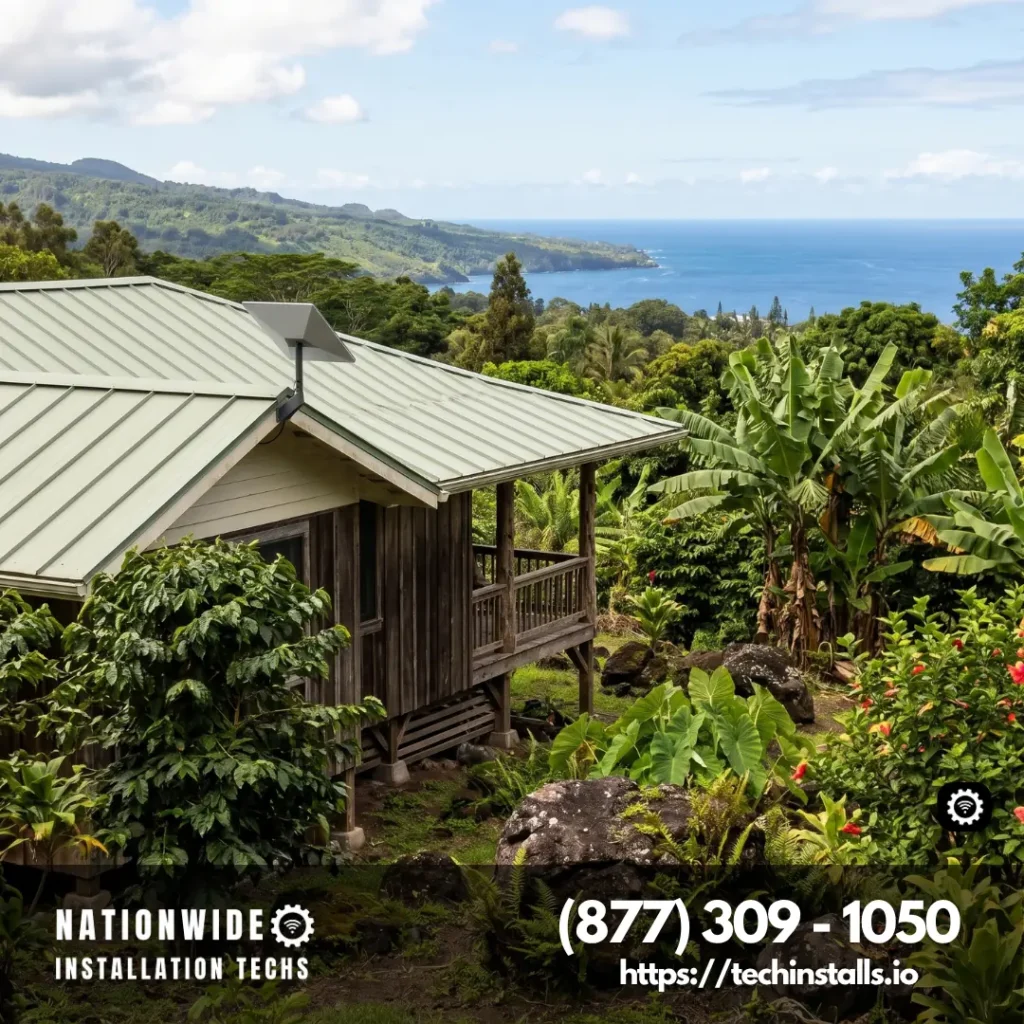
Up here the connection carries real work. Coffee farms sell beans and book farm tours online, vacation rentals promise guests Wi-Fi, and families keep up with relatives on the mainland over video. Starlink reaches all of them the same way, from satellites to a dish with open sky above it, so a farm at the end of a one-lane road signs up for the same service as a house beside Highway 11.
Planning a Kona install starts in your camera roll: video of each side of the house, the gable ends and the catchment tank if there is one, plus the spot indoors where the Wi-Fi matters most. Our technicians mark the mount position and the cable’s path to the router on those clips, free of charge, before the drive down Highway 11. Rather meet face to face first? Book the $199 on-site survey and we walk the lot with you.
Afternoon Clouds Over the Coffee Belt and a Drip Loop at Every Entry
Kona weather keeps a daily schedule. The National Weather Service explains that Mauna Loa and Hualālai block the trade winds over this coast, so sun heats the slope through the morning, air rises inland, and clouds build into afternoon showers at middle elevations, the band where the coffee grows. Summer heating strengthens that cycle and gives Kona the only summer rainfall peak in the state, and after dark the cooled air drains back down the mountain.
Rain that dependable decides the cable route. The entry hole is drilled from inside the house, a couple of inches below the center of an outlet, and outside the line hangs in a U under that hole so water drips off the bottom of the curve instead of following the cable in. A clip every 12 to 18 inches holds the run tight against the siding, and the router goes on a shelf in the living area, the indoor spot Starlink designs it for.
Single-Wall Farmhouses, Steel Roofs and the Mount Each One Takes
Listings around Middle Keʻei Road and the Belt Road describe the older South Kona farmhouse in a few words: single-wall construction, a steel roof, coffee and macadamia trees down the slope. Steel panels stay undrilled on every job we take. Instead, the dish rides on the standard wall mount at the gable end, a steel bracket held to the fascia by just two bolts set one above the other, with a mast plumbed straight so the top of the panel stands higher than the peak. Neither the roof nor the catchment tank it feeds ends up with a single new hole.
A wide lanai roof or a missing fascia board changes the plan. That is the under-eave mount’s job. Its base anchors to the wall beneath the overhang, an arm long enough to clear the gutter juts out from there, and the mast it carries stands tall enough that the panel looks over the roof instead of into it. If nothing at all may be fastened to the house, a paver-loaded frame holds the dish down by weight alone. Asphalt shingle on the newer builds takes the pivot mount, lagged into the rafters a little below the ridge, with a round pivot plate that lets the mast stand straight up whatever the slope.
Vog on the Kona Coast, and Why Every Bolt Head Gets Sealed
When Kīlauea is erupting, trade winds carry its vog around the south end of the island, and along the Kona coast daytime onshore breezes and nighttime offshore breezes hold it in place. Far from the vents, the U.S. Geological Survey notes, vog is mostly fine acidic droplets with the corrosive character of dilute battery acid.
That is why sealant does more than keep water out on a Kona job. Sealant is the first thing into each pilot hole and the last thing over each exposed bolt head, and between those steps a bead traces the whole base of every bracket, so the haze meets sealant rather than bare steel. The dish itself leaves the factory sealed to IP67; the router and the power brick are indoor gear, so they get a shelf under the roof.
Mango, Avocado and Macadamia Canopy Over a Coffee Lot
A coffee lot in Captain Cook is rarely open ground. Mango, avocado and macadamia trees shade much of the slope, so before any bracket goes up, our technicians walk the lot with the Starlink app’s obstruction scan open, testing the gable, the shop roof and any open corner of the yard. It sweeps the patch of sky the dish needs and marks every branch in the way, and we commit only to a spot that comes back clear.
When the canopy wins, two answers remain. Either the mast grows, lifting the panel over the treetops from the same gable bracket, or the dish moves to whichever building on the property sees open sky. Farms here have long had more than one: the Kona Coffee Living History Farm in Captain Cook still shows the kuriba mill and the hoshidana drying platform where coffee was processed. Linking them takes no digging through lava rock: a pair of point-to-point radios aims the signal from one building to the other, the radio pair that also handles wifi to barn and shop links, and mesh nodes carry it on to an ʻohana unit or guest cottage.
Boats Out of Honokōhau, Keauhou Bay and the Kealakekua Bay Permit Zone
Boats in South Kona launch from a few familiar places. Honokōhau Small Boat Harbor north of Kailua-Kona has 262 moorings and three launch ramps, Keauhou Bay has its own ramp closer to Captain Cook, and every vessel that crosses Kealakekua Bay, a Marine Life Conservation District, needs a State Parks permit first, kayaks included.
Charter skippers need the engines to start every morning, so the dish is wired to the house battery bank and the starting battery stays on its own circuit. Honokōhau’s charter cruisers and sportfishers have hardtops with room for the full-size dish. Open boats get the Starlink Mini, which weighs about 2.4 pounds, so a rail clamp holds it on a dive skiff or a center console. Screws and brackets on deck are stainless, the cable goes below through one sealed fitting, and on a boat with a cabin the Ethernet line ends at a router inside so passengers below get a strong signal. Roam service follows the boat out to 12 nautical miles offshore.
Camper Vans and Truck Campers Circling the Island on the Belt Road
Route 11 is part of the Hawaii Belt Road, the loop that rings the island, and camper vans and pickup campers can carry Starlink for the whole drive around it, from the coffee country to the Hāmākua coast.
On a camper van, a Starlink Mini on the roof keeps the setup light. The roof sits between the Mini and the people inside, so we run Ethernet down to a router in the cabin and wire power from the house battery, never the battery that starts the engine. A truck camper or travel trailer with room for a full-size dish gets the bolt-anchored RV mount, fastened into the framing we locate under the roof skin. Lap sealant beds the base, and a single sealed gland is the cable’s only way inside, so rain never finds a path under the roof skin.
Coffee Mills, Tasting Rooms and Tour Vans Along Māmalahoa Highway
Along this stretch of Highway 11, sales run through card readers and bookings through the cloud: coffee mills with tasting rooms, cafés, galleries, vacation rentals and the tour outfits that shuttle snorkelers down toward Kealakekua Bay. For each of them, Starlink is the backup line. Plugged into a dual-WAN router as the spare connection, it sits idle until the wired service fails; the router hands it the card readers and bookings at that moment and returns them when the line is fixed.
Commercial buildings follow the same no-drill rule as homes. A steel-roofed shop gets a gable wall mount, and a flat roof gets a ballasted frame weighted with pavers and tied down with wire, with the cable brought down the outside wall to a sealed entry. Businesses are quoted $750 per location, and a three-location order or bigger is quoted at $650 a location. Tour vans and farm trucks are a separate job: each one gets its dish set level on a flat mount on the cab roof or flat crossbars, powered apart from the starter battery; on a Roam or Priority plan, Starlink lets it stay connected while driving, at up to 100 mph in authorized locations.
Captain Cook Service Area: Kealakekua, Hōnaunau, Keauhou and Down to Ocean View
Every road in the Captain Cook census area is on our route, from the Highway 11 shops near the Kealakekua line to Middle Keʻei Road and the farm lanes off Route 160.
Kealakekua’s center sits just 2 miles north-northwest. Honalo (6 miles due north) and Hōlualoa (12 miles north) sit up the same side of the mountain, Kahaluʻu-Keauhou is 7 miles to the northwest, and Kaloko and Kaiminani lie farther on past Hōlualoa; every figure is a straight-line distance. By road, Route 11 runs 12 miles north to Kailua-Kona, and Route 160 winds 4 miles down to Nāpōʻopoʻo on Kealakekua Bay, with Hōnaunau and Puʻuhonua o Hōnaunau National Historical Park farther along the coast. To the south-southeast, Hawaiian Ocean View marks the far end of the run at about 29 miles, and calls along the same stretch of highway get bundled into one trip.
What a Starlink Install Costs on the South Kona Slope
Houses in Captain Cook, single-wall farmhouses and newer builds off Highway 11 alike, start at $385. Nothing gets added on the day without your sign-off: a taller mast for the canopy or extra mesh nodes for an ʻohana unit appear on the written quote first, and our price guide for every install type lays out the rest.
Before we pack up, your own phone runs the speed test, from the couch rather than out in the driveway.
What South Kona Asks a Captain Cook Starlink Installer
Yes. Starlink is available across the Big Island, so a farm on the Captain Cook slope orders its kit and plan from Starlink, and our technicians take it from the unopened box to a working connection in the farmhouse.
Yes, and the panels stay whole. The fascia at the gable, the wall under a deep eave or a paver-weighted frame carries the dish instead, so a roof that fills a catchment tank keeps doing only that.
Yes. The dish is rated IP67 for life outdoors, and where the cable enters the house we leave a hanging loop that sheds water before the hole, which is sealed around the line.
We seal it. Sealant fills each hole and caps every exposed bolt head, and the indoor electronics stay out of the acidic haze the USGS describes along the Kona coast.
Yes. The Starlink app tells us which spots on the lot have a clear view. When the canopy covers the house, the mast goes higher at the gable, or the dish moves to a mill or barn with open sky and a wireless link carries the signal home.
Yes. Open skiffs take the Starlink Mini and hardtop boats the full-size dish; either way the cable passes below through one sealed fitting, the house batteries run it, and you see it online before the lines come off. Boats headed into Kealakekua Bay still carry their State Parks permit.
Yes. A roof-mounted Starlink Mini wired by Ethernet to a router in the cabin covers a van, and a truck camper or travel trailer can take a full-size dish on a bolt-anchored mount.
Yes, on a Roam or Priority plan. Starlink supports in-motion use up to 100 mph in authorized locations, and we set each vehicle’s dish level on a flat mount with power kept apart from the starter battery.
Yes. On the second port of a dual-WAN router, Starlink stands by while the wired service works and carries the traffic when it stops, so sales on Māmalahoa Highway keep going through.
Yes. Our South Kona route covers Kealakekua, Honalo, Hōnaunau and Nāpōʻopoʻo, Kahaluʻu-Keauhou, Hōlualoa, Kailua-Kona, Kaloko and Kaiminani, and runs south to Hawaiian Ocean View.
A house starts at $385 and a boat at $750. Cars, trucks and campers are $650, trimmed for groups of three or more; a mill, café or office is $750, and $650 per location when a business brings three or more.
About Nationwide Installation Techs
Behind every Kona visit sits a record of more than 3,000 Starlink installs. Nationwide Installation Techs LLC carries its own insurance and operates independently of Starlink, and working as a Captain Cook Starlink installer has meant single-wall farmhouses under steel roofs, mills and drying sheds tied to the house by wireless bridges, camper vans bound around the island and boats tied up at Honokōhau.
Kona addresses outside Captain Cook, and the rest of the islands, are on our Hawaii Starlink page, and the list of every area we cover goes state by state across the mainland. Bookings go through (877) 309-1050.
Talk to a Captain Cook, HI Starlink Installer About Your House, Farm, Van or Boat
Nationwide Installation Techs LLC
- Phone: (877) 309-1050
- Email: support@techinstalls.io
- Free Quote: Contact Us Form
More Starlink Installs Our South Kona Team Handles:
Connectivity News & Updates

Is Starlink Internet Fast Enough for 4K Streaming?
Is Starlink internet fast enough for 4K streaming? Yes, by...

Is Starlink Good Enough for Security Camera Systems?
Is Starlink good enough for security camera systems? Yes, at...


Starlink Dynamic Pricing for Residential
Starlink dynamic pricing for Residential plans matches your monthly rate...
Disclaimer: Nationwide Installation Techs LLC is an independent business and has no affiliation or official connection with Starlink, SpaceX, or any of their subsidiaries or affiliates. We are not associated with, authorized, endorsed, or sponsored by these companies in any capacity. For official information, please visit the Starlink and SpaceX websites at www.starlink.com and www.spacex.com. The names “Starlink,” “SpaceX,” and any related trademarks, logos, or imagery are the exclusive property of their respective owners.
Any references to “certified” or “certification” on this website refer exclusively to Nationwide Installation Techs LLC’s proprietary in-house technician certification program. This training and certification process was developed by our company based on the experience and installation methods of professional technicians who have collectively completed more than 3,000 successful Starlink installations while maintaining an overall 4.9-star customer review rating. It is not affiliated with, issued by, approved by, or endorsed by Starlink, SpaceX, or any of their affiliates.