

Chicago Starlink installer, Nationwide Installation Techs, (877) 309-1050. Professional, insured technicians serving Chicago, Illinois and Cook County. If your kit is already on site, same-day service is often available. Residential installs start at $385. 4.9-star rating on Google with 90+ reviews.
Chicago is not one city as far as a roof is concerned. It is dozens of neighborhoods stacked into a grid of two-flats, three-flats and bungalows, threaded with an alley system most American cities never built, and edged on the east by open water that changes less about the sky than people expect. A Starlink install here depends far more on which of those housing types you live in, and who else has a say over your roof, than on which side of the city you call home. The same technicians who mount a dish on a Gold Coast high-rise roof this week are setting one into a bungalow roofline on the other side of the city the next, and the mount is rarely the same twice.
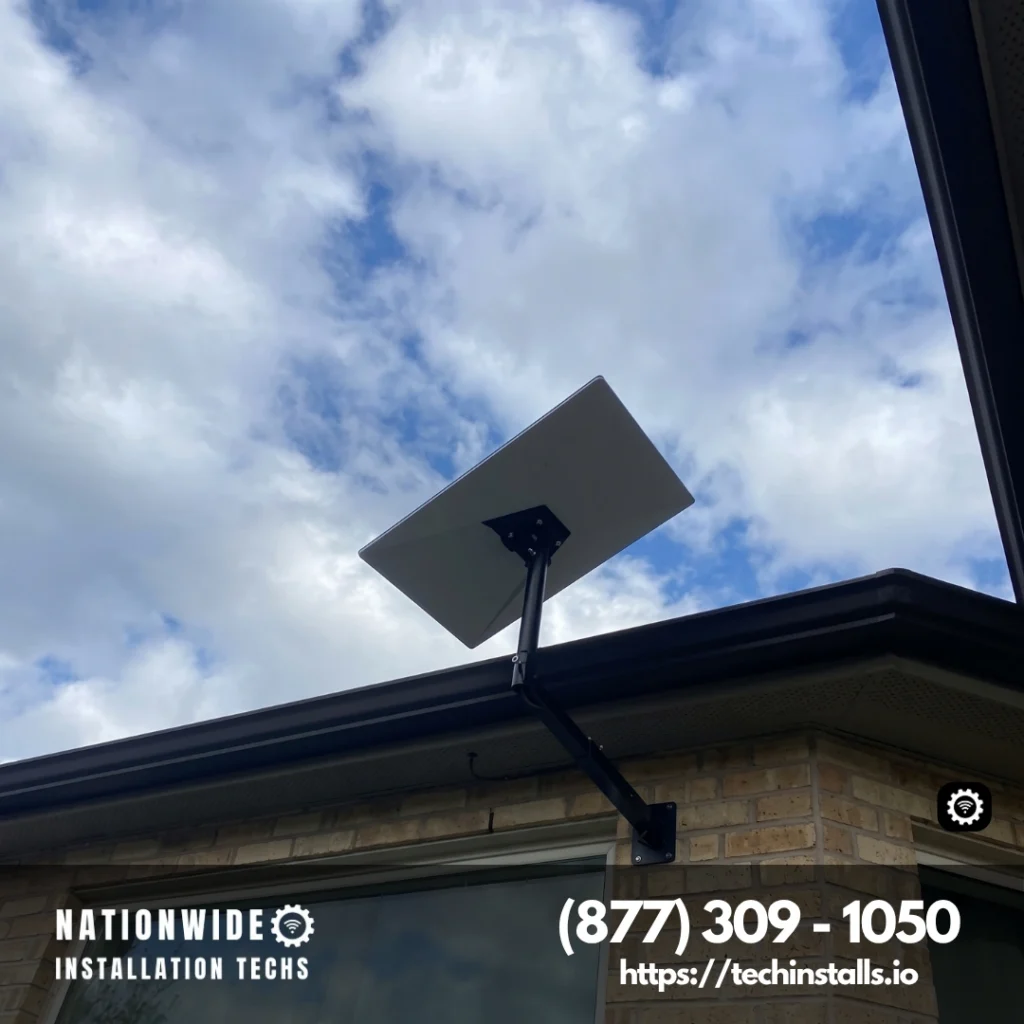
Check your own address on speedtest.net rather than a coverage map before you decide anything. Plenty of Chicago blocks are genuinely well served. Where we actually get called is the two-flat with a flat roof and a landlord to reach first, the vintage bungalow with a low-pitch roofline nobody wants to drill twice, the lakefront high-rise where nothing happens without board approval in writing, and the address where the primary connection drops in a lake-effect storm and a second, independent connection needs to already be running before that happens again.
Two-Flats and Three-Flats Are Chicago's Everyday Roof
A huge share of Chicago’s housing is the classic two-flat or three-flat: a brick multi-unit building, usually two or three stories, built shoulder to shoulder with its neighbors on a standard city lot. Most of these were never built with a steep, shingled roof at all. The roof is flat or low-slope, finished in a built-up tar-and-gravel system or, on anything re-roofed in the last couple of decades, a rubber EPDM membrane.
That roof type decides the mount before anything else does. We do not put a bolted, penetrating mount through a membrane that is doing the entire job of keeping water out of the units below it. A ballasted non-penetrating mount, a weighted base the dish sits on rather than one held down by fasteners through the roof, is the standard answer on a flat Chicago roof, and it is also the one a landlord or building owner can approve without opening up a conversation about voiding a roof warranty.
Because so much of this housing stock is rented rather than owner-occupied, we treat the same-day promise the way we do anywhere else with tenants: the kit can go in fast once roof access is settled, but if you rent your unit, written permission from whoever owns the building comes before the ladder goes up, not after. Running the cable from a shared roof down to one specific unit’s router is also different from a single-family house. On most two-flats and three-flats, the cleanest path follows existing conduit or the back porch stack rather than cutting a new opening through someone else’s ceiling, and we plan that route before the mount goes down. Neighborhoods like Logan Square, Pilsen, Avondale and Albany Park are built largely out of this housing type, block after block of it, which is part of why the flat-roof, ballasted-mount approach is not a special case for us here. It is close to the default.
The Bungalow Belt Is a Roof Type of Its Own
Ringing the city on the northwest, west, southwest and far south sides is the Chicago bungalow belt, an estimated 80,000 brick bungalows built mostly between the 1910s and the 1940s. They are single-story or story-and-a-half homes with a distinctive low-pitch roofline, and that low pitch is the detail that matters to us: it changes the angle a pivot mount sits at and how much clearance the mast needs to clear the roofline itself, not just nearby trees.
The other detail is age. A bungalow roof deck is original construction on a house that has likely been re-roofed more than once since, sometimes with a layer or two of old shingles still underneath the current one. We check what is actually under the surface before we commit to a fastening pattern, because a rafter that has taken several roofing jobs over a century does not always behave like the truss on a house built five years ago.
Bungalow belt streets are also some of the most heavily tree-lined blocks in the city, with mature parkway trees planted along the curb decades ago. Combined with the low roof pitch, that means the survey has to account for canopy at a lower sightline than it would on a taller building, and on some blocks a mast a few inches taller than standard is the whole difference between a clear view of the sky and one that is not. None of this makes the job harder in a way that shows up in the price. It just means we look first.
Lakefront High-Rise Condos Start With the Board, Not the Ladder
Gold Coast, Streeterville and Lincoln Park put a large number of Chicago residents into high-rise condo buildings rather than houses, and a high-rise changes the order of operations completely. There is no single owner to call for a yes or no. There is a condo association and a board, and rooftop or common-element work almost always needs written board approval before anyone can put equipment up, regardless of which unit is asking for it.
That approval step is not paperwork for its own sake. Board rules typically cover where equipment can go, whether it has to be screened from view, and who is liable for the roof membrane once something is bolted or ballasted onto it. We are glad to work from whatever the board specifies, including a ballasted mount on a section of roof they designate, but we need that answer in hand before we schedule anyone, the same way a rental unit needs the property owner’s sign-off first. Skipping that step is the single most common reason a high-rise install stalls after it has already been booked.
Most of these buildings also share the same roof type as a two-flat, just many stories up: flat, membrane-covered, and shared by every unit in the building rather than owned by one resident. That is one more reason the board, not any single owner, controls what happens up there, and it is why we always ask for the building’s own contact and any existing rooftop equipment plan before we price the job.
The Alley Behind Your Block Usually Carries the Cable
Chicago is one of the few American cities built with a genuine alley system running behind almost every residential block, originally laid out for coal and trash service and now mostly used for garages, parking and utility lines. That alley grid turns out to be useful for a Starlink install too. A large share of Chicago garages are detached structures facing the alley rather than the street, and where the roofline of the house itself is shaded or awkward, a garage roof with a clean view of open sky is frequently the better mount location.
When the garage is the right spot and the household devices are in the house itself, the fix is a point-to-point wireless bridge rather than a long cable run buried across a yard or strung along a fence line. It is the same principle we use on any property where the best sky and the living space are not in the same building, and on a standard Chicago lot the alley and the garage behind it are usually exactly that situation.
If what actually needs the connection is the vehicle parked in that garage rather than the house, that is a separate job with its own mounting and power rules: RV Starlink installation covers a coach or travel trailer, and Starlink installation for cars and trucks covers a daily driver.
Alleys also carry most of the overhead utility lines in older Chicago neighborhoods, which we account for when routing a cable or setting a mast, since a mount that clears a garage roofline still has to clear whatever runs along that alley above it.
Lake Michigan Sits to the East, but the Dish Looks North
Lake Michigan forms Chicago’s entire eastern edge, and the assumption we hear most often from lakefront residents is that the water is either the best thing about their sky or a problem for it. Neither is quite right, because the dish looks north, not east. Open water is not an obstruction at all, so a lakefront-facing home rarely has trouble on that side. What actually decides a lakefront job is what sits to the north of the house, a neighboring building, a parapet, a stand of trees, which is the opposite of where most people look first.
Winter is the other Chicago factor worth naming plainly. Lake-effect snow bursts and the wind that comes off open water in January are real, and they are exactly the conditions the dish is built to shrug off: it has a self-heating element that clears snow and frost off the surface on its own rather than needing anyone to climb up and brush it clear.
What the mount has to handle is the wind load, which is one more reason we do not cut corners on ballast or fastening on an exposed roof here. On an exposed lakefront roof or a high-rise setback, we sometimes recommend more ballast or a different mount than we would for the identical roof three blocks inland. The lake does not just sit there scenically; it measurably changes the wind the mount has to survive.
A Chicago Starlink Installer Covers Cook County and the Suburbs Around It
Inside the city we cover every neighborhood, from the lakefront high-rises down to the bungalow belt and the two-flat blocks in between. Our coverage does not stop at the city line. We work throughout Cook County, including Oak Park and Evanston close in, and Cicero, Berwyn and Skokie further out along their own corridors, and the same technicians, mounts and starting price apply whether the roof in question is a Chicago two-flat or a single-family house in one of these suburbs.
If your address sits in one of these suburbs rather than inside Chicago proper, the job is booked and quoted the same way. Property managers with buildings in more than one of these suburbs, or with a mix of Chicago and suburban addresses, are welcome to set up one standing service arrangement across the portfolio rather than requoting every address individually. The rest of Illinois is covered on the same basis through our statewide service, so a property outside Cook County entirely is not a reason to call around for someone else.
What the Quote Covers, and the Roofs We Say No To
Residential installs start at $385. What moves the number from there is the mount your roof actually needs, how much mast height the site requires, how long the cable run is, and whether a garage or second building needs its own coverage. A virtual site survey is free and lets us read the sky over your roof before anyone shows up. An on-site survey is $199 if you would rather have someone physically walk the property first, which is common on a high-rise or a building with more than one roof section to consider.
We carry general liability insurance and our technicians are insured. We are an independent installer: you own the hardware and hold your own Starlink account, and we do not sell the service plan or take a cut of the monthly bill. What we sell is the install itself.
A short list of things we do not do, on any Chicago roof: we do not drill metal roofing, ever, and use a non-penetrating mount instead. We do not mount to slate or clay tile. We do not do roof repair; if the deck or membrane is failing, get that fixed first, and if your roof is already scheduled for tear-off or repair, we would rather wait until that work is finished than seal a mount into a surface about to be replaced. We do not do electrical work or size a solar array, though we will tell an electrician the dish draws 75 to 100 watts. And we will not put a fastener through a flat roof or a drilled mount into any structure on a tenant’s or unit owner’s say-so alone; written permission from whoever owns the building or sits on the board comes first.
Frequently Asked Questions
Yes, and we will ask for it before we schedule anyone. Rooftop and common-element work on a condo building almost always needs written board approval, since the roof belongs to the association rather than to any single unit owner. We are happy to work from whatever the board specifies, mount location, screening, ballast requirements, but we need that answer in hand first, the same way we need a property owner’s permission before drilling into a rented house. Reach out to your building’s management or board as soon as you are considering an install, and bring us into that conversation early if it helps; we can usually answer a board’s technical questions directly.
Yes, with written permission from whoever owns the building, which we will need to see before any mount goes on the roof. It is worth asking first whether a drilled mount is even necessary: on the flat or low-slope roof typical of a Chicago two-flat, a ballasted non-penetrating mount is usually the standard choice anyway, and it is a much easier approval for an owner to grant since nothing goes through the membrane. Tell us it is a rental when you call and we will quote around whichever mount needs the lightest sign-off from your landlord.
It is a ballasted mount rather than a bolted one. Most Chicago two-flats, three-flats and high-rises have a flat or low-slope roof finished in built-up roofing or an EPDM membrane, and we do not put fasteners through that surface. Instead the mount sits on a weighted base that holds the dish in place through its own weight, which keeps the roof’s waterproofing completely intact. It is the same approach whether the building has three units or thirty, and it is also the easiest mount for a landlord or condo board to say yes to, since nothing is permanently altered.
Often, yes, and it is frequently the better option. A large share of Chicago garages are detached and face the alley rather than the street, and where the house roof is shaded or awkward, a garage roof with open sky can be the cleaner mount location. We run the connection back to the house over a point-to-point wireless bridge rather than a long buried cable, which is the same solution we use anywhere the best sky and the living space are not under the same roof. Tell us about your alley and garage layout when you book so we can plan the route in advance.
It is built for it. Lake-effect snow bursts and the wind that comes off Lake Michigan in winter are real conditions here, and the dish has a self-heating element that clears snow and frost off its own surface without anyone needing to climb up and brush it off. What we plan for on our end is wind load rather than snow: on an exposed roof or a lakefront high-rise setback we may specify more ballast or a different mount than the same roof would need a few blocks inland, precisely because of that wind. Winter itself is not a reason to delay a booking.
Not automatically, because the dish looks north rather than east toward the water. Open water is not an obstruction at all, so facing the lake rarely causes a problem on its own. What actually decides a lakefront job is whatever sits to the north of your house, a neighboring building, a parapet wall, a stand of trees, since that is the direction the dish actually has to see past. It is the opposite of what most lakefront homeowners assume, which is exactly why we read the real sky over your specific roof rather than going by the view from your window.
Both. We install throughout the city and across Cook County, including Oak Park and Evanston close to the city, and Cicero, Berwyn and Skokie further along their own corridors. The mount options, the technicians and the $385 starting price are the same whether the roof is a Chicago bungalow or a house in one of these suburbs. If your address is in Cook County or elsewhere in Illinois, we cover it on the same terms, just say which suburb you are in when you call.
Possibly, and it is your district’s rules rather than ours, so check what applies to your specific building before booking. Chicago’s landmark districts typically restrict what is visible from the street rather than banning rooftop equipment outright, so the question is usually where the mount can go rather than whether it can go at all. Be aware that alley-facing work generally counts as visible from a public way too, so a rear placement is not automatically exempt. Send us your address and we will work to whatever your district actually requires. On a building with a shared roof, this is one more item worth clearing with the board or the owner alongside the standard roof-access approval.
About Nationwide Installation Techs
Nationwide Installation Techs LLC is a professional, insured satellite installation company operating in all 50 states, with over 3,000 installations completed and a 4.9-star Google rating from 90+ reviews. Our experienced technicians cover residential, commercial, RV and marine installations, along with mesh networking, point-to-point bridges and on-site repair. We are an independent installer: you own your hardware and hold your own service account, and our crews handle the mounting, sealing and setup.
Serving Chicago, Cook County and the rest of Illinois, plus every other state listed on our locations we serve page. Call (877) 309-1050.
Contact a Chicago Starlink Installer
Nationwide Installation Techs LLC
- Phone: (877) 309-1050
- Email: support@techinstalls.io
- Free Quote: Contact Us Form
Connectivity News & Updates

Residential Starlink Installation — Nationwide and Insured
Residential Starlink installation starting at $385, nationwide. Nationwide Installation Techs...

Expert Starlink Installation for Yachts and Boats
Starlink installation for yachts and boats, nationwide. Nationwide Installation Techs...

Chicago Starlink Installer — Same-Day Service When Your Kit Is On Site
Chicago Starlink installer, Nationwide Installation Techs, (877) 309-1050. Professional, insured...

Professional Starlink Installation for Cars and Trucks
Starlink installation for cars and trucks, nationwide. Nationwide Installation Techs...
Disclaimer: Nationwide Installation Techs LLC is an independent business and has no affiliation or official connection with Starlink, SpaceX, or any of their subsidiaries or affiliates. We are not associated with, authorized, endorsed, or sponsored by these companies in any capacity. For official information, please visit the Starlink and SpaceX websites at www.starlink.com and www.spacex.com. The names “Starlink,” “SpaceX,” and any related trademarks, logos, or imagery are the exclusive property of their respective owners.
Any references to “certified” or “certification” on this website refer exclusively to Nationwide Installation Techs LLC’s proprietary in-house technician certification program. This training and certification process was developed by our company based on the experience and installation methods of professional technicians who have collectively completed more than 3,000 successful Starlink installations while maintaining an overall 4.9-star customer review rating. It is not affiliated with, issued by, approved by, or endorsed by Starlink, SpaceX, or any of their affiliates.