

City of Industry Starlink installer, Nationwide Installation Techs, (877) 309-1050. Professional, insured technicians serving City of Industry, California and the San Gabriel Valley. If your kit is already on site, same-day service is often available. Commercial installs are $750 per site, or $650 per site across three or more. Mobile Starlink installations start at $650, with discounts available for 3+ vehicles and mobile fleets. 1-year workmanship guarantee, by insured, professional technicians. 4.9-star Google rating with 100+ reviews.
City of Industry was incorporated in 1957 to be a place where businesses operate and almost nobody lives, and it has stayed that way: fewer than three hundred residents spread across roughly twelve square miles of warehouse, plant and yard. That makes it an unusual place to install anything, because the questions that decide a residential job never come up. There is no roof pitch to work around, no homeowner’s shingle to seal, no bedroom to route a cable into. What there is instead is flat membrane, tilt-up concrete, buildings measured in acres, and a roof warranty that somebody paid a great deal of money for.
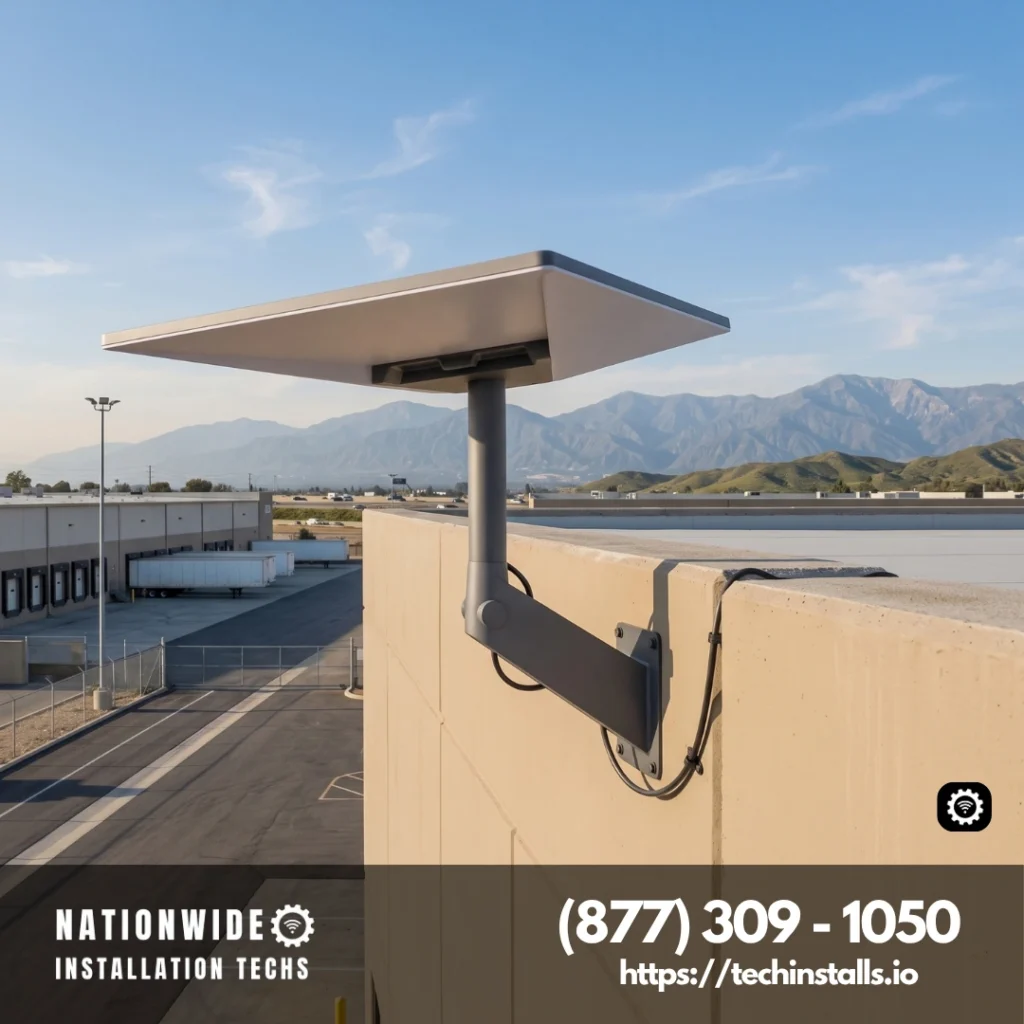
Starlink earns its place here as the connection that does not depend on the same conduit as everything else. A distribution floor that stops because one carrier had a bad morning is not a minor inconvenience; it is trucks idling in a yard and a shift standing around. Run the site on speedtest.net during your busiest hour and again once we are done, and the useful number is not the peak — it is what the link does when the building is full. The City of Industry jobs we do most weeks are the warehouse that wants a second path that shares no infrastructure with the first, the yard or job-site trailer with no service address at all, the multi-building site that needs one connection carried across it, the fleet that leaves the gate every morning, and the unit whose kit arrived and is still shrink-wrapped on a pallet. Order the kit, and book the free virtual survey before it lands.
A City Made of Concrete, Because the Ordinance Says So
There is a detail here that decides more installs than anything else: the city requires buildings to be built of concrete, concrete tilt-up, stucco, masonry or brick. Metal buildings are not permitted, with a narrow exception for solid waste handling.
Everywhere else we work, the first question on a commercial site is whether we are looking at a metal building, because a ribbed or standing-seam roof is one continuous sealed water plane and we do not drill it. In City of Industry that question mostly answers itself. What we are dealing with is a tilt-up concrete shell with a flat or low-slope membrane roof over it, and both of those have their own rules.
Tilt-up panels are genuinely structural, which makes them good to mount to and unforgiving if you get it wrong. A wall mount here takes an anchor sized and set for concrete, drilled with a bit meant for it, placed clear of panel edges and embeds rather than wherever the mast happens to land. On a parapet the fixings go into structure and the penetration is sealed. Stucco over anything is a finish, not a fixing, and nothing of ours is ever anchored into it alone.
The Roof Is a Warranty Before It Is a Roof
Most of the roofs here are single-ply membrane, and TPO is what new construction across Southern California specifies: heat-welded at the seams, light-coloured for Title 24, and covered by a manufacturer warranty that commonly runs fifteen or twenty years on a roof that cost six figures to put down.
That warranty is the reason our answer on a membrane roof is the same every time. The dish goes on a non-penetrating ballasted mount: a weighted frame that sits on its own trays, spreads its load, and never puts a fastener through the waterproofing. Nothing is drilled, nothing is welded, nothing is glued to the sheet. The roof leaves exactly as it was found, and the warranty is still whatever it was that morning.
We will not put a penetrating mount through a membrane roof even when somebody on site says it is fine. It is not our warranty to spend, the leak it causes will not show up for a season, and by then nobody will be able to say for certain what made the hole. Where ballast is genuinely not an option — a roof at its load limit, or an access problem — the mount goes on a parapet or a wall instead, which is a fixing into structure and a different question entirely. What we check before anything goes on a roof covers what a technician looks for before anything is fixed to a roof at all.
Four Buildings, One Connection
A great many sites here are not one building. They are a main warehouse, an office block, a shop or maintenance building, and a yard with a trailer in it, spread over several acres behind one gate.
The dish goes on whichever of those has the best sky and the soundest structure, and from there the connection is carried across the site on a point-to-point wireless bridge rather than trenched across a yard that forklifts and trucks cross all day. A radio link takes minutes to aim, does not care that there is asphalt and a container row in between, and can be moved later without digging anything up.
This is also the answer where a tenant occupies a unit whose roof they do not control. If the landlord will not have hardware on the membrane but the yard building is fair game, the link runs from there. It is the same standard either way: a mount that reaches structure or sits on ballast, one clean cable penetration, nothing improvised.
Where the Router Belongs When the Building Is Six Acres
Coverage is the part of a commercial job that gets underestimated most often. A warehouse is not a big house; it is a steel-racked, concrete-floored space that is actively hostile to a signal, and the router that would cover a home covers about a tenth of it.
So placement is a survey decision rather than a site-day guess. The router goes where the people and the systems actually are, which is usually the office block or a mezzanine rather than the middle of the floor. From there, mesh nodes or cabled access points cover what the racking blocks: the shipping and receiving ends, a mezzanine office, a shop building, a guard house at the gate. Where a scanner or a terminal has to work in a specific aisle, that aisle gets surveyed rather than hoped for.
The cable itself comes in through one planned penetration, drilled from inside facing out, sealed properly, and finished so it looks like it belongs to the building. On a tilt-up wall that hole is going through real concrete, which is another reason it gets decided once rather than twice.
When the Line Goes Down, the Trucks Stop
The practical case for this in City of Industry is rarely about speed. It is about what happens on the morning a backhoe two streets away takes out a conduit that every carrier in the block happens to share.
A satellite link does not share that conduit, that cabinet or that street. It is a genuinely separate path, which is the only kind of redundancy that actually helps when the failure is physical. For a distribution operation that means the WMS keeps talking, the labels keep printing and the trucks keep moving. For a manufacturer it means the floor does not stop. For a site office it means the job keeps being run from the job rather than from somebody’s phone.
It is worth being clear about what this is: a second path that is under your control and comes up in days rather than quarters. We fit it, aim it, prove it with a live speed test while you watch, and leave you with a connection that does not depend on anybody else’s build schedule.
Yards, Trailers and Everything That Leaves the Gate
Not all of the work here sits still, and the parts that move are often the parts with no address at all.
A construction trailer on a site off Temple or Gale has power and a gate and nothing else, and it needs to be running the day it lands rather than six weeks later. The same is true of a yard office, a temporary sales unit or a staging area taken on for a season. Those get the same standard as a building: a mount that reaches structure, a sealed entry, a router where the people are.
Then there are the vehicles. This is a freight city, and a great deal of its business is in motion between the 60, the 605 and the 10. Starlink installation for cars and trucks fits the install to the single vehicle and to how it is actually driven and parked. Starlink installation for mobile fleets sets the mount position, the cable path and the power tie-in as one decision, made once and logged, so a technician fitting truck thirty follows exactly what was done on truck one. Where a director or a crew is living out of a coach between sites, RV Starlink installation follows the same rules on a roof that flexes. And for the boats that some of these businesses own rather than operate, Starlink installation for yachts and boats is specified for salt and for highway speed.
Where We Drive Across the San Gabriel Valley, and What a Commercial Quote Covers
In the city itself we work the length of it: the distribution and manufacturing blocks either side of Valley Boulevard, the units off Salt Lake and Stafford, the yards and job sites around Gale and Temple, and the offices and showrooms out toward Puente Hills.
Around it we cover the valley: north to La Puente, West Covina, Baldwin Park and Irwindale, east to Walnut, Diamond Bar, San Dimas and Chino Hills, south to La Habra, Brea, La Mirada and Fullerton, and west to Whittier, South El Monte, El Monte and Rosemead.
Commercial pricing is per site rather than per hour: a single site is typically $750, and three or more sites are usually $650 each. That carries the mount and its ballast or anchors, the cable and its sealed penetration, the router and any nodes placed where the work actually happens, the aiming, and a live speed test before we leave. Where a site costs more than the base it is for reasons you can see coming: a radio link across to a second or third building, anchors into a two-storey tilt-up panel, a long run through a deep building, or access that needs a lift. Optional KVH account management with 24/7/365 support and advance-exchange replacement runs $19 per month per location, with consolidated billing if you have several.
The virtual survey costs nothing and is where the multi-building questions get settled. From a signed-off survey a crew is normally on site inside about 72 hours, and a unit whose kit is already indoors with open sky to the north is often quicker than that again. Our field technicians carry at least $1M in liability insurance. We are the installer and only the installer: Starlink supplies the hardware, your business holds the account, and no part of the monthly charge reaches us. what a Starlink install actually costs sets the numbers out elsewhere on the site.
Frequently Asked Questions
No, and that is a firm answer rather than a preference. A TPO or single-ply roof is a continuous heat-welded water plane under a manufacturer warranty that commonly runs fifteen or twenty years, and a fastener through it puts both at risk. The dish goes on a non-penetrating ballasted mount that sits on its own trays and spreads its load, so nothing is drilled, welded or glued to the sheet. If ballast will not work on your roof, the mount goes on a parapet or a wall into structure instead.
Yes, and tilt-up is a good wall to mount to precisely because it is structural rather than a facing. The anchors are sized and set for concrete and drilled with a bit meant for it, placed clear of panel edges and embeds rather than wherever the mast happens to fall, and the penetration is sealed. What we will not do is anchor into stucco or any other finish on its own, because a finish will not hold a mast in a Santa Ana.
Usually not. The dish goes on whichever building has the best sky and the soundest structure, and a point-to-point radio link carries the connection to the others. That beats trenching a yard that trucks and forklifts cross all day, it aims in minutes, and it can be moved later without digging. Tell us at the survey how many buildings there are and how far apart they sit, and the links get specified then rather than improvised on the day.
Not usually. If the membrane is off limits, the mount can go on a parapet, on a wall into structure, or on a different building on the site altogether with a radio link back to your unit. A yard building, a shop or even a well-placed trailer can carry the dish. We work out what you actually control at the survey, which is the point of doing one before anybody is scheduled.
It is a genuinely separate path, which is the part that matters most in a physical failure. When a conduit gets cut, every carrier sharing that route goes down together; a satellite link does not share it. We prove the connection with a live speed test while you watch before we leave, and we will tell you honestly at the survey what to expect at your site rather than after the invoice.
That is one of the more common jobs here. A trailer with power and a gate is all we need; there is no line to wait on and no address to register. It gets the same standard as a building — a mount that reaches structure rather than a magnet on a roof skin, a sealed cable entry, and the router where the people are. When the site finishes, the kit moves with you.
A single site is typically $750, and three or more sites are usually $650 each. That covers the mount and its ballast or anchors, the cable and its sealed penetration, the router and any nodes, the aiming and a live speed test. Optional KVH account management with 24/7/365 support and advance-exchange replacement is $19 per month per location, with consolidated billing across sites. The virtual survey that tells you which of these you need costs nothing.
A straightforward single-building install is a few hours once we are there. A multi-building site with radio links, a long run through a deep building or access that needs a lift will take longer, and the survey is where that gets scoped. Once a survey is confirmed the visit usually lands inside about 72 hours, and a unit with the kit already indoors and clear northern sky can often be done the same day. Our technicians carry at least $1M in liability insurance and will work around your shift pattern where the floor cannot stop.
About Nationwide Installation Techs
Nationwide Installation Techs LLC is a professional, insured satellite installation company operating in all 50 states, with over 3,000 installations completed and a 4.9-star Google rating from 100+ reviews. Our experienced technicians cover residential and commercial Starlink installation, along with RV and marine work, mesh networking, point-to-point bridges and on-site repair. We are an independent installer: you own your hardware and hold your own service account, and our crews handle the mounting, sealing and setup.
Serving City of Industry, the San Gabriel Valley and the rest of California, plus every other state listed on our locations we serve page. Call (877) 309-1050.
Contact a City of Industry Starlink Installer
Nationwide Installation Techs LLC
- Phone: (877) 309-1050
- Customer Reviews
- Email: support@techinstalls.io
- Free Quote: Contact Us Form
Connectivity News & Updates

Starlink Installation for Construction Sites — Local, Insured Techs
Starlink installation for construction sites, in all 50 states, from...

Redding Starlink Installer — Same-Day Service When Your Kit Is On Site
Redding Starlink installs work around what the Carr Fire rebuilt:...

Thor Four Winds Starlink Installation | We Come To You
Thor Four Winds Starlink installation means working around a domed...

Palm Desert Starlink Installer — Same-Day Service When Your Kit Is On Site
Palm Desert Starlink installer, Nationwide Installation Techs, (877) 309-1050. Professional,...
Disclaimer: Nationwide Installation Techs LLC is an independent business and has no affiliation or official connection with Starlink, SpaceX, or any of their subsidiaries or affiliates. We are not associated with, authorized, endorsed, or sponsored by these companies in any capacity. For official information, please visit the Starlink and SpaceX websites at www.starlink.com and www.spacex.com. The names “Starlink,” “SpaceX,” and any related trademarks, logos, or imagery are the exclusive property of their respective owners.
Any references to “certified” or “certification” on this website refer exclusively to Nationwide Installation Techs LLC’s proprietary in-house technician certification program. This training and certification process was developed by our company based on the experience and installation methods of professional technicians who have collectively completed more than 3,000 successful Starlink installations while maintaining an overall 4.9-star customer review rating. It is not affiliated with, issued by, approved by, or endorsed by Starlink, SpaceX, or any of their affiliates.