

Pittsburgh Starlink installer, Nationwide Installation Techs, (877) 309-1050. From Lawrenceville and Squirrel Hill to Mount Washington and the South Hills, our insured technicians cover Pittsburgh, PA and the river towns across Allegheny County. When the Starlink kit is already in the house, we can often finish the job the day we arrive. A house costs $385. A commercial site is $750, or $650 apiece once you book three or more locations. Pickups, cars, RVs and vans start at $650, with a lower rate for fleets of three or more, and boat installs start at $750. A one-year guarantee covers our workmanship, and our Google rating stands at 4.9 stars from 100+ reviews. Serving Pittsburgh, PA and all surrounding areas!
Pittsburgh is a city of hillsides. Its neighborhoods climb the bluffs above the Allegheny, the Monongahela and the Ohio, and the city counts more than 700 sets of public steps linking streets too steep to join any other way. The housing is old as well: the median home in the city dates to 1942 in the latest Census figures. Two questions settle most installs here before the sky even comes up. Which way does the hill rise behind the house, and what is the roof made of?
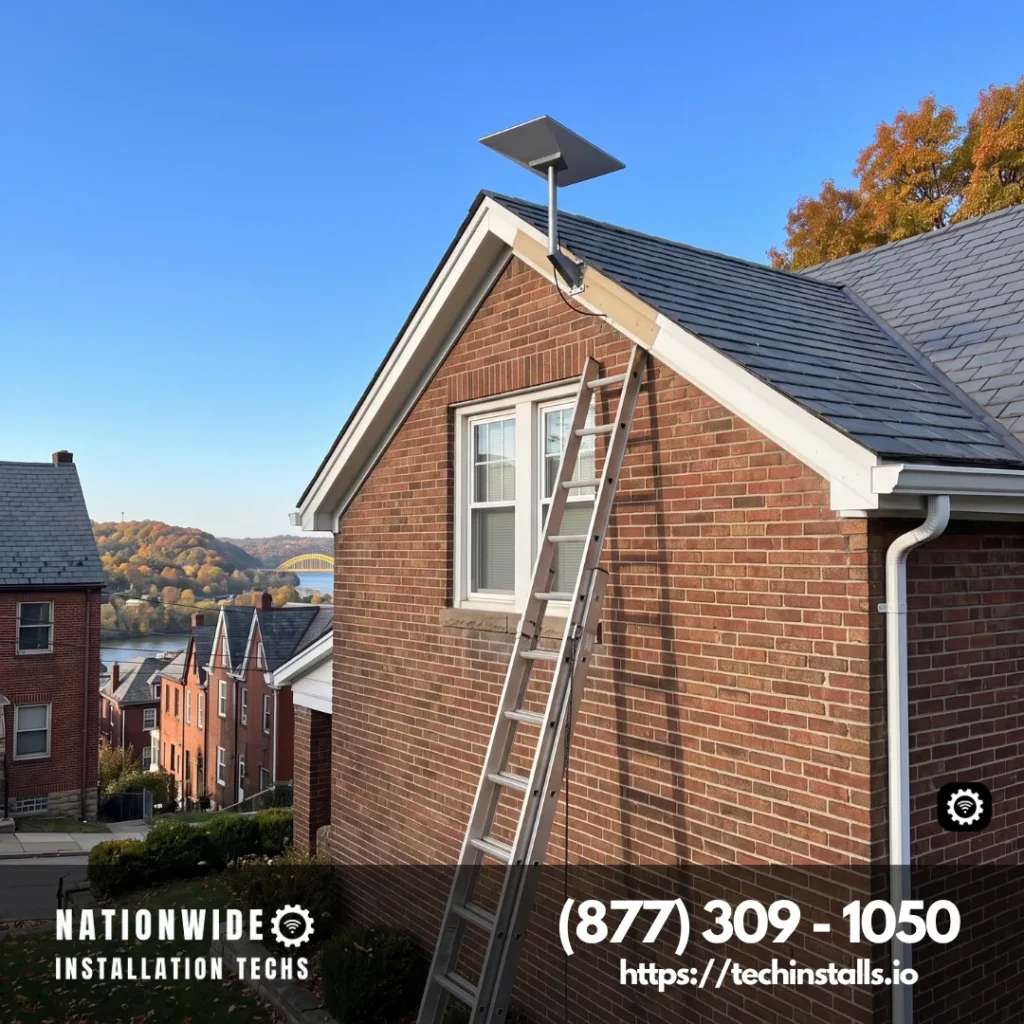
Starlink suits Pittsburgh well. It gives a hilltop house in Brookline or Greenfield a connection that does not depend on a line coming up the street, gives a shop in the Strip District a second way online when the main circuit goes down, and works just as well at a farmhouse out in Washington County. Check your current speeds the week before install day, then check again once the dish is live, and compare the two. A normal week for us might include a brick house in Bloomfield, a frame house on the South Side Slopes, a newer build in the North Hills and a duplex rental near Pitt. Order the kit, and while it ships we handle the free virtual survey, so the mount spot and the cable route are already decided when the box shows up.
Hillsides, Stream Valleys and Which Way the Slope Runs
Across the continental US, a Starlink dish tilts up toward the north and needs a wide cone of open sky in that direction. In a flat suburb that is easy to find. On a Pittsburgh hillside, the slope itself decides where the dish can go.
- Ground rising to the north. When the hill climbs behind the house toward the north, the slope and the houses above it can fall inside the dish’s view. We go higher, to the top of the roof plane or to a Starlink wall mount installation at the gable, with a mast that clears the homes uphill.
- Ground dropping to the north. When the land falls away in that direction, the sky over the valley is usually wide open, and the dish can sit lower and closer to the room you use.
- Stream valleys. Streets tucked down in places like Four Mile Run or along Saw Mill Run have wooded hillsides close on both sides. We check several spots before choosing one, and the clearest sky is sometimes over a garage or back building. A point-to-point wireless bridge then carries the connection to the house without trenching up the yard.
- Rowhouses on steep streets. On attached houses that step up a hill, the neighbor uphill often stands taller than your roof, so we scan from the rear of the roof as well as the front.
Slate, Shingles and Flat Rowhouse Roofs: Matching the Mount
Pittsburgh’s older homes mix steep shingled roofs, slate on many of the revival-style houses from the early 1900s, and flat or low-slope roofs behind the parapets of brick rowhouses and corner storefronts. Each roof calls for a different mount, and all of them come from our standard install set.
- Asphalt shingles. A pivot mount sits near the top of the roof, a short way under the ridge. Sealant fills every pilot hole, runs around the mount’s base and covers each bolt head.
- Slate. We never drill slate. The dish goes on a wall mount bolted to the fascia or gable, its mast plumb and the dish standing clear above the roofline, or on a weighted non-penetrating mount that rests on the roof without a single hole.
- Flat rowhouse and storefront roofs. A non-penetrating mount weighted with pavers or block caps, the weights wired to the frame for windy days, and the cable taped flat across the roof rather than clipped.
- Deep eaves with no fascia board. An under-eave mount bolts to the wall below the eave and reaches out past the gutter, so the mast can lift the dish above the roof.
Mexican War Streets to Schenley Farms: Installing in Historic Districts
The city has 16 local historic districts, among them the Mexican War Streets, Allegheny West, Manchester, Deutschtown, Schenley Farms and East Carson Street. Under the city’s design guidelines, any exterior work in a district that can be seen from the public right-of-way is reviewed, and that includes views from alleys and side streets. A visible roof surface counts as part of the main facade. Work on a side of the building nobody can see from the street is not reviewed at all, and city staff sign off on many minor changes without a full commission hearing.
That rarely gets in the way of an install. In a historic district we look first for clear sky that the street cannot see: the rear roof plane, a spot behind a parapet, a back wall or a garage off the alley. If the only open sky is on a visible face, we hold the mount until the owner has checked with the city’s historic preservation staff, then come back and finish.
Freeze-Thaw Winters, Ida's Floods and the April 2025 Windstorm
Pittsburgh weather wears on an install slowly, then all at once. NOAA’s 1991-2020 normals for the airport show about 39.6 inches of precipitation and 44 inches of snow a year, with roughly 114 nights at or below freezing but only about 32 days that stay below freezing all day. Water works into small gaps, freezes overnight and thaws by afternoon, over and over. The remnants of Ida put 3.3 inches of rain on the airport across two days in 2021 and flooded Millvale and the valleys around it, and on April 29, 2025, a line of storms produced a measured 75 mph gust in Churchill and cut power to about 325,000 customers.
- Every opening sealed. Pilot holes, mount bases, bolt heads and the wall entry all get sealant, so freezing water has nowhere to start.
- A loop below the entry. The cable drops into a U under the hole before it climbs into a sealed grommet, and rain runs off the bottom of the loop.
- Clips a foot or so apart. No slack anywhere in the run, so wind has nothing to whip against the siding.
- Clear of sliding snow. The dish melts snow that lands on it, but it cannot clear a drift piled around it, so we keep it high and out of the path of snow sliding off an upper roof.
Mature Maples, Wooded Slopes and Finding Open Sky
Trees are the other thing between a Pittsburgh dish and the sky. The city’s urban forest assessment found trees covering about 42% of its land, and many of the steep wooded slopes around its neighborhoods are set aside as city greenways, so the trees beside your lot are not going anywhere. Across Allegheny County the canopy covers more than half the land, which is why the lots in the North Hills and the eastern suburbs often sit under mature maples and oaks.
Before we commit to a spot, we stand where the dish would go and scan the sky with the obstruction tool in the Starlink app. We choose the place that clears the branches with room for the trees to keep growing, and on a heavily wooded lot that may mean a taller mast on the gable or an open spot farther from the house.
From Cranberry to the Mon Valley: The Towns We Cover Around Pittsburgh
Inside the city we work every neighborhood, from Downtown, the Strip District and Lawrenceville to Oakland, Squirrel Hill and Greenfield, across the rivers to the North Side and Troy Hill, and up the slopes to Mount Washington, Beechview, Brookline and Carrick.
Just past the city line: Millvale is about 3 miles north-northeast, Dormont 4 miles south-southwest and Mt. Lebanon 5 miles south-southwest, with Carnegie 5 miles west-southwest and Wilkinsburg 6 miles east. Shaler Township is about 6 miles north-northeast, Ross Township 7 miles north and Braddock 8 miles east-southeast, while Bethel Park and Bridgeville both sit about 8 miles out to the south-southwest and southwest, and Fox Chapel 8 miles northeast.
Across the rest of Allegheny County: Upper St. Clair is about 8 miles south-southwest, West Mifflin 9 miles southeast and McKeesport 10 miles southeast. To the north and east, McCandless and Hampton Township are each about 10 miles out, Penn Hills and Oakmont 10 miles east-northeast, Monroeville 13 miles east and Plum 14 miles east-northeast. Coraopolis is about 10 miles west-northwest, Sewickley 12 miles northwest and Moon Township 12 miles west-northwest, with Clairton 12 miles south-southeast, Wexford 13 miles north-northwest and Gibsonia and Pine Township 13 to 14 miles north.
Into the neighboring counties: Peters Township is about 12 miles south-southwest and Canonsburg 16 miles southwest, with Washington, PA 23 miles southwest. North Huntingdon and Irwin sit 15 to 17 miles east-southeast, Murrysville 16 miles east and New Kensington and Lower Burrell 15 to 18 miles northeast. Ambridge and Aliquippa are about 16 and 18 miles northwest, Mars 18 miles north and Cranberry Township 19 miles north-northwest. Down the Mon Valley, Monongahela is about 17 miles south-southeast, Monessen 20 miles, and Charleroi and Belle Vernon 22 to 23 miles in the same direction.
Farther out: Monaca and Beaver, PA are about 22 to 24 miles northwest, Jeannette 22 miles east-southeast, Freeport 23 miles northeast and Leechburg 25 miles east-northeast, and Zelienople 25 miles north-northwest. Greensburg is about 26 miles east-southeast, Beaver Falls 27 miles northwest and Butler, PA 30 miles north. At the edges of our area, Weirton, WV and Steubenville, OH are about 31 to 33 miles west, East Liverpool, OH 33 miles west-northwest, Ellwood City 33 miles north-northwest, Mount Pleasant 32 miles southeast and Latrobe 34 miles east-southeast. Ford City and Kittanning sit 34 to 36 miles northeast up the Allegheny, Connellsville 36 miles southeast and Blairsville about 39 miles east.
The drive does not change the price. A standard home install is $385 whether the house is in Bloomfield or out past Kittanning, and a Starlink installer in Pittsburgh, PA moves the quote only with the work the house itself needs.
Starlink Internet in Pittsburgh and the Surrounding Counties
Most of Pittsburgh is wired for internet, yet not every household is connected. In the 2020-2024 American Community Survey, about 7.3% of the city’s households reported no internet access, and about 10.3% got online only through a cellphone data plan. Out in the surrounding counties the gaps grow: roughly 13.2% of households in Fayette County and 9.9% in Armstrong had no access. Pennsylvania’s $1.16 billion federal broadband program is paying to close those gaps, and on the state’s provisional award list satellite service covers about 23% of the funded locations, with SpaceX picked for 9,476 of them.
If you are comparing internet providers around Pittsburgh, Starlink needs only clear sky over your address, so a house on a back road in Armstrong or Fayette County can be online within days, without waiting on a line to come down the road. In the city, it makes a strong second connection for anyone working from home, because it shares no cable with the service already running to the house.
UPMC, Robotics Row and Businesses Along the Three Rivers
UPMC is the largest nongovernment employer in Pennsylvania, with more than 40 hospitals and about 100,000 staff, and much of the city’s economy runs through its campuses, the universities and the companies that grew out of them. Carnegie Mellon’s Robotics Institute, founded in 1979, helped fill the old riverfront buildings in the Strip District and Lower Lawrenceville with robotics firms, and PNC and U.S. Steel keep their headquarters downtown. The Port of Pittsburgh covers more than 200 miles of navigable river, with barge terminals, marinas and boat clubs from Sewickley and Coraopolis on the Ohio to Sharpsburg and Oakmont on the Allegheny.
On flat commercial roofs we set a non-penetrating mount, a steel frame held in place by ballast that is wired to it, so the roof membrane is never opened. The cable comes inside at one sealed point, and the router and any mesh nodes go where staff and customers actually work. As a failover line, Starlink takes over the moment the main circuit drops, which keeps card readers, phones and cloud software running through the outages that storms bring. It also serves construction trailers, warehouses with detached buildings, and businesses rolling out the same setup across several locations.
Renters, Students and Rowhouse Apartments
More than half of Pittsburgh’s households rent, about 52.3% in the latest Census survey, and thousands of students move in and out of Oakland, Shadyside and Squirrel Hill every year. Starlink works for renters here.
- Space you control. Under the FCC’s Over-the-Air Reception Devices rule, a tenant can put up an antenna a meter or less across, a Starlink dish included, on a balcony, porch or yard reserved for that tenant’s own use. A freestanding weighted base keeps it there without drilling anything.
- The building is the owner’s call. A mount on a wall or roof needs the landlord’s written approval. We can send the owner a short plan showing where the mount goes and how every hole is sealed.
- The kit leaves with you. The hardware belongs to you, so when the lease ends it comes along to the next apartment.
Pittsburgh Starlink Installation Cost, Priced by the House, Not the Drive
For most Pittsburgh homes the price is $385: mount, cable, setup and aiming, backed by our one-year workmanship guarantee. The price only rises when the job grows: a wall mount with a taller mast to clear a slate roof, a cable run from a third-floor roof down to a basement office, a wireless link to a detached garage, or an extra mesh node in a tall, narrow rowhouse. We review your sky from photos for free, or a technician can come out for a $199 on-site survey.
Before we put you on the calendar, you get the price in writing, and most Pittsburgh installs land within a week of booking. If the kit has arrived and the survey raised nothing unexpected, the whole job takes a single trip. Your Starlink bill covers the hardware and the monthly plan; ours covers professional Starlink installation only. Pricing for each kind of job is laid out in our installation cost guide.
Pittsburgh Starlink Questions We Hear Most
Yes. The slate itself is never drilled. We use a wall mount on the fascia or gable that lifts the dish above the roofline, or a weighted non-penetrating mount that sits on the roof with no holes at all.
Usually, yes. If the hill rises to the north behind the house, we mount higher so the dish sees over it. If the land falls away to the north, the sky is often wide open. We test a few spots before choosing.
Exterior work visible from the street or an alley, including a visible roof, is reviewed by the city. We look for a spot the street cannot see first. If the dish has to be visible, check with the city’s historic preservation staff before we mount it.
The dish melts snow that falls on it. We mount it high, away from snow sliding off upper roofs, and seal every hole and entry so freeze-thaw cycles cannot open a leak.
Yes. A freestanding weighted base on your own balcony, porch or yard needs no drilling. Anything attached to the building needs your landlord’s written approval, and the kit is yours to take to the next place.
Yes. As a failover line it takes over when your main connection drops. On a flat roof we use a ballasted mount that leaves the membrane intact.
Yes. Starlink covers Pittsburgh and the surrounding counties. Plans and pricing are shown by address, so enter your street address when you order to see the options for your home. Once the kit arrives, we can often install it the same day.
Yes. Those four, plus Bethel Park, Sewickley, Murrysville, Canonsburg, Greensburg and the rest of the Pittsburgh region, are all on the map for a Starlink installer in Pittsburgh, PA. There is no separate travel charge, and the price is set by the job.
A standard house is $385, and that price includes the mount, the cable, setup, aiming and a one-year guarantee on our work. Commercial sites run $750 each, dropping to $650 a site for three or more. Cars, trucks and RVs start at $650 and boats at $750. Checking your sky from photos costs nothing, and a technician’s on-site survey is $199.
About Nationwide Installation Techs
We are Nationwide Installation Techs LLC, an insured, experienced and independent Starlink installer with over 3,000 completed jobs and a 4.9-star average from Google reviewers. Beyond houses, our technicians set up Starlink on apartments, farms, storefronts, offices, RVs, pickups and boats, and they extend Wi-Fi with mesh, connect outbuildings and redo mounts that were put up wrong. The Starlink account stays registered to you, while our expert, professional team handles the hardware fixed to the building.
With Starlink installers working the city and its suburbs, Pittsburgh falls within our Pennsylvania Starlink installation coverage, and every other city and state we serve is on our service locations page. Call (877) 309-1050 and we’ll find you a date.
Book Your Pittsburgh Starlink Installer
Nationwide Installation Techs LLC
- Phone: (877) 309-1050
- Email: support@techinstalls.io
- Free Quote: Contact Us Form
Other Starlink Work Our Technicians Handle in Western Pennsylvania:
Connectivity News & Updates


Is Starlink Internet Fast Enough for 4K Streaming?
Is Starlink internet fast enough for 4K streaming? Yes, by...

Is Starlink Good Enough for Security Camera Systems?
Is Starlink good enough for security camera systems? Yes, at...

Disclaimer: Nationwide Installation Techs LLC is an independent business and has no affiliation or official connection with Starlink, SpaceX, or any of their subsidiaries or affiliates. We are not associated with, authorized, endorsed, or sponsored by these companies in any capacity. For official information, please visit the Starlink and SpaceX websites at www.starlink.com and www.spacex.com. The names “Starlink,” “SpaceX,” and any related trademarks, logos, or imagery are the exclusive property of their respective owners.
Any references to “certified” or “certification” on this website refer exclusively to Nationwide Installation Techs LLC’s proprietary in-house technician certification program. This training and certification process was developed by our company based on the experience and installation methods of professional technicians who have collectively completed more than 3,000 successful Starlink installations while maintaining an overall 4.9-star customer review rating. It is not affiliated with, issued by, approved by, or endorsed by Starlink, SpaceX, or any of their affiliates.