

Seattle Starlink installer, Nationwide Installation Techs, (877) 309-1050. Professional, insured technicians serving Seattle, Washington and King County. If your kit is already on site, same-day service is often available. Residential installs start at $385. Mobile installations (RVs, cars and trucks) start at $650. Commercial installs start at $750 with discounts for 3+ locations. 4.9-star Google rating from 90+ reviews.
Seattle is a city of hills, saltwater and very large trees, and it is almost always the trees that decide an install here. The ground is dramatic but workable, the weather is wet rather than violent, and the roofs are mostly ordinary composition shingle. What is not ordinary is the canopy. A single mature Douglas fir on the wrong side of a lot in Wedgwood or Mount Baker will settle the question before anyone opens a ladder, and unlike most of the country, it will settle it the same way in February as in August.
Before you decide anything, run your own address on speedtest.net at the hour you actually use the connection rather than trusting a coverage map. A great deal of Seattle is genuinely well served. The people who call us are usually working around something more specific than a gap in the map: a north-side canopy nobody is allowed to cut, a building where the roof is not theirs to drill, a floating home, or a second connection that has to stay up when the first one drops.
The Trees Here Do Not Drop Their Leaves, and That Changes Everything
The dish looks north. That one fact does most of the work in a Seattle survey, because it means the tree that matters is rarely the one people point at.
Homeowners walk us round to the big maple shading the patio on the south side and apologise for it. That tree usually costs nothing at all. The one that decides the job is often a narrower conifer on the north property line that nobody had thought about, because it is not in anybody’s way at ground level.
Then there is the part that makes this city different from most of the markets we work. Seattle’s big trees are largely evergreen — Douglas fir, western red cedar, western hemlock — and evergreens do not thin out in winter. In a deciduous market a survey done in January can read beautifully and then fail in June once the canopy fills in, and we plan for the tree in leaf for exactly that reason. Here the opposite discipline applies: what you see in January is what you get in July, so a clean winter survey in Seattle is worth more than a clean winter survey almost anywhere else. That is genuinely good news, and it is worth knowing before you assume a treed lot is hopeless.
Where a roof truly cannot see north, the answer is usually a different structure rather than a taller mast. A detached garage, a shop or an ADU at the back of the lot is often clear of the canopy, and the connection comes back to the house over a point-to-point wireless bridge. A taller mast is the second choice, not the first, because a shorter mount is always the more durable one.
One thing we will not do is tell you to take a tree down. Seattle regulates the removal of larger trees, that conversation belongs with the city and an arborist rather than with an installer, and in most cases there is a placement that does not require it.
Rain That Never Really Stops, and What It Does to a Seal
Seattle gets around 37 inches of rain a year, which is less than Atlanta or Houston. The difference is that it arrives across a very large number of days rather than in a handful of downpours, and that changes which part of an install fails.
The failure mode here is not storm damage. It is slow water finding a seal that was done carelessly, over and over, for months at a time. A penetration sealed with whatever happened to be in the van will not blow off in a gale; it will weep quietly into a rafter bay through a wet November and announce itself as a stain on a ceiling in spring. So we seal with the right product, we give the cable a proper drip loop, and we secure the run mechanically rather than trusting adhesive that damp will eventually beat.
Moss is the other local reality. North-facing roof planes here grow it, and moss holds water against the surface and lifts shingle edges over time. We will tell you honestly what your roof looks like when we are up there. If it is near the end of its life, have it dealt with before we fix anything to it — a mount is cheap to move on a re-roof and expensive to argue about afterwards.
On the connection itself: very heavy rain can soften throughput briefly while a cell is directly overhead, and it clears on its own. Seattle’s rain is mostly light and steady rather than tropical, so this comes up less often here than customers expect.
Steep Roofs and Steeper Streets: Access Is Often the Real Constraint
Seattle’s older housing stock runs to Craftsman bungalows, Tudors and box houses with genuinely steep pitches, and the city they sit in is built on hills. Queen Anne, Magnolia, West Seattle and Beacon Hill all put lots on grades where the front door and the back garden are a full storey apart.
That rarely stops a job, but it does shape it. Ladder placement has to be worked out rather than assumed, retaining walls and tight side yards limit where a ladder can stand safely, and a steep pitch means more time and more care. We would rather see that on a virtual survey and price it properly than discover it with a technician standing in your driveway.
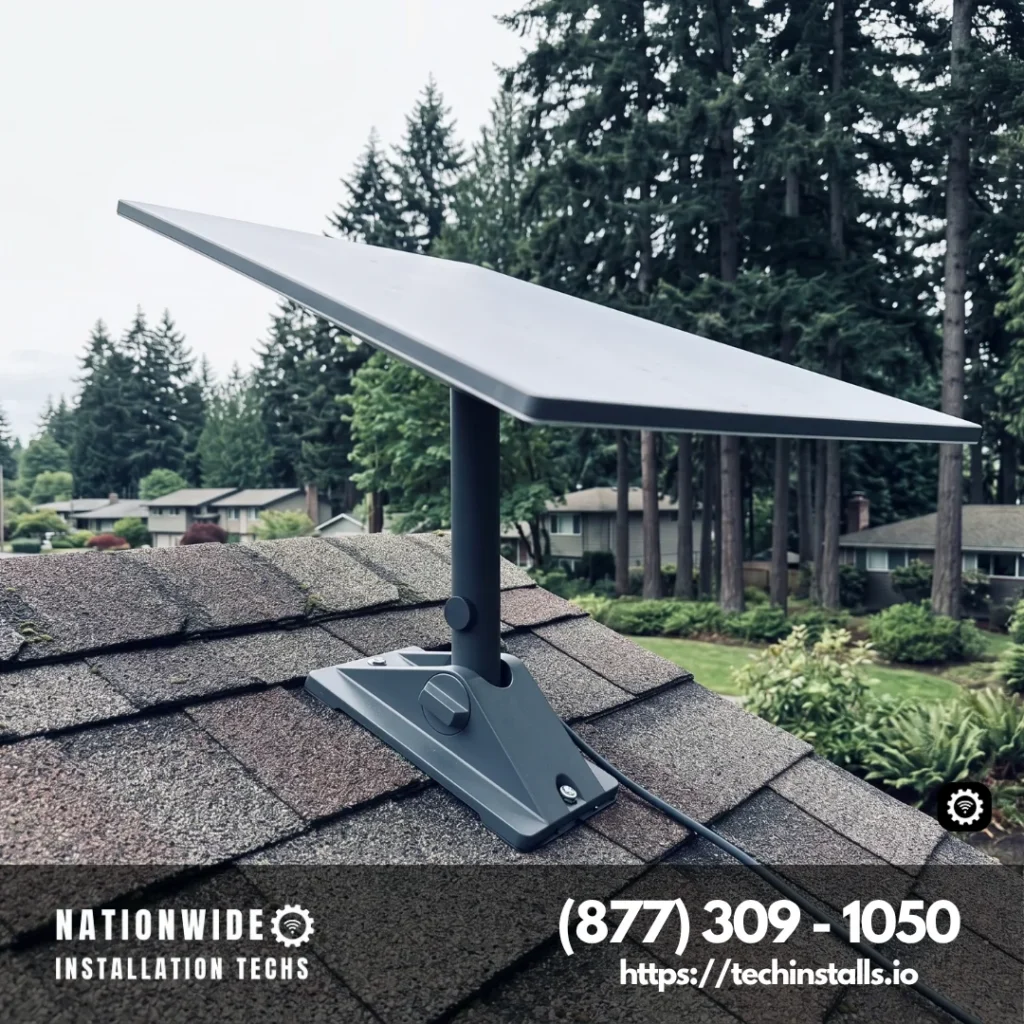
Most Seattle roofs are ordinary composition shingle, and on those the answer is the straightforward one: a pivot roof mount fixed into rafters, sealed properly, with the shortest sensible cable run. A steep pitch makes that slower rather than different. It is the roofs that are not shingle where the method has to change.
Cedar shake deserves a specific note, because there is still a lot of it here. Our written install standard documents five mounting methods and none of them is a shake mount. We do not drill shake and we do not lift it. Where the roof is shake, the answer is a mount that never touches it: a standard wall mount or an under-eave wall mount into solid framing, or a ballasted non-penetrating mount where there is a flat or low-slope section to sit on. Anyone offering to screw through a shake roof is improvising. What we check before anything goes on a roof is written up in full.
Floating Homes, Liveaboards and Boats
Seattle is one of the very few American cities where “we live on the water” is a literal statement. The floating home communities on Lake Union and Portage Bay, and the liveaboard slips at Shilshole Bay, are a real part of the work we do here.
A floating home is not a house. It moves, everything on it lives in a permanently damp environment, and the power situation is its own question. The mount has to account for motion rather than assume a rigid roof, the cable entry has to stay watertight while still being serviceable later, and the hardware has to tolerate salt air where the moorage is on the Sound rather than the lake. Tell us it is a floating home or a boat when you call, because the conversation is different from the first sentence and so is the equipment list.
Apartments, Condos and Who Actually Has to Say Yes
Seattle is a multifamily city, and a large share of the calls we take are from people who do not own the roof over their head.
The short version is that written permission from the owner comes first, and we need to see it before anything is fixed to the building. A verbal from a landlord is not that; a short written authorization naming the property and the work is. For a condo it is usually the HOA or the building association rather than an individual owner, because the roof is common property.
Federal rules do limit what a private restriction can do to a small receiving antenna in an area you exclusively control — a balcony or patio that is yours alone is a different case from a shared roof deck. That is worth knowing before you assume the answer is no, but the document that governs your building is your own, and the conversation is with your association rather than with us. What we can do is hand you the mount specification and a note of where it would sit, which is usually all a board actually wants to see.
Rigs, Work Vehicles and Kit That Moves
Not everything we mount in this city is bolted to a building. The Washington coast, the Olympic Peninsula and the passes east are all within a weekend of Seattle, and a great many of the rigs that go there want their own connection rather than a hunt for signal at the campground.
That is a different job from a house. The mount is bolted to the rig so it stays where it was put at highway speed, the cable entry has to respect a roof that flexes, and the power side has to suit how you actually camp, because 75 to 100 watts drawn continuously is a real load on a battery bank. RV Starlink installation is one of our core service lines. The same discipline applies to vehicles that are not RVs — Starlink installation for cars and trucks covers work trucks, service vehicles and overland builds, and the mounting is much closer to the RV job than to the house job.
Where a Seattle Starlink Installer Drives, and What the Quote Covers
Across the city we work everywhere: Ballard, Fremont and Wallingford, Queen Anne and Magnolia, Capitol Hill and the Central District, Green Lake, Wedgwood and Ravenna, Beacon Hill and the Rainier Valley, West Seattle and Delridge, and north through Northgate and Lake City.
Around it, north through Shoreline and Edmonds, south through Renton and Burien, and east across the lake to Bellevue and Redmond.
West is the part people ask about, because west of Seattle is Puget Sound. We cover Bainbridge Island and Bremerton on the same terms as everywhere else — it is a ferry rather than a drive, and it is worth telling us at the survey stage so the visit gets scheduled around a sailing rather than squeezed between two.
Residential installs start at $385, and what moves the number from there is the work at the far end of it: which mount your roof forces on us, whether a taller mast is needed to clear a canopy, how long and awkward the cable run turns out to be, and whether a second building has to come onto the connection. A virtual survey is free and reads the sky over your actual roof before anyone commits to a date. An on-site survey is $199 if you would rather have a technician physically at the property first, which on a steep treed lot is frequently money well spent.
Typical scheduling is around 72 hours. If the kit is already sitting in your hallway and the survey comes back clean, same day is often possible. We are an independent installer: you own the hardware and you hold your own Starlink account. We do not sell you the service plan, we do not open the account for you, and we do not take a cut of your monthly bill. What we sell is the install, and what a Starlink install actually costs is broken down in full elsewhere on the site.
Frequently Asked Questions
Not necessarily, but they are the right trees to be worried about. The dish looks north, so conifers on the north line are the ones that decide a job, while the big maple on the south side usually costs you nothing. Because they are evergreen, what we see on the survey is what you get year round, so the answer we give you will not change in June. Where the main roof genuinely cannot see past them, a detached garage, shop or ADU at the back of the lot very often can, and we bridge the connection back to the house. We will not tell you to cut a tree down.
Rarely, and not for long. Very heavy rain can soften throughput while a cell is directly overhead and it clears by itself, but Seattle’s rain is mostly light and steady rather than tropical, so this comes up less than people expect. What the weather here really tests is the install rather than the connection: a seal done with the wrong product and a cable run held up by adhesive will be found out by a wet November. We seal with a product rated for it, give the cable a drip loop, and secure the run mechanically.
Not to it, no, and that is deliberate. Our install standard documents five mounting methods and none of them is a shake mount, so we do not drill shake and we do not lift it. The honest options are a standard wall mount or an under-eave wall mount into solid framing, or a ballasted non-penetrating mount if there is a flat or low-slope section to set it on. All three keep the fixings off your roof covering entirely. If somebody offers to screw a foot plate through shake, that is improvising, not a method.
Yes, and it is genuinely different work. A floating home moves, so the mount cannot be specified as though it were sitting on a rigid roof, and everything on it lives in a permanently damp environment. The cable entry has to stay watertight and still be serviceable later, and if your moorage is on saltwater rather than the lake we specify for salt air as well. Tell us it is a floating home when you call rather than on the day, because the equipment list is different from a house.
Often yes, but the permission comes first. We need written authorization from whoever owns the building before anything is fixed to it, and a verbal from a landlord does not cover it. If you have a balcony or patio that is yours exclusively, that is a stronger position than a shared roof, and federal rules do limit what a private restriction can do to a small antenna in an area you exclusively control. Send us a photograph of the outlook from the balcony and we will tell you honestly whether it is worth taking to your landlord.
Sometimes, and we will tell you before we book rather than after. Grade itself is not the problem; ladder placement is. A steep lot with a retaining wall and a narrow side yard limits where a ladder can safely stand, and a steep roof pitch means more time on it. That is exactly the kind of thing the free virtual survey is for, and on an awkward lot the $199 on-site survey is frequently money well spent because it turns a guess into a fixed number.
Yes, on the same terms and at the same price. The drive does not change what you pay. What it does change is scheduling, because getting to Kitsap from Seattle is a ferry rather than a road, so we plan those visits around a sailing instead of squeezing them between two other jobs. Tell us at the survey stage that you are across the water and we will book it properly the first time.
Most residential installs are a couple of hours once we are on site. Typical scheduling is around 72 hours from the survey, and if your kit is already at the house and the survey comes back clean, same day is often available. What slows a job down is almost never the hardware — it is a canopy that needs a second look, a roof that turns out to need work first, or a building owner who has not signed off yet. All three are easier to sort out before the date than on it.
About Nationwide Installation Techs
Nationwide Installation Techs LLC is a professional, insured satellite installation company operating in all 50 states, with over 3,000 installations completed and a 4.9-star Google rating from 90+ reviews. Our experienced technicians cover residential, commercial, RV and marine installations, along with mesh networking, point-to-point bridges and on-site repair. We are an independent installer: you own your hardware and hold your own service account, and our crews handle the mounting, sealing and setup.
Serving Seattle, King County and the rest of Washington, plus every other state listed on our locations we serve page. Call (877) 309-1050.
Contact a Seattle Starlink Installer
Nationwide Installation Techs LLC
- Phone: (877) 309-1050
- Email: support@techinstalls.io
- Free Quote: Contact Us Form
Connectivity News & Updates

Residential Starlink Installation — Nationwide and Insured
Residential Starlink installation starting at $385, nationwide. Nationwide Installation Techs...

Expert Starlink Installation for Yachts and Boats
Starlink installation for yachts and boats, nationwide. Nationwide Installation Techs...

Seattle Starlink Installer — Same-Day Service When Your Kit Is On Site
Seattle Starlink installer, Nationwide Installation Techs, (877) 309-1050. Professional, insured...

Professional Starlink Installation for Cars and Trucks
Starlink installation for cars and trucks, nationwide. Nationwide Installation Techs...
Disclaimer: Nationwide Installation Techs LLC is an independent business and has no affiliation or official connection with Starlink, SpaceX, or any of their subsidiaries or affiliates. We are not associated with, authorized, endorsed, or sponsored by these companies in any capacity. For official information, please visit the Starlink and SpaceX websites at www.starlink.com and www.spacex.com. The names “Starlink,” “SpaceX,” and any related trademarks, logos, or imagery are the exclusive property of their respective owners.
Any references to “certified” or “certification” on this website refer exclusively to Nationwide Installation Techs LLC’s proprietary in-house technician certification program. This training and certification process was developed by our company based on the experience and installation methods of professional technicians who have collectively completed more than 3,000 successful Starlink installations while maintaining an overall 4.9-star customer review rating. It is not affiliated with, issued by, approved by, or endorsed by Starlink, SpaceX, or any of their affiliates.