

Miami Starlink installer, Nationwide Installation Techs, (877) 309-1050. Professional, insured technicians handling Starlink installation in Miami and across Miami-Dade County. If your kit is already on site, same-day service is often available. Residential installs start at $385.
Cable already reaches most of Miami — Xfinity covers roughly 98% of the city and AT&T Fiber a little over 60% — and where either one is available at your address, it’s an option worth considering. Our Starlink installer in Miami earns their place on the addresses and vessels those wired networks don’t reach, or can’t be relied on:
boats, buildings the wiring skipped, spots a storm keeps knocking offline. Our free coverage check tells you which one you’re dealing with before you spend a dime.
What brings people to us here is narrower and more specific: a boat that leaves the dock and loses the marina Wi-Fi, a business that cannot afford to go dark for three days after a storm, a construction trailer on a lot with no service drop yet, and a unit in a building where the wiring is the problem and the association is the reason it stays the problem.
Those four situations are real, and none of them are fixed by another cable quote. Run a test on speedtest.net at the address before you call us. If you are already getting what you pay for, we will say so.
Why We Do Not Put a Hole in a Miami Roof
Miami-Dade and Broward are the two counties that make up Florida’s High-Velocity Hurricane Zone, the HVHZ. The design wind speed used for ordinary residential construction here is 175 mph, and roofing products are held to a Miami-Dade County Notice of Acceptance rather than the standard statewide product approval. We are an installation company, not a roofing contractor. We do not pull roofing permits and we do not certify any assembly against the code.
So our default on a Starlink installation in Miami is a mount that does not break the roof covering at all. On the flat roofs that cover most of the city’s low-rise and commercial stock, and on pitched tile, that means a non-penetrating ballasted mount: a frame that sits on the deck and is held down by pavers or concrete block, tied off in wind.
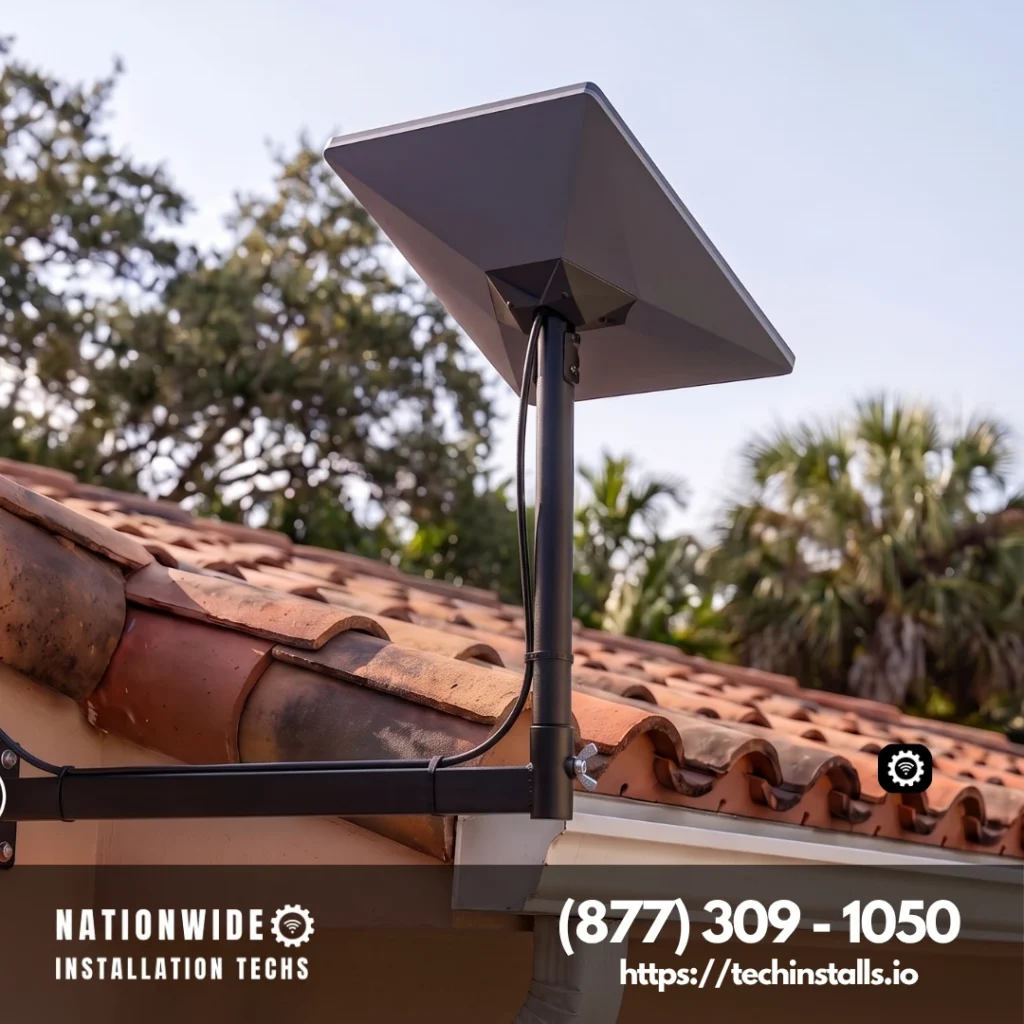
Where a wall will take it instead, we bolt a flat mount to the fascia board at the gable end, high enough that the panel clears the roofline, because a dish sitting below the ridge turns your own roof into the obstruction. Where neither fits, an arm through the wall under the eave reaches past the gutter and carries a plumb mast at its end.
The mast stands vertical regardless of what the roof is doing under it, and the cable never crosses a roof plane. It comes down the mast, along to the gutter line, down the wall on clips every foot to eighteen inches with no sag, forms a drip loop, and enters through the wall through a sealed grommet, within about four feet of an outlet and a few inches below its center.
Inside, it lands on a brush wall plate rather than a bare hole. Salt air is the other Miami variable, and it is the reason we use stainless fixings rather than whatever came in the box.
Once the dish is up, the harder half of the job is usually getting the signal to the far end of the property. A detached garage, a guest house across the yard, a second building on a commercial lot or a slip a hundred yards from the office are all better solved with a point-to-point wireless bridge than with a second subscription. We fit mesh and extenders too, and we will tell you which one your layout actually needs rather than selling you the bigger one.
Take the Dish Down Before a Named Storm, Not the Mount
Yes, take it down. The published specification for the Standard dish gives one wind figure and it is an operational rating of 60 mph or better. There is no published survival rating at all. The design wind speed this county builds to is 175 mph. A hurricane will exceed what the hardware is rated to work in long before it threatens a mount that went on properly.
The dish itself is about 23 by 15 inches and weighs 6.4 pounds, and it is manually oriented rather than motorized, so it does not fold itself flat the way some older satellite hardware did. Anything that comes off the mast comes off by hand.
So the practical answer when a storm is named for Miami-Dade is to lift the dish off the mast, bring it inside, and leave the mount, the mast and the cable exactly where they are. Putting it back afterwards takes minutes and does not need a technician.
Do that early, in daylight, and only if the dish is somewhere you can reach safely from the ground or a stable ladder. If it sits on a second storey, above a parapet, or on a mast you needed us to install in the first place, do not go up there ahead of a storm. Call us instead.
What we control is the part that stays behind. Ballast is tied to the frame with metal tie-wire rather than left loose, fixings are stainless because of the salt, and the cable is clipped and looped so wind cannot work it against the wall.
After the Storm, the Dish Works If You Can Power It
Starlink does not depend on anything in your neighborhood staying up, which is the whole reason a Miami business puts one in. It does depend on electricity at your end, and that is the part people forget until the third day.
The published figure for the Standard dish and its router together is an average of 75 to 100 watts, drawn continuously whenever it is switched on. That is small enough to plan around. A 1,000 watt-hour portable power station will hold both up for roughly ten hours of real use, and a 2,000 watt-hour unit gets you through most of a day. A modest generator carries it without noticing, and the power supply is a standard 100 to 240 volt unit, so nothing exotic is involved.
We do not sell power equipment and we do not run new circuits, because that is an electrician’s work. What we do is put the router and the wall entry within reach of an outlet you can actually switch over, and tell you which outlet that is before we leave, so nobody is tracing cable in the dark with a storm outside.
If continuity is the reason you are buying, say so on the call. It changes where we put the router, not just where we put the dish.
The Miami Starlink Installer Coverage Map, Brickell to Little Haiti
We cover the City of Miami and the wider county from the same crews. Inside the city that means Downtown Miami and Brickell, Edgewater, Wynwood and Midtown, the Design District and Buena Vista, Little Havana, Little Haiti, Liberty City, and Coconut Grove down to Dinner Key.
The ZIP codes we work regularly group up like this: Downtown, Brickell and the bayfront are 33128, 33129, 33131 and 33132. Little Havana and the streets west of it are 33125, 33130, 33135 and 33145. Wynwood, Edgewater, the Design District, the Upper Eastside and Little Haiti are 33127, 33137, 33138 and 33150. Overtown, Allapattah, Liberty City and Brownsville are 33136, 33142 and 33147. Coconut Grove down to Dinner Key is 33133, and Flagami out toward the airport is 33126.
Outside the city limits we charge the same rates in Miami Beach across the bay, North Miami and Miami Gardens to the north, Hialeah and Doral to the northwest, Coral Gables and Sweetwater to the west, and Key Biscayne, Pinecrest and Palmetto Bay to the south. For the rest of the state, see our Florida Starlink installation page, and every other state we operate in is listed on our locations we serve page.
Credentials You Can Check Before We Arrive
None of this is difficult to verify, and you should verify it before you let anyone onto your roof or your boat.
- More than 3,000 installations completed across all 50 states
- $1M general liability insurance, certificate available on request
- Background-checked technicians
- 1-year workmanship warranty plus 3 months of support
- 72-hour typical scheduling, with same-day service when the kit is already on site
- A 4.9-star Google rating from 90+ reviews
- Residential from $385, commercial $750 per site and $650 per site at three or more, RV and mobile $650, marine $750
- A virtual site survey is free. An on-site survey is $199.
Xfinity and AT&T Fiber Reach Almost Every Miami Address
For a straightforward pitched-roof mount where the roof is simple and you are comfortable on a ladder, the kit is designed to be self-installed. Starlink sells its own installation at checkout through OnTech for around $199, free on the MAX plan, and for an easy job that is the right call.
A Starlink installation in Miami is worth paying for when the job is not easy: a flat commercial roof that cannot be drilled, a tile roof, a mast that has to clear a parapet, a cable run through a building you do not own, a boat, or a lift.
Where AT&T Fiber reaches your address, it is a genuine alternative: a wired connection at a fixed address will generally beat satellite on price, latency and consistency, and we will not pretend otherwise. We are the answer for the addresses and the vessels the wired networks do not reach, not a replacement for them.
Where a Condo Board or the Building Code Stops Us
Miami is a condo city, so this comes up more here than almost anywhere else we work. The FCC’s Over-the-Air Reception Devices rule, OTARD, generally protects your right to put a dish one meter (39 inches) or less across in an area you have exclusive use of, which usually means your own balcony, terrace or patio. It does not cover common property.
That protection covers renters as well as owners. If your lease gives you exclusive use of a balcony or a patio, the rule reads the same way for you as it does for the person who owns the unit, though your lease can still carry its own terms and it is worth reading before you book.
The building’s roof, the exterior walls and the risers belong to the association, and no federal rule obliges them to let you drill into any of it. We will mount on your balcony where the sky allows it, and where it does not we will tell you that you need written permission before we can do anything else. We do not install into common areas on a resident’s say-so, and we will not put you in breach of your documents to make a sale.
The rest of the list is short. We are not roofers and we do not repair, replace or re-certify a roof. We do not run new mains circuits; an electrician does that. We do not sell you a service plan, because you hold your own account and own your own hardware. We do not touch structural work on a vessel.
And we do not promise a signal we have not looked at. If mature trees, a taller tower next door or a parapet leave you without a usable view of the sky, we say so before you spend money, which is what the free virtual survey is for.
Sometimes a taller mast, a different corner of the roof or the other end of the dock solves it. Sometimes it does not, and satellite is simply the wrong technology for that address.
Frequently Asked Questions
Often, yes, if the hardware is physically at the property and the mount location is straightforward. Same-day service depends on crew availability in your part of the county on the day. Call (877) 309-1050 and we will tell you honestly whether we can make it, rather than booking you and missing it.
Yes. Marine installs run $750 and are a different job from a house: the mount has to survive vibration and salt, the cable run has to be planned around the vessel’s existing routes, and the hardware has to sit where it will not be shaded by a tower or a bimini underway. We do not do structural modification to a vessel.
Usually. The FCC’s Over-the-Air Reception Devices rule, OTARD, generally protects a dish one meter (39 inches) or less across in an area you have exclusive use of, and a balcony normally qualifies. It reads the same way for renters as it does for owners. The building’s roof and exterior walls are common property and are not covered, so anything outside your balcony needs the association’s written permission first.
No. Miami-Dade sits in the High-Velocity Hurricane Zone, the HVHZ, and we are installers rather than roofers. On tile and on flat roofs we use a non-penetrating ballasted mount that is weighted down instead of fixed through the covering, or we bolt to the fascia board, or we run an arm through the wall under the eave.
Residential starts at $385. Commercial is $750 per site and drops to $650 per site at three or more. RV and mobile is $650 and marine is $750. A virtual survey is free and an on-site survey is $199. Our Starlink installation cost breakdown sets out what changes the number.
At most Miami addresses, no. Xfinity reaches about 98% of the city and AT&T Fiber a little over 60%, and a wired connection will generally beat satellite on price and latency. Starlink earns its place here where the wire does not reach, or cannot be relied on.
The mount is the part that matters, which is why we use ballast or a fascia fixing rated for the load rather than a bracket that came in a box. No installer can promise any rooftop equipment will survive a major hurricane. What we can do is mount it properly, use stainless fixings against the salt, and route the cable so water runs away from the building.
Yes, along with North Miami, Miami Gardens, Hialeah, Doral, Sweetwater, Key Biscayne, Pinecrest and Palmetto Bay, at the same rates as the city itself.
About Nationwide Installation Techs
Nationwide Installation Techs LLC is a professional, insured satellite installation company operating in all 50 states, with over 3,000 installations completed and a 4.9-star Google rating from 90+ reviews. Our experienced technicians cover residential, commercial, RV and marine installations, along with mesh networking, point-to-point bridges and on-site repair. We are an independent installer: you own your hardware and hold your own service account, and our expert crews handle the mounting, sealing and setup.
Handling Starlink installation in Miami, across Miami-Dade County and the rest of Florida, plus every other state listed on our locations we serve page. Call (877) 309-1050.
Contact a Miami Starlink Installer
Nationwide Installation Techs LLC
- Phone: (877) 309-1050
- Email: support@techinstalls.io
- Free Quote: Contact Us Form
Connectivity News & Updates

Starlink Installation for Construction Sites — Local, Insured Techs
Starlink installation for construction sites, in all 50 states, from...

Thor Four Winds Starlink Installation | We Come To You
Thor Four Winds Starlink installation means working around a domed...

Ocala Starlink Installer — Same-Day Service When Your Kit Is On Site
Ocala Starlink installer, Nationwide Installation Techs, (877) 309-1050. Professional, insured...

Orlando Starlink Installer — Same-Day Service When Your Kit Is On Site
Orlando Starlink installer, Nationwide Installation Techs, (877) 309-1050. Professional, insured...
Disclaimer: Nationwide Installation Techs LLC is an independent business and has no affiliation or official connection with Starlink, SpaceX, or any of their subsidiaries or affiliates. We are not associated with, authorized, endorsed, or sponsored by these companies in any capacity. For official information, please visit the Starlink and SpaceX websites at www.starlink.com and www.spacex.com. The names “Starlink,” “SpaceX,” and any related trademarks, logos, or imagery are the exclusive property of their respective owners.
Any references to “certified” or “certification” on this website refer exclusively to Nationwide Installation Techs LLC’s proprietary in-house technician certification program. This training and certification process was developed by our company based on the experience and installation methods of professional technicians who have collectively completed more than 3,000 successful Starlink installations while maintaining an overall 4.9-star customer review rating. It is not affiliated with, issued by, approved by, or endorsed by Starlink, SpaceX, or any of their affiliates.