

Tijeras Starlink installer, Nationwide Installation Techs, (877) 309-1050. Professional, insured technicians serving Tijeras, New Mexico and Bernalillo County. If your kit is already on site, same-day service is often available. Residential installs start at $385, and an on-site survey is $199.
Tijeras is a village of 465 people at 6,382 feet, sitting in the gap where the Sandia Mountains to the north meet the Manzanita Mountains to the south. Two canyons meet here: Tijeras Canyon running east to west, which is the one I-40 uses, and Cedro Canyon coming up from the south. The village was incorporated in 1973 and the Sandia Ranger District office of the Cibola National Forest sits on NM-337 just south of the interchange. That geography is the whole job. In most of the towns we work, the obstruction is a tree or a neighbouring building.
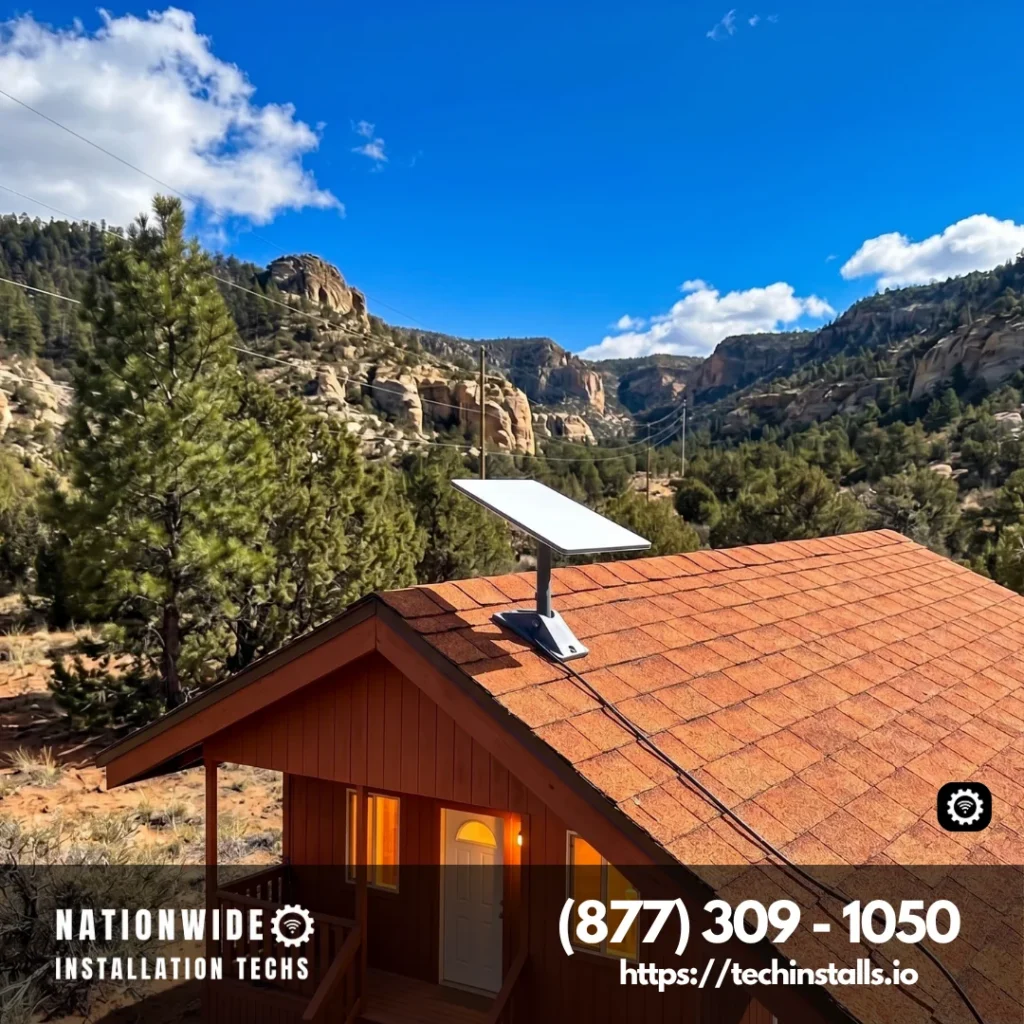
Here the first thing that takes sky is the ground itself, and it does it before anybody has looked at a single pinon.
Check your own address on speedtest.net rather than a coverage map before you decide anything. Along the interstate corridor there are wired options worth having. Up a side canyon on five acres, the picture is usually different.
The Canyon Wall Takes Sky Before Any Tree Does
A satellite terminal in the mid-northern hemisphere leans north and needs a clear cone of roughly 100 to 110 degrees on that side. In Tijeras, north is the Sandias.
That does not mean the job cannot be done. It means the job has to be sited rather than guessed at, and the answer is genuinely different from one lot to the next in a way it is not on flat ground. A house on the north side of the canyon floor, tucked against the slope, can be looking straight into rising terrain in exactly the direction the antenna wants. A house a quarter mile away with a little elevation on the south side of the canyon can have a completely clean view over the top of the same problem.
What that changes about the work:
- The survey is the job, not a formality. We look at the actual sky from the actual candidate positions, not from the driveway. On this terrain the difference between two mounting points thirty feet apart can be the difference between a clean install and an unusable one.
- Height is a real tool here and we use it carefully. Where terrain is the obstruction, a taller mast sometimes solves it and sometimes does not, because the ridge does not get shorter. We will tell you which case you are in before you spend money on hardware.
- A detached position often beats the roof. On a canyon lot the best sky is frequently not on the house at all. It is on a shed, a bank above the house or a pole set away from the building, and then the question becomes the run back, which is the next section.
- Nothing gets promised from a map. Terrain shadowing is not something a coverage map models at this resolution, and we are not going to quote a canyon lot as if it were a suburb.
Forecasters Name This Canyon First When the Wind Comes
Tijeras Canyon is a wind corridor and everybody who lives here already knows it.
When a wind event is heading for the middle Rio Grande, Albuquerque forecasters routinely call out Tijeras Canyon by name alongside the east Albuquerque foothills, with gusts commonly in the 35 to 45 mph band and isolated stronger gusts near the canyon openings. The reason is the shape of the place: a gap between two ranges accelerates whatever is trying to get through it.
So a Tijeras mount gets specified for wind in a way a valley-floor Albuquerque mount does not.
- Non-penetrating and ballasted where the roof allows it, because a ballasted mount that is properly weighted and tied to structure handles gusting better than a marginal bolted one and puts no hole in the envelope.
- Where it is bolted, it is bolted into structure. Rafter or truss, located properly, not into decking and not into stucco.
- Short, well-supported mast runs by preference. Every extra foot of mast is extra leverage at the base in a place that gusts hard, so we buy height only where the sky actually requires it.
- Cable clipped at short intervals with a proper drip loop. A cable left to move in this wind wears through its own jacket at the fixings, and it does it faster here than almost anywhere else we work.
Pinon, Juniper and Ponderosa Close Over a Site That Looked Open
Terrain is the first obstruction here. Vegetation is the second, and it behaves differently from the hardwood canopy in the eastern posts on this site.
Pinon, juniper and ponderosa are evergreen. They do not open up in winter and close in summer the way an oak or a maple does, which is genuinely good news: what you can see in February is what you will have in July, so a survey done in winter stays true. The catch is that they are dense year-round and they grow in stands rather than as individual specimens, so a screen of juniper forty feet from the house can take a wide band of low sky permanently.
The practical rules we work to on a wooded East Mountain lot:
- Low elevation angles are the ones that get lost. Trees rarely take the sky directly overhead. They take the part near the horizon, which is the part that matters for tracking satellites low in the northern sky.
- Growth gets planned for. A ponderosa that clears the sight line today will not in ten years. Where there is a choice between two positions with similar sky, we take the one with headroom.
- We do not cut your trees. That is not our trade, several of these lots back onto Cibola National Forest land, and it is not our decision to make in any case. We site around them.
Fire Country Changes Where the Cable Runs
The Cibola National Forest covers roughly 1.6 million acres and its Sandia Ranger District is headquartered here in Tijeras. Living against a national forest is the reason many people are on these lots, and it changes a couple of decisions on an install.
We are installers rather than fire officials, so we will not tell you what your defensible-space obligations are. What we will do is not make them harder:
- Cable is routed and secured, never left loose across a roof or draped through vegetation.
- Penetrations are sealed properly rather than foamed and forgotten, because a sealed entry is also a closed entry.
- Where you have cleared space around a structure deliberately, we work with it instead of running hardware back into the part of the lot you spent money clearing.
Ask your fire district about anything that touches clearance and siting near vegetation. That call costs nothing and it is the right order to do it in.
Snow, Ice and What 6,382 Feet Actually Means
The village sits at 6,382 feet and the canyon floor runs between about 5,600 and 7,000 feet, with the pass near 7,040. Elevation changes fast here, and so does what the weather does to a mount.
Snow is largely a non-issue for the dish itself, which has a melt function and clears in normal use. Snow is very much an issue for the mount and for the person servicing it, and ice is the harder case. Freezing precipitation loads the panel, the mast and the cable at once and adds it on a long lever arm.
The elevation-specific parts we plan for:
- Where meltwater goes. A mount sited above a doorway, a walkway or an entry point is a problem that only shows up on the first thaw. It gets sited somewhere else.
- Access in winter. If servicing the position would need equipment nobody keeps on a snowy mountain lot in January, that is the wrong position, and we would rather find that out in September.
- The temperature range at the bottom of the specification. Cold is the end of the operating envelope the hardware reaches for up here, not the heat.
Where a Tijeras Starlink Installer Drives, From Carnuel Out to Moriarty
A Tijeras Starlink installer covers a ring that crosses two county lines and climbs and drops several hundred feet doing it.
Close in, Cedar Crest is two miles north north east up NM-14 and Sandia Park six miles, both still Bernalillo County. Carnuel is four miles west south west down the canyon and Albuquerque itself fifteen miles west. South down NM-337, still called South 14 by people who were here before it was renumbered, Cedro is four miles and Escabosa twelve.
East the ring leaves the county. Edgewood is eleven miles east in Santa Fe County and Moriarty twenty miles east south east in Torrance County, both out on the flat once the canyon opens up. That transition matters: the same install is a terrain problem in Tijeras and an open-sky problem by the time you reach Moriarty, and the mount decisions change with it.
The drive does not change what you pay. What changes it is the work at the other end: which mount the structure requires, whether the sky needs height, how long and awkward the cable run is, and whether a second building has to be brought in. Past the ring, the rest of New Mexico is covered the same way.
A Tijeras Starlink Installer Will Ask About Your Power Setup
On an acre lot in the East Mountains, power is a real part of the conversation in a way it is not on a city street, and it comes up on most of the jobs we do up here.
The number to have in front of you is that the dish draws an average of 75 to 100 watts. That is the figure to hand to whoever does your electrical work, sizes your battery bank or specs your inverter. We are installers, not electricians, and we do not do electrical work or size systems. But we know that number gets asked for, so here is what it actually means in practice on a mountain property.
- On a generator. 75 to 100 watts continuous is small against any generator that is running a well pump, so the dish is rarely the constraint. The constraint is usually that the router and the dish both need to be on the circuit that stays live, and that is a decision made when the transfer arrangement is wired rather than afterwards.
- On solar with a battery. Here it matters, because it is a continuous draw rather than an intermittent one. A terminal that is powered around the clock is a meaningfully different load from a pump that runs for twenty minutes. Whoever sizes the bank needs the continuous figure, not a peak.
- On grid power with outages. The dish comes back by itself when power returns. The router usually does too. What does not come back is anything that needed a person to restart it, so if the connection is load-bearing, put it on the protected circuit rather than a wall socket.
- Cold weather adds draw. The melt function is a heater and it runs when it needs to, so winter consumption at 6,382 feet is not summer consumption. Anyone sizing a battery bank for an East Mountain property should be planning around the winter case.
Where the mount ends up affects this too. A pole position out away from the house has the best sky on many of these lots and the longest run back to power, and those two things pull in opposite directions. That trade-off is exactly what the on-site survey is for.
Wells, Shops and Casitas on East Mountain Acreage
Lots out here are measured in acres, and the buildings that need a connection are scattered across them. The house, a shop, a barn, a well house, a casita or a short-term rental unit, and often none of them sit where the sky is best.
Trenching an East Mountain lot is an unattractive job. Much of this ground is shallow soil over rock, so a trench that would take an afternoon in the valley becomes a week and a machine. A point-to-point wireless bridge solves the same problem with two small radios and a clear line between them, and it does not care what is under the ground.
The wrinkle here that flat-country properties do not have is that line of sight between your own buildings is not guaranteed either. On a sloping lot with tree cover, the shop can be out of sight of the house even though you can walk it in two minutes. Sometimes that is solved with height at one end, sometimes with a relay position, and occasionally the honest answer is a second dish. We will tell you which one you are looking at after we have seen it, not before.
Rental and casita situations have their own considerations, covered on the tiny homes and rural rentals page.
What Moves the Price Between Cedar Crest and Escabosa
Residential installs start at $385 and an on-site survey is $199. On this terrain the survey earns its keep more often than it does in a subdivision, because it is the difference between a quoted job and a guessed one.
What moves the figure:
- Mount type. A standard roof mount or eave mount is the base case. Non-penetrating ballasted mounts and pole mounts set away from the building cost more because they are built rather than bolted.
- Height. Occasionally the answer to terrain or to a stand of juniper, and it is priced when it is genuinely needed rather than added as a default.
- Cable run. Distance and difficulty both. A run from a detached pole position back to the house is a different job from a run down an interior wall.
- Second building. Bridge hardware at both ends plus alignment, which on a sloping wooded lot takes longer than it does on flat ground.
- Access. Steep driveways, snow and awkward working positions get priced before we start rather than discovered on the day.
Full detail is on the installation cost page. If the connection is load-bearing for a business or a rental, the backup connection page covers running a second path.
Frequently Asked Questions
Not on its own, but it is exactly why the survey matters here. A terminal in the mid-northern hemisphere leans north and needs a clear cone of roughly 100 to 110 degrees on that side, and in Tijeras north is the Sandias. The answer changes from one lot to the next in a way it does not on flat ground. A house tucked against the slope on the north side of the canyon floor can be looking straight into rising terrain in the direction the antenna wants, while a house a quarter mile away with a little elevation on the south side has a clean view over the top of the same problem.
Yes, and on this terrain we would rather. An on-site survey is $199 and it earns its keep more often here than it does in a subdivision, because it is the difference between a quoted job and a guessed one. Terrain shadowing is not something a coverage map models at this resolution, and we are not going to quote a canyon lot as if it were a suburb. We look at the actual sky from the actual candidate positions rather than from the driveway, and thirty feet between two mounting points can decide the whole job.
Yes, and it is the main thing separating a Tijeras mount from a valley-floor Albuquerque one. When a wind event is heading for the middle Rio Grande, Albuquerque forecasters routinely call out Tijeras Canyon by name alongside the east foothills, with gusts commonly in the 35 to 45 mph band and stronger near the canyon openings. A gap between two ranges accelerates whatever is trying to get through it. So we favour non-penetrating ballasted mounts where the roof allows, bolt into structure rather than decking or stucco where it does not, and buy mast height only where the sky genuinely requires it.
No. We do not cut your trees, it is not our trade, several of these lots back onto Cibola National Forest land, and it is not our decision to make. We site around them. The useful thing about pinon, juniper and ponderosa is that they are evergreen, so unlike the hardwood country further east, what you can see in February is what you will still have in July and a winter survey stays true. The catch is they are dense year round and grow in stands, so a screen of juniper forty feet out can take a wide band of low sky permanently.
Usually a point-to-point wireless bridge, and it is a better answer than trenching because much of this ground is shallow soil over rock, so a trench that takes an afternoon in the valley becomes a week and a machine. The wrinkle here that flat-country properties do not have is that line of sight between your own buildings is not guaranteed either. On a sloping lot with tree cover the shop can be out of sight of the house even though you can walk it in two minutes. Sometimes that is height at one end, sometimes a relay position, and occasionally the honest answer is a second dish.
It changes a couple of decisions, and it is the reason many people are on these lots. The Cibola National Forest covers roughly 1.6 million acres and its Sandia Ranger District is headquartered here in Tijeras. We are installers rather than fire officials, so we will not tell you what your defensible-space obligations are. What we will do is not make them harder: cable routed and secured rather than left loose across a roof or draped through vegetation, penetrations sealed properly rather than foamed and forgotten, and we work with cleared space instead of running hardware back into it. Ask your fire district about anything touching clearance.
Snow is largely a non-issue for the dish, which has a melt function and clears itself in normal use. Snow is very much an issue for the mount and for whoever has to service it, and ice is the harder case because freezing precipitation loads the panel, the mast and the cable at once on a long lever arm. At 6,382 feet the elevation-specific parts are where meltwater goes, so a mount above a doorway or a walkway gets sited somewhere else, and winter access, because if servicing the position needs equipment nobody keeps on a snowy mountain lot in January, that is the wrong position and we would rather find out in September.
Some do and some do not, and both are reasonable. Along the interstate corridor and in the built-up parts of the canyon there are wired options worth having, which is why we tell people to check their own address on speedtest.net rather than a coverage map. The ones who switch usually do it over price, over how an outage gets handled, or because they want a second line that does not fail for the same reasons. The picture changes again as soon as you are up a side canyon on five acres. Bernalillo County runs an East Mountain broadband programme precisely because coverage past the corridor is uneven, and that unevenness is measured in hundreds of feet here rather than miles.
About Nationwide Installation Techs
Nationwide Installation Techs LLC is a professional, insured satellite installation company operating in all 50 states, with over 3,000 installations completed and a 4.9-star Google rating from 90+ reviews. Our experienced technicians cover residential, commercial, RV and marine installations, along with mesh networking, point-to-point bridges and on-site repair. We are an independent installer: you own your hardware and hold your own service account, and our crews handle the mounting, sealing and setup.
Serving Tijeras, Bernalillo County and the rest of New Mexico, plus every other state listed on our locations we serve page. Call (877) 309-1050.
Contact a Tijeras Starlink Installer
Nationwide Installation Techs LLC
- Phone: (877) 309-1050
- Email: support@techinstalls.io
- Free Quote: Contact Us Form
Connectivity News & Updates

Residential Starlink Installation — Nationwide and Insured
Residential Starlink installation starting at $385, nationwide. Nationwide Installation Techs...

Expert Starlink Installation for Yachts and Boats
Starlink installation for yachts and boats, nationwide. Nationwide Installation Techs...

Albuquerque Starlink Installer — Same-Day Service When Your Kit Is On Site
Albuquerque Starlink installer, Nationwide Installation Techs, (877) 309-1050. Professional, insured...

Professional Starlink Installation for Cars and Trucks
Starlink installation for cars and trucks, nationwide. Nationwide Installation Techs...
Disclaimer: Nationwide Installation Techs LLC is an independent business and has no affiliation or official connection with Starlink, SpaceX, or any of their subsidiaries or affiliates. We are not associated with, authorized, endorsed, or sponsored by these companies in any capacity. For official information, please visit the Starlink and SpaceX websites at www.starlink.com and www.spacex.com. The names “Starlink,” “SpaceX,” and any related trademarks, logos, or imagery are the exclusive property of their respective owners.
Any references to “certified” or “certification” on this website refer exclusively to Nationwide Installation Techs LLC’s proprietary in-house technician certification program. This training and certification process was developed by our company based on the experience and installation methods of professional technicians who have collectively completed more than 3,000 successful Starlink installations while maintaining an overall 4.9-star customer review rating. It is not affiliated with, issued by, approved by, or endorsed by Starlink, SpaceX, or any of their affiliates.