

Clearwater Starlink installer, Nationwide Installation Techs, (877) 309-1050. Professional, insured technicians serving Clearwater, Florida and Pinellas County. If your kit is already on site, same-day service is often available. Residential installs start at $385. 4.9-star Google rating from 90+ reviews.
Clearwater is the county seat of Pinellas County, and it sits on the Pinellas peninsula with Old Tampa Bay on one side and the Gulf of Mexico a short causeway away on the other, and the barrier island out front narrows to well under a mile in places. That geography is the whole story here. A downtown Clearwater address near the bay is a different job from a beach address on the barrier island, and both are different again from a stucco block a few miles inland toward the middle of the county.
Pinellas itself is one of the smallest counties in Florida by land area and one of the most densely built, which means fewer wide-open acreage lots and a lot more roofs packed close together: tile roofs, condo towers, HOA-governed neighborhoods, and mobile home communities filling in the gaps between them. None of that rules out a clean install. It does mean the right answer changes block by block, and it is worth reading before anyone books a ladder. Check your own address on speedtest.net before you assume anything about coverage in Clearwater. Most of the county already has solid wired options, so satellite is rarely about a total lack of service here. What actually brings people to us is different: a beach condo where cable was never wired past the lobby, a rental that changes tenants every season, a mobile home community where the park’s own internet is slow and shared, a vacation house that sits empty from May through October, or simply a homeowner who wants a second connection that keeps working if the first one drops during a summer storm.
Clearwater Beach Is an Island, and the Roof Job Reflects It
Clearwater Beach and the rest of the barrier strand it sits on are not an extension of the mainland with better views. The island is connected to downtown Clearwater by the Memorial Causeway crossing Clearwater Harbor, and it continues south past the Clearwater Pass Bridge onto Sand Key, a separate strip of barrier land running toward Belleair and beyond. Everything built out there sits in salt air full time, and salt air is a materials problem before it is anything else. Steel fasteners that would last decades a few miles inland can show surface corrosion within a couple of years on the island, and a mount that is not rated for a marine environment is the wrong mount, full stop.
On a barrier island install we use stainless or marine-grade hardware throughout, not as a nice extra but because ordinary galvanized fasteners are the wrong material choice this close to open salt water. The same logic applies to the cable entry and the sealant: a method that is adequate on a mainland roof a few miles inland needs to hold up to a different chemical environment out on the beach.
Wind is the second half of the story. Anything built on Clearwater Beach or Sand Key answers to the Florida Building Code’s high-wind provisions, and fasteners, mount selection and penetration sealing all get treated more conservatively than they would on a lower-exposure inland job. That is standard Florida coastal construction practice, not a special island rule, but it does mean the mast height and mount choice we would use on a quiet inland cul-de-sac are not automatically the right call two miles away on the sand.
Clearwater Harbor, between the mainland and the island, is also full of docked boats and working marinas, and if you are asking about a boat rather than a house, that is a marine install with its own separate mount discipline. Tell us which one you mean when you call, since the two are not interchangeable jobs.
None of this makes an island install harder to book, only different in what we take seriously. Tell us up front that the address is on Clearwater Beach or Sand Key rather than the mainland side of the causeway, and we bring the right hardware the first time.
Barrel Tile Is the Default Roof Here, and We Never Screw Into One
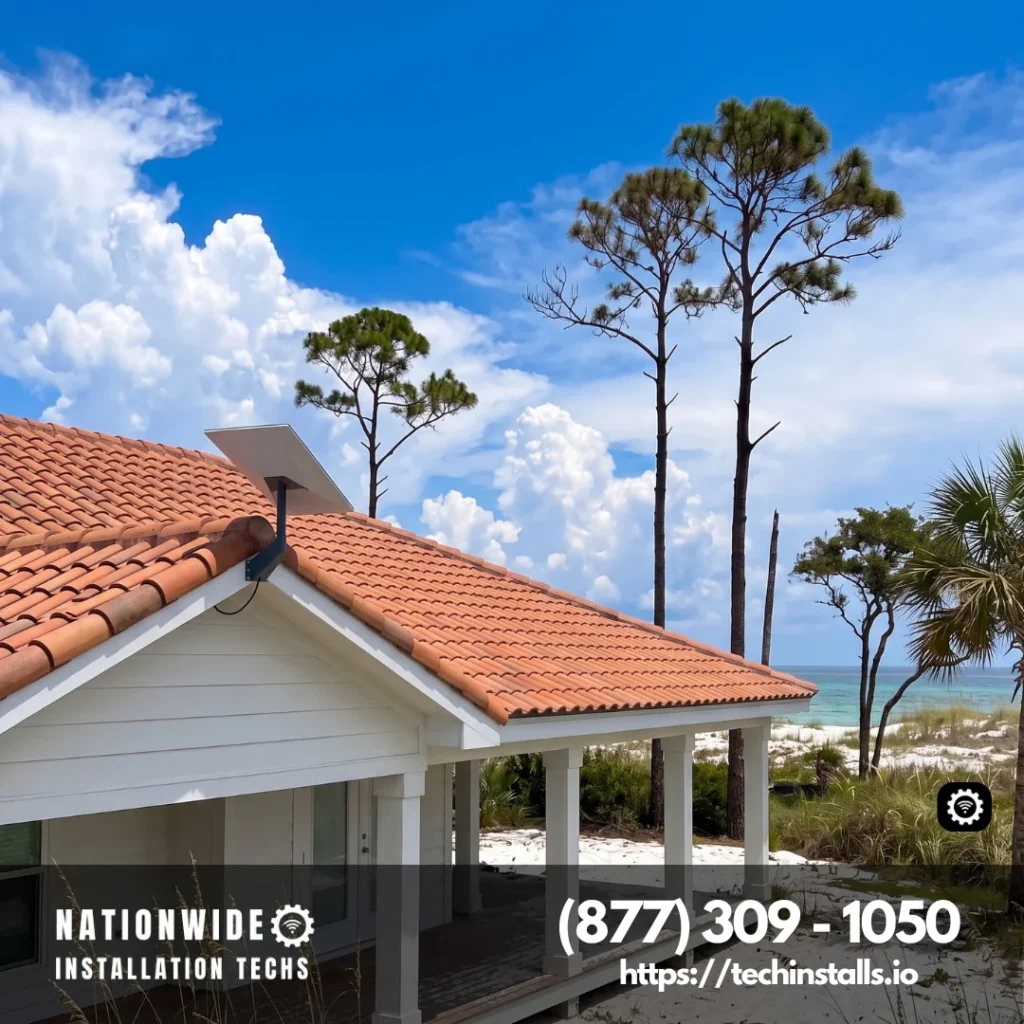
Walk almost any newer subdivision in Pinellas County and the roof over your head is concrete or clay barrel tile, not shingle. It is one of the most common roofs here and the default in newer subdivisions, and it is also the one roof type our written install standard has no mounting method for. That is deliberate. Drilling or screwing through a tile roof cracks tile that is expensive to match and hard to source in an exact profile, and a broken tile is a leak waiting for the next thunderstorm. We do not do it, and any installer who tells you they can screw a mount straight through your barrel tile without touching the tile itself is describing something our own documented standard does not include.
The honest answer on a tile roof is one of three mounts that never contact the tile at all. Where the roof has a flat section, such as over a lanai extension or a garage wing, a ballasted non-penetrating mount sits on that flat area, held down by weight rather than fasteners, with nothing driven into the tile or the deck beneath it. Where the roof is a simple gable, a gable-end wall mount goes into the vertical wall framing at the peak instead of the roof plane, keeping the tile completely untouched. And on many Clearwater houses the cleanest option is an under-eave wall mount, reaching up past the fascia board into solid framing below the roofline, again with zero contact with the tile above.
Which of the three fits your house depends on the roof shape and where the clear sky actually is, and that is exactly what the free virtual site survey is for. We would rather spend ten minutes looking at photos of your roof before quoting than show up to a tile roof with the wrong plan already assumed.
Condos and HOAs Decide Before We Ever Show Up
A large share of Clearwater’s housing, especially anywhere near the water, is a condominium rather than a single-family house, and Pinellas County as a whole carries one of the highest shares of condo and multi-family housing stock in Florida. That changes the order of operations completely compared with a standalone home. On a single-family house, the homeowner can say yes and we can be on the roof the same week. On a condo building, the roof, the exterior walls and often even the balcony railing belong to the association, not to the unit owner, and no technician should be putting a mount on any part of that structure without the board’s written sign-off.
We ask for that approval before we schedule, not after. Some Clearwater and beach-area associations already have a standard Starlink or satellite dish policy on file, in which case the process is quick. Others have never been asked and need to review it board-meeting to board-meeting, which can take longer than a homeowner expects. Either way, get the request in early rather than waiting until the kit arrives.
Where the board allows a mount on a private balcony rail or a ground-floor patio rather than the roof or building exterior, that is often the fastest path to approval, since it does not touch common elements at all. We can quote either version once we know what your specific association will actually permit. If you manage several units in the same building or complex, one written standing approval for the property saves everyone from repeating this conversation unit by unit.
Manufactured and Mobile Home Communities Need a Different Read on the Roof
Inland from the beaches, a significant part of Pinellas County’s housing stock is manufactured or mobile homes, often inside age-restricted communities with their own private roads and their own rules. These roofs are a genuinely different structure from either a stick-built house or a condo tower, and treating a manufactured home roof like a standard asphalt shingle roof is how installers end up with a mount that is not actually secure.
A manufactured home roof is typically a thinner deck over lighter framing than a site-built house, and it was not engineered to carry the same point loads. Before anything goes on the roof, we check what is actually underneath: the truss spacing, the decking material, and whether the structure can take a roof-mounted pivot mount at all. On many manufactured homes, a ground mount set on its own post clear of the home, or a mount on a carport or shed with sturdier framing, is the more sensible choice than putting additional weight or a penetration on the home’s own roof.
Community rules add a second layer. Most manufactured home communities in Pinellas have a park management office or a homeowners’ association that reviews exterior additions, and a satellite mount is exactly the kind of change that gets flagged if it was not cleared first. As with condos, get that approval lined up before we schedule the visit. Tell us when you call that the property is a manufactured or mobile home so we can plan for a ground or outbuilding mount as the default rather than assuming a roof penetration.
A Lot of Clearwater Sits Empty for Half the Year
Pinellas County has one of the largest seasonal populations on Florida’s Gulf Coast, and Clearwater gets a heavy share of it. Condos and houses that are full of activity from November through April sit closed up and empty for the rest of the year, and that changes how a Starlink install actually gets scheduled here compared with a market where every address is occupied year-round.
The practical problem is straightforward: a technician cannot survey a roof properly from a phone call with an owner who is a thousand miles away and will not be back for months. That is exactly what the free virtual site survey solves. We can review photos and a short video of the roof and the surrounding sightlines that a property manager, a neighbor, or the owner captures on a visit before the season starts, and have the mount, the mast height and the cable run planned out before the owner ever gets off the plane. When they do land, the install can happen in the first week rather than waiting for a second trip out to figure out what the job even needs.
The same pattern works in reverse at the end of the season. If you are closing up a Clearwater property for the summer and want the dish removed, capped, or the mount left in place for next winter, say so when you call. We would rather plan around a seasonal schedule than have a mount or a cable run sitting exposed and unattended for months for no reason.
Plenty of Clearwater’s seasonal residents arrive in a coach rather than to a fixed address, and that is a different install with its own mount and power discipline: RV Starlink installation covers the rig itself, and Starlink installation for cars and trucks covers a tow vehicle or daily driver.
Pinellas Follows Standard Florida Wind Code, Not the High-Velocity Hurricane Zone
It is worth being precise about this because a lot of Starlink content online is not. Florida’s High-Velocity Hurricane Zone, the strictest wind-resistance standard in the state’s building code, applies only to Miami-Dade and Broward counties. Pinellas County, including Clearwater, is not in that zone. That does not mean wind is not a real consideration here; it means the correct standard is the statewide Florida Building Code’s standard high-wind provisions rather than the tougher HVHZ rules that apply roughly two hundred miles south of us.
In practice, that means fastener selection, mount anchoring and penetration sealing all follow the wind-rated methods the Florida Building Code specifies for this part of the state, scaled to the exposure of your specific roof: a beachfront property on Clearwater Beach faces a different wind exposure than a house set back on an inland lot, even though both fall under the same statewide code. We size the mount and the fastening pattern to the job in front of us rather than applying one blanket standard to every address.
What we will not do is describe Pinellas County as HVHZ territory to make an install sound more rigorous than it needs to be, or apply HVHZ-specific requirements that legally do not apply here. The standard Florida high-wind approach, done correctly, is the right amount of caution for a Clearwater roof. Getting the classification wrong in either direction, treating it as unregulated or treating it as HVHZ, is the kind of detail that separates an installer who has actually read the code from one who is guessing.
What the Quote Covers, the Refusals We Stand By, and What Moves the Number
Residential installs start at $385. What moves the number from there is the same in Clearwater as anywhere else: which of the mount types your roof actually needs, how much mast height the site calls for, how long the cable run has to travel to reach the router, and whether a second building, a boat, or a detached casita needs its own coverage. A free virtual site survey reads the sky over your specific roof before anyone quotes a number. An on-site survey is $199 if you would rather have someone physically at the property first, which is often the right call on a condo roof or a beach property where photos alone do not tell the whole story.
You will have the figure before any work starts, and the price does not change because your address happens to be on the island rather than the mainland side of the causeway. What a Starlink install actually costs is broken down in full elsewhere on the site if you want the detail before you call.
- We do not drill barrel tile, ever. A ballasted, gable-end wall or under-eave wall mount is used instead, and one of those three fits nearly every tile roof in Pinellas County.
- We do not drill metal roofs. A non-penetrating mount is used instead, the same rule as everywhere else we work.
- We do not put a mount on condo common elements without the association’s written approval on file first.
- We do not do roof repair. If the deck underneath is soft or the roof is due for replacement, get that done first.
- We do not do electrical work or size a solar setup. We can tell you the dish draws 75 to 100 watts so you can hand that number to whoever does.
- We do not sell the Starlink service plan or open the account for you. You own the hardware and hold the account; we handle the mount, the seal and the cable run.
Clearwater Starlink Installer: Frequently Asked Questions
Barrel tile is the roof we see most often in Clearwater, and our written install standard has no method for screwing or drilling through it, so we don’t. Instead we use one of three mounts that never touch the tile: a ballasted non-penetrating mount on a flat section of roof, a gable-end wall mount that anchors into the wall framing at the peak instead of the roof plane, or an under-eave wall mount that reaches past the fascia into solid framing below the roofline. Which one fits depends on your roof’s shape and where the clear sky actually is, which is exactly what the free virtual site survey figures out before we quote a number.
Usually, yes. On a condo, the roof and exterior walls are common elements that belong to the association, not to your unit, so we need the board’s written sign-off before we put anything on the building itself. Some Clearwater Beach associations already have a policy on file for satellite equipment, which speeds things up considerably; others need to review the request at a board meeting, which takes longer. If your unit has a private balcony rail or a ground-floor patio the board allows equipment on, that route often avoids the roof and common-element question entirely. Start the approval process before your kit arrives so scheduling isn’t held up waiting on paperwork.
It can, but we check first rather than assuming. Manufactured home roofs are built lighter than a site-built house, with thinner decking and different truss spacing, and they were not engineered to carry the same point loads as a shingle or tile roof. In a lot of cases the better answer is a ground mount on its own post clear of the home, or a mount on a carport or shed with sturdier framing, rather than adding weight and a penetration to the home’s own roof. Tell us up front that it’s a manufactured or mobile home, and mention any community rules about exterior additions, so we can plan the right mount before the visit rather than during it.
Yes, and this is a common situation in Clearwater given how many properties here are seasonal. We can run the free virtual site survey remotely using photos or a short video of the roof that you, a property manager, or even a neighbor captures ahead of time, so the mount type, mast height and cable run are already planned before you land. When you do arrive in January, the install itself can often happen within the same week instead of needing a second visit just to figure out what the roof needs. If you’re closing the property up for the off-season instead, tell us that too and we can plan the removal or the next season’s reinstall around your schedule.
Yes, and we account for it on every barrier island and near-coast job. Ordinary galvanized fasteners corrode faster in salt air than they do a few miles inland, so on Clearwater Beach, Sand Key and other close-to-the-water addresses we use stainless or marine-grade hardware throughout the mount and cable entry rather than standard fasteners. The sealant and cable management get the same treatment. It’s a small difference in materials at install time that avoids a corroded, failing mount a couple of years down the line, which is a much bigger problem to fix after the fact than to plan for up front.
No. Florida’s High-Velocity Hurricane Zone is the state’s strictest wind code, and it applies only to Miami-Dade and Broward counties, not to Pinellas. Clearwater falls under the standard Florida Building Code’s high-wind provisions instead, which is still a real, meaningful standard, just not the HVHZ one. In practice that means we choose fasteners, mount anchoring and sealing methods rated for this region’s wind exposure, scaled to your specific site, whether that’s a beachfront address or a house further inland. We won’t tell you HVHZ rules apply here when they don’t, and we won’t under-build the mount either; the correct standard Florida wind-code approach is what actually applies.
No, and it’s important to say that clearly rather than blur the two. A house install and a boat install use different mount hardware and a different approach entirely, because a boat moves, vibrates and deals with a much harsher marine environment than a fixed roof ever does. If you keep a boat at a marina on Clearwater Harbor or anywhere else in the area, tell us it’s a marine install when you call so we quote the right hardware and technique from the start. We do both residential and marine work, but they are genuinely separate services with separate pricing, not the same job in a different location.
The core difference is materials and wind exposure, not the install process itself. Everything on Clearwater Beach and Sand Key sits in full-time salt air, so we use stainless or marine-grade hardware there instead of standard fasteners, and wind-rated mounting gets applied a little more conservatively given the closer exposure to open water. A mainland Clearwater address a few miles from the coast is usually a more straightforward job by comparison. Both get the same $385 starting price and the same free virtual site survey beforehand; tell us which side of the Memorial Causeway your address is on when you call so we bring the right hardware the first time.
About Nationwide Installation Techs
Nationwide Installation Techs LLC is a professional, insured satellite installation company operating in all 50 states, with over 3,000 installations completed and a 4.9-star Google rating from 90+ reviews. Our experienced technicians cover residential, commercial, RV and marine installations, along with mesh networking, point-to-point bridges and on-site repair. We are an independent installer: you own your hardware and hold your own service account, and our crews handle the mounting, sealing and setup.
Serving Clearwater, Pinellas County and the rest of Florida, plus every other state listed on our locations we serve page. Call (877) 309-1050.
Contact a Clearwater Starlink Installer
Nationwide Installation Techs LLC
- Phone: (877) 309-1050
- Email: support@techinstalls.io
- Free Quote: Contact Us Form
Connectivity News & Updates

Orlando Starlink Installer — Same-Day Service When Your Kit Is On Site
Orlando Starlink installer, Nationwide Installation Techs, (877) 309-1050. Professional, insured...

Residential Starlink Installation — Nationwide and Insured
Residential Starlink installation starting at $385, nationwide. Nationwide Installation Techs...

Expert Starlink Installation for Yachts and Boats
Starlink installation for yachts and boats, nationwide. Nationwide Installation Techs...

Clearwater Starlink Installer — Same-Day Service When Your Kit Is On Site
Clearwater Starlink installer, Nationwide Installation Techs, (877) 309-1050. Professional, insured...
Disclaimer: Nationwide Installation Techs LLC is an independent business and has no affiliation or official connection with Starlink, SpaceX, or any of their subsidiaries or affiliates. We are not associated with, authorized, endorsed, or sponsored by these companies in any capacity. For official information, please visit the Starlink and SpaceX websites at www.starlink.com and www.spacex.com. The names “Starlink,” “SpaceX,” and any related trademarks, logos, or imagery are the exclusive property of their respective owners.
Any references to “certified” or “certification” on this website refer exclusively to Nationwide Installation Techs LLC’s proprietary in-house technician certification program. This training and certification process was developed by our company based on the experience and installation methods of professional technicians who have collectively completed more than 3,000 successful Starlink installations while maintaining an overall 4.9-star customer review rating. It is not affiliated with, issued by, approved by, or endorsed by Starlink, SpaceX, or any of their affiliates.