

Albuquerque Starlink installer, Nationwide Installation Techs, (877) 309-1050. Professional, insured technicians serving Albuquerque, New Mexico and Bernalillo County. If your kit is already on site, same-day service is often available. Residential installs start at $385.
Albuquerque sits at roughly 5,300 feet with a mountain range for an eastern wall, a river and a cottonwood forest running down the middle of it, and an open volcanic mesa on the west side that is mostly sky. Those three facts are the entire install briefing. A Bernalillo County address can mean a flat-roofed Pueblo Revival house near the Country Club with a parapet and a sprayed foam roof, a pitched-shingle tract house on the Westside with nothing between it and the horizon, or a half acre in the South Valley under cottonwoods that were already old when the ditch beside them was lined. The hardware is identical on all three. Very little else is.
Run your own street address on speedtest.net before you decide anything, because service here is not uniform and a coverage map will not tell you which side of the line your block sits on. Plenty of Heights and mid-city addresses do perfectly well. What brings people to us is the valley lots where the wired options thin out, the properties whose roofs cannot take a conventional mount at all, the acreage east and south of the metro, and the second connection that stays up when the first one does not.
Flat Roofs, Adobe Walls and What Albuquerque Gives Us to Bolt To
Most American cities hand an installer a pitched shingle roof and a stud wall. Albuquerque frequently hands us neither. Pueblo Revival and Territorial styling dominate large parts of the older city, and the defining feature of both is a flat or very low-slope roof behind a parapet. On top of that deck is usually built-up tar and gravel, sprayed polyurethane foam under an elastomeric coating, or a single-ply membrane.
On foam and on membrane, the answer is a ballasted non-penetrating mount, and it is not a compromise. A foam roof fails at one thing above all others: something driven through the coating. Put a fastener through it and you have not mounted a dish, you have started a leak that will find you in July. A ballasted mount holds itself down with weight rather than fasteners, so the roof stays sealed exactly as the roofer left it. On a parapeted house it also tends to sit below the roofline from the street, which solves a second problem for free.
Flat roofs move water sideways. An Albuquerque roof drains through canales, and those spouts and the paths feeding them are not negotiable real estate. We keep the mount base and the cable run clear of the drainage path, because anything sitting in it becomes a small dam, and a small dam on a flat roof in a monsoon downpour is how ponding starts.
The walls are their own question. Stucco here can be over stud framing, over block, or over genuine adobe, and the three behave nothing alike under an anchor, so we establish what is behind the finish before anything is drilled. Where there is solid framing to bite into — a rafter tail, a fascia board, a portal beam — a standard wall mount or an under-eave wall mount is straightforward. Where the wall is true adobe with nothing structural to anchor to, we do not force it and we do not improvise. The flat roof is generally right above that wall anyway.
The newer half of the metro is the ordinary half. Westside subdivisions, Ventana Ranch, Volcano Cliffs and most of Rio Rancho are pitched composition shingle over a clean deck, which is a pivot roof mount into rafters, sealed properly, with a short cable run. If you want to know what we check before anything goes on a roof before we quote, that is written up in full.
Fifty-Three Hundred Feet of Dry Air, Hard Sun and a July Monsoon
Elevation is not trivia here, it is a materials problem. The valley floor runs a little under 5,000 feet, the airport sits near 5,300, and the foothills climb well past 6,000. Thinner atmosphere means measurably more ultraviolet reaching the roof, and Albuquerque adds a great many clear-sky days and single-digit humidity for months at a stretch.
Metal does not care. Everything else does. Cable jacketing chalks and then goes brittle, cheap sealant shrinks back from the edge of a penetration, and hardware-store zip ties turn to confetti in about two seasons. A run that would quietly last a decade in a humid climate does not get a decade here, and the failure is almost never the dish or the mount. It is the foot of jacket left flapping in the sun.
So the discipline is unglamorous and it matters more here than almost anywhere we work. Keep the exposed run short, secure it at close intervals so it is not flexing every time the wind gets up, enter the building at a protected point rather than the nearest one, and seal any penetration with the right product rather than whatever is on the truck.
Then there is the monsoon. From roughly July into September the moisture arrives from the south and the afternoons turn violent in a hurry: outflow wind ahead of the rain, then half an inch in twenty minutes onto a city that averages somewhere around nine inches for the whole year. Nothing about that is gentle, and it finds every shortcut. An under-sealed base and a cable lying loose across a flat roof are both exposed on the first serious storm afternoon.
Spring is the other season to plan around: March through May brings sustained wind and blowing dust off the mesa, which is hard on anything not properly restrained. A mount that was anchored and sealed correctly does not move for any of it.
The Bosque Cottonwoods Are the Valley's One Real Obstruction
The Rio Grande runs north to south through the middle of Albuquerque, and along it stands the bosque: a continuous ribbon of Rio Grande cottonwood that is genuinely a forest, in a county that is otherwise high desert. Those trees get very tall and very wide, and they are the only vegetation in this metro that reliably decides an install.
On the mesa and up in the Heights, landscaping is mostly desert willow, ash and juniper on small lots and it rarely costs us anything. In the North Valley, Los Ranchos, Alameda and across the South Valley it is a different scale entirely, and the acequias are part of why: the irrigation ditches that have run through these lots for generations are exactly where the oldest cottonwoods stand, so the tree line follows the water rather than the property line.
Here is the part that reverses most people’s assumptions. The dish looks north. A hundred-year-old cottonwood on the south side of your lot will very often cost you nothing at all, while a much smaller tree on the north side ends the conversation about that roof entirely. Homeowners who walk their own yard and conclude it is hopeless are frequently looking at the wrong trees.
One trap specific to the bosque: cottonwoods are deciduous. A survey done on a clear January afternoon can read beautifully and then fail in June when the canopy fills in. We plan for the tree in full leaf, not the bare one, which is precisely why the free virtual survey is worth doing before anyone books a truck.
Where the house genuinely cannot see north, the outbuilding usually can. Valley properties tend to come with a shop, a detached garage, a barn or a casita, and one of them is normally clear of the canopy. The dish goes there and the connection comes back to the house over a point-to-point wireless bridge. On a treed valley acre that is a far better answer than fighting the canopy from the main roof.
The Sandias Sit East, the Dish Looks North, and the Crest Is Its Own Job
The Sandia Mountains rise to 10,678 feet at the crest and they go up almost straight from the eastern edge of the city, better than a mile above the valley floor. They are the first thing anyone notices about Albuquerque and the first thing customers worry about on the phone.
They should worry less. The dish looks north. A range that spectacular sitting a few miles due east of your back fence is very rarely in the part of the sky that matters, which is why foothills addresses in Sandia Heights, High Desert, Glenwood Hills and Four Hills survey clean far more often than their owners expect. What slows those jobs is the ground rather than the sky: steep lots, retaining walls and ladder placement that has to be thought about rather than assumed.
East of the crest is a different proposition and we would rather say so plainly than pretend otherwise. Elevation climbs, the vegetation turns to piñon, juniper and ponderosa instead of cottonwood, snow and sustained wind become design inputs rather than weather, and a real share of properties run on well pumps and their own power rather than a utility connection. We cover all of it on the same terms, but it is a different survey and a different conversation, and we have written the East Mountains up separately for exactly that reason.
The practical version for anyone on the mountain side of the county: tell us about your power before we quote, not after. The dish draws 75 to 100 watts continuously, unremarkable on a utility panel and a significant number on a battery bank feeding a well pump.
Balloon Fiesta Season and Kit That Has to Move
Every October the Balloon Fiesta puts a temporary city on the north end of Albuquerque, and a large share of it arrives on wheels. Motorhomes, fifth wheels and travel trailers fill the Fiesta grounds and every park with a spare hookup from Bernalillo down to Los Lunas, and most of those rigs want a working connection rather than a hunt for a signal.
A rig is not a house and the install is not the same one. The mount has to be bolt-anchored so it stays where it was put at highway speed, the cable entry has to respect a roof that flexes, and the power plan matters far more than it does on a building, because 75 to 100 watts drawn continuously is a real load on a battery bank and an inverter. That is a specific discipline and RV Starlink installation is written up on its own page.
Work vehicles are quieter but steadier business here. Albuquerque is where I-25 and I-40 cross, and crews stage out of this city to run west toward Grants, east into the Estancia Valley and south down the river, all of it country where cell coverage thins fast. Surveyors, contractors, film units and ranch trucks ask the same question, and Starlink installation for cars and trucks is a different job again from either a house or a motorhome.
One practical note for anyone passing through. A lot of our calls are people with four days in town and a kit already in the vehicle, and if the hardware is on site, same-day is often genuinely possible. October is the obvious exception, so book ahead of Fiesta week rather than during it.
An Albuquerque Starlink Installer Covers Bernalillo County and the Ring Around It
Across the city we work everywhere: Downtown and Old Town, the Country Club and Huning Castle streets, Nob Hill and the University area, Uptown and the Northeast Heights, Four Hills, and the whole Westside from Taylor Ranch and Paradise Hills out through Ventana Ranch and Volcano Cliffs.
Around it, the unincorporated county is much of our work: the North Valley, Los Ranchos de Albuquerque, Alameda and the South Valley down to the county line.
The ring past the county line is the same job on the same terms. North into Sandoval County through Corrales, Rio Rancho, Bernalillo, Placitas and Algodones. South into Valencia County through Bosque Farms, Peralta, Los Lunas and Belen. Rio Rancho and the mesa subdivisions in particular are the easiest sightlines in this metro — graded lots, young landscaping and open sky in the direction that counts — and those jobs are usually quick.
The drive does not change the price, and the rest of New Mexico is covered on exactly the same basis.
What the Quote Covers, What Moves It, and the Work We Turn Down
Residential installs start at $385. What moves the number is the work itself: which mount your roof requires, whether the site needs a taller mast, how long and awkward the cable run is, and whether a second building has to come onto the connection.
A virtual site survey is free and reads the sky over your own roof before anybody gets on a ladder. An on-site survey is $199 if you want a technician at the property first, which on a valley acre with three outbuildings and a canopy, or a foam roof of uncertain age, is frequently money well spent. Typical scheduling runs around 72 hours, and when the kit is already at the property same-day is often available.
You will have the figure before any work starts. We do not quote from the roof, and the drive out to Placitas or down to Los Lunas does not get added to it. We carry general liability insurance and our technicians are experienced and insured. We are an independent installer: you own the hardware and you hold the Starlink account, and what we sell is the install. What a Starlink install actually costs is broken down in full elsewhere on the site.
The other half of an honest quote is the work we decline:
- We do not drill metal roofs. Not on a house, not on a shop, not on a barn, not for a discount. Our written standard is that we never drill into a metal roof and use a non-penetrating mount instead, and that is what happens.
- We do not drill sprayed foam or single-ply membrane either. Same reasoning, and it comes up far more often in Albuquerque than metal does. Ballast it and the roof stays sealed.
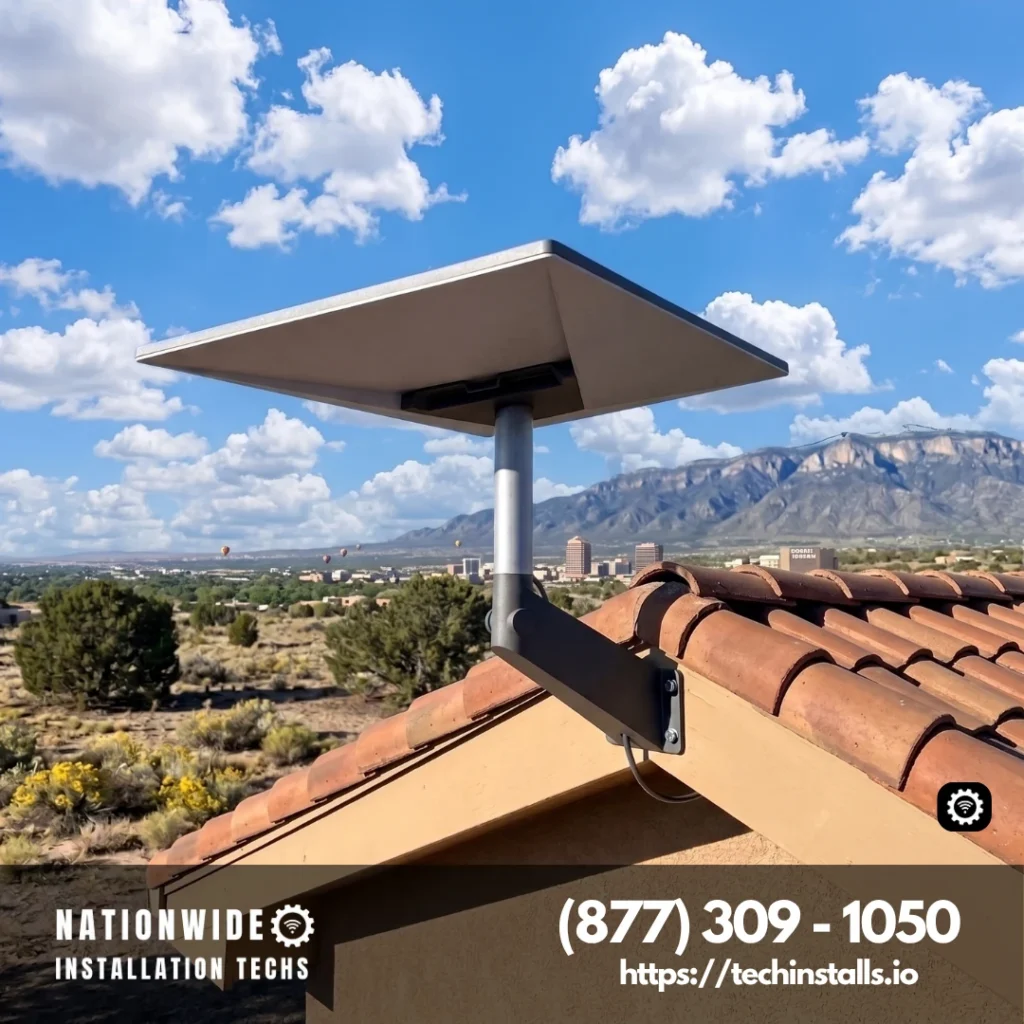
- We do not mount to slate or clay tile. Our standard documents five mounts and none is for those roofs. On tile the honest options are a ballasted non-penetrating mount, a gable-end wall mount or an under-eave wall mount. Anyone offering something else is improvising.
- We do not do roof repair. If the deck is soft, or a foam coating is at the end of its life and due for a recoat, get that done first and call us afterwards.
- We do not do electrical work or size your solar array. We will tell you the dish draws 75 to 100 watts so you can hand that number to whoever does, and our part of it stops there.
- We do not sell you the Starlink service plan or open the account. You own the hardware and hold the account. We handle the install.
- We will not drill a roof on a tenant’s say-so. If you rent, written permission from the owner comes first and we will need to see it.
Frequently Asked Questions
Yes, and not putting a hole in it is the entire point. Sprayed foam roofs are everywhere in Albuquerque and they fail at one thing above all others: something driven through the coating. So on foam, and on single-ply membrane, we use a ballasted non-penetrating mount that holds itself down with weight rather than fasteners, and the roof stays sealed exactly as your roofer left it. On a parapeted house it usually ends up below the roofline from the street as well. Tell us the roof is foam when you call, and roughly how old the coating is, and we will quote it that way from the start.
No. The dish looks north and the Sandias are east, so a range rising to 10,678 feet a few miles off your back fence is spectacular and almost never in the part of the sky we care about. Foothills addresses in Sandia Heights, High Desert, Glenwood Hills and Four Hills survey clean far more often than their owners expect. What does add time on those lots is the ground rather than the sky: steep grades, retaining walls and ladder placement that has to be worked out rather than assumed. We will flag that on the virtual survey.
Usually, yes, and the direction is the reason. The dish looks north, so a hundred-year-old cottonwood on the south side of the lot often costs you nothing while a much smaller one on the north side is the tree that decides it. That is the opposite of the conclusion most people reach walking their own yard. One warning specific to the bosque: cottonwoods are deciduous, so a survey done in January can read clean and then fail in June once the canopy fills in. We plan for the tree in full leaf, and where the house cannot see north a shop or detached garage usually solves it.
No, not a mount that was installed properly. What the monsoon punishes is shortcuts. From July into September the afternoon storms arrive with outflow wind ahead of the rain and can drop half an inch in twenty minutes onto a city that averages around nine inches for the entire year, so an under-sealed penetration and a cable lying loose across a flat roof both get found out fast. Very heavy rain can soften throughput briefly while the cell is directly overhead, and that clears on its own. Anchored and sealed correctly, the hardware itself does not move.
Yes, and it shows in the non-metal parts first. Above five thousand feet, with very low humidity and a great many clear-sky days, ultraviolet and dryness go after cable jacketing, sealant and cheap plastic hardware long before they touch a mount. Jacketing chalks and then goes brittle, budget sealant shrinks back from the edge of a penetration, and hardware-store zip ties give up in a couple of seasons. So we keep the exposed run short, secure it at close intervals so it is not flexing in the wind, and seal with the correct product.
Not directly, no. Stucco in this city can be over stud framing, over block, or over genuine adobe, and those three behave nothing alike under an anchor, so we establish what is actually behind the finish before anything gets drilled. Where there is solid framing to bite into, such as a rafter tail, a fascia board or a portal beam, a standard wall mount or an under-eave wall mount is straightforward. Where the wall is true adobe with nothing structural to anchor to, we do not force it. The flat roof is normally right above that wall anyway, and a ballasted non-penetrating mount solves it without a single hole.
Usually very straightforward. Rio Rancho and the Westside mesa subdivisions are the easiest work in this metro: graded lots, young landscaping, pitched composition shingle over a clean deck, and open sky in the direction that matters. That is a pivot roof mount into rafters, sealed properly, with a short cable run, and it is often same-day when your kit is already at the house. The one thing worth checking before you book is what your HOA says about roof-mounted equipment, since some of the newer subdivisions out there have rules about placement.
Yes, and it prices and schedules as a genuinely different kind of job. Once you cross the Sandias the elevation climbs, the trees turn to piñon, juniper and ponderosa rather than cottonwood, snow load and sustained wind stop being weather and start being design inputs, and a real share of properties run on wells and their own power. None of that stops us. It does mean the survey carries more weight and that we want to discuss your power setup before quoting, because the dish draws 75 to 100 watts continuously and that is a serious number on a battery bank.
About Nationwide Installation Techs
Nationwide Installation Techs LLC is a professional, insured satellite installation company operating in all 50 states, with over 3,000 installations completed and a 4.9-star Google rating from 90+ reviews. Our experienced technicians cover residential, commercial, RV and marine installations, along with mesh networking, point-to-point bridges and on-site repair. We are an independent installer: you own your hardware and hold your own service account, and our crews handle the mounting, sealing and setup.
Serving Albuquerque, Bernalillo County and the rest of New Mexico, plus every other state listed on our locations we serve page. Call (877) 309-1050.
Contact an Albuquerque Starlink Installer
Nationwide Installation Techs LLC
- Phone: (877) 309-1050
- Email: support@techinstalls.io
- Free Quote: Contact Us Form
Connectivity News & Updates

Residential Starlink Installation — Nationwide and Insured
Residential Starlink installation starting at $385, nationwide. Nationwide Installation Techs...

Expert Starlink Installation for Yachts and Boats
Starlink installation for yachts and boats, nationwide. Nationwide Installation Techs...

Albuquerque Starlink Installer — Same-Day Service When Your Kit Is On Site
Albuquerque Starlink installer, Nationwide Installation Techs, (877) 309-1050. Professional, insured...

Professional Starlink Installation for Cars and Trucks
Starlink installation for cars and trucks, nationwide. Nationwide Installation Techs...
Disclaimer: Nationwide Installation Techs LLC is an independent business and has no affiliation or official connection with Starlink, SpaceX, or any of their subsidiaries or affiliates. We are not associated with, authorized, endorsed, or sponsored by these companies in any capacity. For official information, please visit the Starlink and SpaceX websites at www.starlink.com and www.spacex.com. The names “Starlink,” “SpaceX,” and any related trademarks, logos, or imagery are the exclusive property of their respective owners.
Any references to “certified” or “certification” on this website refer exclusively to Nationwide Installation Techs LLC’s proprietary in-house technician certification program. This training and certification process was developed by our company based on the experience and installation methods of professional technicians who have collectively completed more than 3,000 successful Starlink installations while maintaining an overall 4.9-star customer review rating. It is not affiliated with, issued by, approved by, or endorsed by Starlink, SpaceX, or any of their affiliates.