

Philadelphia Starlink installer, Nationwide Installation Techs: call (877) 309-1050. From South Philly rowhouses to the twins of the far northeast, our insured technicians handle installs across the city and county. Have the kit delivered before the visit and the work can often be done that same day. A home install starts at $385.
Philadelphia is a rowhouse city, and the rowhouse decides almost every install here. Most of the housing stock is attached, a great deal of it with a flat or very low-slope roof sitting behind a parapet, no side yard to speak of and no driveway at all. That sounds like a problem and it is mostly the opposite. A flat roof behind a brick parapet is one of the most forgiving things we mount on anywhere in the country, because the parapet gives us a solid wall to fix to and the covering itself never has to be touched. What slows a job down in this city is rarely the roof. It is the ten feet of pavement in front of it.
Our Philadelphia customers rarely call about coverage in general. They call because the roof belongs to a condo association, because a landlord’s signature is needed before anything touches the brick, because a home office at the back of the house cannot go down when the main line fails, or because the connection needs to travel with a rig. Starlink handles every one of those well once it is mounted right. On install day, run a quick speed test before we start and again after the dish is aimed, and you will have the difference in black and white.
The Rowhouse Roof Is Flat, and That Changes the Whole Method
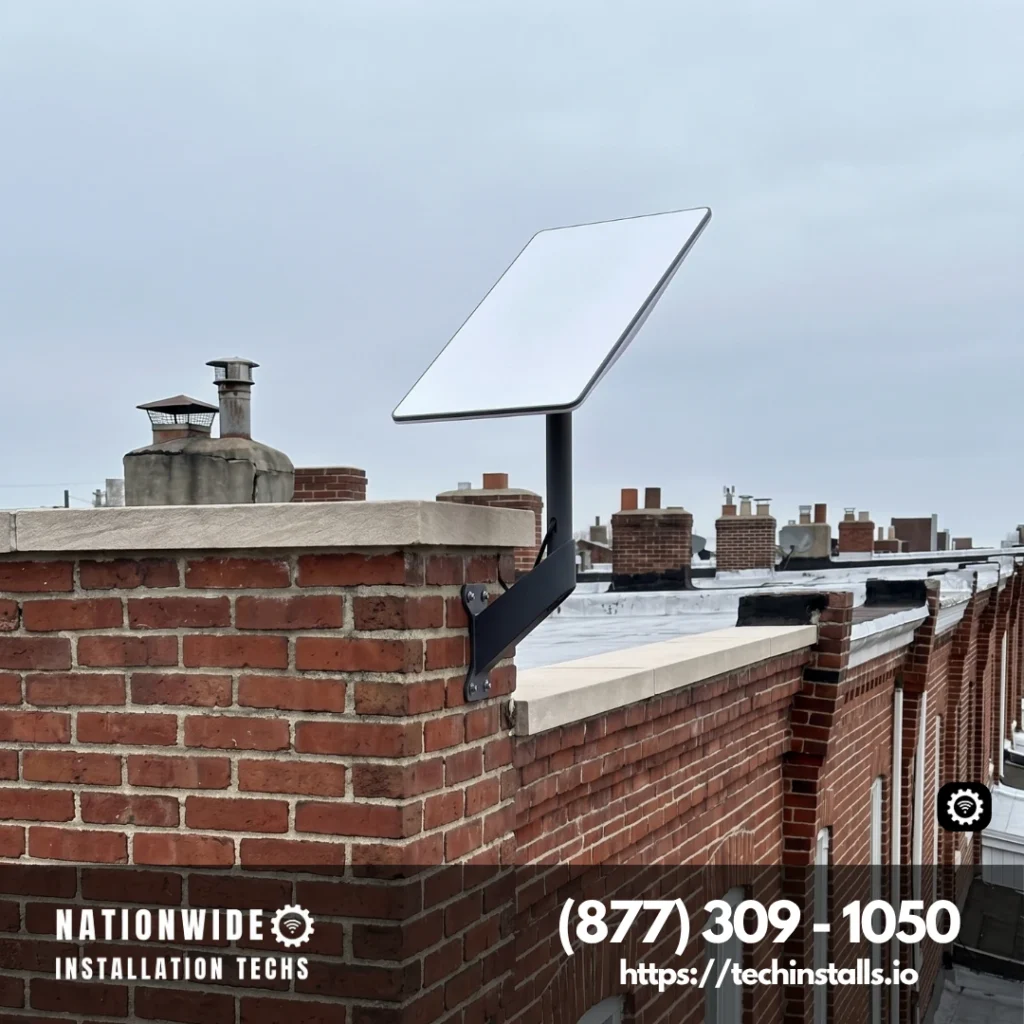
A Philadelphia rowhouse roof is typically flat or close to it, finished in rubber membrane or a modified bitumen cap sheet, and hidden from the street behind a parapet. That surface is the reason a lot of installs in this city are simpler than the homeowner expects.
Our written install standard documents five mounting methods, and on a Philadelphia rowhouse the one that fits best is usually the standard wall mount. It goes into the parapet or a rear or side wall, which on this housing stock is solid brick, and the mast carries the dish up clear of the roof. The membrane itself is never touched. On a covering whose entire job is to be continuous, that is worth more than anything else we could do for it. The one rule the method has to respect is that the dish must sit comfortably above the roof rather than below it, because a wall the dish cannot see over stops being a mounting surface and becomes the obstruction. Where nothing at all may be fixed to the building, which is the usual answer for renters and for condo roofs, the non-penetrating ballasted mount is the documented alternative: it sits on the roof under its own weight, weighted with pavers or block, and makes no hole in anything.
The far northeast breaks the pattern. Mayfair, Bustleton and Somerton were built out after the war as twins, semi-detached and detached houses, most with pitched shingle roofs and a driveway. On that stock the job reverts to a pivot roof mount lagged into the rafters, sealed at every hole, with a short cable run; a steep pitch slows us down but does not change the method. If the gable or side wall offers solid, square framing, a standard wall mount can go there instead, and where a gutter line or deep overhang blocks that, the under-eave mount is the better fit. Knowing which kind of house you own tells you a lot about which install to expect.
Wherever the mount ends up, the cable enters through the wall, not the roof. We drill one opening in the brick, seal it outside and finish it inside with a wall plate, so the membrane that keeps rain off your top floor stays unbroken. Party walls leave little room to choose where that opening lands, which is why we pin it down during the survey. Our roof prep guide lists everything we check beforehand.
The Dish Looks North, and on a Rowhouse Block That Decides Everything
The dish looks north. On a detached house that is a detail. On a Philadelphia rowhouse it is the entire survey, because you do not own the sky in three directions and the building attached to yours may be a story taller than it is.
Blocks in this city do not all run at the same angle, which is why the answer changes neighborhood to neighborhood. In South Philadelphia the grid sits close to true, the rows run north and south, the neighbors are east and west of you, and the view north over the parapet is usually open. Along the river wards through Fishtown, Kensington and Port Richmond the grid twists to follow the Delaware, so a row that feels like it runs north actually runs northeast, and that changes which neighbor is in your way. Out in the northwest, in Manayunk and Roxborough, the ground does the work instead: the hill drops hard toward the Schuylkill and a house partway down it can be looking straight into the back of the one above.
We settle this before a date is set. The survey reads the actual sky above your roof, and if clearing a neighbor’s cornice calls for a taller mast, that comes up in the survey report, not as a surprise from a tech standing on your roof.
Historic Blocks, Facades and Where We Will Not Put a Fixing
Few American cities protect as much of their old building stock as Philadelphia does. In Old City and Society Hill, and on the scattered historic blocks of Queen Village and Spring Garden, there are real limits on what can go on the outside of a house, and a dish on a front facade is a quick way to receive a notice.
So we keep the hardware where passers-by will not see it. On a historic rowhouse that normally means a wall mount on the back or side of the building, or on the roof side of the parapet out of sight from the sidewalk, with the front elevation left alone. If the brick or stone is too delicate to anchor into, or the association forbids any attachment, a ballasted mount sitting well behind the parapet does the job without a single fastener.
Rules differ block by block, and interpreting them is a job for the Historical Commission or your own adviser rather than an install crew. Our part is to leave the protected face of the building untouched as standard, and to flag during the survey if the only workable spot is one that should be approved first.
Center City Towers, Student Blocks and Who Actually Has to Say Yes
Many Philadelphia callers do not own the roof over their heads. Center City living is mostly high-rise, University City is dominated by students and institutions, and whole neighborhoods of rowhouses have been split into apartments.
Our requirement here is firm: a signed authorization from the building’s owner before we attach anything. An okay from the leasing office by phone does not qualify, and neither does word that a previous tenant had a dish. In a condominium the roof is typically a common element, so the association, not the individual owner, gives the approval.
The request is usually easier to grant than people expect. A ballasted mount leaves the roof untouched, and building managers say yes to that far more readily than to drilling, so it is what we propose first when an owner is hesitant. If the roof stays off-limits, a balcony or terrace facing open northern sky can sometimes work, and a garage or rear building with a clear view can feed the apartment through a point-to-point bridge. When none of that is possible, we say so plainly instead of installing something that would have to be removed.
Freeze-Thaw, Wet Snow and What They Do to a Bad Seal
An average Philadelphia year brings just over forty inches of rain plus a proper winter, and it is the pairing that punishes an install. Water that seeps into a weak seal in late fall freezes, swells and levers the gap open a little further; after a season of that, a seal that passed inspection in October is dripping by March.
Our answer is a sealant made for that movement, never whatever tube is handy, plus a drip loop that sheds water before it reaches the entry hole. How the cable is held depends on what it crosses: mechanical clips on brick, and roofing tape instead of screws wherever it passes over membrane. With a ballasted mount, the blocks and cable stay out of the path water takes to the drain, since a rowhouse roof that ponds around a ballast block will eventually find the weak spot.
The age of the covering matters as much as the weather does. A great many rowhouse roofs in this city are on their third or fourth membrane, and the layers underneath are not always in the condition the surface suggests. That is another argument for taking the mount off the roof surface altogether and putting it on the wall, where the condition of the membrane stops being anybody’s problem. Where a ballasted mount is the one that fits, it is at least forgiving about an older covering, because it spreads its load rather than concentrating it at four fixings. Where a roof is visibly near the end of its life we will say so, and if you are planning to have it redone it is worth doing that first and having us come afterwards, rather than working around a surface that is about to be stripped off.
Snow here tends to be wet and heavy rather than deep, and it bears down on a mast more than most people assume, so a mount anchored firmly into sound brick counts for more in Philadelphia than in a drier climate. Where wind is a real factor on a ballasted install, our standard calls for tying the weights to the frame with metal tie-wire so they cannot shift, and on some roofs bonding the base down with construction-grade adhesive, still with no penetration.
Rigs, Work Vans and Kit That Moves
Some of our Philadelphia work never touches a building. We install bolt-anchored mounts on motorhomes, fifth wheels, camper vans and work trucks, and the city shapes that work in its own way: a block of twelve-foot rowhouse frontages has no room to park a thirty-foot coach.
Most rigs are kept in storage lots beyond the city limits and only come home just before a trip. We are glad to meet you at the lot on a day that suits you rather than have you circle for curb space. Technicians bring every part the install needs, so a trip to the storage yard ends with a working dish, not a quote and a return visit.
Boats are a smaller slice of the work but a real one. Marinas line the Delaware and dot the Schuylkill, and a boat mount shares the RV’s challenges: constant motion, permanent damp, and a surface that flexes where a roof would not.
We treat RV Starlink installation as a core service, and the same care carries over to other vehicles through our vehicle installs: work trucks, service vehicles and overland builds. Tradespeople who run a van as a rolling office and contractors who need internet on a jobsite months before a line arrives make up much of that here. Every vehicle install ends with a speed reading taken with you before we pack up.
Where a Philadelphia Starlink Installer Drives, and What the Quote Covers
Across the city we work everywhere: Fishtown, Northern Liberties and Kensington, Port Richmond and Frankford, Mayfair, Bustleton and Somerton in the far northeast, Manayunk, Roxborough, Germantown, Mount Airy and Chestnut Hill in the northwest, Fairmount and Brewerytown, University City and Overbrook to the west, Old City and Society Hill, and south through Passyunk and Point Breeze.
Around it we cover the counties the city runs straight into: north into Montgomery County through Norristown and Willow Grove, west into Delaware County through Upper Darby, and across the river into New Jersey for Camden, Cherry Hill and the Gloucester County towns behind them.
Your address inside or outside the city line does not change the rate. A home starts at $385; after that, the price tracks the job itself: which mount your roof calls for, whether extra mast height is needed to see past the house next door, how long and tricky the cable path is, and whether a second unit or rear building also needs service. We run a free virtual survey of your real sky before booking a date. For $199 a technician can inspect the property in person first, which is often worth it on an attached house where the northern view is in doubt.
Most jobs are booked about three days out, and if the equipment is already in your hallway and the survey raises no questions, same-day work is often possible. We are independent of Starlink. The hardware belongs to you and so does the account; we do not sell subscriptions, set up accounts, or collect any share of your monthly fee. We are paid for the installation and nothing else, and our full price breakdown lays out every figure.
Frequently Asked Questions
No, and that is deliberate rather than a compromise. On a rowhouse the method we reach for first is the standard wall mount, fixed into the parapet or a rear or side wall, which on this housing stock is solid brick. The mast carries the dish up clear of the roof and the covering is never drilled at all. Where nothing may be fixed to the building, a renter or a condo roof being the usual reasons, the non-penetrating ballasted mount is the documented alternative: it sits on the surface under its own weight and makes no hole in anything. The cable goes in through a wall penetration we seal on the outside and plate on the inside, not through the roof plane.
Not necessarily. It matters because the dish aims north, so the neighbor on that side is the only one whose height counts. The impact depends on how much taller they are, how deep your roof runs, and whether the parapet lets us set the mount further back. A little more mast height often clears a cornice; when it does not, a rear addition or garage roof may give a better view. The free virtual survey checks this for your specific roof, not for the block as a whole.
In most cases, yes, because of how we mount. Our default keeps every piece of hardware off the street elevation, typically using a wall mount at the back or side of the house or one tucked on the roof side of the parapet, out of view from the sidewalk. That is nothing like bolting a dish to an eighteenth-century front wall. What your property is allowed is a question for the Historical Commission, not for us, but we will flag at the survey if the only position that works ought to be approved first.
Usually, provided the owner signs off first; that step cannot be skipped. We need written permission from the building’s owner before attaching anything, and a verbal okay from the leasing office is not enough. It helps that a ballasted mount needs no holes, which property managers approve much more easily than drilling. If the roof is off-limits, a balcony or terrace with a clear northern view may work, and if that fails too, we will tell you honestly.
Frequently it does not go anywhere, which is one of the quiet advantages of a rowhouse. A great many of them have interior roof access through a hatch or a bulkhead, so the work happens without a ladder on a twelve-foot street at all. Where exterior access is needed we work out at the survey where it can stand safely and whether the visit needs to be timed around street cleaning or parking. It is exactly the kind of thing worth catching before the day rather than on it.
Seldom, and only briefly. Philadelphia weather is harder on the hardware than on the signal. A heavy downpour can trim speeds for a few minutes while the storm cell moves through, then it recovers without any help. The real threat is freeze-thaw attacking a seal not made for it, so we use a sealant rated for that movement, add a drip loop, and fasten the cable to suit the surface: tape across membrane, mechanical clips on brick. On flat roofs the mount and cable stay clear of the drainage route.
We do, at the same rates. Crews go north into Montgomery County, west into Delaware County, and across the Delaware to Camden, Cherry Hill and the Gloucester County towns. The price is the same in New Jersey as in Pennsylvania; mentioning your location at the survey simply lets us plan the right day.
Once we arrive, a typical home takes around two hours. Visits are usually booked about three days after the survey, and if your dish has arrived and nothing unusual turned up, we can often finish on the day we first come out. Hold-ups here almost never involve the hardware; they come from a permission still pending, a roof the customer cannot authorize, or a northern view that needs a second look before we settle the mast height.
About Nationwide Installation Techs
Nationwide Installation Techs LLC is a professional, insured satellite installation company operating in all 50 states, with over 3,000 installations completed and a 4.9-star Google rating from 100+ reviews. Our experienced technicians cover residential, commercial, RV and marine installations, along with mesh networking, point-to-point bridges and on-site repair. We are an independent installer: you own your hardware and hold your own service account, and our crews handle the mounting, sealing and setup.
Philadelphia and the rest of the county are covered as part of our Pennsylvania Starlink installs. For anywhere else in the country, check locations we serve or book on (877) 309-1050.
Contact a Philadelphia Starlink Installer
Nationwide Installation Techs LLC
- Phone: (877) 309-1050
- Email: support@techinstalls.io
- Free Quote: Contact Us Form
Connectivity News & Updates

Starlink Installation for Construction Sites — Local, Insured Techs
Starlink installation for construction sites, in all 50 states, from...

Thor Four Winds Starlink Installation | We Come To You
Thor Four Winds Starlink installation means working around a domed...

Residential Starlink Installation — Nationwide and Insured
Residential Starlink installation starting at $385, nationwide. Nationwide Installation Techs...

Expert Starlink Installation for Yachts and Boats
Starlink installation for yachts and boats, nationwide. Nationwide Installation Techs...
Disclaimer: Nationwide Installation Techs LLC is an independent business and has no affiliation or official connection with Starlink, SpaceX, or any of their subsidiaries or affiliates. We are not associated with, authorized, endorsed, or sponsored by these companies in any capacity. For official information, please visit the Starlink and SpaceX websites at www.starlink.com and www.spacex.com. The names “Starlink,” “SpaceX,” and any related trademarks, logos, or imagery are the exclusive property of their respective owners.
Any references to “certified” or “certification” on this website refer exclusively to Nationwide Installation Techs LLC’s proprietary in-house technician certification program. This training and certification process was developed by our company based on the experience and installation methods of professional technicians who have collectively completed more than 3,000 successful Starlink installations while maintaining an overall 4.9-star customer review rating. It is not affiliated with, issued by, approved by, or endorsed by Starlink, SpaceX, or any of their affiliates.