

Lake Havasu City Starlink installer, Nationwide Installation Techs, (877) 309-1050. Professional, insured technicians serving Lake Havasu City, Arizona and Mohave County. If your kit is already on site, same-day service is often available. Residential installs start at $385. 4.9 Google star rating from 90+ reviews. 1-year workmanship guarantee!
Lake Havasu City is a heat city with a lake in the middle of it, and both halves of that change the install. Summer here runs past 115°F and the roof surface under that sun runs hotter still, so every material in the assembly is being cooked for a third of the year. Then there is the water: the Colorado River and forty-five miles of lake, a town built around boats, and a good share of the work here mounted on something that floats rather than something that stands still. The sky over this town is almost never the problem. The heat and the hull are.
Before you decide anything, and before you call us, run your own address on speedtest.net at the hour you actually use the connection rather than trusting a coverage map. A good deal of town is genuinely well served, and we will say so plainly. The calls that make sense here come from somewhere more specific: a property out past the edge of the built-up area toward Desert Hills or the Parker Strip, a tile roof that cannot take a conventional mount, a boat or a coach that is not at an address at all, or a second connection that has to hold when the first one drops.
The Hillside Decides Where the Dish Goes
The first thing we look at here is not the roof. It is the ground behind the house.
The dish looks north, and it is the first measurement we take. This town is built in tiers up the slope away from the water, and that arrangement produces a problem people rarely see coming: the lots with the best views have them to the south, over the lake, while the thing rising directly behind the house is the hillside. A property can have a completely open outlook from the deck and still be looking into a wall of rock in the only direction that counts.
It cuts the other way too. Higher up the same slope, a house can be sitting above everything in front of it with as clean a northern horizon as you will find anywhere, and the install becomes trivial. Two houses three streets apart can be opposite cases. That is why nothing here gets quoted off a map.
Where the house genuinely cannot see past the slope, the dish does not have to live on the house. A detached garage, a casita or a shop higher on the lot will carry it, and the connection comes back to the main building over a point-to-point wireless bridge. It is a normal piece of work rather than a last resort, and on a stepped lot it is frequently the cleanest answer available.
The free virtual survey reads the sky over your specific address and settles which of those cases you are before anyone commits to a date.
A Boating Town, and a Good Share of the Work Floats
Forty-five miles of lake and the Colorado River channel make this a town organised around boats, so we spend real time on the water here, and Starlink installation for yachts and boats is a real share of what we do here rather than a sideline.
Water changes the specification in ways a roof never does. The mount is in motion whenever the boat is, and in several axes at once, so anything that depends on being torqued down once and left alone will eventually work loose. Every fastener is stainless. The cable entry has to be sealed and still openable in two years when something needs servicing, which is a harder requirement than sealed alone. Power comes off the house bank, never the starting battery, because a flat starting battery on the water is a different order of problem than a flat one on a driveway.
Havasu is fresh water, which spares the equipment the worst of what salt does, but it substitutes its own load: relentless ultraviolet exposure and a boat that spends much of the year on a trailer in the open. The trailer is the part people forget. A boat towed up from Phoenix on a Friday takes sustained highway wind on the mount that a boat living in a slip never sees, and those two cases want different hardware. We ask how the boat is actually used before specifying anything, because the length of the hull tells us much less than the trailer does.
Tile, Stucco, and Why the Wall Usually Wins
Concrete tile covers a great many roofs on the slopes above the lake, and it rules out a whole category of mounting for us, working to a written standard. Our install standard sets out five methods and a tile mount is not among them. Nothing we do involves drilling, lifting or flashing into a tile field, because a cracked tile is a water path and this town takes its rain in a few violent afternoons rather than spread across the year.
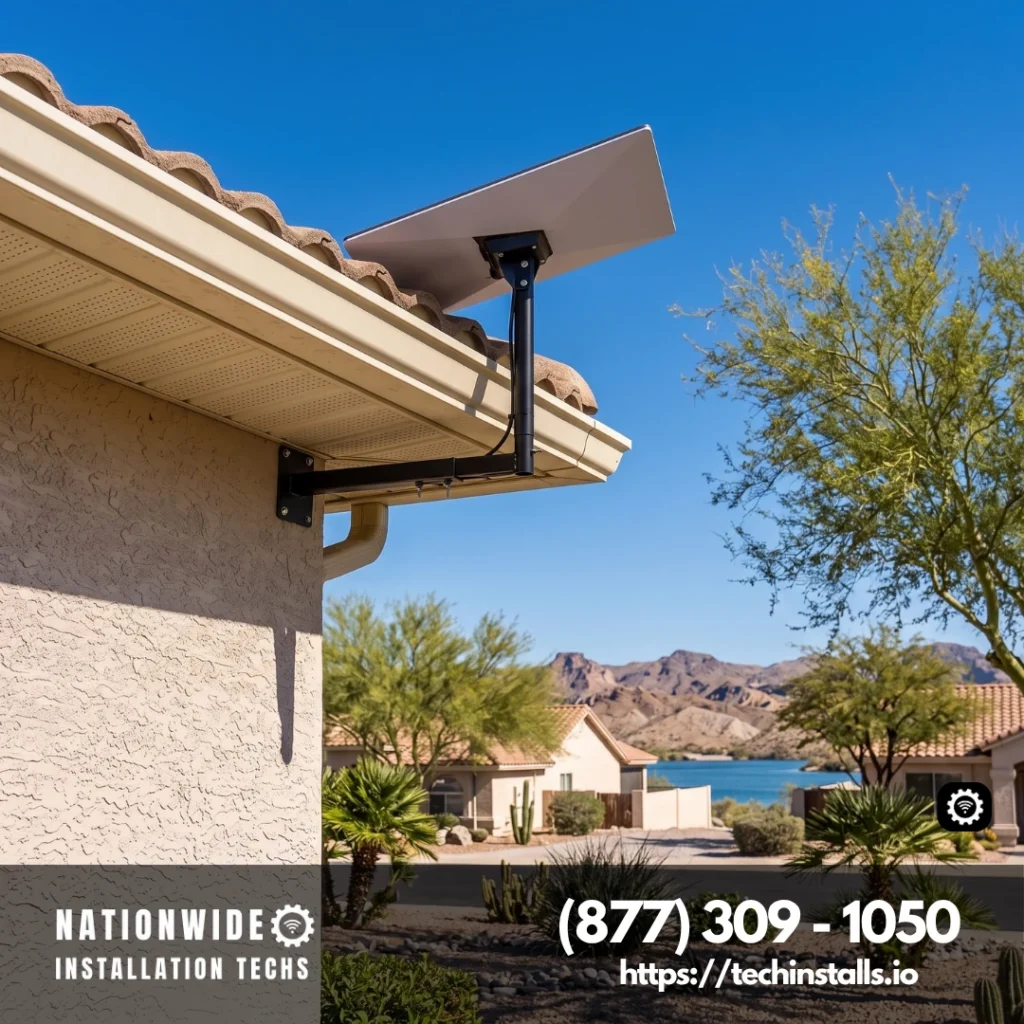
In practice that constraint bites less here than the roof covering alone would suggest, because the hillside has usually already pushed us onto a wall. When the dish has to gain height to clear the slope behind the house, a standard wall mount bolted into framing or masonry is the method that gets there, and it happens to put every fixing somewhere other than the tile. The constraint and the solution point the same way.
Where the north side offers no usable wall, an under-eave mount tucks the assembly beneath the overhang. Where a house has a flat section over a garage or patio, and a great many here do, a ballasted non-penetrating mount sits on it under its own weight with nothing driven through the deck at all. Plain composition shingle over a sound deck goes back to a pivot roof mount into rafters, sealed at every pilot hole.
Stucco deserves its own note, since most walls in this town are stucco over block or over framing, and those two want different anchors entirely. Getting that wrong is how a mount ends up pulling out of a wall three summers later. What we check before anything goes on a roof covers what we look for.
Empty Houses, and What a Havasu Summer Finds
Half this town leaves for the summer, and for us that changes what a defect costs rather than what causes it.
A house shut up in May and reopened in October has spent the worst five months of the year unwatched. Whatever the heat found, it found without anyone present. A seal that let go in July is discovered in the autumn, by which point the monsoon has already run water through the gap for months. The same fault on an occupied house gets noticed the first afternoon somebody sees a stain.
So the standard we install to here assumes nobody is checking. Sealant chosen for the movement the joint will actually see across a 60-degree annual swing, not a general-purpose tube that is fine in a mild climate. Cable and clips rated for sustained ultraviolet, because a jacket that chalks and splits does it silently. Mechanical fixing anywhere adhesive would otherwise be asked to hold at 115 degrees. A drip loop below every entry, which costs nothing and is the single cheapest insurance against a summer nobody was home for.
The hardware itself is untroubled by the heat and is built for hot climates. It is the workmanship around it that either survives an unattended Havasu summer or does not.
Coaches, Trucks and the Country Past Town
Mohave County carries one of the largest seasonal RV populations in the country, which keeps us working well past the town limits, and a good deal of our Arizona work is anchored to something that moves.
On RV Starlink installation the mount is bolt-anchored into structure rather than fastened into a thin roof skin, the run is clipped tight so nothing is left to flap at highway speed, and power is taken from the house bank. Our technicians arrive with the equipment the job needs, which matters when the rig is parked well outside town and the nearest parts counter is an hour away. We aim it and run a live speed test before leaving.
Out past the built-up area the reasoning changes entirely. Toward Yucca, Golden Shores and the properties strung along the river, a wired option worth having frequently does not exist, and a connection there is nobody’s second choice. Distance does not change the install price. It changes scheduling, so tell us where you are while we are still doing the survey.
Starlink installation for cars and trucks covers work trucks, service vehicles and overland builds, and Starlink installation for mobile fleets applies the same standard across an operator running a whole yard of them.
Where We Drive Across Lake Havasu City, and What the Quote Covers
Across town we work everywhere, from the Island and the channel through the older streets above the marina to the newer building climbing the slope and out along the highway.
Around it we cover the ground Mohave County runs into: north through Desert Hills toward Golden Shores and Yucca, and south down the river through the Parker Strip, Cienega Springs and Bluewater toward Parker. East and west the map runs out fast, which is the honest answer rather than a short list. The Colorado River and the California line sit immediately west, and open desert and mountain sit east.
Residential installs start at $385. What moves it from there is the work at the far end: whether the slope behind the house forces the dish onto a second structure and a bridge back, what the wall turns out to be made of once we are looking at it, how long and awkward the cable run becomes, and whether a casita or a shop has to come onto the connection as well. A virtual survey is free and reads the sky over your actual roof. An on-site survey is $199 if you would rather have a technician physically at the property first, which on a stepped hillside lot frequently pays for itself.
Scheduling generally runs about 72 hours. Where the kit is already at the property and the survey is clean, we can often come the same day. We are an independent installer, so you own the hardware and hold your own Starlink account. The service plan is not ours to sell and we take nothing from your monthly bill. We sell the install, and what a Starlink install actually costs is broken down in full elsewhere on the site.
Frequently Asked Questions
They point opposite ways more often than not, and it is the most common surprise in this town. The dish looks north, while Havasu is built in tiers up the slope away from the water, so the outlook you enjoy from the deck faces south and the hillside sits behind you in the direction that actually matters. Higher up the same slope the situation reverses and the northern horizon is wide open. The free virtual survey reads your specific address and tells you which case you are before anyone books a date.
Onto a wall, almost always, and on a hillside lot that is usually where it was heading anyway. Our install standard sets out five mounting methods and a tile mount is not among them, so nothing gets drilled into or lifted out of a tile field. A standard wall mount into framing or masonry takes the load on the wall instead, an under-eave mount does the same beneath the overhang, and a flat section over a garage or patio will take a ballasted mount that penetrates nothing at all. Tell us what the wall is built of, because stucco over block and stucco over framing need different anchors.
Yes, and marine work is a real share of what we do here. A mount on the water moves constantly, so every fastener is stainless and nothing relies on being torqued once and forgotten. The cable entry is sealed and still serviceable later, and power comes off the house bank rather than the starting battery. The question we will ask is whether the boat is trailered or lives in a slip. A trailered boat takes sustained highway wind every trip and a slipped boat never does, and that changes the specification more than the size of the hull does.
It matters a great deal, which is why we build for it. A property shut from May to October spends the hardest months of the year with nobody there to notice anything, so a seal that fails in July has been letting monsoon water through for months before it is found. We use sealant rated for the full annual temperature swing rather than a general-purpose tube, cable and clips rated for sustained ultraviolet, mechanical fixing wherever adhesive would otherwise be holding at 115 degrees, and a drip loop below every entry. The aim is an install that does not need supervising.
No. The hardware handles its own thermal behaviour and is designed for hot climates, so the dish is not what summer threatens. What 115-degree afternoons test is everything around it: the sealant, the cable jacket, the clips and the anchors. Those are workmanship choices made on the day of the install, and they are the difference between a Havasu install that is still sound in year five and one that quietly opens up in year two.
Yes, and properties out past the built-up area are much of the reason this company exists. Toward Yucca, Golden Shores or south down the Parker Strip there is frequently nothing wired worth having. The distance does not change what the install costs. It does affect how we schedule, so mention where you are during the survey and the visit gets booked properly the first time.
It loads it hard and briefly. Most of the year’s rain arrives in a handful of violent afternoons with strong wind and blowing dust ahead of it, so a mount that felt solid in April meets very different forces in August. That is why we fit the shortest mast that clears the obstruction rather than the tallest that fits, since every additional foot is leverage working on the anchor. Monsoon is also when a marginal seal gets found out, after a dry spring has already worked on it.
Most residential installs run a couple of hours once the technician is on site, and scheduling is generally about 72 hours from the survey. Where the kit is already at the property and the survey comes back clean, same day is often possible. The thing that adds time here is almost never the hardware. It is a stepped lot where the slope behind the house needs a proper look first, or a wall whose construction has to be confirmed before we choose an anchor.
About Nationwide Installation Techs
Nationwide Installation Techs LLC is a professional, insured satellite installation company operating in all 50 states, with over 3,000 installations completed and a 4.9-star Google rating from 90+ reviews. Our experienced technicians cover residential, commercial, RV and marine installations, along with mesh networking, point-to-point bridges and on-site repair. We are an independent installer: you own your hardware and hold your own service account, and our crews handle the mounting, sealing and setup.
Your Lake Havasu City Starlink installer, serving Lake Havasu City, Mohave County and the rest of Arizona, plus every other state listed on our locations we serve page. Call (877) 309-1050.
Contact a Lake Havasu City Starlink Installer
Nationwide Installation Techs LLC
- Phone: (877) 309-1050
- Email: support@techinstalls.io
- Free Quote: Contact Us Form
Connectivity News & Updates

Residential Starlink Installation — Nationwide and Insured
Residential Starlink installation starting at $385, nationwide. Nationwide Installation Techs...

Lake Havasu City Starlink Installer — Same-Day Service When Your Kit Is On Site
Lake Havasu City Starlink installer, Nationwide Installation Techs, (877) 309-1050....

Expert Starlink Installation for Yachts and Boats
Starlink installation for yachts and boats, nationwide. Nationwide Installation Techs...

Phoenix Starlink Installer — Same-Day Service When Your Kit Is On Site
Phoenix Starlink installer, Nationwide Installation Techs, (877) 309-1050. Professional, insured...
Disclaimer: Nationwide Installation Techs LLC is an independent business and has no affiliation or official connection with Starlink, SpaceX, or any of their subsidiaries or affiliates. We are not associated with, authorized, endorsed, or sponsored by these companies in any capacity. For official information, please visit the Starlink and SpaceX websites at www.starlink.com and www.spacex.com. The names “Starlink,” “SpaceX,” and any related trademarks, logos, or imagery are the exclusive property of their respective owners.
Any references to “certified” or “certification” on this website refer exclusively to Nationwide Installation Techs LLC’s proprietary in-house technician certification program. This training and certification process was developed by our company based on the experience and installation methods of professional technicians who have collectively completed more than 3,000 successful Starlink installations while maintaining an overall 4.9-star customer review rating. It is not affiliated with, issued by, approved by, or endorsed by Starlink, SpaceX, or any of their affiliates.