

Savannah Starlink installer, Nationwide Installation Techs, (877) 309-1050. Professional, insured technicians serving Savannah, Georgia and Chatham County. If your kit is already on site, same-day service is often available. Savannah residential installs start at $385. Commercial installs start at $750, with discounts for 3+ locations. Mobile installations start at $650, with discounts available for 3+ vehicles and mobile fleets. Yacht and boat Starlink installations start at $750. 4.9 Google star rating with 90+ reviews. 1-year workmanship guarantee, by professional, insured technicians. Serving Savannah, GA and surrounding areas.
Savannah puts two rules on an installer that most cities put on nobody. In the historic district nothing may be visible from the street, and everything east of the Truman Parkway sits in a hurricane evacuation zone with salt in the air and a seven-foot tide under the docks. Add a live oak canopy that never drops its leaves, and you have a city where the mount is chosen for the house rather than the house making do with the mount. Before you decide anything, and before you call us, run your own address on speedtest.net at the hour you actually use the connection rather than trusting a coverage map.
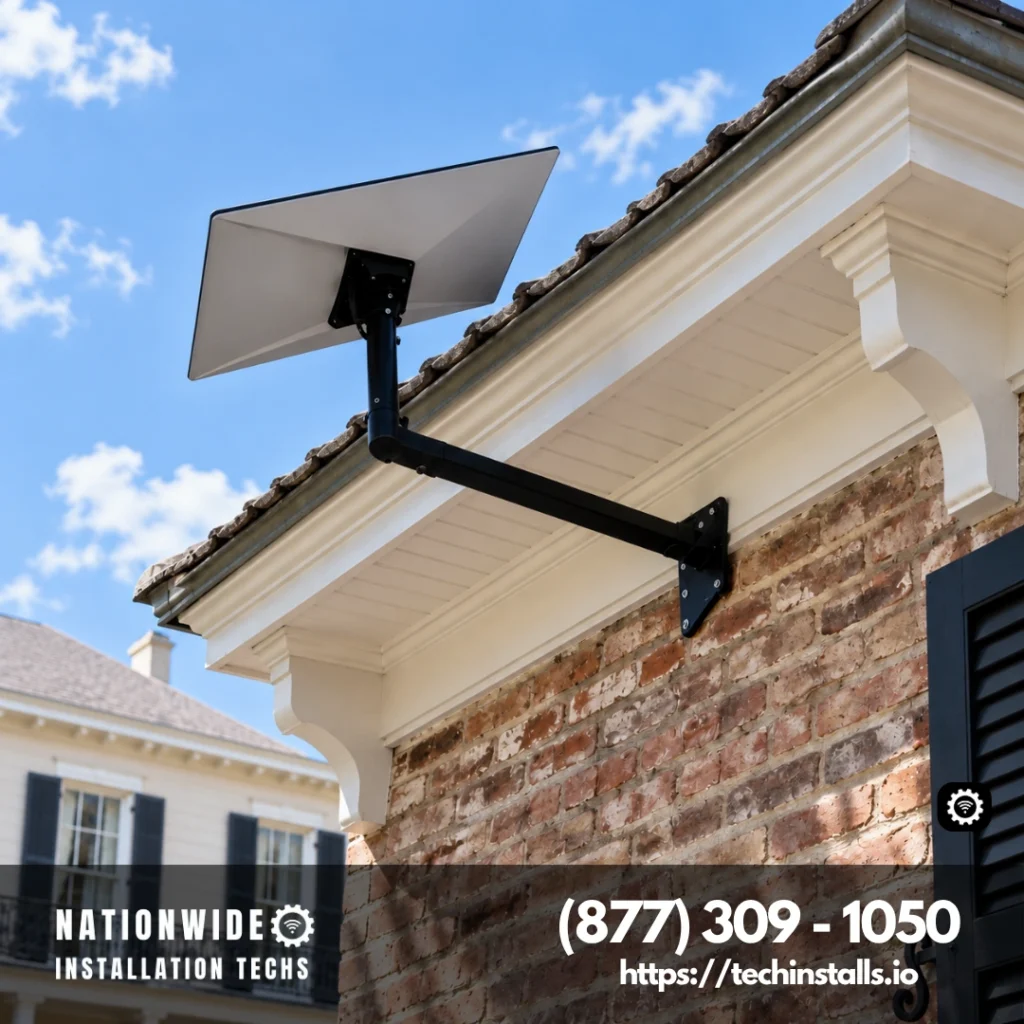
Much of Chatham County is genuinely well served, and we will say so plainly. The calls that make sense here come from somewhere more specific: a rowhouse in the district where nothing may show from the square, an island lot under live oaks, a metal roof that went on after Matthew, a boat on a tidal creek, a fleet running the port, or a second connection that has to hold when the first one drops.
The Parapet Does the Hiding
The historic district is one of the largest National Historic Landmark districts in the country, and the review standard for anything on the outside of a building is whether it can be seen from the public right-of-way. That single test decides where a dish goes downtown.
A great deal of the district is brick rowhouses and commercial blocks with flat or very low-slope roofs behind a parapet. That is the easiest case we have, not the hardest. A ballasted non-penetrating mount set back from the parapet on the roof deck holds itself down with weight, puts nothing through the membrane, and from the square below there is nothing to see. The parapet was built to hide the roof, and it hides the dish with it.
On the pitched-roof houses of the Victorian District and the streets south of Forsyth, the answer is a wall mount on a rear or side elevation facing the lane, or an under-eave mount tucked beneath the overhang at the back, with nothing fixed to the street face. We are installers, not your preservation consultant, and we will not tell you what the review board will approve. What we will do is hand you the mount specification and a note of exactly where it sits, so the question you take to them is a specific one.
Live Oak Canopy Is Permanent, and It Is Wide
The trees here are not the seasonal problem they are further north. A live oak keeps its leaves through the winter, so what the survey sees in January is what the dish will see in July, and there is no leaf-out surprise waiting in April.
What there is instead is width. A mature live oak in Ardsley Park, on Isle of Hope or along the older streets of Wilmington Island can carry a crown a hundred feet across, low to the ground, with moss hanging off it, and it can own the entire northern sky of a lot by itself. The dish looks north, and when the tree is north of the house there is no mast height that fixes it.
The fix is position. The rear roof plane, a detached garage, a dock house on the marsh side or a shed at the back of the lot frequently has the sky the front lost, and the connection comes back over a point-to-point wireless bridge. We would rather move the dish forty feet than raise it four, because every extra foot of mast is leverage on the fixing when the wind comes.
Salt, Storm Season and the Shortest Mast That Works
Everything from the islands in to the Truman Parkway is in an evacuation zone, and Matthew and Irma both emptied it inside a year of each other. That history is a design input.
Wind loading here is not a footnote, so we fit the shortest mast that clears the obstruction rather than the tallest that fits, and the mount goes into structure rather than sheathing. Every exposed fixing on the coastal side is stainless, because the salt air reaches well past the marsh, and the sealant is one rated for heat and humidity rather than whatever is in the van. A seal that stays elastic through an August afternoon and a January cold snap is the difference between a dry attic and a stained ceiling two years on.
The cable follows the same logic: a drip loop below the entry so water sheds before it reaches the hole, stainless clips on the wall run, roofing tape where it crosses roof, and the penetration sealed on the outside and finished inside. None of it is exotic. All of it is the part that gets skipped.
Metal Roofs After Matthew and Irma
Drive Wilmington Island, Isle of Hope or the newer streets in Pooler and Richmond Hill and you will see standing-seam metal on a large share of the houses, much of it put on after the storms replaced what was there before.
Our written standard on metal is short: we never drill into a metal roof. A standing-seam panel is a single continuous water plane, the fixings that hold it are engineered, and a hole put through it by somebody else is a hole that panel was never designed to have. So on a metal roof the dish goes on a wall mount, an under-eave mount on the back elevation, or a ballasted mount on a flat section such as a porch roof or an addition, and the metal stays exactly as the roofer left it.
Where the covering is ordinary architectural shingle on a sound deck, which is still most of Chatham County, the job reverts to a pivot roof mount fixed into rafters with every pilot hole sealed. What we check before anything goes on a roof covers what we look at first.
The Islands, the Creeks and the Boats
Thunderbolt, Isle of Hope, Wilmington Island and the tidal creeks behind Skidaway hold a fleet that runs from center consoles on a lift to sportfishers and cruisers in the marinas along the Intracoastal, and Starlink installation for yachts and boats is a real share of what we do here.
A mount on the water has a problem a roof does not. The hull is in motion whenever the boat is, it lives permanently in brackish water and salt air, and the dock it ties to rises and falls seven feet twice a day. Every fastener is stainless. The cable entry keeps water out and still comes apart cleanly for service later. Power comes off the house bank rather than the starting battery, because a flat starting battery at the mouth of Wassaw Sound is a different order of problem than a flat one at the ramp.
We ask how the boat is actually used before specifying anything. A lift boat behind the house, a slip at Thunderbolt and a trailer that runs to the ramp every Saturday want three different pieces of hardware, and the length of the hull tells us less than that does.
The Port, the Plant and the Trucks
One of the busiest container ports in the country sits on the river at Garden City, the new vehicle plant is going up in Bryan County, and the aerospace campus by the airport builds aircraft. Between them they put more trucks on the road here than in most metros twice the size.
Starlink installation for cars and trucks covers the service trucks, work vans and drayage tractors, with the mount anchored to the vehicle rather than stuck on, the run routed away from anything hot or moving, and power taken properly off the vehicle. Starlink installation for mobile fleets scales that same specification to a whole yard of trucks at once, and around a port this busy, running a dozen of them the same way is just how the work gets scheduled.
Not everything on wheels is working. On RV Starlink installation the fixing goes into the coach’s own framing, never through the thin skin that covers a roof, the cable is secured along its full run so highway vibration doesn’t shake it loose, and the draw comes from the house bank instead of the chassis battery. Skidaway Island State Park and the campgrounds near Richmond Hill keep a steady stream of rigs passing through the county, and our crew shows up carrying whatever that particular setup calls for.
Where We Drive Across Savannah, and What the Quote Covers
Across the city we work everywhere, from the squares and the Victorian District through Ardsley Park and Midtown, the Southside and Windsor Forest, out to Georgetown, and across the bridges to Whitemarsh, Wilmington and Isle of Hope.
Around it we cover the counties Chatham runs into: north to Port Wentworth and Rincon, and Hardeeville over the South Carolina line, east across the islands to Tybee, south to Thunderbolt, Isle of Hope and Skidaway, and west through Garden City and Pooler to Richmond Hill.
Residential installs start at $385. What moves it from there is the work at the far end: whether the district puts the dish behind a parapet or on a lane-facing wall, whether a live oak forces it onto a rear structure and a bridge back, what the roof is made of, and whether a dock house or a second building has to come onto the connection. A virtual survey is free and reads the sky over your actual roof before anyone commits to a date. An on-site survey is $199 if you would rather have a technician physically at the property first, which on a district rowhouse frequently pays for itself.
Typical scheduling is around 72 hours. If the kit is already at the house and the survey comes back clean, same day is often possible. We are an independent installer: you own the hardware and you hold your own Starlink account. We do not sell you the service plan, we do not open the account for you, and we do not take a cut of your monthly bill. What we sell is the install, and what a Starlink install actually costs is broken down in full elsewhere on the site.
Frequently Asked Questions
Usually, and the method is the reason. The review test is visibility from the public right-of-way, and on a flat-roofed rowhouse a ballasted mount set back behind the parapet is invisible from the square and puts nothing through the roof. On a pitched-roof house the mount goes on a rear or side wall facing the lane. We will not tell you what the board will approve, but we will hand you the exact specification and position so the question you take to them is a specific one rather than a general one.
No. A ballasted non-penetrating mount holds itself down with weight, sits on the deck rather than through it, and is the easiest case we have downtown rather than the hardest. We keep the base and the cable run clear of the drains and scuppers so nothing dams water on a flat roof in a summer storm, and we tie the ballast down mechanically rather than trusting it to stay put in a gale.
Not hopeless, but a taller mast is not the fix. Live oak keeps its leaves all year, so the survey is honest in any month, and a crown that wide simply owns the northern sky above the house. The answer is a different position: the rear roof plane, a garage, a dock house or a shed at the back of the lot, with a wireless bridge back to the house. We would rather move the dish forty feet than raise it four.
With the shortest mast that clears the obstruction, a mount anchored into structure rather than sheathing, stainless fixings throughout on the coastal side, and a sealant rated for heat and humidity rather than a general-purpose tube. The dish itself is designed for wind; what fails in a storm is a mount that was screwed into sheathing or a seal that dried out. Both are workmanship, and both are avoidable.
Anywhere but the metal. Our standard is that we never drill into a metal roof, so the dish goes on a wall mount, an under-eave mount on the back elevation, or a ballasted mount on a flat section such as a porch roof or an addition. The panels stay exactly as the roofer left them. Say which you have at the survey and we arrive with the right hardware rather than the wrong one.
Yes, and the islands keep us busy with it. A hull on a tidal creek is never still, and the brackish water and salt air work on every fastener, so all of them are stainless and each is locked off rather than left to hold on its own. The cable entry is sealed against the weather and still comes apart for service, and the dish draws from the house bank so the starting battery is never touched. Tell us whether the boat lives on a lift, in a slip at Thunderbolt or on a trailer, because those three want three different pieces of hardware.
Yes, on the same terms and at the same price. We work north to Port Wentworth and Rincon, and Hardeeville over the South Carolina line, east across the islands to Tybee, south to Thunderbolt, Isle of Hope and Skidaway, and west through Garden City and Pooler to Richmond Hill. Crossing a county line or the state line does not change what you pay. What it occasionally changes is scheduling.
Most residential installs are a couple of hours once we are on site. Typical scheduling is around 72 hours from the survey, and if your kit is already at the house and the survey comes back clean, same day is often available. What slows a job down here is rarely the hardware. It is a district position that wants clearing with the board first, a live oak that needs a proper look, or a roof whose covering has to be confirmed before we choose the mount.
About Nationwide Installation Techs
Nationwide Installation Techs LLC is a professional, insured satellite installation company operating in all 50 states, with over 3,000 installations completed and a 4.9-star Google rating from 90+ reviews. Our experienced technicians cover residential, commercial, RV and marine installations, along with mesh networking, point-to-point bridges and on-site repair. We are an independent installer: you own your hardware and hold your own service account, and our crews handle the mounting, sealing and setup.
Serving Savannah, Chatham County and the rest of Georgia, plus every other state listed on our locations we serve page. Call (877) 309-1050.
Contact a Savannah Starlink Installer
Nationwide Installation Techs LLC
- Phone: (877) 309-1050
- Email: support@techinstalls.io
- Free Quote: Contact Us Form
Connectivity News & Updates

Residential Starlink Installation — Nationwide and Insured
Residential Starlink installation starting at $385, nationwide. Nationwide Installation Techs...

Expert Starlink Installation for Yachts and Boats
Starlink installation for yachts and boats, nationwide. Nationwide Installation Techs...

Professional Starlink Installation for Cars and Trucks
Starlink installation for cars and trucks, nationwide. Nationwide Installation Techs...

Atlanta Starlink Installer — Same-Day Service When Your Kit Is On Site
Atlanta Starlink installer, Nationwide Installation Techs, (877) 309-1050. Professional, insured...
Disclaimer: Nationwide Installation Techs LLC is an independent business and has no affiliation or official connection with Starlink, SpaceX, or any of their subsidiaries or affiliates. We are not associated with, authorized, endorsed, or sponsored by these companies in any capacity. For official information, please visit the Starlink and SpaceX websites at www.starlink.com and www.spacex.com. The names “Starlink,” “SpaceX,” and any related trademarks, logos, or imagery are the exclusive property of their respective owners.
Any references to “certified” or “certification” on this website refer exclusively to Nationwide Installation Techs LLC’s proprietary in-house technician certification program. This training and certification process was developed by our company based on the experience and installation methods of professional technicians who have collectively completed more than 3,000 successful Starlink installations while maintaining an overall 4.9-star customer review rating. It is not affiliated with, issued by, approved by, or endorsed by Starlink, SpaceX, or any of their affiliates.