

Wichita Starlink installer, Nationwide Installation Techs, (877) 309-1050. Professional, insured technicians serving Wichita, Kansas and Sedgwick County. If your kit is already on site, same-day service is often available. Residential installations start at $385. Commercial Starlink installations start at $750, with discounts for 3+ locations. Mobile Starlink installations start at $650, with discounts available for 3+ vehicles and mobile fleets. Yacht and boat Starlink installs start at $750. 1-year workmanship guarantee, by professional, insured technicians. 4.9-star Google rating with 100+ reviews. Wichita, KS and surrounding areas.
Wichita gives a dish the easiest sky in the country and then throws the hardest weather in the country at the mount. The ground is flat, the horizon is empty in every direction, and to the north of almost any roof there is nothing but air. What the job turns on is everything else: a hail season that rewrites the roofing calendar every few years, straight-line wind that comes across the prairie with nothing to slow it, brick ranches on the east side that want the right anchor, old elms over the older neighborhoods, and a basement under nearly every house that makes the cable entry a different job from the one we do on a slab.
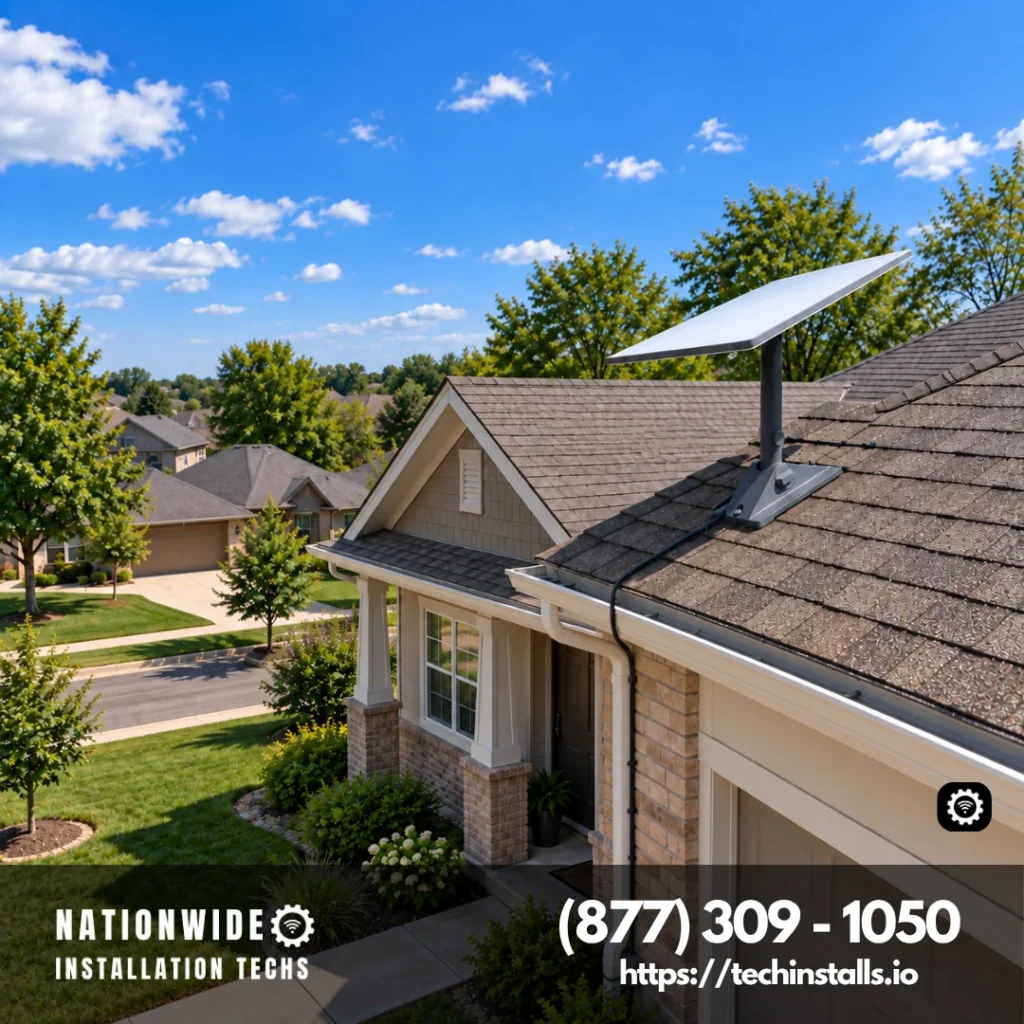
Starlink earns its keep in Wichita at the edges and in the second slot. Cox and the fiber builds reach most of the grid, but the acreage out past Goddard and Colwich, the new houses north of Valley Center and the farmhouses toward Benton were never on that map, and a home office in College Hill that cannot afford the afternoon the cable line drops wants a path that does not fail with it. The fastest way to see the difference is to run your address on speedtest.net this week and again on the day we leave. The Wichita jobs we do most are the acreage beyond the last fiber cabinet, the house waiting on a roofer after the last hailstorm, the office that needs a second line before the next ice storm, the rig headed for Cheney, and the kit that arrived Monday and is still in the garage. Order the kit, and book the free virtual survey while it is on its way.
Hail Country: Every Fixing Sealed for the Storm That Is Coming
Sedgwick County sits squarely in the hail belt, and a spring supercell that leaves the east side under a layer of golf balls is a normal year here rather than a memorable one. Roofers work on an insurance cycle in this city, which is why the first thing we ask at a survey is whether there is a claim open on the roof or a re-roof already scheduled.
The answer changes where the dish goes. With a re-roof coming, we keep the dish off the shingle entirely, on a wall mount at a gable or on an under-eave arm, so it rides through the roof replacement untouched and nobody pays twice. With a sound roof that is staying, the pivot mount goes into the rafters and we photograph every fixing before we leave, so that after the next storm a roofer can lift the mount, re-shingle and reseat it in the same holes. Either way you are online this week rather than after the adjuster.
Wind is the other half of the Kansas weather, and it is the reason we fit the shortest mast that clears an obstruction rather than the tallest one that fits. Every added foot of mast is leverage on the fixings when a sixty-mile-an-hour gust comes through, and our standard does not allow a dish on a tall pole for exactly that reason. Cable is clipped every foot to a foot and a half so no length of it can flap, and every penetration is sealed against rain that arrives sideways.
Shingle Roofs Get the Pivot Mount. Brick Ranches Get the Right Anchor
Nearly every Wichita roof is composition shingle, and on a sound shingle roof the pivot mount is the default. It sits high on the roof plane near the ridge, its two feet are fastened into rafters rather than into the decking between them, sealant goes into every pilot hole and over every fastener head, and the pivot lets the mast be set truly plumb whatever the pitch, which matters on the steeper roofs of the newer builds off Rock Road and out past 135th Street West.
The wall below that roof is very often brick, and Wichita brick comes in two kinds. On the postwar ranches in Crown Heights, Eastborough and the streets east of Oliver the brick is a veneer, a single skin tied back to a framed wall, so a wall mount’s two bolts go through the brick and into the studs behind it. On the older solid-brick houses and the block-walled outbuildings the anchor is a masonry anchor set for the material, drilled with a bit meant for brick rather than wood. We confirm which wall you have before the drill comes out, and the penetration is sealed so water never tracks into the wall.
Where the eave is deep and the pitch is shallow, as it is on a great many of the ranches here, we work from under the soffit instead. A horizontal arm takes the load, its far end clearing the gutter line, and a stub of mast on that end lifts the dish above the shingle. Metal roofs get the same treatment for a different reason: a standing-seam panel on a farmhouse or a shop out west is a sealed water plane, so nothing of ours goes through it and the dish takes a wall or an eave. What we check before anything goes on a roof sets out what we look for before that call is made.
Old Elms, Bare Branches and the Northern Sky in Riverside and College Hill
The dish looks north, and in the older neighborhoods the thing standing to the north is a tree. Riverside, College Hill, Delano and the streets around Crown Heights were built under elms, cottonwoods, hackberries and oaks that now stand well above the roofs, and the newer subdivisions have planted the same species and are waiting for them to grow.
Those are deciduous trees, and that cuts both ways. A survey done in January is looking through bare branches at a sky that will close over in May, so we read a winter survey for the July canopy rather than for the view on the day; a survey done in August shows the worst case and the answer only improves. Either way the free virtual survey reads the canopy over your own roof from photos and the satellite view, and we plan for the leaf-on months, not the leaf-off ones.
A canopy over the front of the house is not the end of the job; it just moves the mount. Nine times in ten the back slope of the same roof is clear, and the garage at the rear of a Wichita lot is clearer still, sitting out from under the street trees. From either of those a point-to-point wireless bridge carries the signal indoors on a radio link rather than a trench. Two things we will not do to get around a tree: fix hardware to the tree itself, or stack mast until the dish looks over it.
Where the Cable Comes In: Rim Joists, Basements and the Newer Slabs
Most of Wichita has a basement or at least a crawlspace, which gives us the cleanest cable entry there is. The cable comes down the wall, hangs in a drip loop, and goes through the rim joist just above the foundation into a sealed grommet, then runs across the basement ceiling to the room where the router belongs. Nothing goes through the roof, and the hole is in framing rather than in a finished wall.
The newer houses on the west side and out toward Maize and Goddard are slab-on-grade, and those get the entry the rest of the standard calls for: drilled from inside the room outward so the hole lands within four feet of an outlet, low on the wall, with the drip loop outside and a sealed grommet in the wall, finished inside at a white brush plate rather than a raw hole. The room is chosen with you at the survey, not by whichever wall happens to be nearest the roof.
Coverage is the other half of the visit. A long ranch plan, an office finished off in the basement, and the metal shop standing behind half the houses in this county each ask for something the dish alone cannot give: nodes placed where the signal actually thins, and for the shop, a radio link across the yard so the building gets the same connection the house has.
Tornado Season, Ice Storms and a Second Line for the Home Office
Wichita gets its weather at both ends of the year. The spring brings the storm lines and the sirens, and the winter brings the ice storms that have coated the east side and taken the wired lines down for days at a time. Both are the weeks a second connection earns its place, and both are what the mount has to be built for.
Three habits decide whether an install survives a Kansas winter. Structure carries the mount, never sheathing or a brick skin on its own. The mast is kept short, because a long one is a lever for the wind and a shelf for the ice. And nothing on the wall is allowed to hang: clips hold the run flat so no span can ice up and pull, with the loop at the entry sending meltwater to the ground instead of the wall. We answer the phone after the storm too, and the fixing photographs from install day tell a roofer exactly where the mount belongs when the shingle is replaced.
The dish itself is built for the cold, and it handles the snow that Wichita gets. What it needs from us is a position that does not sit under a roof edge that sheds ice onto it, which is one more reason the pivot mount near the ridge and the wall mount at a gable end are the two placements we reach for first here.
Cheney, El Dorado and the Fleets on Kellogg
A good deal of what we mount in Sedgwick County has wheels or a hull under it.
The rigs stage at Cheney and El Dorado state parks and at Lake Afton, and a great many more live on acreage or in a barn between trips. RV Starlink installation starts underneath rather than on top. The bracket picks up the coach’s framing, so none of the load is carried by the roof skin, and the run is clipped end to end because a crosswind on I-135 will find any slack there is. Power is the third decision and it comes off the house bank, leaving the starting battery whole. A technician arrives with the brackets, the fixings and the cable already on board.
Cheney Reservoir is one of the best sailing lakes in the Plains, and the sailboats, pontoons and wake boats that live there spend the week on a trailer in a Wichita driveway and the weekend on the water. Starlink installation for yachts and boats on a trailered hull works from the same list every time: every fastener in stainless so the lake never gets a chance at it, a wiring penetration that stays watertight yet can still be opened if something needs attention, the dish wired to the house battery bank so cranking power is untouched, and a mount built to survive the drive to Cheney as much as the afternoon on it.
Wichita works for a living, and a lot of that work happens in a cab. Kellogg moves the aircraft suppliers’ trucks all day, roofing crews chase every hailstorm across the county, the HVAC vans cannot stop in July, and the oilfield pickups head west before daylight. Fit one of those and the job is shaped around how that vehicle is driven, which is what Starlink installation for cars and trucks covers. Fit a yard of them and it becomes Starlink installation for mobile fleets: mount, cable route and power feed decided once, written down, then repeated truck after truck so the last one out of the shop matches the first.
Where We Drive Across Wichita, and What the Quote Covers
Across the city we work everywhere: Riverside and Delano, College Hill and Crown Heights, Old Town and the streets off Douglas, the east side out past Rock Road and Greenwich, the west side along Maize Road, Oaklawn and Planeview to the south, and the north end along Hillside and Oliver.
Around it we cover the country Sedgwick County runs into: north to Park City, Valley Center and Kechi, south to Haysville, Derby and Mulvane, east to Andover, Benton and Rose Hill, and west to Maize, Goddard and Colwich.
Residential work begins at $385, and on an ordinary Wichita house that is the whole invoice: the mount in and sealed, cable run and brought inside, router set where the rooms need it, dish aimed, and a speed test run in front of you before the van leaves. Houses that ask for more are the ones that move it, and in this city that usually means anchors into solid brick, a wall position chosen because the shingle is due for replacement, a long run around a rambling ranch plan, a shop or garage joined over a radio link, or nodes to reach a finished basement. Reading your sky costs nothing; the virtual survey does it from photographs and the satellite view. A technician on the property beforehand is $199 if you would rather start there.
From a confirmed survey to a technician at the door is usually about 72 hours, and a Wichita address with the kit already indoors and nothing in the northern sky is often booked for the same day. Installation is all we sell. Starlink sells the hardware, the account stays in your name, and your monthly bill is between you and them. what a Starlink install actually costs breaks the numbers down line by line elsewhere on the site.
Frequently Asked Questions
Yes, and the pending claim decides the position rather than the date. Where a new roof is coming, the dish goes on a gable wall or an eave arm and simply stays put while the shingle is torn off and replaced. Where the roof is sound, the pivot mount goes into the rafters, every hole sealed, and we photograph each fixing so a roofer can lift it and put it back in the same holes after the next storm. Either way the connection is working this week rather than whenever the adjuster gets to you.
Yes, and the first thing we check is which brick it is. The postwar ranches on the east side are brick veneer over a framed wall, so the two bolts go through the brick into the studs behind it. The older solid-brick houses take a masonry anchor set for the material with a bit meant for brick. Either way the penetration is sealed so water never tracks into the wall, and the dish sits comfortably above the roof line.
Not once we have planned for it. Elms and cottonwoods drop their leaves and put them back, so a tree that looks harmless in January can fill the northern sky in July; we read a winter survey for the summer canopy, not the view on the day. If the front roof loses the north when the leaves are on, the back roof or the detached garage usually keeps it, and a wireless bridge brings the connection to the house. We never mount to the tree and never raise the dish on a tall pole to see over it.
Through the rim joist just above the foundation, into a sealed grommet, with a drip loop outside so water never follows the cable in. From there it runs across the basement ceiling to the room the router belongs in, which we decide with you at the survey. On the newer slab houses out west the entry is through an outside wall instead, drilled from the inside out within four feet of an outlet and finished with a brush plate.
Neither troubles the signal; both test the hardware. What holds up out here is a fixing that reaches framing, a mast no longer than it has to be, and a cable run with no slack in it, because slack is where ice collects and starts pulling. The loop at the entry keeps meltwater outside the wall. The dish itself shrugs off the cold and melts what lands on it. And if a storm does take the roof apart, our install photographs show the roofer where every fixing belongs.
Yes, and Cheney keeps us busy from April to October. A boat that spends the week on a trailer meets highway wind long before it meets the water, so we build for stainless hardware rated for that trip, a wiring pass-through that can be reopened for service without losing its seal, and a hookup to the house battery bank so the outboard’s starting charge is never touched. Tell us at the survey whether the boat lives on a trailer, a lift or a slip, because it changes the mount.
We do, on identical terms and at the same price. Butler County means Andover, Benton and Rose Hill to the east. North of the city it is Park City, Valley Center and Kechi; south, Haysville, Derby and Mulvane; west, Maize, Goddard and Colwich. Crossing a county line adds nothing to the invoice. Give us the address at the survey and the visit gets scheduled correctly the first time.
Budget two to three hours at the house; anchoring into solid brick or bringing a shop onto the connection stretches it. Visits generally land about 72 hours after the survey is confirmed, and because the northern sky in this city is rarely the problem, a kit already sitting in the house often means we come the same day. The one thing that holds a Wichita job up is a roof waiting on a claim decision, and the survey settles that by putting the dish on a wall instead.
About Nationwide Installation Techs
Nationwide Installation Techs LLC is a professional, insured satellite installation company operating in all 50 states, with over 3,000 installations completed and a 4.9-star Google rating from 100+ reviews. Our experienced technicians cover residential, commercial, RV and marine installations, along with mesh networking, point-to-point bridges and on-site repair. We are an independent installer: you own your hardware and hold your own service account, and our crews handle the mounting, sealing and setup.
Serving Wichita, Sedgwick County and the rest of Kansas, plus every other state listed on our locations we serve page. Call (877) 309-1050.
Contact Us to Book A Wichita Starlink Installer
Nationwide Installation Techs LLC
- Phone: (877) 309-1050
- Email: support@techinstalls.io
- Free Quote: Contact Us Form
- Customer Reviews
Connectivity News & Updates

Residential Starlink Installation — Nationwide and Insured
Residential Starlink installation starting at $385, nationwide. Nationwide Installation Techs...

Expert Starlink Installation for Yachts and Boats
Starlink installation for yachts and boats, nationwide. Nationwide Installation Techs...

Professional Starlink Installation for Cars and Trucks
Starlink installation for cars and trucks, nationwide. Nationwide Installation Techs...

Starlink Ethernet Adapter Guide: Picking the Right One for Your Setup
Only one current Starlink router needs the Ethernet adapter —...
Disclaimer: Nationwide Installation Techs LLC is an independent business and has no affiliation or official connection with Starlink, SpaceX, or any of their subsidiaries or affiliates. We are not associated with, authorized, endorsed, or sponsored by these companies in any capacity. For official information, please visit the Starlink and SpaceX websites at www.starlink.com and www.spacex.com. The names “Starlink,” “SpaceX,” and any related trademarks, logos, or imagery are the exclusive property of their respective owners.
Any references to “certified” or “certification” on this website refer exclusively to Nationwide Installation Techs LLC’s proprietary in-house technician certification program. This training and certification process was developed by our company based on the experience and installation methods of professional technicians who have collectively completed more than 3,000 successful Starlink installations while maintaining an overall 4.9-star customer review rating. It is not affiliated with, issued by, approved by, or endorsed by Starlink, SpaceX, or any of their affiliates.