

Ocala Starlink installer, Nationwide Installation Techs, (877) 309-1050. Professional, insured technicians serving Ocala, Florida and Marion County. If your kit is already on site, same-day service is often available. Residential installs start at $385. Commercial Starlink install starts at $750, with discounts for 3+ locations. Mobile Starlink installation in Ocala starts at $650, with discounts available for 3+ vehicles and mobile fleets. Yacht and boat Starlink installation starts at $750. Every install we do comes with a 1-year quality of workmanship guarantee, by expert, insured, local technicians. 4.9-star Google rating with 100+ reviews. Serving Ocala, FL and all surrounding areas!
Marion County is flat, and that settles most of the hard part before anyone climbs a ladder: the horizon sits low in every direction and the dish, which looks north, usually has all the sky it will ever need. What decides an Ocala job is what the buildings are made of and how far apart they sit. Walls here are concrete block under stucco rather than timber. Roofs are shingle over trusses, with ribbed metal on every barn behind them. And on a farm the building that needs the connection is very often four hundred yards from the building the dish belongs on.
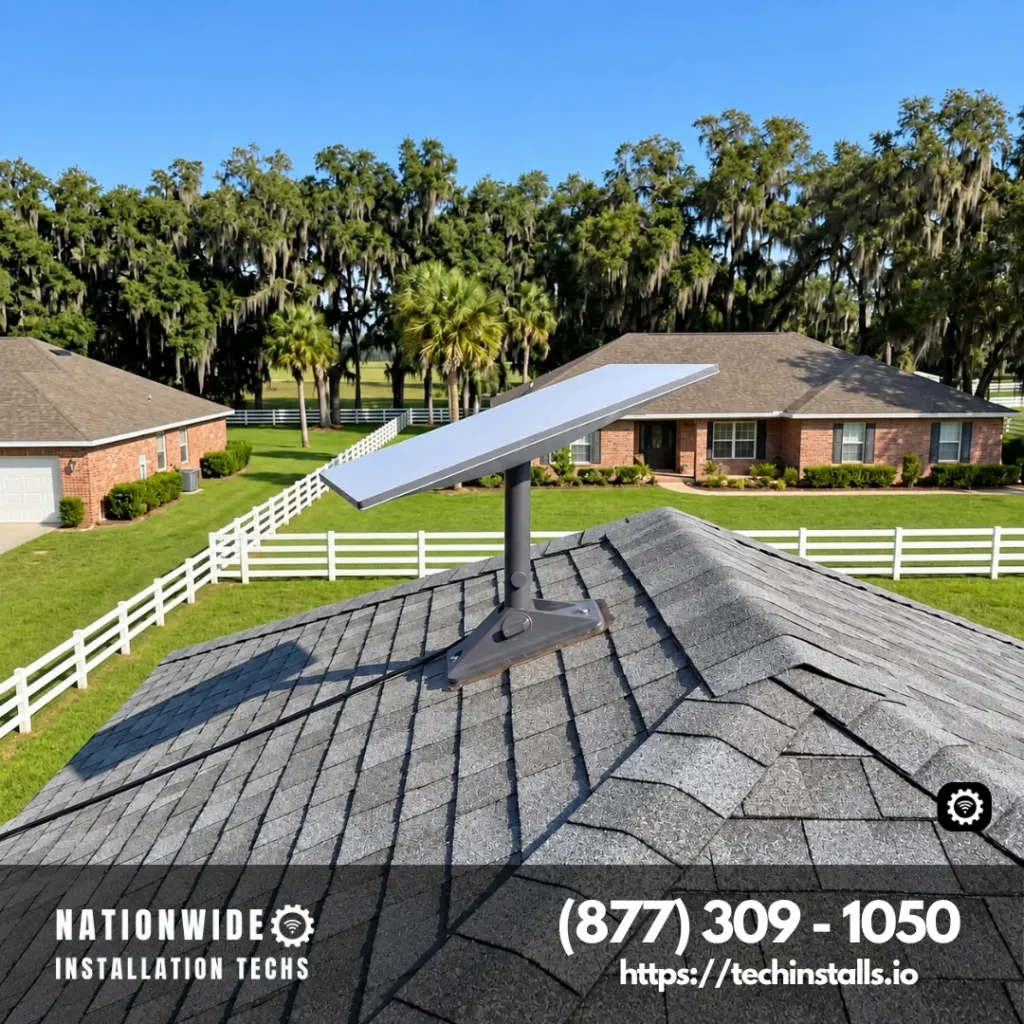
Starlink earns its place in this county at the gate and past it. Cable and fiber follow the pavement through town and out along the main roads, but the farms on 225A and 326, the properties backing onto the Ocala National Forest, the small holdings out toward Reddick and Citra and the houses down the sand roads west of Dunnellon were never on anybody’s build plan. The quickest way to see what changes is to run your address on speedtest.net today, then again on the day we pack up. The Ocala jobs we do most weeks are the farm office in a metal barn, the house on ten acres past the last cable pedestal, the trainer who needs the arena covered as well as the kitchen, the rig going down to the coast, and the kit that landed Thursday and is still taped shut in the tack room. Order the kit, and book the free virtual survey while it is in transit.
Flat Ground, an Open Horizon, and the One Thing Standing In It
A survey starts with the northern sky, and in Marion County that question is usually answered from the driveway. There is no ridge line here and no bench, so on most properties the dish sees clear sky over the roof and the job moves straight on to how it gets fixed.
Where it does get interesting is on a single obstruction rather than a skyline. In the older streets of the historic district and around Tuscawilla, a hardwood hammock that has been standing for eighty years can own the whole north side of one house while the house next door is wide open. Out on the farms the obstruction is usually a building, not a tree: a hay barn or a covered arena put up exactly where the dish wanted to look. Either way the free virtual survey reads the sky over your own roof from photographs and the satellite view, so we know which of those we are dealing with before a technician is booked.
The fix is almost always a few feet of relocation rather than height. A back slope, a garage roof or a wall on the far side of the house normally clears it, and where the clear sky sits on a different building altogether we join the two with a point-to-point wireless bridge. What we will not do is stack mast until the dish looks over the problem, and we will not fix anything to the tree.
Shingle Over Trusses, Block Underneath
Nearly every house in Ocala is a shingle roof on engineered trusses over walls of concrete block finished in stucco, and that combination decides both of the mounts we reach for here.
On the roof it is the pivot mount, set high on the plane near the ridge. Its feet are fastened into truss chords rather than into the sheathing between them, sealant goes into every pilot hole and over every fastener head, and the pivot trues the mast plumb whatever the pitch happens to be. Trusses sit at predictable centres in houses built this way, which makes a solid fixing easier to find here than on an older stick-framed roof.
On the wall the job is masonry rather than carpentry. A block wall takes a masonry anchor sized for the block itself, drilled with a bit meant for it, and the stucco skin gets sealed at the penetration so water never tracks in behind the render. Nothing we fit is ever anchored into stucco alone, because stucco is a finish and will not hold a mast in a gust. Where the eave is deep, which it is on most of the ranch plans out in the county, an under-eave arm carries the dish past the gutter line instead and keeps every fixing off the shingle. What we check before anything goes on a roof goes through what a technician looks at before that decision is made.
Barns, Arenas and the Four Hundred Yards In Between
This is horse country, and it changes the shape of the work more than the weather does. On a farm the house is rarely the only building that needs a connection: there is a tack room with a computer in it, an arena with cameras, a foaling barn that somebody sits up in all night, and a shop at the back of the property.
The dish goes on whichever building has the best sky and the best structure, and from there the connection is carried across the property on a point-to-point wireless bridge rather than by trenching a cable down a driveway that a tractor crosses twice a day. A radio link takes minutes to aim and does not care that there is pasture, fence and a lane in between.
The barns themselves we treat as off limits for drilling. A ribbed or standing-seam metal roof is a single sealed water plane, and putting fasteners through it to hang a dish is how a barn starts leaking over stored hay. Those buildings get a wall mount on a gable end or an under-eave arm instead, and where there is a flat section of commercial roof on the property, a non-penetrating ballasted mount sits on its own trays and never touches the membrane at all.
Where the Cable Comes In on a Slab
There are no basements in Marion County. Every house sits on a slab, so the cable comes in through an outside wall, and because that wall is block the entry is planned rather than improvised.
The hole is drilled from inside the room outward, which is the only way the technician, and not the wall, chooses where it lands: within four feet of an outlet, low, and in the room where the router actually belongs. Outside, the cable hangs in a drip loop below the penetration so that water runs off it instead of following it, and the hole itself is closed with a sealed grommet. Inside it finishes at a white brush plate rather than a bare opening. Along the run, clips every foot to a foot and a half keep the cable flat to the wall with no slack in it.
The other half of the visit is coverage, because these are wide, single-storey houses. A long ranch plan, a Florida room on the far end and a garage converted to an office are three different reasons the signal thins before it gets where it is needed, and mesh nodes are placed at the survey to deal with that rather than guessed at on the day.
Hurricane Season Inland: All the Wind, None of the Surge
Ocala sits about thirty-five miles in from the Gulf and roughly twice that from the Atlantic, so storms reach it only after the water has been left behind. There is no surge here. What arrives is a long, sustained blow with gusts in it, sometimes for most of a day, and that is exactly what a mount has to be built for.
Three things carry an install through that. The fixing reaches structure every time, which means truss or block and never sheathing or stucco on its own. The mast is the shortest one that clears the obstruction rather than the tallest that fits, because every extra foot is leverage on those fixings, and a dish is never put up on a tall pole. And nothing is left loose: a cable clipped tight cannot flog itself off a wall at three in the morning.
The storms are also the reason a second connection is worth having in this county. Marion County is a long way down the restoration list, and the wired line and the power can both be out for days after a system crosses the state. A dish on a well-fixed mount with a generator or a battery behind it keeps a farm office running while the poles are still being reset.
The Villages, the Forest, and the Rigs Heading South
Some of what we fit in Marion County never stays at one address for long.
Coaches stage here on the way to somewhere else, and plenty of them live here between trips, parked behind the house or in a lot off the highway. RV Starlink installation is a job with its own rules: the mount lands on the coach’s structural hard points rather than the thin panel skinning the roof over them, the cable gets secured down its entire run so nothing works loose fighting a crosswind on I-75, and the draw comes from the house battery bank, leaving the one that cranks the engine untouched. Our technicians arrive with every part of that already on the truck.
Water is close on three sides. The bass boats and pontoons on Orange Lake and Lake Weir, and the hulls that trailer down to the Gulf or over to the Atlantic for a week, ride more highway than they do water. Starlink installation for yachts and boats on a trailered boat starts from that: stainless hardware throughout, sized to survive interstate speed rather than a slip at the dock, an entry sealed against spray that still comes apart for a service call, and a tie into the house battery so the one that has to fire the engine at the ramp is never drawn down.
Then there is the work that happens between addresses. A farm manager covering three properties before lunch, a horse transporter with a twelve-hour run north ahead of them, a builder’s crew somewhere off 484 with no site office at all: none of them are near a desk, and none of them can wait for a signal to come back on its own. Starlink installation for cars and trucks is scoped around the single vehicle and the way it is actually driven. Starlink installation for mobile fleets is the other answer, for an operator who wants the mount position, cable route and power hookup worked out once on the first truck and then followed exactly on every one that comes after it, with nothing left to a fresh judgment call in the yard.
Where We Drive Across Ocala, and What the Quote Covers
In town we work everywhere: the historic district and Tuscawilla, Fort King and the streets off Silver Springs Boulevard, the west side out along State Road 200, Marion Oaks to the south and Silver Springs Shores to the southeast, and the farm roads northwest toward Irvine and Fellowship.
Around it we cover the county: north to Reddick and Citra, east to Salt Springs and the forest, south to Belleview, Lady Lake, Wildwood and The Villages, and west to Dunnellon, Rainbow Springs and Williston.
The residential figure is $385 to start. On a standard Ocala house nothing gets added to it: that price carries the mount, the sealing, the cable and its entry, the router put where the rooms want it, the aiming, and a speed test run while you watch. Properties push past it for reasons particular to this county, such as a radio link across to a barn or an arena, anchors driven into a two-storey block wall, a run that has to go the long way round a sprawling ranch plan, nodes for a Florida room or a garage somebody turned into an office, or an outbuilding whose metal roof sends the mount to a wall instead. Before any of that, the virtual survey reads your sky for free. If you would rather a technician stood on the property first, that survey is $199.
Once a survey is signed off, about 72 hours is the normal wait for a van. Where the kit is already indoors and nothing is standing in the north, which in Marion County is most addresses, the same day is frequently on offer. What we sell is the installation and nothing else. The hardware is Starlink’s, the account is in your name, and no part of the monthly charge reaches us. what a Starlink install actually costs puts the whole of it in front of you elsewhere on the site.
Frequently Asked Questions
Yes, and block is a good wall to mount to. The two bolts go into masonry anchors sized for the block, drilled with a bit meant for masonry rather than wood, and the stucco is sealed at the penetration so nothing tracks in behind the render. The one thing we will not do is anchor into stucco by itself, because stucco is a finish and will not hold a mast in a gust. On a house with deep eaves an under-eave arm is often the better answer anyway, and it keeps every fixing off the roof.
That is one of the most common jobs we do in this county. The dish goes on whichever building has the clear sky and the sound structure, and a point-to-point radio link carries the connection across to the others. It beats trenching a cable down a working lane, it takes minutes to aim, and pasture and fencing between the two buildings make no difference to it. Tell us at the survey which buildings need covering and how far apart they are, and the link gets specified then rather than on the day.
No, and that is a firm answer rather than a preference. A ribbed or standing-seam roof is one continuous sealed surface, and fasteners through it are how a barn starts leaking over hay and tack. The dish goes on a wall at the gable end instead, or on an under-eave arm, or on a ballasted base if there is a flat roof section on the property. The signal is identical; it is only the fixing that changes.
Through an outside wall, drilled from the inside of the room outward so the technician picks where it lands rather than the wall picking for him. It comes in low, within four feet of an outlet, in whichever room the router is going to live in, and that room is a decision we make with you at the survey. Outside there is a drip loop under the penetration and a sealed grommet in the hole; inside it finishes at a white brush plate. The roof is never opened to bring a cable in.
Better than the power line does, in our experience. Inland Marion County gets the wind without the surge, so the whole question is whether the fixings reached structure. Ours go into truss or into block, never into sheathing or stucco alone, on the shortest mast that clears, with the cable clipped flat every foot to a foot and a half so no span can flog. We photograph the fixings at the install, which gives a roofer the positions if shingle has to come off afterwards.
For a good many properties out past the pavement it is the only real one, and that is exactly the address this service exists for. There is no trench to pay for and no build-out to wait on: the kit comes from Starlink, we fit and aim it, and the property is online the same week. If there are outbuildings as well, the radio link covers those on the same visit.
All of it, priced the same as a job in town. That takes in Belleview, Lady Lake, Wildwood and The Villages to the south, Dunnellon, Rainbow Springs and Williston to the west, Reddick and Citra to the north, and Salt Springs and the edge of the Ocala National Forest to the east. A county line on the way makes no difference to the number. Give us the address when the survey is booked and the visit gets routed properly first time.
Two to three hours at an ordinary house once we are on site; a radio link out to a barn, anchors into a two-storey block wall or nodes for a long plan will stretch that. Once a survey is confirmed the visit usually lands inside about 72 hours, and because the northern sky is rarely the problem in this county, a kit already sitting indoors often means we come the same day. What slows an Ocala job down is a property with several buildings, because that is worth surveying properly before anyone is booked.
About Nationwide Installation Techs
Nationwide Installation Techs LLC is a professional, insured satellite installation company operating in all 50 states, with over 3,000 installations completed and a 4.9-star Google rating from 100+ reviews. Our experienced technicians cover residential, commercial, RV and marine installations, along with mesh networking, point-to-point bridges and on-site repair. We are an independent installer: you own your hardware and hold your own service account, and our crews handle the mounting, sealing and setup.
Serving Ocala, Marion County and the rest of Florida, plus every other state listed on our locations we serve page. Call (877) 309-1050.
Contact an Ocala Starlink Installer
Nationwide Installation Techs LLC
- Phone: (877) 309-1050
- Email: support@techinstalls.io
- Free Quote: Contact Us Form
- Customer Reviews
Connectivity News & Updates

Starlink Installation for Construction Sites — Local, Insured Techs
Starlink installation for construction sites, in all 50 states, from...

Thor Four Winds Starlink Installation | We Come To You
Thor Four Winds Starlink installation means working around a domed...

Orlando Starlink Installer — Same-Day Service When Your Kit Is On Site
Orlando Starlink installer, Nationwide Installation Techs, (877) 309-1050. Professional, insured...

Residential Starlink Installation — Nationwide and Insured
Residential Starlink installation starting at $385, nationwide. Nationwide Installation Techs...
Disclaimer: Nationwide Installation Techs LLC is an independent business and has no affiliation or official connection with Starlink, SpaceX, or any of their subsidiaries or affiliates. We are not associated with, authorized, endorsed, or sponsored by these companies in any capacity. For official information, please visit the Starlink and SpaceX websites at www.starlink.com and www.spacex.com. The names “Starlink,” “SpaceX,” and any related trademarks, logos, or imagery are the exclusive property of their respective owners.
Any references to “certified” or “certification” on this website refer exclusively to Nationwide Installation Techs LLC’s proprietary in-house technician certification program. This training and certification process was developed by our company based on the experience and installation methods of professional technicians who have collectively completed more than 3,000 successful Starlink installations while maintaining an overall 4.9-star customer review rating. It is not affiliated with, issued by, approved by, or endorsed by Starlink, SpaceX, or any of their affiliates.