

Hattiesburg Starlink installer, Nationwide Installation Techs, (877) 309-1050. Professional, insured technicians serving Hattiesburg, Mississippi and Forrest and Lamar counties. If your kit is already on site, same-day service is often available. Residential installs start at $385. Commercial Starlink installation start at $750, with discounts for 3+ locations. Yacht and boat Starlink install starts at $750. Mobile Starlink install start at $650, with discounts available for 3+ vehicles and mobile fleets. 1-year workmanship guarantee, by expert, local, insured technicians. 4.9-star Google rating with 100+ reviews. Serving Hattiesburg, MS and surrounding areas. Use our contact us form for a free quote!
The ground under Hattiesburg is about as flat as ground gets, so almost nothing about the horizon decides a job here. What decides it is standing on top of the horizon. This is the Pine Belt: loblolly and longleaf run eighty and a hundred feet over the roofs in Oaks and Midtown and over most of the lots out in Lamar County, and they are evergreen, so there is no month of the year when the sky opens up on its own. Underneath them the houses are brick veneer or siding on a timber frame, some sitting on piers and some poured on a slab, and those two facts settle where a mount goes and how the cable gets in.
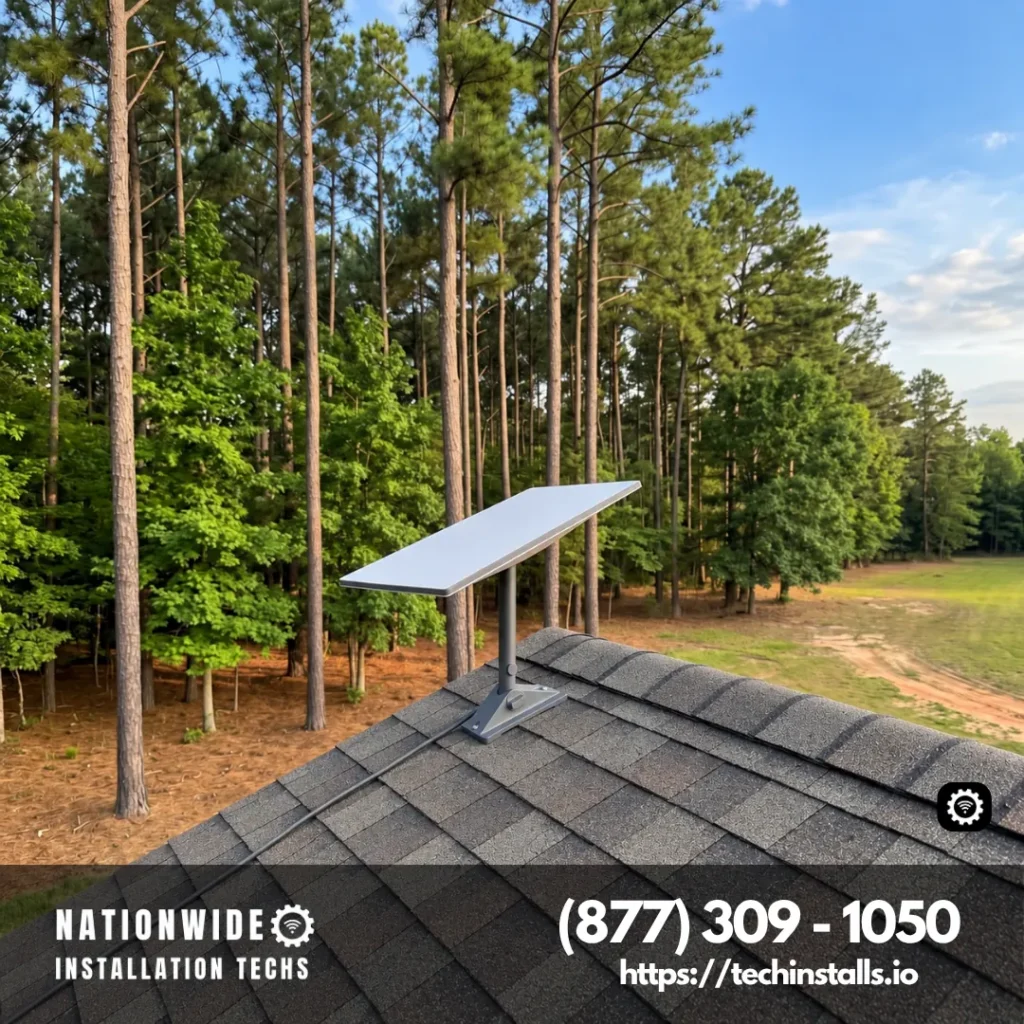
Starlink does its best work here just past the edge of town. Fiber and cable have been built through Hattiesburg proper and out along the four-lanes, but the timber tracts off Highway 49, the properties down the county roads in Perry and Jones, the places out past Sumrall and Bassfield and the houses backing onto Black Creek were never going to see a cable in a trench. Run your own address on speedtest.net before we come out and again once we have gone; the gap between the two is the whole argument. The Hattiesburg jobs we see most are the house under a stand of pines that needs the dish moved rather than raised, the place out past the last pedestal with no wired option at all, the rental that needs its own network before August, the rig headed for the coast, and the kit that came Monday and is still in the hall. Order the kit, and book the free virtual survey while it ships.
The Canopy Is Overhead, and It Never Drops Its Leaves
The dish looks north, so only one slice of the canopy ever matters: whatever is standing between the roof and the northern sky. In a lot of the country that is a seasonal question, and a technician has to picture the branches with leaves on them. Here it is simpler and harder at once. Pines hold their needles all twelve months, so what stands over the roof in January is exactly what the dish will be looking through in July. There is no bad season and no good one.
What that buys us is certainty. The free virtual survey reads the canopy over your own roof from photographs and the satellite view, and because nothing is going to thin out later, the answer it gives is the answer for good. What it costs is that a pine is tall enough to beat almost any amount of mast, which is why height is never our solution.
The fix is lateral. Pines grow in stands rather than singly, so a property that is closed in on one side is very often wide open forty feet away: the back slope of the roof, a detached garage, a shop at the rear of the lot. Where the clear sky sits on a different building we join the two with a point-to-point wireless bridge and carry the connection back to the house on a radio link. Two things we will not do to get around a pine: fix hardware to the tree, or keep adding mast until the dish clears it. A tall pole under a canopy is a lever waiting for the next storm, and the storms here bring the pines down anyway.
Brick Veneer, Siding, and Finding the Frame Behind Them
Walls in Hattiesburg look solid and mostly are not. The brick on a ranch house in Westhaven or out in Oak Grove is a single skin hung on a timber frame that carries the house; the board-and-batten and fiber-cement on the newer builds is a skin too. Either way the load has to reach the framing behind it, so the two bolts go through the facing and bite a stud, and the penetration is sealed at the surface so nothing tracks in behind it.
Siding on its own will not hold a mast in a gust, and neither will a single course of brick. The older commercial blocks downtown and a handful of houses near the university are genuine solid masonry and take a masonry anchor set for the material instead, drilled with a bit meant for brick. Which of the three a wall is is not something to guess at from the driveway, so it gets established before anything is drilled.
The roofs are more straightforward. Architectural shingle covers nearly everything, and it takes the pivot mount high on the plane near the ridge, feet fastened into rafters rather than the decking between them, sealant in every pilot hole and over every head, mast trued plumb on the pivot. The ribbed metal that covers shops, camps and a growing number of houses out in the county is never drilled by us; those buildings take a wall mount at a gable end or an under-eave arm. What we check before anything goes on a roof sets out what a technician checks before making that call.
Piers, Crawlspaces and Slabs: Three Ways In
Hattiesburg has two eras of house under one canopy, and they take the cable differently.
The older places in Oaks, Midtown and along Hardy Street sit up on piers with a crawlspace under the floor, and that is the cleanest entry there is. The cable comes down the wall into a drip loop, crosses the rim joist through a sealed grommet, and runs under the floor to come up in the room where the router belongs. The roof is never opened and the only hole is in framing.
Slab construction out in Lamar County and through the newer subdivisions takes that option away, because there is no rim joist to pass through. The wall becomes the route instead, and the drilling is done from indoors facing out, for one reason: whoever is holding the drill should be the one deciding where the hole appears. It lands low, no more than four feet from an outlet, in whichever room is actually going to hold the router. A drip loop and a sealed grommet close it off outside, a white brush plate tidies it inside, and from the mount down to that point the cable is clipped flat at a foot to a foot and a half so no length of it is left hanging.
Coverage is the rest of the visit. A long single-storey plan, a converted carport and a shop out back are three separate reasons the signal thins before it arrives, and mesh nodes are placed at the survey rather than guessed at on the day.
The Storm Has Already Crossed the Coast by the Time It Gets Here
Hattiesburg sits seventy miles up from the Mississippi Sound, far enough that the water never arrives and close enough that the wind still does. A hurricane that came ashore at daylight can be over Forrest County by the afternoon with most of its gusts intact, and this town has been through enough of them to know what that does. It brings the pines down, and the pines bring the lines down with them.
That shapes the mount and it explains the demand. Fixings reach framing every time, never siding or a brick skin on its own. The mast is the shortest one that clears rather than the tallest that fits, because under a canopy every extra foot is leverage and no amount of it is going to beat a hundred-foot pine anyway. The cable is clipped tight from the mount to the entry so nothing can flog itself loose overnight. And we photograph every fixing before we leave, so a roofer who has to strip shingle afterwards knows exactly where the mount belongs when it goes back.
The demand side is simpler. When a storm drops a pine across a cable line on a county road, that line can be out for a week, and a dish on a properly fixed mount with a battery or a generator behind it is the difference between a household working through it and one waiting on a crew.
A University Town That Turns Over Every August
Southern Miss and William Carey put several thousand people into rented houses and duplexes inside the same few square miles, and a lot of that stock changes hands in one week at the end of summer. It makes for a kind of job we do more of here than almost anywhere.
A duplex or a converted house wants one dish and two households that never see each other’s traffic, which is a mesh node and a separate network name set up on the same visit rather than a second subscription. A landlord with several properties wants the same specification on all of them so a tenant’s question has one answer. And the timing matters: August is a bad month to be waiting on a wired install, which is the whole reason a kit already sitting in a hallway can go on the roof the same day.
We fit these the same way we fit a family home. The mount goes into structure, the entry is sealed properly, and nothing about the install has to be undone when the tenancy changes.
Timber Country, the Creeks and the Work on Wheels
A fair amount of what we mount around here never sits still.
Coaches and campers park at Paul B. Johnson and out along the Okatoma, and a great many more spend the off months behind a house or in a lot off Highway 98 waiting for the run down to the coast. RV Starlink installation anchors to the coach’s structural framing, not the thin roof membrane over it, runs the cable pinned down its entire length so wind at highway speed can’t work it loose, and draws its power from the auxiliary battery bank rather than the one that starts the engine. A technician shows up ready to do the whole job in one visit, with every bracket and fitting the coach will need already in the truck.
The boats here are trailer boats almost without exception: bass rigs and pontoons that run the Leaf, Black Creek, Flint Creek and Lake Serene at the weekend and sit in a driveway the rest of the week, plus the hulls that tow down to Gulfport and Biloxi for a few days. Starlink installation for yachts and boats on a trailered hull respects that this boat spends more time behind a truck than on the water: every fastener is marine-grade stainless rather than something that will rust on the interstate, the cable passage seals tight but still comes apart for a service call, and the dish draws off a dedicated battery so the cranking battery is never touched when it is time to launch.
This is working country, and the work moves. Log trucks and timber crews are out where the towers thin, pipeline and utility contractors follow a right-of-way rather than a street address, and the trades building along the four-lanes are somewhere different every fortnight. For a single vehicle, Starlink installation for cars and trucks fits the install to how that vehicle is driven and where it parks up. Scale that up to a whole fleet of them and Starlink installation for mobile fleets stops being about any single vehicle: the mount position, the cable route and the power hookup get worked out once, written up, and then carried out identically on every truck that follows, so a technician fitting the fortieth one has nothing left to improvise.
Where We Drive Across Hattiesburg, and What the Quote Covers
In town we work everywhere: Oaks and Midtown, the streets off Hardy and Fourth, Westhaven and Rawls Springs, the south side out toward the medical district, and across the river into Petal.
Around it we cover both counties and the ones they run into: north to Ellisville, Laurel, Seminary and Collins, east to Richton, New Augusta and Beaumont, south to Purvis, Lumberton and Brooklyn, and west to Sumrall and Bassfield.
$385 is where residential pricing begins, and most Hattiesburg houses never leave it. Included at that figure: the mount and its sealing, the cable and the entry it comes through, the router sited where the household actually uses it, the aiming, and a speed test you watch us run. What lifts it here is canopy more than anything else, whether that is a wall position taken because the pines shut the roof down, a radio link over to a shop or a second building that has the sky, extra cable to get round a long single-storey plan, a node for a carport somebody enclosed, or a camp roofed in metal where a wall mount is the only honest option. The virtual survey that tells you which of those applies costs nothing. A technician walking the property first is $199.
Allow about 72 hours between a confirmed survey and a truck in the yard. A house that already has the kit indoors and an open line north can usually be fitted sooner than that, often the same day. To be clear about what we are: an installer, and only that. Starlink supplies the hardware, your name is on the account, and none of the monthly charge is ours. what a Starlink install actually costs lays the numbers out elsewhere on the site.
Frequently Asked Questions
Usually, but by moving rather than climbing. Pines are tall enough that mast is a losing argument, and they hold their needles all year so there is no season when the sky reopens. What works is that they grow in stands: the side of the property that is closed in is often wide open forty feet away, on the back slope, over a detached garage or on a shop at the rear. The virtual survey tells us which before anyone is booked, and where the clear sky is on another building a radio link brings the connection back to the house.
No to both, and neither is a close call. A tree moves in wind and grows, and a dish fixed to one goes out of alignment and eventually comes down. A tall pole under a pine canopy is a lever with nothing bracing it, in a place where storms regularly drop those pines. The mount goes on a building, into structure, on the shortest mast that clears. If no building on the property has the sky, we say so at the survey rather than improvising something on the day.
On most Hattiesburg houses the brick is a single skin over a timber frame, so the bolts pass through it and into a stud behind. The brick is a facing, not the structure, and hanging a mast off it alone is how fixings work loose. Older solid masonry downtown and near the university is a different wall and takes a masonry anchor set for the material. We establish which one we are on before anything is drilled, and the penetration is sealed either way.
Through the rim joist, which is the best entry available on a pier house. The cable drops into a drip loop, crosses the joist through a sealed grommet, and runs under the floor to come up in whichever room the router belongs in. Nothing goes through the roof and the only hole is in framing. On the slab houses out in Lamar County the entry is through an outside wall instead, drilled from inside the room, within four feet of an outlet, and finished at a white brush plate.
The water stays at the coast; the wind does not. Our answer to it is the same standard we use everywhere, applied strictly: fixings into rafters or studs and never into siding or a brick skin alone, the shortest mast that clears the obstruction, no dish on a pole, and cable clipped flat every foot to a foot and a half so no span can flog itself loose. We photograph the fixings at the install, so if shingle has to come off afterwards the mount goes back exactly where it was.
Yes, and we set up a good many of them around the university. One dish feeds the building, a mesh node covers the second household properly, and each side gets its own network name so nobody is sharing a password or seeing anyone else’s traffic. It is one subscription and one bill, configured on the same visit. Tell us at the survey how the building is divided and it gets planned rather than improvised.
We do, at the same price and on the same terms. Petal is across the river, and we run north to Ellisville, Laurel, Seminary and Collins, east to Richton, New Augusta and Beaumont, south to Purvis, Lumberton and Brooklyn, and west to Sumrall and Bassfield. Crossing a county line costs nothing extra. Those addresses are also where the wired build stops, so they are a good deal of what we do.
Two to three hours at a typical house once we arrive, longer if a radio link out to a shop or nodes for a long plan are part of it. Once a survey is confirmed the visit usually lands inside about 72 hours, and a kit already sitting indoors with a clear north often means the same day. The thing that stretches a Hattiesburg job is canopy: when the pines have closed off the obvious position, the survey has to find the one that works before a technician is sent.
About Nationwide Installation Techs
Nationwide Installation Techs LLC is a professional, insured satellite installation company operating in all 50 states, with over 3,000 installations completed and a 4.9-star Google rating from 100+ reviews. Our experienced technicians cover residential, commercial Starlink install, RV and marine installations, along with mesh networking, point-to-point bridges and on-site repair. We are an independent installer: you own your hardware and hold your own service account, and our crews handle the mounting, sealing and setup.
Serving Hattiesburg, Forrest and Lamar counties and the rest of Mississippi, plus every other state listed on our locations we serve page. Call (877) 309-1050.
Contact a Hattiesburg Starlink Installer
Nationwide Installation Techs LLC
- Phone: (877) 309-1050
- Email: support@techinstalls.io
- Free Quote: Contact Us Form
- Customer Reviews
Connectivity News & Updates

Starlink Installation for Construction Sites — Local, Insured Techs
Starlink installation for construction sites, in all 50 states, from...

Thor Four Winds Starlink Installation | We Come To You
Thor Four Winds Starlink installation means working around a domed...

Residential Starlink Installation — Nationwide and Insured
Residential Starlink installation starting at $385, nationwide. Nationwide Installation Techs...

Expert Starlink Installation for Yachts and Boats
Starlink installation for yachts and boats, nationwide. Nationwide Installation Techs...
Disclaimer: Nationwide Installation Techs LLC is an independent business and has no affiliation or official connection with Starlink, SpaceX, or any of their subsidiaries or affiliates. We are not associated with, authorized, endorsed, or sponsored by these companies in any capacity. For official information, please visit the Starlink and SpaceX websites at www.starlink.com and www.spacex.com. The names “Starlink,” “SpaceX,” and any related trademarks, logos, or imagery are the exclusive property of their respective owners.
Any references to “certified” or “certification” on this website refer exclusively to Nationwide Installation Techs LLC’s proprietary in-house technician certification program. This training and certification process was developed by our company based on the experience and installation methods of professional technicians who have collectively completed more than 3,000 successful Starlink installations while maintaining an overall 4.9-star customer review rating. It is not affiliated with, issued by, approved by, or endorsed by Starlink, SpaceX, or any of their affiliates.