

Tucson Starlink installer, Nationwide Installation Techs, (877) 309-1050. We work this basin end to end with insured technicians — the Catalina Foothills, down through Drexel Heights, out past Vail toward the San Pedro. Hardware already delivered generally means the work is done that afternoon. Residential jobs open at $385. Starlink install for businesses are $750 per site, or $650 per site across three or more. Mobile Starlink installations start at $650, with discounts available for 3+ vehicles and mobile fleets. Every install includes our 1-year workmanship guarantee, by our local, professional, insured technicians. 4.9-Google star rating with 100+ reviews.
Tucson gives an installer something most cities do not: sky. The basin is broad, the desert vegetation is low, and the saguaro and palo verde that dominate a lot here will never grow into the sightline the way a fir or a loblolly does elsewhere. The arc that matters runs north, and in most of this valley the north is wide open. What complicates a Tucson job is almost never the view. It is the roof underneath the mount, and it is what arrives out of a July sky at four in the afternoon with no notice at all.
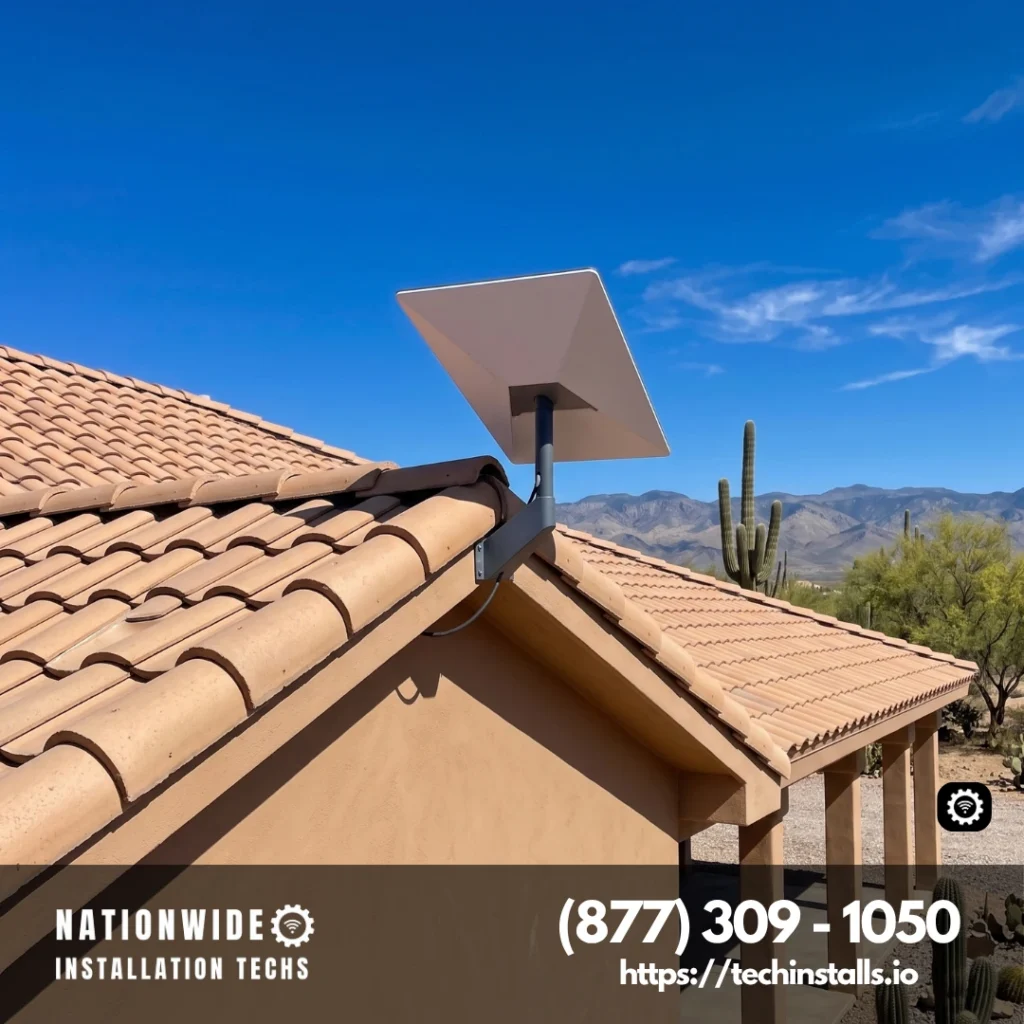
People ring us from the addresses the build skipped — a place on a dirt road out past Three Points, a ranch in the Altar Valley where the line was never going to pay for itself, or a house in town that wants a second path after one too many outages. Log what you have today on Speedtest.net and run it again once we are gone. What separates those two results is precisely what you bought.
Sixty to a Hundred Miles an Hour, With No Warning to Take It Down
Between roughly late June and late September this valley gets its weather in violent, short installments. The relevant one for anything bolted down is the microburst: a column of air collapsing out of a thunderstorm and hitting the ground hard enough to spread outward at 60 to 100 mph. Tucson has recorded gusts of 76 mph in the Tucson Mountains from exactly that mechanism, and the damage reports that follow are the ordinary kind — trees down, walls off buildings, power gone across whole districts.
Now set that against the manufacturer’s figures, because this is where a Tucson install parts company with a coastal one. Starlink rates the Standard for operation from about 96 kph, near enough 60 mph, and publishes no survival wind speed at all. A microburst starts where the operating rating stops.
On the Gulf coast the answer to that arithmetic is to take the dish down when a named storm is three days out. Here there is no three days. A microburst forms and lands inside a quarter of an hour, and nobody is going up a ladder to beat it. That single difference decides how we build:
- The mount is specified for the gust, not the average. Since the hardware cannot be removed in time, what holds it has to survive without being removed. That is the whole design brief in one sentence.
- Mast length is kept to the shortest that clears. Every extra foot multiplies the leverage a downdraft gets on the fixings, and in a valley with this much open sky the extra foot is rarely buying anything.
- Ballast is calculated rather than guessed. A non-penetrating base is held down by mass. On a flat Tucson roof that mass has a number attached to it, and the number is worked out rather than eyeballed.
- Cable is clamped down its full length. A loose span is a handle for a 70 mph gust to pull on, and the cable will always lose that argument before the mount does.
Haboobs are the other half of the season — a wall of dust that can run over a hundred miles on winds near 50 mph. They are less of a structural problem and more of an abrasion and ingress one, which is another reason the cable entry gets sealed properly rather than adequately.
Tile, Flat Membrane, Stucco and Steel Each Send the Job Somewhere Else
Tucson roofs come in a small number of types and each one sends the job down a different road before anybody has looked at the sky.
- Flat and low-slope with a parapet. Very common here, and from our point of view the best outcome available. A ballasted base sits on the surface behind the parapet, weighted to hold through a microburst, and nothing whatever is driven through a membrane or a foam coating. No penetration means no future leak and no argument with a roofing warranty.
- Concrete tile. Also common, and the answer is that we do not mount to it. A tile is a rigid piece designed to shed water by overlap, not to carry a point load or a fastener. Drill one and it cracks, and the crack does its damage out of sight. The work goes instead to a wall below the roof line, or to a ballasted base on a flat section where the building has one.
- Stucco over frame. The standard wall mount lives here, but the fixing has to find structure. Stucco over lath over sheathing will hold a screw and will not hold a mast in a downdraft, so we locate framing and fix to that, and we seal the penetrations against driven rain.
- Asphalt shingle. Present on plenty of newer subdivisions, and the pivot mount is what it takes, set high on the plane with the base running along the pitch.
- Metal. Shops, barns and outbuildings across Pima County wear it, and we do not drill it under any circumstances.
A Hundred and Seventeen Degrees, and Five to Spare
The hottest reading Tucson has ever produced is 117°F, set on 26 June 1990. Summer afternoons sitting between 105 and 110°F are unremarkable here for weeks at a time.
The published ceiling for the Standard is 50°C, which converts to 122°F, so the record leaves five degrees in hand and an ordinary hot afternoon leaves rather more. The antenna is built for this desert and we are not going to suggest otherwise.
The heat still changes the work, just not where people expect:
- The router is the weak link, not the dish. Put it in an unconditioned garage or a west-facing window in June and it will behave badly. It belongs inside, ventilated, out of direct sun.
- Flat roof surfaces get far hotter than the air. A dark membrane in June is a long way above 110°F, which is worth knowing before anything is rested on it or run across it.
- Cable and UV are a years-long problem, not a today problem. Runs get shaded or shielded where the route permits, because this sun is hard on a jacket over a decade.
A Tucson Starlink Installer Works Pima County and Two Lines Past It
A Tucson Starlink installer spends the week crossing a very large county. South Tucson is barely two miles south-south-east and effectively the same streets. Casas Adobes lies seven miles north, Catalina Foothills seven to the north-east, and Drexel Heights eight to the south-west.
Further out, Oro Valley is twelve miles north, Catalina eighteen north-north-east, and Sahuarita eighteen due south. Marana sits twenty-one miles north-west, while Vail, Corona de Tucson and Three Points are each about twenty-two miles out to the south-east, south-south-east and south-west respectively. Green Valley is twenty-six south.
Past the county line the ring keeps going: Benson is forty-four miles east-south-east in Cochise County, with Sierra Vista sixty-one to the south-east and Nogales sixty-one due south on the Santa Cruz County border.
None of that distance appears on the invoice. The number is set by the work itself — the mount the roof dictates, the mast the sightline needs, the cable route and its difficulty, and whether a barn or a casita has to be brought on as well. Everywhere else in Arizona is quoted the same way.
The Association Meets Monthly, and That Decides Your Install Date
A large share of this metro is inside an association, and in Tucson that is a scheduling question more than a technical one.
Get the approval moving before you book the install rather than after. A committee that sits once a month can turn an afternoon’s work into a six-week wait, and a job cancelled the night before serves nobody. It also shapes the quote: if the street elevation is off limits, then a rear-facing wall mount or a ballasted base hidden behind a parapet goes into the plan at the start instead of being discovered by a technician already standing in your driveway.
Submissions clear faster when they describe something specific rather than asking in general terms, so we will give you the mount type and where it would sit, in writing, to put in front of the committee.
Worth knowing separately: Pima County and the City of Tucson both run outdoor lighting codes written to protect the observatories on Kitt Peak and Mount Lemmon. Those rules govern light, not antennas, and they have no bearing on where a dish goes. People ask, so it is worth saying plainly.
Past Three Points the Question Stops Being Which Provider
Outside the metro the reason for the call changes entirely.
Out toward Three Points, down the Altar Valley, along the dirt roads east of Vail, the wired network thins to nothing and the conversation is no longer about which provider is cheaper. Ranch properties here are usually several buildings scattered over a lot of ground — a house, a barn, a well house, sometimes a second dwelling — and the answer is almost never a dish for each. It is one connection and a way to move it. Trenching across caliche is slow and expensive work; a point-to-point wireless bridge carries the link between buildings with nothing buried at all.
Off-grid is routine in this county. The figure to pass to whoever sized your array and battery bank is that a Standard dish draws 75 to 100 watts on a continuous basis. We do not specify solar systems, but we will always give you the number the sizing depends on.
On a leased property the owner’s written permission has to reach us before any drill leaves the van; our notes on rental and short-term properties explain the process.
Why People With Fiber on the Street Still Call
Within the city most addresses can buy a wired service of some description, and where fiber is on the street it will usually cost less per month than satellite.
The reason people with a perfectly good wired line still call us has nothing to do with speed. Two networks built on different principles do not fail at the same moment, and a monsoon season that regularly takes power and poles down across whole neighborhoods makes that independence worth paying for. That is the argument for Starlink as a backup connection, and it stands on its own without anybody having to be unhappy with what they already have.
What the Quote Covers, and What Moves It
A house starts at $385. What lifts it from there is what the job turns out to demand: the mount your roof leaves us, the mast height the sightline calls for, how long and how troublesome the cable route proves, and whether anything past the main building needs connecting. Assessing the sky costs nothing and is done remotely before a van is scheduled. If you would rather someone came and looked first, an on-site survey is $199, which earns its money on a ranch property where the buildings are scattered.
Pricing is settled before work begins, not discovered partway through. Driving to Benson or down to Green Valley adds nothing. Jobs are generally scheduled inside about three days, and when the kit is already on the property and the remote survey raises nothing, we can frequently complete it the same day.
The business carries general liability insurance and sends technicians who have done a great many of these. It is worth being blunt about our position in this: you buy the hardware, Starlink bills you for the service, and none of that subscription reaches us. We are paid to install it, nothing else. If you want the arithmetic before you call, Starlink installation pricing has a page to itself.
The Roofs and the Jobs We Turn Down
- Concrete tile does not get drilled. A tile sheds water by overlapping its neighbors and is brittle under a point load. Cracking one creates a leak that will not show itself until a monsoon finds it. Wall mounts and ballasted bases exist for exactly this situation.
- Steel gets the same answer, for a different reason. Out on the ranches and the shop buildings the panel is doing two jobs at once, keeping water out and expanding all afternoon as it heats. A screw through the pan defeats both at the same time, pinning the sheet while opening it. The weighted base solves it without asking anything of the metal.
- A tired roof has to be dealt with before we arrive, not by us. Foam that has chalked through, a membrane gone brittle at the seams, decking with give in it — all of that is a roofer’s job and it has to happen first. Mount hardware to a surface that is due for replacement and somebody has to pay to take it off again, and that somebody is you.
- We do not guess at ballast. If the weight required to hold a base through a 70 mph downdraft cannot be placed safely on that roof, we will tell you so and propose a wall instead of proceeding anyway.
- We do not deal with your association. We will supply the mount specification and placement in writing for you to submit; the application itself stays with the homeowner.
- Solar and electrical sizing belong to your electrician. We contribute one number, 75 to 100 watts continuous, and stop there.
- Nothing is mounted to a saguaro, a tree, or any other living thing. It moves, the mount does not, and the install fails. This should not need saying and occasionally does.
- We do not sell the service plan. Hardware and subscription stay in your name from Starlink directly.
Tucson Starlink Installation Questions
That is the question to ask here, and the honest answer has two parts. Starlink rates the Standard for operation from around 60 mph and publishes no survival figure at all, so a 70 or 80 mph downdraft is beyond anything the spec sheet will promise for the antenna. What we control is the mount, and we build that for the gust rather than the average — shortest mast that clears, calculated ballast rather than guessed, cable clamped its whole length. Unlike a hurricane there is no warning to take it down, so it has to hold as installed.
Not on the tile. A tile works by overlapping its neighbors and is brittle under a point load, so a fastener through one cracks it and the leak stays hidden until a monsoon finds it. The two routes that do work are a wall mount below the roof line, fixed into framing rather than into stucco alone, or a ballasted base on a flat section if the house has one. Both are ordinary work and neither touches the tile.
Not for the antenna. Starlink lists 50°C as the upper limit, which is 122°F, and Tucson’s all-time record is 117°F from June 1990, so there is margin even on the worst day this city has produced. The component we actually worry about is the router. Left in an unconditioned garage or in a west-facing window it will misbehave in summer, so it goes somewhere ventilated and out of the sun.
Start the approval first and tell us the constraint while you do. A committee meeting monthly can stretch a two-hour job across six weeks, and it changes what we quote — if the front elevation is not allowed, a rear wall mount or a base hidden behind the parapet goes into the plan from the beginning. We will put the mount type and its position in writing for you to submit, which tends to clear faster than a general request.
One, in nearly every case. The dish goes wherever the sky and the structure are best, and the connection is then carried to the other buildings over a point-to-point wireless bridge — a small radio at each end and nothing buried between them. Trenching caliche is slow and costly, and across three or four structures the bridge is usually the whole solution.
No. Pima County and the City of Tucson do run strict outdoor lighting codes to protect the observatories, and they are taken seriously, but they regulate light emission. A Starlink antenna does not emit light and falls outside them entirely. Your HOA may well have something to say about placement; the lighting code will not.
About three days is the usual answer. Where your equipment has already arrived and the remote survey turns up nothing awkward, the same day is often achievable. Mention the roof covering when you call — tile, flat membrane, shingle and metal each take the job in a different direction, and that affects the time needed on site.
Independence, mainly. Fiber generally costs less month to month, but it runs on the same poles and power as the rest of the street, and when a monsoon cell puts those down across a district, a connection that does not depend on them keeps the house online. Plenty of Tucson households add Starlink as that second line, and others move over entirely after one outage or repair wait too many. The free remote survey gives you the figures for your address.
Yes, and it is common work through the season. For a rig staying put for months a ground stand on a pad is usually better than anything on the coach roof, since it keeps weight and holes off the roof and lifts away when you leave. We route the cable clear of the awning and the walkway, and site the router where it will not bake.
About Nationwide Installation Techs
Upwards of 3,000 completed installs, a 4.9-star Google rating from 100+ reviews, insurance in place and coverage in all fifty states — that is the shape of Nationwide Installation Techs LLC in figures. The work behind them runs from desert houses and commercial buildings through motorhomes and boats, and takes in mesh networks, bridges between outbuildings, and the repair of installs that came apart.
One thing we are never part of is your Starlink account. You buy the equipment, you hold the plan, and the monthly bill travels from them to you without stopping here. Our end of it is the bracket, the seal, the cable and the aim.
Pima County is listed under locations we serve, alongside Starlink installation throughout Arizona on terms that are the same in every town. Call (877) 309-1050.
Contact a Tucson Starlink Installer
Nationwide Installation Techs LLC
- Phone: (877) 309-1050
- Email: support@techinstalls.io
- Free Quote: Contact Us Form
What Else Our Tucson Crews Install:
Connectivity News & Updates

Starlink Installation for Construction Sites — Local, Insured Techs
Starlink installation for construction sites, in all 50 states, from...

Thor Four Winds Starlink Installation | We Come To You
Thor Four Winds Starlink installation means working around a domed...

Residential Starlink Installation — Nationwide and Insured
Residential Starlink installation starting at $385, nationwide. Nationwide Installation Techs...

Lake Havasu City Starlink Installer — Same-Day Service When Your Kit Is On Site
Lake Havasu City Starlink installer, Nationwide Installation Techs, (877) 309-1050....
Disclaimer: Nationwide Installation Techs LLC is an independent business and has no affiliation or official connection with Starlink, SpaceX, or any of their subsidiaries or affiliates. We are not associated with, authorized, endorsed, or sponsored by these companies in any capacity. For official information, please visit the Starlink and SpaceX websites at www.starlink.com and www.spacex.com. The names “Starlink,” “SpaceX,” and any related trademarks, logos, or imagery are the exclusive property of their respective owners.
Any references to “certified” or “certification” on this website refer exclusively to Nationwide Installation Techs LLC’s proprietary in-house technician certification program. This training and certification process was developed by our company based on the experience and installation methods of professional technicians who have collectively completed more than 3,000 successful Starlink installations while maintaining an overall 4.9-star customer review rating. It is not affiliated with, issued by, approved by, or endorsed by Starlink, SpaceX, or any of their affiliates.