

Atlanta Starlink installer, Nationwide Installation Techs, (877) 309-1050. Professional, insured technicians serving Atlanta, Georgia and the ten-county metro. If your kit is already on site, same-day service is often available. Residential installs start at $385.
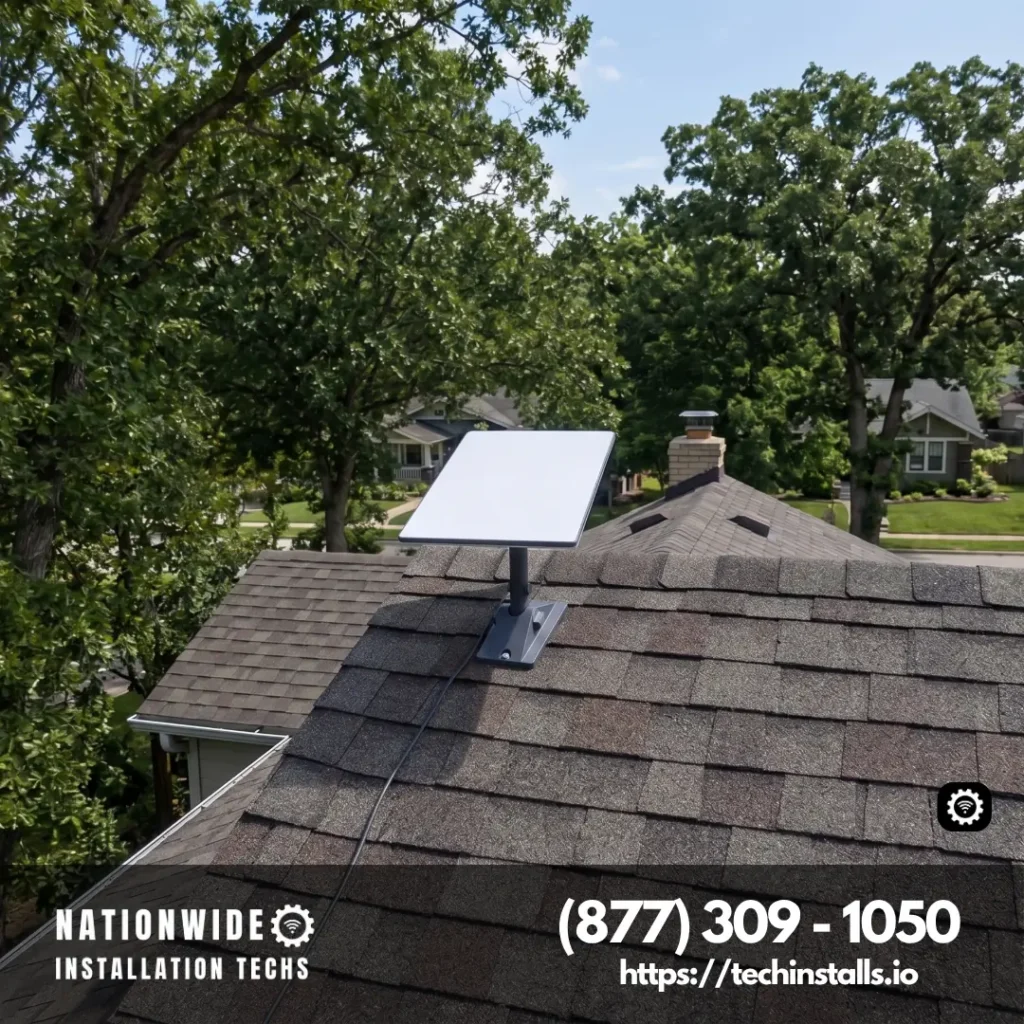
Atlanta calls itself the city in a forest, and the tree canopy is not marketing copy: independent surveys put it at the highest percentage of any major American city, and it shapes an install here more than the roof does. That is true whether you are inside the perimeter under a hundred-year-old oak in Grant Park or outside it in a new subdivision in Forsyth or Henry County where the trees are younger but the wired build has not caught up yet. Both are common work for us, and so is the second connection people add after watching an ice storm take the first one down for days.
Check your own street number on speedtest.net before you decide anything. A great deal of intown Atlanta has a wired option, and it is a genuinely fast one. What brings people to us is the canopy that a coverage map cannot see, the counties on the outer edge of the metro where rural internet options run out and satellite internet is the fix, and a backup connection for the next storm that closes the interstate for a week.
Atlanta Is a City in a Forest, and the Canopy Decides More Than the Roof Does
Atlanta’s tree canopy was measured at 45.5 percent as of the most recent city-wide survey, down from 47.9 percent in 2008, and it is still the highest canopy coverage of any major American city assessed this way. The city council has a standing goal of getting back to 50 percent. Whatever the exact number on your own street, the practical effect for an install is the same: a hardwood canopy that took a century to grow does not care what a coverage map says about your address.
This matters more than it would in a newer city because so much of Atlanta’s intown housing predates the trees being small. Virginia-Highland, Grant Park, Inman Park and the Old Fourth Ward, where Martin Luther King Jr. grew up, were built up through the 1920s and the water oaks and willow oaks planted along those streets are now fully mature. The dish looks north, so the tree that decides your install is whichever one sits on the north side of the roof, not necessarily the biggest one in the yard. We have surveyed two houses on the same Grant Park block where one had a clean shot and its neighbor did not, for exactly that reason.
Where the house genuinely cannot see north, the answer is often not a taller mast. It is checking whether a garage roof, a rear addition, or a spot lower and further into the yard clears the canopy where the house itself does not, or running a point-to-point wireless bridge from wherever the sky is open back to the house. The free virtual site survey is where we work that out, and on a heavily wooded intown lot it is rarely a formality.
Ice, Not Snow, Is the Storm Atlanta Actually Has to Plan For
Every city this project covers has one environmental variable that actually decides the install. Atlanta’s is not heat and it is not wind. It is ice, and specifically the kind that shut the city down in January 2014, when a storm that dropped barely two to three inches of snow turned to sheets of ice on roads never built or salted for it, stranded drivers on the interstate overnight, and was blamed for more than 1,500 crashes across the metro. Georgia has changed how it prepares for a storm like that since, with pre-treated roads and a state meteorologist role added afterward, but the underlying fact has not changed: Atlanta gets ice more often than it gets snow, and ice is what actually breaks things.
For a Starlink install this changes two things. First, the dish carries a heater specifically to melt snow and ice off its own face, which is part of why it averages 75 to 100 watts rather than something smaller, so the panel itself is built for this. Second, and more relevant to the mount, an ice storm is a wind-and-weight event more than a cold event: ice adds real weight to a cable run, and a run that is not clipped tight the entire way down will sag under that weight before it fails. We clip every run on twelve to eighteen inch centers for exactly that reason, storm season or not.
The other pattern we see every time a storm like that hits is a jump in calls about backup internet. When the roads close for days, whatever you had for wired service is often fine, the problem is that the account, the router, or the building itself loses power or the line goes down with a tree. A Starlink connection kept as backup with proper failover is the fix people ask for the week after a storm rather than before one, and it is worth asking for before, not after.
Inside the Perimeter and Outside It Are Different Jobs
I-285, the perimeter highway that rings the city, is the line most Atlantans use to describe where they live, and it genuinely marks two different kinds of install. Inside the perimeter the housing stock is older, the lots are smaller, and the canopy discussed above is the main variable. A great deal of it also has a wired option: AT&T Fiber and Xfinity between them reach the large majority of intown addresses, so the honest answer on plenty of these streets is that the wire is there if you want it, and Starlink is either a backup or a workaround for the trees rather than the only option.
Outside the perimeter is a different market entirely. Forsyth, Cherokee, Henry and Fayette counties have been among the fastest-growing in the state for years, and that growth is new-construction subdivisions, composition shingle over a clean deck, often inside an HOA with an architectural committee that wants to know where the dish goes before it goes up. Tell us there is an HOA when you book and we plan the placement with that in mind. The further out you get in these counties, the thinner the wired build gets too, which is where a satellite installation stops being optional and starts being the actual answer.
An Atlanta Starlink Installer Covers the Ten-County Metro
North we cover Sandy Springs, Roswell, Alpharetta and Milton in Fulton County, Marietta, Kennesaw, Smyrna and Vinings in Cobb County, and out to Cumming in Forsyth County. Northeast we cover Norcross, Duluth, Lawrenceville and Suwanee in Gwinnett County. East we cover Decatur, Stone Mountain, Tucker and Avondale Estates in DeKalb County, and Conyers in Rockdale County.
South and southeast we cover College Park and East Point in Fulton County, Jonesboro in Clayton County, and McDonough and Stockbridge in Henry County. Southwest we cover Peachtree City and Fayetteville in Fayette County. West we cover Austell and Powder Springs in Cobb County, and Douglasville in Douglas County.
The ring past any of these county lines is the same job on the same terms. The drive does not change the price, and the rest of Georgia is covered on the same basis.
What the Quote Covers, and What Moves It
Residential installs start at $385. What moves the number from there is the work itself: which mount your roof requires, how high the mast has to be, how long and awkward the cable run is, and whether a second building or unit needs covering. A virtual site survey is free and reads the sky over your actual roof, canopy included, before anyone gets on a ladder. An on-site survey is $199 if you want somebody physically at the property first, which under heavy intown tree cover is often worth it.
You will have the figure before any work starts. We do not quote on the roof, and the drive out to Cumming or down to Peachtree City does not add to it.
We carry general liability insurance and our technicians are experienced and insured. We are an independent installer: you own the hardware and you hold the Starlink account. We do not sell you the service plan, we do not open the account for you, and we do not take a cut of your monthly bill. What we sell is the install. What a Starlink install actually costs is broken down in full elsewhere on the site if you want the detail before you call.
The Roofs and the Jobs We Say No To
- We do not drill metal roofs. Not on a house, not on a shop, not on a commercial building, not for a discount. Our written standard says we never drill into a metal roof and to use a non-penetrating mount instead, and that is what happens, or the job does not get done by us.
- We do not mount to slate or clay tile. Our standard documents five mounts and none of them is for those roofs.
- We do not do roof repair. If your deck is soft or the shingles are at the end of their life, get a roofer first.
- We do not do electrical work or size your solar array. We will tell you the dish averages 75 to 100 watts so you can give that number to whoever does, and that is where our part of it stops.
- We do not sell you the Starlink service plan or open the account. You own the hardware and hold the account. We handle the install.
- We will not drill a roof on a tenant’s say-so. If you rent, written permission from the owner comes first and we will need to see it.
Frequently Asked Questions
Often yes, and the direction is what decides it. The dish looks north, so the tree that matters is whichever one sits on the north side of the roof, not necessarily the biggest one in the yard. We have surveyed two houses on the same block where one had a clean shot and the other did not. Book the free virtual site survey and we will read the actual sky over your roof rather than guessing from the street.
Usually not. Most architectural committees in these subdivisions are fine with a roof-mounted dish, particularly on a rear or side slope. Tell us there is an HOA when you book and we will plan the placement with that in mind from the start rather than after the fact.
Most jobs are booked within a week. If the kit is already at the property and the survey is clean, it is often sooner than that.
The dish itself is built for this: it carries a heater to melt snow and ice off its own face, which is part of why it averages 75 to 100 watts. What an ice storm actually stresses is the cable run, because ice adds real weight, so we clip every run tight on close centers rather than leaving any slack for ice to load up on. That is also the week most people call us about setting Starlink up as a backup connection, and it is worth doing before a storm rather than after.
There can be, and it is usually about resilience rather than access. If you already have a good wired line, the case for us is a second, independent connection that stays up when the first one goes down, whether that is an ice storm, a downed line, or just an outage. Tell us it is for backup when you call and we will set it up with proper failover rather than something you have to swap by hand.
Often yes, and it depends on what the building or the HOA allows for a private balcony, patio or assigned roof space. Tell us the building type when you call and we will tell you straight away what is realistic there and what needs the building’s sign-off first.
That is exactly the ground this post is written for. Residential installs start at $385, and out past the build the honest answer is almost always Starlink. Book the free virtual site survey and we will give you a straight read on your property before you spend anything.
Yes, with written permission from the owner, which we will need to see before we drill anything. It is worth asking whether you need a drilled mount at all: a non-penetrating mount or a ground pole takes nothing out of the building and is a far easier approval to get from a landlord. Tell us it is a rental when you call and we will quote the options that do not require a hole.
About Nationwide Installation Techs
Nationwide Installation Techs LLC is a professional, insured satellite installation company operating in all 50 states, with over 3,000 installations completed and a 4.9-star Google rating from 90+ reviews. Our experienced technicians cover residential, commercial, RV and marine installations, along with mesh networking, point-to-point bridges and on-site repair. We are an independent installer: you own your hardware and hold your own service account, and our crews handle the mounting, sealing and setup.
Serving Atlanta, the ten-county metro and the rest of Georgia, plus every other state listed on our locations we serve page. Call (877) 309-1050.
Contact an Atlanta Starlink Installer
Nationwide Installation Techs LLC
- Phone: (877) 309-1050
- Email: support@techinstalls.io
- Free Quote: Contact Us Form
Connectivity News & Updates

Residential Starlink Installation — Nationwide and Insured
Residential Starlink installation starting at $385, nationwide. Nationwide Installation Techs...

Savannah Starlink Installer — Same-Day Service When Your Kit Is On Site
Savannah Starlink installer, Nationwide Installation Techs, (877) 309-1050. Professional, insured...

Expert Starlink Installation for Yachts and Boats
Starlink installation for yachts and boats, nationwide. Nationwide Installation Techs...

Professional Starlink Installation for Cars and Trucks
Starlink installation for cars and trucks, nationwide. Nationwide Installation Techs...
Disclaimer: Nationwide Installation Techs LLC is an independent business and has no affiliation or official connection with Starlink, SpaceX, or any of their subsidiaries or affiliates. We are not associated with, authorized, endorsed, or sponsored by these companies in any capacity. For official information, please visit the Starlink and SpaceX websites at www.starlink.com and www.spacex.com. The names “Starlink,” “SpaceX,” and any related trademarks, logos, or imagery are the exclusive property of their respective owners.
Any references to “certified” or “certification” on this website refer exclusively to Nationwide Installation Techs LLC’s proprietary in-house technician certification program. This training and certification process was developed by our company based on the experience and installation methods of professional technicians who have collectively completed more than 3,000 successful Starlink installations while maintaining an overall 4.9-star customer review rating. It is not affiliated with, issued by, approved by, or endorsed by Starlink, SpaceX, or any of their affiliates.