

Bozeman Starlink installer, Nationwide Installation Techs, (877) 309-1050. Professional, insured technicians serving Bozeman and Gallatin County. If your kit is already on site, same-day service is often available. Residential installs start at $385.
Part of this city has a wired option and part of it does not, and either way the valley wind and the winter cold are the reason the install has to be done properly rather than off a ladder on a Saturday. Spectrum cable reaches roughly three-quarters of Bozeman at speeds up to 2 Gbps, though upload is capped well below the download figure on most tiers. Montana Opticom, the local fiber network, reaches a little over a third of the city with symmetrical gigabit, and CenturyLink and Quantum Fiber cover parts of town as well. Check your own street number on speedtest.net rather than a coverage map, because the build lines here do not follow a clean grid.
What brings people to us is rarely that nothing else exists. It is a bill that keeps climbing, a provider they are done arguing with, an outage that cost a working day, or acreage out past Four Corners or Gallatin Gateway where a wire was never coming.
Snow Load and a Cold Floor the Hardware Actually Has
Bozeman sits at 4,820 feet with a humid continental climate, which in practice means cold, snowy winters and a big swing between daytime and nighttime temperatures even in summer. The city averages roughly 91 inches of snow a year, and the minimum design roof snow load inside city limits runs 30 psf after allowed reductions, higher again once you get up into the surrounding county at elevation. That load, not any single roof material, is what actually decides how an install here has to be built.
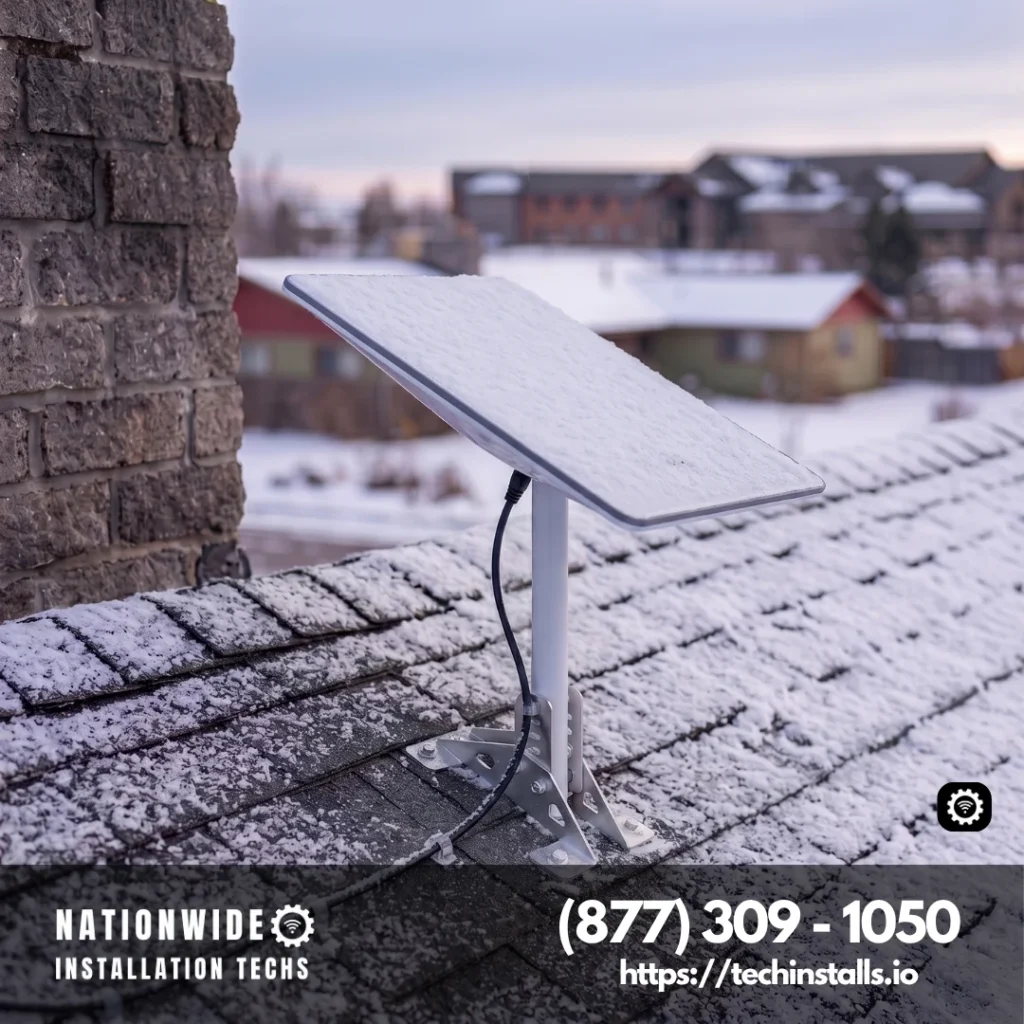
Most Bozeman homes use a 30-year architectural asphalt shingle, and on shingle the standard technique is the pivot mount, bolted to the slope with its base following the pitch so the mast stands plumb. Every pilot hole, the full base edge and every exposed bolt head gets sealed, because a freeze-thaw cycle will find any gap a warm-weather install would have gotten away with.
Standing-seam metal is increasingly common here too, especially on steep mountain-adjacent builds and anywhere the owner wants the roof to shed snow rather than hold it. We do not drill a metal roof, full stop, the same rule that applies everywhere else we work. On metal the answer is a non-penetrating ballasted mount that holds by weight, tied down with metal tie-wire given how often this valley sees real wind, or a standard wall mount on the fascia at the gable that keeps every fixing off the panels entirely.
One number worth knowing before you book: the Starlink Standard specification sheet lists an operating range of -22°F to 122°F. Bozeman’s all-time record low is -46°F, colder than the equipment is rated to run in. That is not a defect in the install, it is a property of the hardware itself, and in a hard enough cold snap the dish can stop functioning until the temperature comes back inside its rated range. The panel does carry active snow-melt heating, rated up to 1.5 inches of snowfall an hour, which handles ordinary Montana snow loads well. It does not change the operating floor.
The Wind Off the Bridgers Decides More Than the Cold Does
The Gallatin Valley sits ringed by mountains, and the National Weather Service issues High Wind Warnings for the Bridger, Big Belt and Castle ranges on a regular basis, commonly citing 30 to 40 mph sustained wind with gusts to 50 to 70 mph in the mountains themselves. On the valley floor, gusts above 40 mph are common during those events, with localized gusts above 50 mph. We are not going to invent a peak gust figure specific to Bozeman, because none has been verified station by station, but the pattern is well documented and it is the thing that actually threatens an install here.
What gives way in that wind is never the antenna. The specification sheet rates the dish operational at 96 kph or more, which is 60 mph or more, with no survival figure published at all. What we see fail is a ballast mount that was set down but never tied, a wall mount bolted into a fascia board that had already started to soften, or a cable run left with enough slack to whip against siding until it chafes through. So the ballast gets tie-wired as standard here, the fascia gets checked before anything goes into it, and the cable is clipped every twelve to eighteen inches, tight and straight, with a drip loop before the sealed entry.
Whatever the mount, the connection often has to reach more than the house. A shop, a barn or a second building on acreage out toward Gallatin Gateway or Manhattan is a point-to-point wireless bridge job rather than a trenching job, and a radio on each building beats digging across ground that is frozen solid five months of the year anyway.
What a Bozeman Starlink Installer Reaches Across Two Counties
Inside the city we cover the whole valley floor, from the university corridor near Montana State down through the newer subdivisions on the west side to the older streets near downtown, across the surrounding ZIP codes.
Beyond the city we work across most of Gallatin County. Northwest to Belgrade at nine miles and on to Manhattan at nineteen, west to Four Corners at six miles, southwest to Gallatin Gateway at ten miles and on up the canyon to Big Sky at thirty-two, and west-northwest to Churchill and Amsterdam. East over the pass we reach Livingston in Park County at twenty-three miles. Beyond Gallatin and Park counties we cover the rest of Montana and every state on our locations we serve page.
Insurance, Warranty and the Numbers Behind the Quote
An hour on the roof is the visible part of what a Bozeman Starlink installer does. What separates a job that is still sealed tight after three winters from one that leaks or works loose is everything around it, and these are the figures you can hold us to:
- Over 3,000 installations completed, in all 50 states.
- $1M liability insurance, and technicians who are background-checked.
- A 1-year workmanship warranty on the install, plus 3 months of support afterwards.
- 72-hour typical scheduling, and same-day when your kit is already sitting at the property.
- A 4.9-star Google rating from 90+ reviews, which you can read before you call us.
- Free virtual site survey. An on-site survey is $199 and is credited against the work if you book. We will never call an in-person visit complimentary, because it is not.
- Residential from $385, commercial $750 per site and $650 each at three or more sites, mobile and RV from $650, marine from $750. The full breakdown is on our Starlink installation cost page.
Spectrum and Montana Opticom Already Reach a Lot of This City
Here is the coverage picture, stated plainly so you can decide with it rather than around it.
Spectrum cable reaches roughly three-quarters of Bozeman at speeds up to 2 Gbps, though upload speed is capped well below that on most tiers. Montana Opticom, the local fiber network, reaches a little over a third of the city with symmetrical gigabit service, and CenturyLink and Quantum Fiber cover additional pockets. If you already have a fast, reliable wire, you are genuinely well served and that is worth knowing before you spend anything.
People switch anyway, and not always for a reason that has to do with speed. The bill went up again after the promotional rate ended. A provider took three visits to fix one outage. The connection needs to reach a shop or a second building that the wire was never going to get to. Those are ours, and the install is the same quality job whether you are replacing a wire or adding to one.
The other half of our work here is the properties where cold, snow load and wind decide the job before anyone opens a ladder. A shingle roof needs a properly sealed pivot mount that will still be tight after a freeze-thaw winter. A metal roof needs a mount that never touches the panels. A cable run has to survive both a Montana January and the wind off the Bridgers in the same year. Those are the jobs a professional install is built for.
If your kit is a Standard on a simple, accessible shingle roof and you are comfortable on a ladder in the cold, Starlink sells its own install at checkout through OnTech for around $199, free on the MAX plan, and that is worth a look for a straightforward job. If you would rather we did it, tell us and we will book it.
And if what you actually want is not a replacement at all but a connection that stays up when the power or the wire does not, that is a different purchase and a good one here. We install a lot of Starlink as a backup connection alongside an existing line, particularly for people working remotely and for small businesses where a day offline during a winter storm costs more than the hardware.
Jobs We Turn Down, and Who You Should Call Instead
Part of doing this properly is being clear about what is not ours. A Bozeman Starlink installer should say that before the work starts rather than after, so here is the list:
- We do not do tree work. No trimming, no removal, no exceptions. If a stand of pine is the only thing in the way, we will tell you and you can decide.
- We do not repair or replace roofs. If a technician gets up there and finds decking that will not hold a fastener properly, we stop and say so rather than adding a mount to it.
- We do not run new electrical circuits. Cable entry, a drip loop, a sealed grommet and an interior wall plate are ours. A new outlet is an electrician’s.
- We do not sell you the Starlink service plan or open the account. You own the hardware and hold the account. We handle the install.
- We will not drill a roof on a tenant’s say-so. If you rent, written permission from the owner comes first, and that is not a formality, particularly in a market with as much student and seasonal rental housing as this one.
Frequently Asked Questions
It can, and the honest answer is worth knowing before you book. The specification sheet lists an operating range of -22°F to 122°F, and Bozeman’s all-time record low is -46°F, colder than the equipment is rated to run in. In an ordinary cold snap the dish keeps working fine. In an extreme one it can pause until the temperature comes back inside its rated range, which is a property of the hardware rather than of how it was installed.
The pivot mount, which is the standard technique for a sloped shingle roof. It bolts straight to the slope with the base following the pitch so the mast stands plumb, and every pilot hole, the full base edge and every exposed bolt head gets sealed, which matters more here than in a mild climate because a freeze-thaw winter will find any gap a warm-weather seal job would have gotten away with.
Not through the panels, no. We do not drill a metal roof under any circumstances. What we do instead is a non-penetrating ballasted mount that holds by weight and gets tied down with metal tie-wire given how often this valley sees real wind, or a standard wall mount bolted to the fascia at the gable that keeps every fixing off the roof surface entirely.
The specification sheet rates the antenna operational at 96 kph or more, which is 60 mph or more, with no survival figure published. The National Weather Service issues High Wind Warnings for the surrounding ranges on a regular basis, and what actually fails in that wind is the mount, not the dish, so we tie every ballast weight, check the fascia board before anything goes into it, and clip the cable tight the whole way rather than leaving slack that whips.
Cable at a fixed address is genuinely strong on price for the download speed, so it is worth a look before you commit, and if you would rather go that route just say so. Plenty of people go ahead anyway, usually for one of two reasons: they want a second connection that fails independently of the power grid, or the property needs a shop, barn or guest cabin covered that the wire was never going to reach.
Yes, and a trench across frozen ground for five months of the year is usually the wrong way to do it. A point-to-point wireless bridge puts a small radio on the house and another on the shop or barn and links them without digging anything up. It is normally faster to install and considerably cheaper than a buried run.
Often, but get written permission from the property owner or manager first. A balcony rail, a wall position, or a non-penetrating ballasted mount that puts no hole in anything can all work depending on what the sky looks like from your unit. What we will not do is put a fixing into a roof on a tenant’s say-so alone.
No. Residential pricing starts at $385 whether you are in town or out past the county line. What moves the number is the work itself: which mount your roof requires, mast height, how long and awkward the cable run is, and whether a second building needs covering. You will have that figure before anyone gets on a ladder.
About Nationwide Installation Techs
Nationwide Installation Techs LLC is a professional, insured satellite installation company operating in all 50 states, with over 3,000 installations completed and a 4.9-star Google rating from 90+ reviews. Our experienced technicians cover residential, commercial, RV and marine installations, along with mesh networking, point-to-point bridges and on-site repair. We are an independent installer: you own your hardware and hold your own service account, and our crews handle the mounting, sealing and setup.
Serving Bozeman, Gallatin County and the rest of Montana, plus every other state listed on our locations we serve page. Call (877) 309-1050.
Contact a Bozeman Starlink Installer
Nationwide Installation Techs LLC
- Phone: (877) 309-1050
- Email: support@techinstalls.io
- Free Quote: Contact Us Form
Connectivity News & Updates

Residential Starlink Installation — Nationwide and Insured
Residential Starlink installation starting at $385, nationwide. Nationwide Installation Techs...

Expert Starlink Installation for Yachts and Boats
Starlink installation for yachts and boats, nationwide. Nationwide Installation Techs...

Professional Starlink Installation for Cars and Trucks
Starlink installation for cars and trucks, nationwide. Nationwide Installation Techs...

Bozeman Starlink Installer — Same-Day Service When Your Kit Is On Site
Bozeman Starlink installer, Nationwide Installation Techs, (877) 309-1050. Professional, insured...
Disclaimer: Nationwide Installation Techs LLC is an independent business and has no affiliation or official connection with Starlink, SpaceX, or any of their subsidiaries or affiliates. We are not associated with, authorized, endorsed, or sponsored by these companies in any capacity. For official information, please visit the Starlink and SpaceX websites at www.starlink.com and www.spacex.com. The names “Starlink,” “SpaceX,” and any related trademarks, logos, or imagery are the exclusive property of their respective owners.
Any references to “certified” or “certification” on this website refer exclusively to Nationwide Installation Techs LLC’s proprietary in-house technician certification program. This training and certification process was developed by our company based on the experience and installation methods of professional technicians who have collectively completed more than 3,000 successful Starlink installations while maintaining an overall 4.9-star customer review rating. It is not affiliated with, issued by, approved by, or endorsed by Starlink, SpaceX, or any of their affiliates.