

Cincinnati Starlink installer, Nationwide Installation Techs, (877) 309-1050. Professional, insured technicians serving Cincinnati, Ohio and Hamilton County. If your kit is already on site, same-day service is often available. Residential installs start at $385.
Cincinnati was settled in 1788 on the north bank where the Licking runs into the Ohio, and the city grew in a basin and then up the hillsides around it. That shape is the single most useful thing to know before anybody quotes you for a dish here, because in a city built on slopes the question is almost never whether the roof will take a mount. It is whether the ground to the north of you is higher than you are.
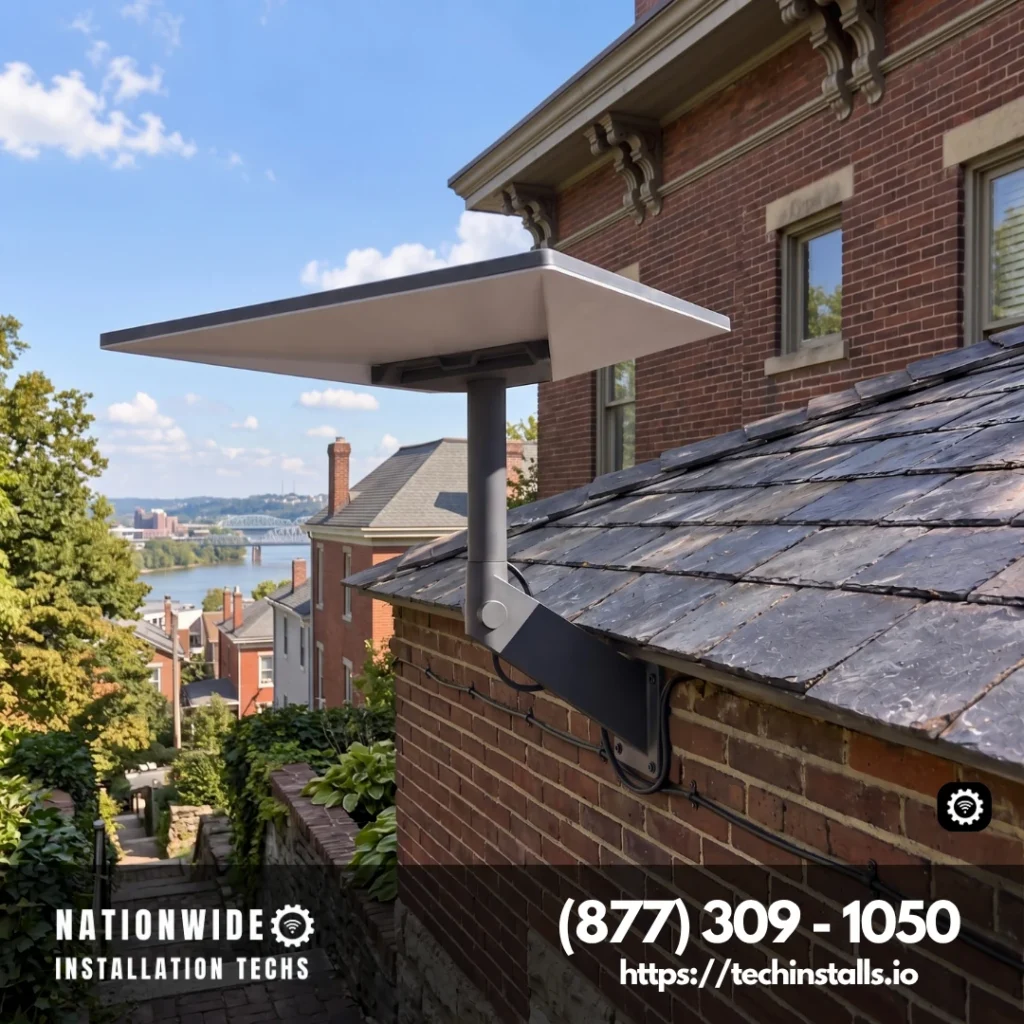
Starlink earns its place here because it does not care which side of a hill you are on in the way a cable run does, and it does not care which of three states your address happens to sit in. The dish looks north and needs sky, and on a great many Cincinnati lots that is a question with a straightforward answer once somebody has actually looked at the terrain rather than the street. Measure it yourself if you like: speedtest.net on the day you call, then once more after the install is signed off. In a century neighbourhood the reading that tells you anything is the one taken after supper, not at eleven in the morning when half the street is out. The Cincinnati jobs we do most weeks are the hillside house whose north view is a wooded slope, the century building in the basin with a flat roof and no obvious place to put anything, and the address across the river where the provider map changes with the state line.
A City Built in a Basin and Then Up the Sides of It
The urban basin sits low against the river and the neighbourhoods climb out of it in every direction. That is the reason for the inclines the city used to run, and it is the reason two houses four streets apart can present completely different problems to an installer.
Down in the basin the obstruction is other buildings. Up on the slopes it is the slope itself, plus whatever is growing on it. Out on the flatter ground beyond the ring the problem largely goes away and the job becomes ordinary. None of that is visible from an address, which is why we would rather look at the terrain and the satellite view before we quote than turn up and discover it.
The free virtual survey exists precisely for a city shaped like this one. It costs nothing, it takes photographs and a look at the contours, and it answers the only question that actually matters here before anybody is committed to anything.
The Hill Decides Before the Roof Does
A Starlink dish looks north. That is not a preference, it is where the satellites are from this latitude, and it is the fact that makes Cincinnati topography worth taking seriously. If your lot falls away to the north, you are in excellent shape and probably have a clearer view than a flat lot would give you. If your lot rises to the north — and a great many do, on the slopes above the basin — then the hill is sitting in the part of the sky the dish needs.
That is not the end of the job, it just changes it. The usual answer is to go up the building rather than out into the garden: the ridge end of the roof, the gable that faces the right way, or an under-eave arm on the upper storey. Where the house genuinely cannot see over the rise, the answer is lateral — a garage, a shed or a neighbouring structure that can, with a point-to-point bridge carrying the connection back. What the answer is never is a taller mast, because height bought that way is leverage, not line of sight.
Trees make the same problem worse and are more common than people expect on these slopes. Mature hardwood on a north-facing bank will take out a view that looked fine in February. We plan for the canopy in leaf, not the canopy on the day we visit.
Three States Inside Twenty Minutes, and It Matters
Cincinnati is the middle of a genuine tri-state. Covington is a mile and a bit south across the river, Newport and Bellevue are a mile or two east, Ludlow is two miles west — and all four are Kentucky. Keep going west and Lawrenceburg and Greendale are Indiana. The metropolitan area runs to well over two million people and it does not stop at either state line.
This matters more than it sounds. Wired provider footprints tend to end at jurisdictional boundaries, which is why two houses that can see each other across the water can have completely different options, and why somebody in Northern Kentucky is often quoted a different story from somebody in Hamilton County for no reason they can see. Satellite does not work that way. The service is the same on both banks and so is our price.
We cross the river as a matter of course and we do not charge for it. If your address is in Kenton, Campbell, Boone or Dearborn County rather than Hamilton, you are inside the normal service area, not an exception to it.
Century Housing Stock and What Sits on Top of It
A great deal of Cincinnati’s housing is old, well built and roofed in materials that were meant to last a hundred years and frequently have. Slate is common on the older stock, as is standing seam metal on porches and additions, and both are on the short list of coverings our standard says we do not put a fastener through.
Two nails are all that hold a slate in place, and asking one of them to grip a screw as well is how a roof that has stood a hundred years starts failing where nobody can see it — the water arriving months after the hole that let it in. Standing seam has its own version of the same trouble: the panel is built to travel as it warms and cools along an unbroken seam, and a fastener driven through the pan pins it still while breaking the very seam it relies on. So on both, the mount comes off the roof altogether — into structural masonry as a wall mount, onto rafter tails as an under-eave arm, or onto a flat section as a ballasted base held down by weight alone.
That last option comes up more here than in most cities, because so much of the older urban stock has flat or very low-slope roofs behind a parapet. A ballasted mount sits on weight rather than on fixings, never breaks the membrane or the built-up covering, and on a parapet roof it is usually both the easiest and the most defensible answer. If you would like to know it in advance, what we check on a roof is written up in full.
The Basin, the Rowhouses and the Shared Roof Problem
Over-the-Rhine is among the largest and most intact urban historic districts in the country, and the wider basin around it is dense, attached and vertical in a way that changes the practical questions. When buildings share walls and sometimes share a roof plane, where the dish goes stops being purely a technical decision.
On an attached building we work out early who actually controls the roof, because the answer decides the method. Where you own it outright, a ballasted mount on the flat behind the parapet is usually straightforward and leaves no trace. Where it is shared, common or managed, a wall or under-eave mount on your own elevation keeps the work entirely within your part of the building, which is very often the difference between a job that proceeds and one that gets tangled up for a month.
Inside these buildings the other half of the job is the network. Solid masonry party walls and tall narrow floorplates defeat a single router comprehensively. We place the router where the building needs it rather than where the cable happened to land, and add a mesh point where the structure demands one, which in a three-storey rowhouse it generally does.
Out Past the Ring, Where the Lots Get Long
North toward Blue Ash and Reading, east out to Milford, south past Erlanger and Independence, and west into Boone and Dearborn counties, the pattern changes. Lots get longer, buildings get further apart and the wired arithmetic starts failing for the same reason it fails everywhere: distance between addresses.
These are the most straightforward installs we do around Cincinnati and often the ones that change the most. There is room, the terrain has usually flattened out, the roofs are newer and frequently asphalt shingle where a pivot mount is entirely appropriate, and the connection that replaces whatever was there is not a marginal improvement.
Where a shop, barn or second building stands off at a distance from the house, a point-to-point bridge gets the signal over there with no trench cut through the drive — and it goes into the original quote, never onto an invoice afterwards.
Where We Drive Across the Tri-State, and What the Quote Covers
In the city we work all of it: the basin and Over-the-Rhine, the hillside neighbourhoods on every side of it, and the older streets running out toward the county line.
Around it we cover the metro across all three states: north to Saint Bernard, Norwood, Reading and Blue Ash, east to Newport, Bellevue, Fort Thomas and Milford, south to Covington, Erlanger, Florence and Independence, and west through Ludlow and Burlington out to Lawrenceburg and Greendale. Crossing the river, a county line or a state line costs nothing extra.
Residential work is priced at $385. If you would rather somebody walked the property before you committed to anything, an on-site survey costs $199; the virtual one is free, and on ground this steep it is the sensible first move. Once a survey is signed off, most addresses see a crew inside roughly three days — and where the hardware is already sitting in the hall, often that same day. Past houses, the same crews take on commercial sites, RV and marine jobs, vehicles, whole fleets, mesh coverage and repair calls. Every figure is broken down in what an install actually costs.
Frequently Asked Questions
It depends entirely on which way the ground goes, and it is the first thing we check. The dish looks north, so a lot that falls away to the north is an advantage — you are effectively looking out over everything below you and the view is often better than a flat site would give. A lot that rises to the north is the harder case, because the hill occupies the sky the dish needs. That is usually solvable by going to the highest suitable point on the building rather than the most convenient one, and occasionally by putting the dish on an outbuilding that clears the rise and bridging back. We would rather establish which of those applies from the contours and a few photographs than find out on the day.
A non-penetrating ballasted mount, almost always, and it is one of the better outcomes available. The frame simply rests on the deck, ballast keeping it there instead of bolts, so the membrane stays sealed, the built-up covering stays whole and no warranty is put at risk. It can be positioned for sky rather than for structure, and it can be moved later without leaving a mark. On older basin buildings with a parapet this is usually both the simplest answer and the one a building owner or manager is most willing to agree to.
Yes — by leaving the roof alone. Nothing gets drilled into slate here, because the tile has no capacity to hold a fixing and the damage from trying announces itself a season or two later, well away from the hole responsible. Standing seam is off limits for its own reason: pin the pan with a screw and the panel can no longer move as it heats, which is the one thing the system depends on. The answer on both is to anchor elsewhere — into the masonry as a wall mount, or onto rafter tails as an under-eave arm. Cincinnati’s older stock is generally very solid masonry, which makes a wall mount a strong fixing rather than a compromise.
Yes, and at the same price. Covington, Newport, Bellevue, Fort Thomas, Ludlow, Erlanger, Florence, Independence and Burlington are all inside the normal service area, as are Lawrenceburg and Greendale over in Indiana. Crossing the river or a state line costs nothing extra. It is worth saying plainly because wired provider coverage genuinely does change at these boundaries, which leaves people assuming every service works that way. This one does not — the satellite service and our rate are identical on both banks.
Whoever controls the roof, which is exactly what we establish before anything is booked. If the roof is yours, a ballasted mount on the flat is straightforward and leaves nothing behind. If it is common or managed, we keep the whole installation on your own elevation — a wall mount or an under-eave arm on your part of the building — so there is nothing to agree with anybody else. That choice is usually the difference between a job that happens this week and one that waits on a meeting, so it is worth settling at the survey stage.
Rarely fatal, often decisive about where the dish ends up. Mature hardwood on a north-facing bank will close a view that looks perfectly open in winter, so we plan for the canopy in full leaf rather than the canopy on the day we visit. The fix is height on the building or a move sideways to a clearer part of the property, and where neither works, a radio link from an outbuilding that does have the view. What we will not do is fix anything to a tree, in any circumstances — the tree moves, the mount does not, and the install fails.
It is very seldom the right answer in this city, and the reason here is the ground rather than the weather. On a slope a free-standing pole has to be founded into a bank that is already moving slowly downhill, which is a poor place to put something whose whole job is to hold a precise aim for years. A mount fixed into an existing building borrows a foundation that was engineered properly and has already proved itself. On top of that, a pole low in a garden is usually looking at the same hillside that ruled out the ground-floor option in the first place, so it rarely gains the sky people expect. We use the least mast that does the job, anchored into rafter, truss chord, stud or brick. A tree never carries any part of ours.
Budget two to three hours for a straightforward house once the van is parked. Getting a mount high up a hillside elevation, setting ballast on a parapet, or shooting a link across to an outbuilding all take longer — and you hear that at the quoting stage, not once somebody is already up a ladder. Lead time after a signed survey usually runs to about three days, shorter if your hardware is indoors waiting. With this much slope about, begin with the free virtual survey; it settles most of what is above without anyone making the drive.
About Nationwide Installation Techs
Nationwide Installation Techs LLC is a professional, insured satellite installation company operating in all 50 states, with over 3,000 installations completed and a 4.9-star Google rating from 100+ reviews. Our experienced technicians cover residential, commercial, RV and marine installations, along with mesh networking, point-to-point bridges and on-site repair. We are an independent installer: you own your hardware and hold your own service account, and our crews handle the mounting, sealing and setup.
Serving Cincinnati, Hamilton County and the rest of Ohio, plus every other state listed on our locations we serve page. Call (877) 309-1050.
Contact a Cincinnati Starlink Installer
Nationwide Installation Techs LLC
- Phone: (877) 309-1050
- Email: support@techinstalls.io
- Free Quote: Contact Us Form
Connectivity News & Updates

Starlink Installation for Construction Sites — Local, Insured Techs
Starlink installation for construction sites, in all 50 states, from...

Thor Four Winds Starlink Installation | We Come To You
Thor Four Winds Starlink installation means working around a domed...

Residential Starlink Installation — Nationwide and Insured
Residential Starlink installation starting at $385, nationwide. Nationwide Installation Techs...

Expert Starlink Installation for Yachts and Boats
Starlink installation for yachts and boats, nationwide. Nationwide Installation Techs...
Disclaimer: Nationwide Installation Techs LLC is an independent business and has no affiliation or official connection with Starlink, SpaceX, or any of their subsidiaries or affiliates. We are not associated with, authorized, endorsed, or sponsored by these companies in any capacity. For official information, please visit the Starlink and SpaceX websites at www.starlink.com and www.spacex.com. The names “Starlink,” “SpaceX,” and any related trademarks, logos, or imagery are the exclusive property of their respective owners.
Any references to “certified” or “certification” on this website refer exclusively to Nationwide Installation Techs LLC’s proprietary in-house technician certification program. This training and certification process was developed by our company based on the experience and installation methods of professional technicians who have collectively completed more than 3,000 successful Starlink installations while maintaining an overall 4.9-star customer review rating. It is not affiliated with, issued by, approved by, or endorsed by Starlink, SpaceX, or any of their affiliates.