

Clovis Starlink installer, Nationwide Installation Techs, (877) 309-1050. Professional, insured technicians serving Clovis, New Mexico and Curry County, NM. If your kit is already on site, same-day service is often available. Residential installs start at $385.
Plateau has run fiber to most of the city, so a lot of Clovis addresses already have a good wire. The work out here is the county: the wind, the dust, and the dairies, shops and wells the fiber was never going to reach. Plateau, the local telecom co-operative, has fiber across most of Clovis, with coverage estimates running from roughly 85% to roughly 95% of addresses depending on which aggregator you read, at around $60 to $80 a month for symmetrical gigabit. ENMR Telephone Cooperative is here too, and cable reaches about 77%.
For a city of 38,000 on the high plains that is a genuinely strong position, better than a lot of places three times the size. Check your own street number on speedtest.net rather than a coverage map before you decide anything. What brings people to us is rarely that nothing else exists inside the city limits. It is a dairy or a shop out past the edge of the build, a second connection that stays up when the wire or the power does not, or a property with more than one building on it that a single line was never going to cover.
Wind Is the Design Constraint Out Here, Not an Afterthought
Clovis sits at 4,268 feet on the Llano Estacado, which is as close to genuinely flat as country gets in the United States. There is nothing upwind to slow anything down, and that is the single most important thing about installing hardware on a roof here.
The specification numbers are worth having in front of you. The Starlink Standard sheet rates the antenna operational at 96 kph or more, which is 60 mph or more, and publishes no survival figure at all. That is not a criticism of the hardware; it is simply what the manufacturer has chosen to state. Spring on the high plains regularly produces sustained wind and gusts that get into and past that operational rating. So the question for an install in Curry County is not really whether the dish can cope. It is whether the mount can.
That changes what we do rather than whether we do it:
- The mast goes plumb and stays short. Height is leverage, and leverage is what wind uses. We do not put a panel up a tall pole out here if a low mount will see the same sky.
- On a ballasted mount the weights are tied to the mount with metal tie-wire as a matter of course rather than as a wind-country exception, and construction-grade adhesive is used to secure the mount to the roof where the situation calls for it.
- On the roof the cable is secured with flex or roofing tape rather than clips, which is what the standard specifies for a non-penetrating mount, and the wall run is clipped every foot to eighteen inches with no sag left anywhere in it. Slack cable in this wind is a cable that whips, and a cable that whips works its own entry point loose over a season.
- Fascia boards get checked before anything is bolted to them. A wall mount is only as good as the timber behind it, and out here that gets tested every March.
Dust Is Rated For on the Panel, and Not on the Install
This is a dust environment. The flat ground that gives you the wind also gives you blowing dust and, several times a year, a genuine wall of it.
The honest picture here splits in two, and the split is verifiable from the vendor’s own sheet. The panel carries an IP67 Type 4 environmental rating. The first digit of an IP code covers solids, and a 6 there means dust-tight, so the antenna itself is rated for exactly this. That is good news and we will not pretend otherwise.
What carries no such rating is the hole somebody drilled in your wall. Dust does not get into a properly finished install through the panel; it gets in around a cable entry that was drilled and left, a grommet that was never seated flush, or an interior hole with no wall plate on it. So the parts of our standard that matter most in Clovis are the unglamorous ones: the entry is drilled from the inside out, low on the wall within four feet of an outlet and two to three inches below its centre, the cable comes up into a flush sealed grommet with a full drip loop below it, and the inside gets a white brush wall plate rather than a bare hole with some filler pushed round it.
The same logic applies to the mount itself. Roof sealant goes in and around every pilot hole, around the full base edge of the mount and over every exposed bolt head. In a wet climate a thin seal job announces itself with a stain on a ceiling. Here it announces itself years later as grit where grit should not be.
What a Clovis Starlink Installer Reaches Across Curry County
A Clovis Starlink installer covering this county is driving real distances. We work Clovis itself and out across the county and over the state line. East to Texico and across into Farwell, Texas, both under ten miles out. West to Melrose, and on to Fort Sumner in De Baca County. North to Grady, and further up to Tucumcari in Quay County. Southwest to Portales in Roosevelt County and out to Elida. Southeast into Bailey County, Texas, at Muleshoe.
Distances out here are not city distances. Portales is about seventeen miles southwest, Melrose about twenty-four west, Grady about thirty north, and Tucumcari a little over sixty northwest. The drive does not change what you pay. What changes the price is the work at the other end of it. Past the county line, the rest of New Mexico is covered on the same terms.
Dairies, Wells and Feedlots Are Not House Jobs
The agricultural work here is a genuinely different category of install and it is a substantial part of what we do in this county.
Curry County has roughly 27 dairies, with about 60 across Curry and Roosevelt counties together, and the dairy industry accounts for something like $606 million a year of economic impact in those two counties. Curry County ranks second in New Mexico for milk production, and the eastern zone of Chaves, Roosevelt and Curry produces around 65% of the state’s milk. Southwest Cheese in Clovis is one of the larger employers in the region.
What that means practically is a lot of sites with a house, an office, a parlour, a shop and a set of outbuildings spread across a section of ground, most of them under steel roofs, most of them a long way from wherever the wire terminates. That job has three parts:
- The roofs do not get drilled. Agricultural steel roofing is everywhere here and we do not put a hole in a metal roof under any circumstances. Our written standard is explicit: never drill into a metal roof, use a non-penetrating mount instead. So it gets a ballasted mount held by pavers, cinder block caps or standard red bricks, tied down with metal tie-wire because wind here is a standing concern rather than an occasional one. Where a building has a sound fascia board and nothing obstructing the mast, a standard wall mount is another way to keep every fixing off the roof.
- Getting the connection between buildings is its own problem. Trenching a quarter mile across a working yard is slow, expensive and in the way of everything. A point-to-point wireless bridge puts a small radio on each building and links them without digging. On a site with four or five buildings that is usually the whole answer.
- Remote sites need power thought about before hardware. A dish at a well, a pivot or a remote pen draws 75 to 100 watts on average, and that number decides the solar and battery sizing rather than the other way round. We would rather talk about that before anyone buys anything.
In Town It Is a Pivot Mount on Shingle
Most of the houses inside the Clovis city limits are ordinary asphalt shingle, and that is a different job from the one above. It is also the most common one we do here.
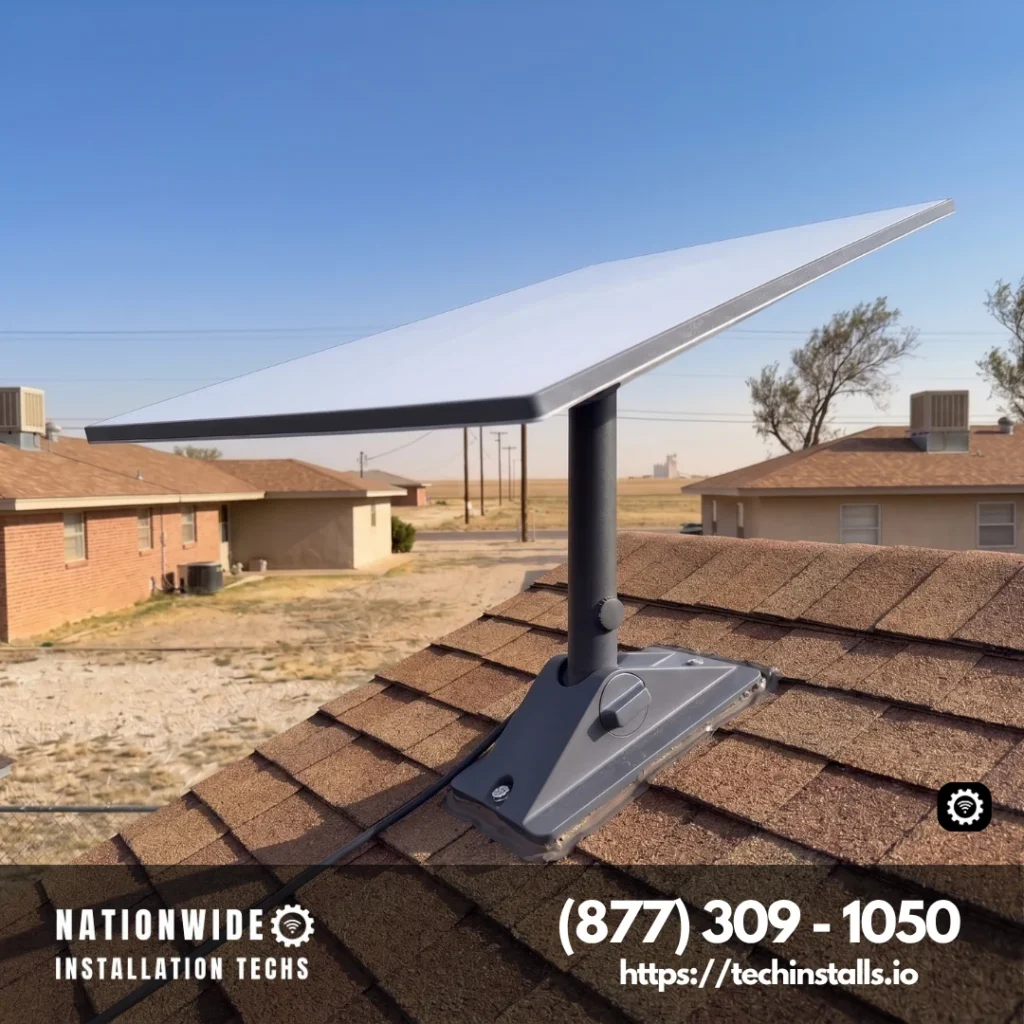
A shingle roof takes the pivot mount: a plate with two splayed feet and a circular pivot disc between them, bolted to the slope with the base running with the pitch rather than against it. That disc is what brings the mast to true vertical on a sloped roof, and it matters more than it sounds. If the base runs against the slope the mast cannot stand plumb, the dish sits at the wrong tilt, and you lose signal for a reason that has nothing to do with the sky. The mount goes high on the roof plane immediately below the ridge, or straddling the ridge cap, so the panel clears everything on the roof.
Then the part that decides whether it is still good in five years. Roof sealant goes in and around every pilot hole, around the full base edge of the mount, and over every exposed bolt head. In a climate this dry that is less about rainwater than about keeping wind-driven grit out of a hole somebody made in your roof, and it is the same standard whether the house is new or ninety years old.
The wind rules from earlier still apply on a house. The mast stays short, because height is leverage. The cable is clipped down the wall run every foot to eighteen inches with no sag left in it, into an entry drilled from the inside out, low on the wall within four feet of an outlet and two to three inches below its centre, with a full drip loop below a flush sealed grommet and a white brush wall plate on the inside.
Cannon Air Force Base and the Install You May Have to Undo
Cannon Air Force Base sits a short distance west of Clovis and is home to the 27th Special Operations Wing, which makes a meaningful share of the households in this area military families.
That changes one practical thing about the install: you may be moving in two years, and the hardware is yours to take with you. It is worth saying up front that we hold no base access, contract or approval of any kind, and anything on government property goes through whatever process the base and your housing office require, not through us.
For an off-base house or rental, what is worth knowing is that not every mount has to leave a mark. A non-penetrating ballasted mount puts no hole in anything at all and comes off the roof the day you leave. A wall mount on a fascia board is two bolts and a patch rather than roof work. If you are renting, get written permission from the owner or the property manager before anything is drilled, and we will need to see it. That is not a formality and it is not us being difficult; it is the difference between a deposit returned and a deposit argued over. There is more on rental and short-term properties elsewhere on the site.
Plateau Fiber Already Reaches Most of Clovis
We would rather give you the real picture than sell against it.
Plateau has built fiber across most of the city, and depending on the source you read that is somewhere between about 85% and about 95% of Clovis addresses, at roughly $60 to $80 a month for symmetrical gigabit. ENMR Telephone Cooperative is in the area as well, and cable covers around 77%. If a symmetrical gigabit line is available at your address at that price, it is a strong product and it is worth checking before you commit to anything.
What that picture does not cover is the rest of the reasons people call us here, and they are the ordinary ones. Property outside the build, which in this county is most of the ground and a good share of the businesses. A second connection that fails independently of the wire, which matters if a parlour or an office cannot stop when a line goes down. A site with buildings the wire was never going to reach. A rig, a trailer or a work vehicle that needs a connection wherever it happens to be parked. None of those is answered by a coverage map showing green over the city grid.
Insurance, Warranty and the Numbers Behind the Quote
Residential installs start at $385. What moves the number from there is the work itself: which mount your roof requires, how high the mast has to be, how long and awkward the cable run is, and whether a second building needs covering. A virtual site survey is free and reads the sky over your roof before anyone gets on a ladder. An on-site survey is $199 if you want someone physically at the property first.
You will have the figure before any work starts. We do not quote on the roof, and the drive out to a dairy or a place past Grady does not add to it.
We carry general liability insurance and our technicians are experienced and insured. We are an independent installer: you own the hardware and you hold the Starlink account. We do not sell you the service plan, we do not open the account for you, and we do not take a cut of your monthly bill. What we sell is the install. What a Starlink install actually costs is broken down in full elsewhere on the site if you want the detail before you call.
Jobs We Turn Down, and Who You Should Call Instead
- We do not drill metal roofs. Not on a house, not on a shop, not on a dairy barn, not for a discount. Our written standard says we never drill into a metal roof and to use a non-penetrating mount instead, and that is what happens, or the job does not get done by us.
- We do not do roof repair. If your deck is soft or the roof is at the end of its life, get a roofer first. Mounting hardware to a roof that is about to be replaced wastes your money twice.
- We do not do electrical work or size your solar array. We will tell you the dish averages 75 to 100 watts so you can give that number to whoever does, and that is where our part of it stops.
- We hold no Cannon Air Force Base access, contract or approval. Anything on government property goes through the base and your housing office, not through us.
- We do not sell you the Starlink service plan or open the account. You own the hardware and hold the account. We handle the install.
- We will not drill a roof on a tenant’s say-so. If you rent, written permission from the owner comes first, and we will need to see it.
Frequently Asked Questions
That is the right question to ask, and it is a mount question rather than a dish question. The specification sheet rates the antenna operational at 96 kph or more, which is 60 mph or more, and publishes no survival figure. Out on the Llano that operational rating gets reached. So we keep the mast short because height is leverage, we tie ballast weights down with metal tie-wire as standard rather than as an exception, we check the fascia board before anything goes into it, and we clip the cable tight the whole way so there is no slack anywhere to whip.
Not into the panel, no. The specification sheet gives an IP67 Type 4 rating, and the 6 in that code means dust-tight, so the antenna itself is rated for this environment. Where dust actually gets in is the install: a cable entry that was drilled and left, a grommet that never seated flush, a bare hole inside with no wall plate. That is the part we control and it is the part we are careful about here.
Not through the panels. We do not drill a metal roof under any circumstances, and on agricultural buildings out here that comes up constantly. What we do instead is a non-penetrating ballasted mount that holds by weight, using pavers, cinder block caps or red bricks, tied down with metal tie-wire given the wind. That is what our standard specifies for a metal roof. Where the building has a sound fascia board and a clear line for the mast, a standard wall mount is another way to keep everything off the roof surface.
Yes, and trenching across a working yard is usually the wrong way to do it. A point-to-point wireless bridge puts a small radio on each building and links them without digging anything up. On a site with four or five buildings that is normally the whole answer, and it is considerably faster and cheaper than a buried run.
Symmetrical gigabit at that price is a strong product, so compare it properly before you commit. Plenty of people go ahead regardless, usually for one of two reasons: they want a second connection that fails independently of the wire, which matters if an office or a parlour cannot afford to stop, or the property has buildings out past where the fiber stops.
The hardware is yours and it goes with you, so the question is really whether you want to leave a mark on the house. You do not have to. A non-penetrating ballasted mount puts no hole in anything and comes straight off the roof when you go. On a rental, get written permission from the owner or manager before anything is drilled and we will need to see it. We hold no base access or approval of any kind, so anything on government property goes through the base and your housing office rather than through us.
We can do the mount and the setup, and we will give you the number that decides everything else: the dish draws 75 to 100 watts on average, and that figure sizes the solar and battery rather than the other way round. We do not do electrical work or specify solar arrays ourselves, so bring that number to whoever does before you buy hardware.
No. A Clovis Starlink installer charges the same whether the job is in town or thirty miles out. Residential pricing starts at $385 whether you are on a street in Clovis or thirty miles out. What moves the number is the work itself: the mount your roof requires, mast height, how long and awkward the cable run is, and whether a second building needs covering. You will have that figure before anyone gets on a ladder.
About Nationwide Installation Techs
Nationwide Installation Techs LLC is a professional, insured satellite installation company operating in all 50 states, with over 3,000 installations completed and a 4.9-star Google rating from 90+ reviews. Our experienced technicians cover residential, commercial, RV and marine installations, along with mesh networking, point-to-point bridges and on-site repair. We are an independent installer: you own your hardware and hold your own service account, and our crews handle the mounting, sealing and setup.
Serving Clovis, Curry County and the rest of New Mexico, plus every other state listed on our locations we serve page. Call (877) 309-1050.
Contact a Clovis Starlink Installer
Nationwide Installation Techs LLC
- Phone: (877) 309-1050
- Email: support@techinstalls.io
- Free Quote: Contact Us Form
Connectivity News & Updates

Residential Starlink Installation — Nationwide and Insured
Residential Starlink installation starting at $385, nationwide. Nationwide Installation Techs...

Expert Starlink Installation for Yachts and Boats
Starlink installation for yachts and boats, nationwide. Nationwide Installation Techs...

Albuquerque Starlink Installer — Same-Day Service When Your Kit Is On Site
Albuquerque Starlink installer, Nationwide Installation Techs, (877) 309-1050. Professional, insured...

Professional Starlink Installation for Cars and Trucks
Starlink installation for cars and trucks, nationwide. Nationwide Installation Techs...
Disclaimer: Nationwide Installation Techs LLC is an independent business and has no affiliation or official connection with Starlink, SpaceX, or any of their subsidiaries or affiliates. We are not associated with, authorized, endorsed, or sponsored by these companies in any capacity. For official information, please visit the Starlink and SpaceX websites at www.starlink.com and www.spacex.com. The names “Starlink,” “SpaceX,” and any related trademarks, logos, or imagery are the exclusive property of their respective owners.
Any references to “certified” or “certification” on this website refer exclusively to Nationwide Installation Techs LLC’s proprietary in-house technician certification program. This training and certification process was developed by our company based on the experience and installation methods of professional technicians who have collectively completed more than 3,000 successful Starlink installations while maintaining an overall 4.9-star customer review rating. It is not affiliated with, issued by, approved by, or endorsed by Starlink, SpaceX, or any of their affiliates.