

Empire, NV Starlink installer, Nationwide Installation Techs, (877) 309-1050. Professional, insured technicians covering Empire, Gerlach and the north end of Washoe County. If your kit is already on site, same-day service is often available. Residential installs start at $385.
The county already ran fiber to 156 homes in Gerlach and Empire at 100 Mbps for $49 a month. If yours is one of them, take it and keep your money. This page is about the other addresses: the ranches, shops, wells and outbuildings scattered along the 60 miles of line that reached the two townsites and served almost nothing on the way. Tell us where the property is, what the road into it is like, and what your power situation is, and you will get an honest read before anyone drives anywhere.
Washoe County and Digital Technology Solutions finished a fiber build that reaches 156 homes across the two townsites, off a $2.3 million middle-mile network that borrowed the Pyramid Lake Paiute Tribe’s existing fiber from Reno up to Nixon and then ran the remaining 60 miles north to Gerlach. By August 2024, 74 of Gerlach’s 108 homes were connected. That is a genuinely good outcome for a place this size, and at $49 a month it is better than satellite on price and on latency. Check what you can actually get at your own address with a test on speedtest.net before you buy any hardware.
156 Addresses Got Fiber Out Here. Everything Else Did Not.
It is worth being precise about the shape of this, because the usual version of the sentence, that rural areas lack broadband, is now wrong for the two townsites and right for almost everything around them.
Inside Gerlach and inside Empire, there is a modern fiber network with a real price on it. We are not going to pretend otherwise to sell a $385 install. If you live on one of those streets, call the county’s provider first. If the answer is that your particular structure was not in the build, or that you are the address at the end where the line stopped, then we are worth a conversation.
Outside the townsites the situation is unchanged. The fiber runs 60 miles up from Nixon along the 447 corridor and serves the two towns at the end of it, not the properties along the way. The ranches on the Smoke Creek side, 21 miles west-south-west, the places out toward Sand Pass, 32 miles south-west, the properties strung along Soldier Meadows Road running north-north-east from about 25 miles out, the ground around Trego 16 miles north-east and Sulphur 38 miles east-north-east, and the whole north-west run on the Gerlach to Cedarville highway toward Vya, 75 miles out, have the same options they always had. For a fixed structure with sky over it, that realistically means satellite.
There is a second category people forget: the property that has a connection at the house and nothing at the shop, the bunkhouse or the well pump half a mile away. Trenching a mile of conduit across a Nevada ranch is a bigger job than the internet connection it carries. A point-to-point wireless bridge from the building that has service to the one that does not is usually the cheaper and faster answer, and on holdings out here it is the single most useful thing we install.
The Mount Is Decided by Wind, Not by Roof Pitch
In most of the country the first mounting question is what the roof is made of. Out here it is what the wind does to whatever we put on it.
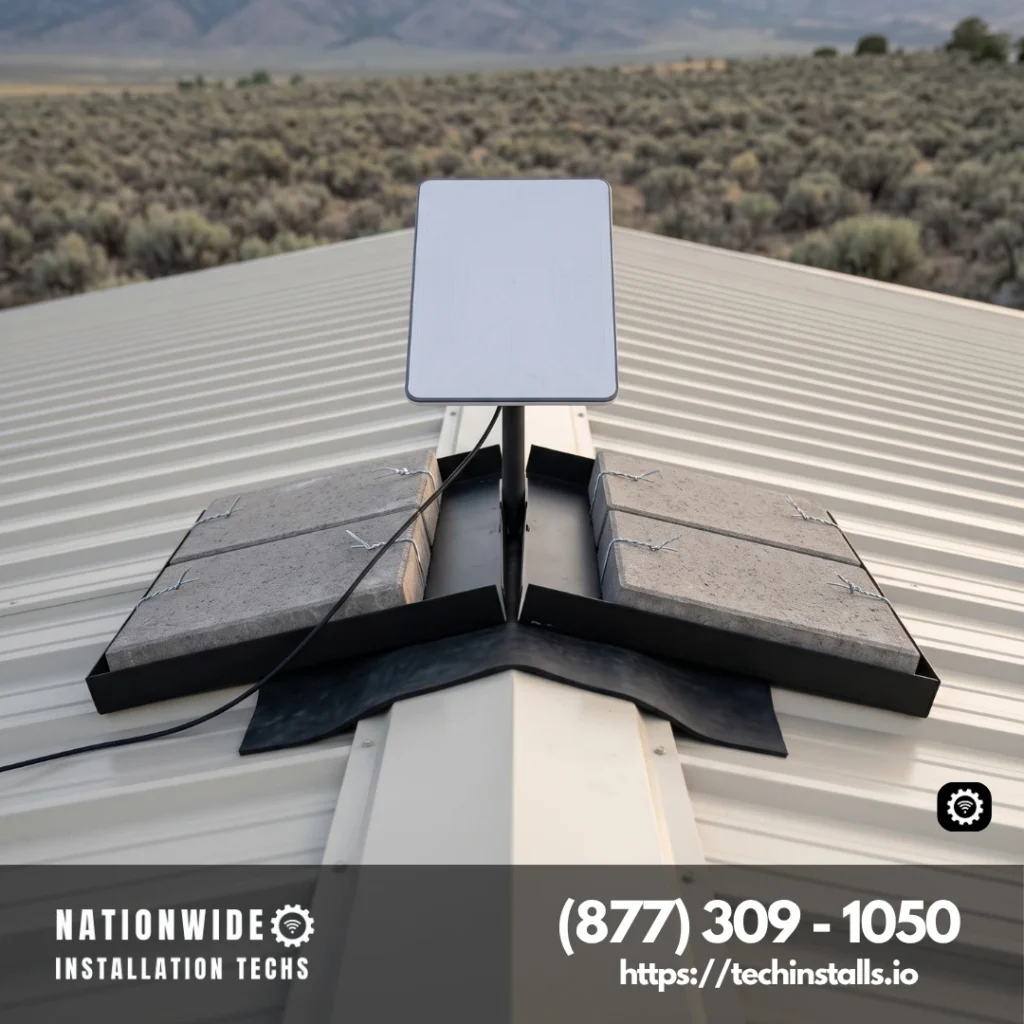
The building stock reflects that. A great many structures on this ground are metal: standing-seam and corrugated shop roofs, steel outbuildings, container conversions, equipment sheds. We do not drill metal roofs. A hole in a metal roof is a leak with a delay on it, and the fix is not sealant, it is not making the hole. The answer is a non-penetrating ballasted mount that holds by weight, sits on the roof rather than through it, works on flat and pitched roofs alike, and gets tied off. Out here the tie-off is not a formality we add for tidiness. It is the part of the job that decides whether the mount is still there in March.
Where there is a conventional pitched roof with a fascia board to catch, the standard wall mount is the better install: the flat angled blade fixed at the gable rake near the peak with exactly two bolts, one top and one bottom, about five inches of clear space between the mount base and the inside of the mast, and the mast rising at a true vertical with no pitch in any direction. The panel finishes comfortably above the ridge with open sky over it. A dish mounted plumb but sitting level with or below the roofline makes your own building the obstruction and throws away a large part of what the hardware can do. Where the fascia is out of square, two to four stainless washers behind a bolt bring the mast back to true.
Dust is the other local variable and it is less serious than people expect. Playa dust does not degrade the signal in any way you will notice. What it does is get into everything mechanical and every unsealed opening, which is why the cable entry matters more here than the panel does: a proper drip loop before a sealed grommet, the run clipped tight the whole way rather than swinging, and no gap left at the entry for dust or water to track into. A cable that is allowed to move in the wind for two seasons is a cable that will fail at the connector, and that is a far more common service call out here than anything to do with the dish. On completion we run a speed test at the router and give you the number.
Empire Starlink Installer Range, the Playa Edge to the County Line
Around the townsites we cover 89405 at Empire and 89412 at Gerlach, including the ground along Main Street and the Gerlach to Cedarville highway and the properties set back from SR 447 on either side. North and north-east we take the playa-edge addresses toward Fly Geyser, 19 miles north, Trego, 16 miles north-east, and out along Soldier Meadows Road toward the Calico Mountains Wilderness, 32 miles north-north-east, and as far as the High Rock Canyon country 56 miles north when the roads are open. Further north we reach Summit Lake, 69 miles north-north-east, and the ground around the Sheldon National Wildlife Refuge, 85 miles north.
North-west along CR 34 we run to Vya, 75 miles, and across the state line to Cedarville, California, 79 miles north-north-west. West and south-west we cover the Smoke Creek Desert side, 21 miles, Sand Pass at 32 miles, and out into Lassen County, California at Herlong, 52 miles, and Doyle, 56 miles.
South down the 447 corridor we work the whole run to Nixon, 52 miles, and on to Wadsworth and Fernley, 65 and 67 miles out, with Pyramid Lake 40 miles south-south-west. East we cover Sulphur, 38 miles, out along Jungo Road, and we run the same rates to Lovelock, 53 miles east-south-east, and Winnemucca, 88 miles east-north-east. Reno and Sparks are about 77 miles as the crow flies and 107 by road, and we work both.
If you are elsewhere in Nevada we still come, and the rest of the states we operate in are on our locations we serve page.
Power Is the Real Question on a Property With No Meter
On most jobs we ask about the roof first. On a property out here we ask about the power first, because it changes whether there is a job at all.
The Gen 3 Standard kit draws 75 to 100 watts. That is a small number next to a well pump and a large one next to nothing, and on a place running off a solar array and a battery bank it is a continuous 24-hour load rather than a peak. Run the arithmetic before you buy hardware: a hundred watts held for a full day is a real slice of a small bank, and it does not go away overnight when the array stops producing. On a property with a generator that runs a few hours a day, a permanently connected dish is not a workable design without storage behind it.
Two related points, both of which come up constantly and neither of which is obvious. The Starlink Mini draws 25 to 40 watts, which on a genuinely tight off-grid system is sometimes the difference between a connection and no connection, and it is worth knowing that before you buy the Standard kit by default. And the Gen 3 Standard is not motorized, so it holds whatever tilt we set at the mount. That matters less here than it does in snow country, but it does mean the aim is a decision made once, at install, rather than something the hardware corrects later.
We will look at your power setup and tell you honestly what the load means for it. What we will not do is design, install or modify the system, which is a different trade with a different licence.
What a Job Costs When the Drive Is a Hundred Miles
Residential starts at $385. Commercial is $750 per site and drops to $650 per site at three or more. RV and mobile is $650, marine is $750. A virtual site survey is free. An on-site survey is $199.
Scheduling is worth understanding out here. Typical scheduling is 72 hours, and same-day service is often available when the kit is already on site. For the addresses at the end of a dirt track a long way up the 447 corridor we also gather jobs into a run and come up together, which is how the far properties get done without a mileage surcharge on top of the quote. That is why the free virtual survey matters more here than anywhere else we work. It costs nothing, it happens before anyone drives anywhere, and it is how we establish that a job is real before we schedule a day around it.
Three things worth asking any installer to produce before you book, because all three are easy to supply and awkward to invent.
- $1M general liability insurance, certificate available on request
- 1-year workmanship warranty plus 3 months of support
- A 4.9-star Google rating from 90+ reviews, and the review count matters as much as the number
Alongside those: more than 3,000 installations completed across all 50 states and background-checked technicians. Our cost breakdown page sets out what moves the number, which on this ground is mostly cable run length, whether the mount can be bolted or has to be ballasted, and how far the building sits off a road we can get a van down.
The Solar Array, the Well and the Road Are Not Our Trades
We are not solar installers. We will tell you what the panel draws and we will tell you if we think your bank will not carry it, but we do not size, supply, install or modify an off-grid power system. Getting that wrong on somebody else’s system in country where the nearest help is an hour away is not a risk worth taking to close a $385 job.
We are not roofers. We do not repair, replace or re-cover a roof, and we will not mount on one that is failing. We do not drill metal roofs at all, which out here is the common case rather than the exception. We are not electricians and we do not run new mains circuits. We do not sell service plans, because you hold your own account and own your own hardware. We are an independent installer and are not affiliated with, endorsed by, or acting for Starlink or SpaceX.
One limit that is specific to this country. Much of the ground around here is federally managed, and a great deal of the Black Rock and High Rock country is designated wilderness or a wilderness study area, including the Calico Mountains, High Rock Canyon and Massacre Rim. We install on private property, on structures the owner controls. We will not put a mast on ground we cannot confirm you have the right to fix something to, and if a parcel boundary is unclear the answer is to sort that out with the BLM field office before we come, not after.
We also do not do temporary rigs on open playa. An RV install is a real job we do at $650, on the vehicle, mounted and sealed properly. A dish propped on the ground for a week is not an installation and we would only be taking your money.
Empire Starlink Installer: What People Ask From Out Here
Usually not, if it’s working the way you want. At 100 Mbps for $49 a month, fiber beats what we sell on price and on latency, and we would rather tell you that than take a job you don’t need. Where it makes sense anyway: a second structure the line does not reach, a property that turned out to sit past the end of the build, a vehicle, or a connection that has not been as reliable as advertised.
Yes, and we plan for it rather than pretending it is a normal call. Tell us the surface, the last gate, and whether a van gets there or whether it needs something with clearance, and we will put you into the next run north. The free virtual survey happens first so nobody drives 25 miles up a dirt road to look at a roof that was never going to work.
It can, and the number that decides it is 75 to 100 watts continuous for the Standard kit. That is a 24-hour load on your bank, not a daytime one. The Mini draws 25 to 40 watts and is sometimes the better choice on a tight system. Tell us what your array and storage actually are and we will tell you straight whether it carries.
The dust does nothing to the signal. The wind is the whole engineering problem, and it is why a ballasted mount gets tied off and why we clip the cable tight the entire run. The failures we get called back to on this ground are almost always a cable that was left free to move, working a connector loose over two seasons. The panel itself is rarely the fault.
Usually yes, and that is generally the right way to do it. One dish goes on whichever structure has the most open sky, and a point-to-point wireless bridge carries the link to the others. It is faster and a great deal cheaper than trenching conduit across a mile of Nevada, and it is the job we do most often on holdings out here.
No. We install on structures and on vehicles, mounted and sealed to last. An RV install is $650 and is a real job. A dish set on the ground for a week does not need an installer, and charging you for one would not be honest.
We come when the road is passable and we will tell you plainly when it is not. Some of the northern routes, the Soldier Meadows and High Rock country in particular, are seasonal, and a job booked in January on that ground may be a job done in April. We would rather schedule it honestly than take a deposit against a drive we cannot make.
Residential starts at $385, the same as anywhere else we work, and RV and mobile is $650. What moves it here is cable run length, whether the mount can be bolted to a fascia or has to be ballasted on metal, and access. The virtual survey is free and the on-site survey is $199. We do not add a mileage surcharge on top of the quoted price, which is the other reason we gather jobs into a run.
About Nationwide Installation Techs
Nationwide Installation Techs LLC is a professional, insured satellite installation company operating in all 50 states, with over 3,000 installations completed and a 4.9-star Google rating from 90+ reviews. Our experienced technicians cover residential, commercial, RV and marine installations, along with mesh networking, point-to-point bridges and on-site repair. We are an independent installer: you own your hardware and hold your own service account, and our crews handle the mounting, sealing and setup.
Serving Empire, Gerlach, Washoe County and the rest of Nevada, plus every other state listed on our locations we serve page. Call (877) 309-1050.
Contact an Empire Starlink Installer
Nationwide Installation Techs LLC
- Phone: (877) 309-1050
- Email: support@techinstalls.io
- Free Quote: Contact Us Form
Connectivity News & Updates

Starlink Ethernet Adapter Guide: Picking the Right One for Your Setup
Only one current Starlink router needs the Ethernet adapter —...

Empire Starlink Installer — Same-Day Service When Your Kit Is On Site
Fiber reaches parts of Gerlach and Empire, but the ranches,...

Henderson Starlink Installer — Same-Day Service When Your Kit Is On Site
Nationwide Installation Techs is a Henderson Starlink installer working across...
Expert Entegra Odyssey RV Starlink Installation | Serving Customers in all 50 States
Mounting Starlink on an Entegra Odyssey means working around a...
Disclaimer: Nationwide Installation Techs LLC is an independent business and has no affiliation or official connection with Starlink, SpaceX, or any of their subsidiaries or affiliates. We are not associated with, authorized, endorsed, or sponsored by these companies in any capacity. For official information, please visit the Starlink and SpaceX websites at www.starlink.com and www.spacex.com. The names “Starlink,” “SpaceX,” and any related trademarks, logos, or imagery are the exclusive property of their respective owners.
Any references to “certified” or “certification” on this website refer exclusively to Nationwide Installation Techs LLC’s proprietary in-house technician certification program. This training and certification process was developed by our company based on the experience and installation methods of professional technicians who have collectively completed more than 3,000 successful Starlink installations while maintaining an overall 4.9-star customer review rating. It is not affiliated with, issued by, approved by, or endorsed by Starlink, SpaceX, or any of their affiliates.