

Green Bay Starlink installer: Nationwide Installation Techs, (877) 309-1050. Insured crews from our team work the city and the rest of Brown County, and when the dish is already sitting in its box at your house we can frequently finish the same day. Pricing starts at $385 for a home, $750 per commercial site (less from the third site on), $650 per vehicle with fleet discounts, and $750 for a boat or yacht. Every job carries a one-year workmanship guarantee, and customers have left us a 4.9-star Google rating from 100+ reviews.
Green Bay is a snow city, and the snow decides more about an install here than the roof does. Houses in Brown County are built with the pitch to shed it, the bay pushes lake-effect over the east side all winter, and anything bolted to a roof between November and March is not sitting in still air. It is sitting in the path of a season of accumulation that eventually has to come down. Where a mount goes on a Green Bay roof is a question about January, not about the day we install it.
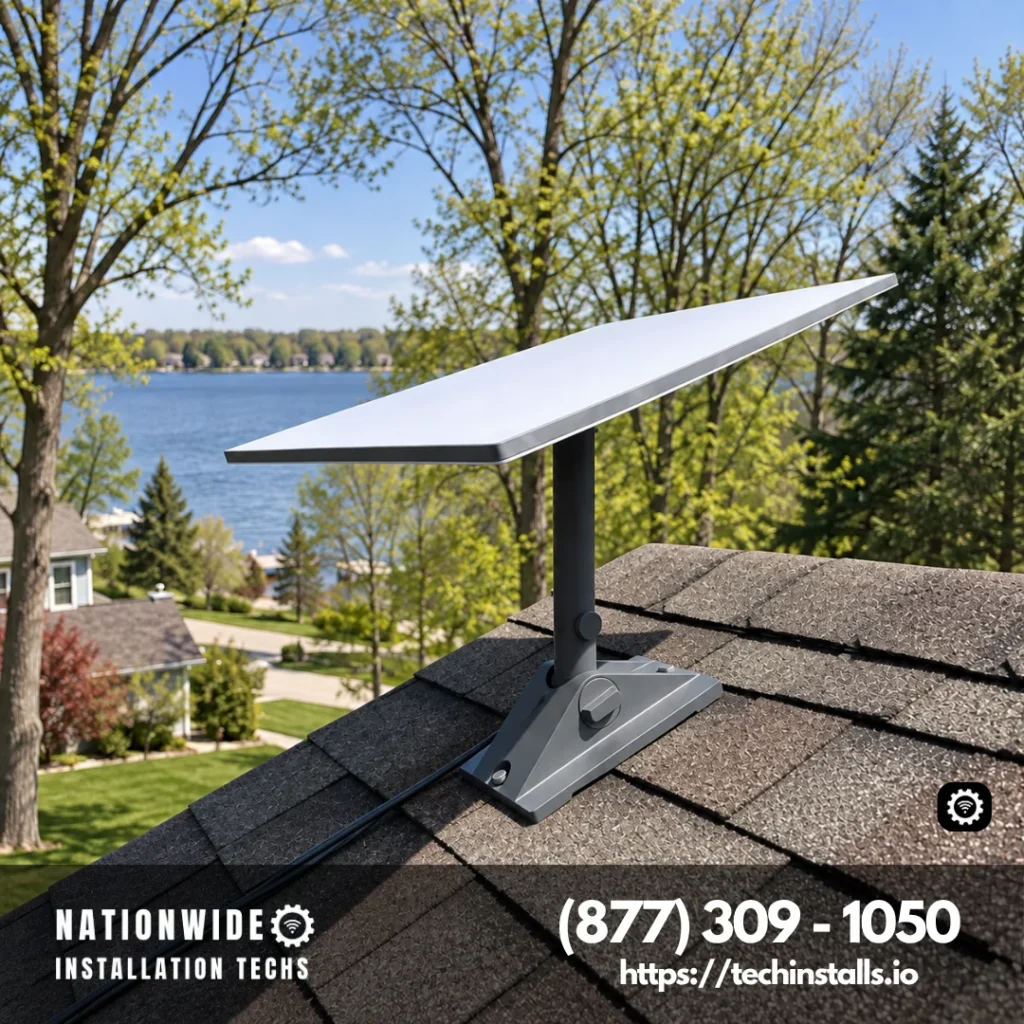
People who ring us from Brown County usually have one particular reason. The house sits beyond where the cable company stopped building, the roof is steel and cannot take a screw, the connection has to follow a camper or a boat, or a business needs a backup line that stays up when a winter storm knocks the primary out. Each of those is a problem a properly mounted Starlink dish solves. Whatever brought you here, take a reading with a free speed test the morning we arrive and a second one once the dish is locked in; comparing the two is the simplest proof of what changed.
Snow Load, the Slide Path, and Where a Mount Can Actually Live
A steep roof sheds snow, and that is the whole point of building them that way here. What it means for hardware is that we have to think about where the snow goes, not just where the sky is.
Accumulated snow on a pitched roof does not sit still. It creeps, and when it finally releases it comes off in a slab with real weight behind it. A mount sitting in that path takes the load of the whole slope above it, which is a different force entirely from wind. So we set the mount high on the plane, close under the ridge where there is little above it to come down, rather than partway down where a season of snow is waiting upslope.
Height is handled with the same caution. A mast works as a lever against whatever it is fastened to, and here that lever is loaded by heavy, wet snow on top of the wind, so each additional foot costs strength at the base. We fit the lowest mast that still sees past the obstacle. If the survey shows a taller one really is required, you hear that before booking, along with any shift it forces in the mount’s position.
Cold does its damage at the penetration. Moisture that gets into a weak joint during autumn turns to ice, grows, and pries the joint wider each cycle; by spring, dozens of those cycles can turn a tidy-looking seal into a drip on the ceiling. Our sealant is chosen for that expansion and contraction, the cable dips into a drip loop just under its entry point, and clips are fastened mechanically because adhesive lets go in a hard freeze. Our roof inspection checklist covers what we look at first.
Shingle, Metal, and Which Mount Your Roof Forces On Us
The bulk of homes around the city wear asphalt shingle on plywood or OSB sheathing, which is the easy case. There we use a pivot roof mount lagged into the rafters, with sealant at each pilot hole and under the foot, placed near the ridge for the snow reasons covered above, and a cable route kept as short as it sensibly can be.
Steel changes that. You find it on dairy barns and machine sheds around Pulaski and Seymour, and more and more on houses too. We do not put a drill through a metal roof, ever; it is written into our install standard. Those panels shed water as one unbroken sheet held down by fasteners the manufacturer engineered and placed, and any extra hole is a leak path the design never allowed for.
That leaves three ways to mount on a steel-roofed building, none of them touching the panels. A standard wall mount bolts into the framing of a gable or side wall. An under-eave wall mount attaches below the overhang and reaches out past it. Where an addition or lean-to has a flat or near-flat section, a ballasted non-penetrating mount rests there, held by weight alone.
Cable routing obeys the same rule. From the dish it travels down the outside wall and enters through a hole in the siding that we seal on the exterior and trim with a wall plate indoors. The roof deck, which is what keeps meltwater out of your living room, is never used as a way in.
The Dish Looks North, and the Bay Is Not the Problem
Direction comes first: the dish aims at the northern sky. Newcomers sometimes worry the bay will interfere, but water blocks nothing, and a home with the bay spread out to its north has one of the cleanest views in the city.
Trees are the real obstacle. The older blocks around Astor and across the Fox on the east side are shaded by silver maples and oaks as old as the houses beneath them. In winter those crowns are bare sticks; by midsummer they are solid leaf. A dish aimed through a leafless gap in February can lose its view by June, which is why the survey models the full summer canopy rather than the branches visible on the day.
If the house itself cannot clear the canopy, a taller mast is rarely our first answer. We look for another spot with open sky, such as the back slope, a detached garage or a machine shed, and carry the signal indoors over a wireless bridge link. On farm parcels west of the city the outbuilding often wins outright: it stands taller, sits in the open, and is simpler to work on than the farmhouse.
Campers, Boats and Trucks: Installs That Travel
A good share of our Brown County calendar is not houses at all. This corner of Wisconsin camps, fishes and boats hard from ice-out to deer season, and plenty of those rigs and hulls want a connection that goes where they go.
Our RV Starlink installation work follows the same written standard as a house. The mount is bolted to structure rather than screwed into the thin roof skin, the cable is clipped every short stretch so nothing flaps at highway speed, and the dish draws from the coach’s house batteries so it cannot drain the one that starts the engine. We finish by aiming it and showing you a live speed result. Techs show up with every part the job needs, which helps when your campsite is an hour from the nearest hardware store.
Marine installs matter here more than in most inland cities. Between the bay, the lower Fox River and the Door County shoreline, a lot of boats sit within an hour of Green Bay, and our boat Starlink installs are built for them. A hull flexes and rolls, stays wet all season, and needs stainless hardware from top to bottom, so a boat mount is engineered differently from anything on a roof. Whether yours comes out of the water for winter or stays in a slip also changes the specification.
Pickups, contractor vans and overland builds go through our vehicle Starlink installs, and businesses running a larger group of vehicles can use our fleet installation program. The method matches the RV work, and each vehicle gets its own before-and-after speed reading when we finish.
Where We Drive Across Green Bay, and What the Quote Covers
Across the metro we work everywhere: Astor and the east side, Allouez, Bellevue and De Pere to the south, Ashwaubenon and Howard to the west, Hobart and the Oneida Nation beyond them, and Suamico north up the bay.
Around it we cover the counties Brown runs straight into: north into Oconto County through Little Suamico and Abrams, east into Kewaunee County through Luxemburg and Casco and on toward Door County, south into the Fox Valley, and west through Seymour and Pulaski into Outagamie County.
Distance never enters the price. Homes begin at $385, and the figure moves only with the work: the mount type your roof allows (steel narrows the choice straight away), the pitch and how much snow slope sits above the mount point, the length and difficulty of the cable path, and whether a barn, shop or second house joins the network. The free virtual survey looks at your real sky before a date goes on the calendar. If you would like a technician to walk the property first, the on-site survey costs $199, and on a steep roof in January that visit usually pays for itself.
Scheduling usually runs about 72 hours out, and a same-day finish is common if the kit is waiting at the house and nothing on the survey needs extra planning. We are not Starlink: the dish is yours and the subscription sits in your name. We sell no plans, open no accounts, and earn nothing from your monthly payment; our income is the installation itself. For line-by-line pricing, see our installation cost guide.
Frequently Asked Questions
We will mount near it, but never through it. Drilling a metal roof is off the table under our install standard, since the panel system keeps water out as one continuous sheet and every added hole is a leak it was not built to handle. On a shop that usually means a standard wall mount on the gable end or an under-eave arm below the overhang, both fixed into framing. If there is a flat lean-to or low-slope section, a ballasted non-penetrating base can sit there instead. On most farm buildings the wall ends up being the stronger spot regardless.
Not if it is positioned for it, which is why position comes before everything else here. Accumulated snow creeps and then releases in a slab, so a mount sitting partway down a slope takes the weight of everything above it. We set the mount high on the plane, close under the ridge where there is little above it to come down. It is the single most important decision on a Green Bay roof and it is made at the survey, not on the day.
Rarely, and not for long. The dish runs a heater and sheds snow on its own in most conditions, and what usually causes a longer outage is snow building on something else in the sightline rather than on the panel. The bigger winter risk is not the connection at all, it is a seal that was never rated for freeze-thaw. Water works in, freezes, expands and opens the gap, and by March you have a leak rather than a dropout.
No. Open water is open sky, and since the dish points north, the bay actually gives you an excellent view. Trees cause far more trouble here, especially the old maples and oaks on the east side, and they are judged by how full they will be in midsummer, not by how bare they look during a winter survey.
We do. Homes beyond the reach of cable and fiber are exactly the customers we built this business for, and the drive adds nothing to the install price. Distance can affect which day we come, so mention your location when you book the survey. On rural parcels a machine shed or pole barn with open sky often makes the best mount, linked back to the house with a wireless bridge.
We can. Boat work is a steady part of our schedule around the bay. A marine mount has to cope with constant motion and constant damp, uses stainless hardware throughout, and is designed for a flexing hull rather than a rigid deck. Let us know whether the boat is hauled out each fall or kept in the water, because that changes the parts we specify.
We do, and the price does not change when you leave Brown County. Our crews head north through Little Suamico and Abrams into Oconto County, east via Luxemburg and Casco into Kewaunee County and up the peninsula into Door, south down the Fox Valley toward Appleton, and west by way of Seymour and Pulaski into Outagamie County. The farther addresses can shift which day we arrive, never the cost.
On site, a typical home install takes about two hours. Booking is normally about three days after the survey; with the hardware already delivered and nothing odd found, a same-day slot is often open. Delays in this area rarely come from the equipment. They come from a steel roof that needs the right off-roof position worked out first, a steep pitch that should be re-checked in winter weather, or a tree question still open.
About Nationwide Installation Techs
Nationwide Installation Techs LLC is a professional, insured satellite installation company operating in all 50 states, with over 3,000 installations completed and a 4.9-star Google rating from 100+ reviews. Our experienced technicians cover residential, commercial, RV and marine installations, along with mesh networking, point-to-point bridges and on-site repair. We are an independent installer: you own your hardware and hold your own service account, and our crews handle the mounting, sealing and setup.
We serve Green Bay and all of Brown County as part of our Wisconsin Starlink installs, and the locations we serve page lists coverage in every other state. Call (877) 309-1050 to book.
Contact a Green Bay Starlink Installer
Nationwide Installation Techs LLC
- Phone: (877) 309-1050
- Email: support@techinstalls.io
- Free Quote: Contact Us Form
Connectivity News & Updates

Starlink Installation for Construction Sites — Local, Insured Techs
Starlink installation for construction sites, in all 50 states, from...

Milwaukee Starlink Installer — Same-Day Service When Your Kit Is On Site
On a Milwaukee Polish flat or duplex, one roof often...

Thor Four Winds Starlink Installation | We Come To You
Thor Four Winds Starlink installation means working around a domed...

Residential Starlink Installation — Nationwide and Insured
Residential Starlink installation starting at $385, nationwide. Nationwide Installation Techs...
Disclaimer: Nationwide Installation Techs LLC is an independent business and has no affiliation or official connection with Starlink, SpaceX, or any of their subsidiaries or affiliates. We are not associated with, authorized, endorsed, or sponsored by these companies in any capacity. For official information, please visit the Starlink and SpaceX websites at www.starlink.com and www.spacex.com. The names “Starlink,” “SpaceX,” and any related trademarks, logos, or imagery are the exclusive property of their respective owners.
Any references to “certified” or “certification” on this website refer exclusively to Nationwide Installation Techs LLC’s proprietary in-house technician certification program. This training and certification process was developed by our company based on the experience and installation methods of professional technicians who have collectively completed more than 3,000 successful Starlink installations while maintaining an overall 4.9-star customer review rating. It is not affiliated with, issued by, approved by, or endorsed by Starlink, SpaceX, or any of their affiliates.