

Gulf Shores Starlink installer, Nationwide Installation Techs, (877) 309-1050. Professional, insured technicians serving Gulf Shores, Alabama and Baldwin County. If your kit is already on site, same-day service is often available. Residential installs start at $385.
Gulf Shores has almost no obstruction problem and almost nothing but mounting problems. The land between the Gulf and the Intracoastal Waterway is flat, the pines are scattered rather than closed in, and the sky over most lots here is wide open. What decides a job in this town is what the roof is, how high off the ground it sits, who owns it, and whether it carries a certificate somebody is getting an insurance discount for. Check your own street number on speedtest.net rather than a coverage map before you decide anything. A great many Gulf Shores addresses already have a solid wired option.
What brings people to us is more often a rental that cannot afford an outage in July, a place out toward Fort Morgan where the build thins, or a second line that survives the week the poles do not.
A FORTIFIED Roof Is a Certificate, and It Changes How We Mount
This is the first question we ask on a Baldwin County roof and it is the one almost nobody expects.
Fifteen local zoning boards in Baldwin County, from Bay Minette in the north down to Gulf Shores and Orange Beach, now require new and reconstructed homes to meet the basic FORTIFIED standard. Basic FORTIFIED certification requires that a roof built with specified materials and techniques be able to withstand 130 mph winds. A FORTIFIED designation is not a marketing phrase. It is a written certification issued after an IBHS-approved evaluator inspects the work, and in Alabama it typically sits behind an insurance discount the owner is actually receiving.
What we will tell you: the program exists, your roof may well be in it, and the designation is a document with an inspection behind it. What we will not tell you is whether putting a fastener through your deck affects that designation or that discount, because IBHS does not publish a plain answer and we are not going to guess with your policy. Ask your evaluator or your insurer before anybody drills.
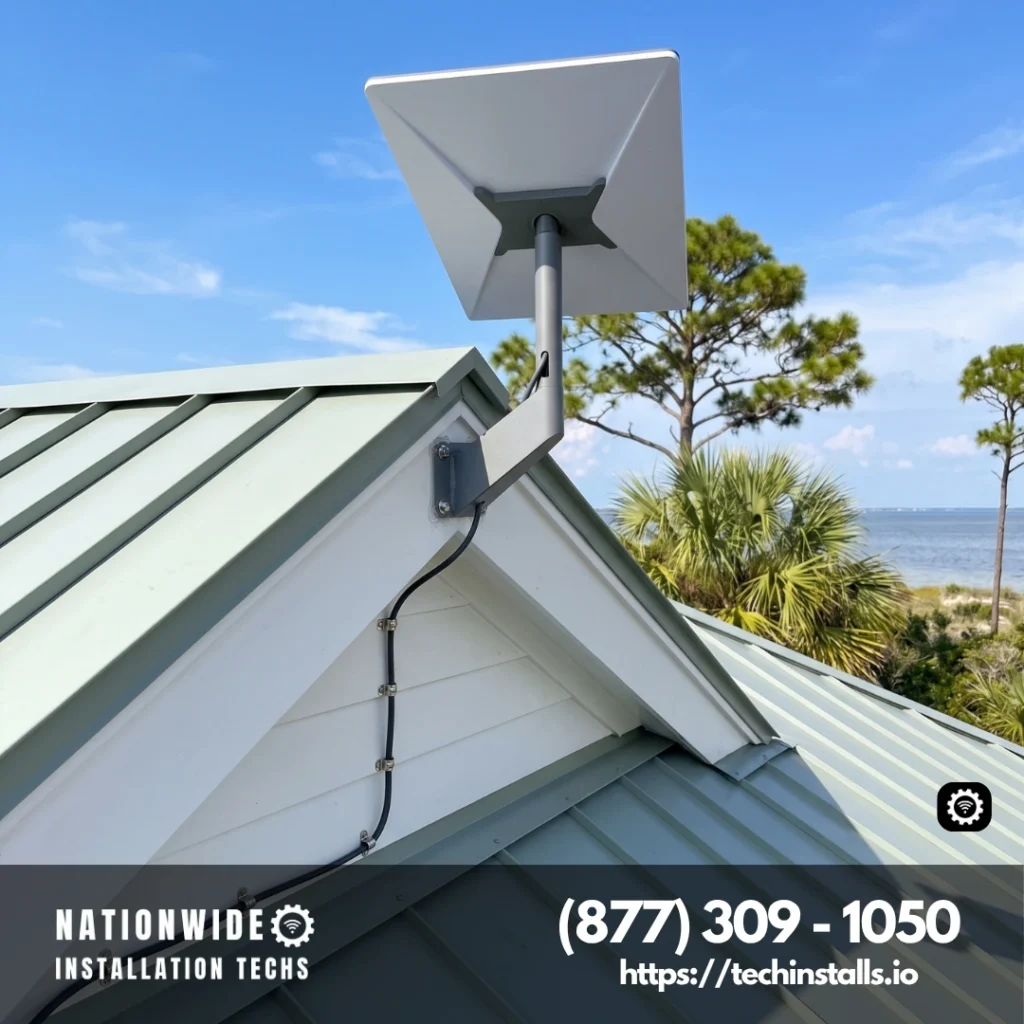
What we can do is keep the fasteners off your roof entirely. On most Baldwin County houses the mount we specify is a standard wall mount: a flat blade bolted to the fascia board at the gable end, mast plumb, dish sitting clear above the ridge. Nothing goes through the deck and nothing goes through the roof covering. That is a far smaller question to put to an evaluator than a fastener driven through the roof plane, though it is still worth putting to them rather than assuming. Where somebody wants nothing fastened to the building at all, the non-penetrating mount is the fallback, weighted rather than fixed.
Sally Sat on Top of This Town for Hours, Which Is the Design Problem
On September 16, 2020, Hurricane Sally made landfall at Gulf Shores as a Category 2 with 105 mph sustained winds. The category is not the interesting number. The interesting number is that Sally was crawling at under 5 mph when it came ashore, which meant hurricane-force wind, surge and rain sat over the same roofs for hours rather than passing through in one.
Duration is what breaks mounts. A gust loads a bracket once. Hours of sustained load work a fastener back and forth, find the one that was not torqued properly, and open the seal around it. That is why a coastal mount is not just a stronger version of an inland mount, it is a mount specified for a load that does not let go.
The hardware numbers set the boundary. The Starlink Standard sheet rates the antenna operational at 96 kph or more, which is 60 mph or more, and publishes no survival figure at all. Sally was comfortably past that operational rating, and so is any named storm that gets this far up the Gulf. So the honest split is:
- The dish comes down before a storm. It is four bolts and a few minutes and there is no reason to leave it up there.
- The mount stays. It is built to still be there afterwards, so the dish goes back on the same bracket, plumb, without a second roof visit.
- The cable entry is the part that matters when it is over. A seal that survived the wind but wicked water for six hours is a seal that failed, just slowly. That is where we spend the extra ten minutes.
Heat, for what it is worth, is not the constraint here. The Standard sheet rates the antenna from -30°C to 50°C, which is -22°F to 122°F, and an Alabama coastal summer does not come near the top of that range. The wind, the salt and the water are the whole story.
Beach Houses on Pilings Put the Roof Twenty Feet Further Up
A large share of the housing stock south of the Intracoastal sits on pilings, because it has to. That changes three things about the job before anyone looks at the sky.
The roof is a full story higher than a normal house. Access takes longer, ladder setup is a real part of the work, and nothing about the job benefits from being rushed. This is one of the places where the on-site survey earns its fee, because a photograph does not tell you what the approach looks like.
The roof is very often standing-seam metal. We do not drill metal roofs. Not on a beach house, not on a carport, not for a discount. That rule does not put us up on the roof with ballast, though. It moves the mount to the fascia board, where a standard wall mount takes two bolts, holds the mast plumb and puts the dish clear above the ridge without a single fastener touching the roof covering. Where there is no usable fascia, where gutters are in the way, or where the eave is too wide for the blade to clear, the under-eave mount does the same job from underneath. Both are bolted into structure, which on a coast that sat under Sally’s wind for hours is rather the point. A weighted non-penetrating mount is what we use when somebody wants nothing fastened to the building at all, not something a metal roof forces on us.
Everything is more exposed. A mount twenty feet up on the Gulf side takes salt spray directly, not the diluted version three streets back. So stainless or coated fasteners are the default, not an upgrade, and where two metals have to meet they get isolated so the salt cannot turn the joint into a battery. Aluminum bracket, steel screw and salt water will quietly eat the softer metal without anybody touching it.
Where a property has more than one building, a house and a garage or a house and a boathouse, that is a coverage question rather than a second install, and it is worth raising on the call rather than on the day. The answer is rarely a second dish. A point-to-point wireless bridge puts a small radio on each building and carries the connection across without trenching, which matters on this coast because a lot of these lots are sand over a high water table and a buried run is the expensive way to solve a problem that does not need digging.
A Gulf Shores Starlink Installer Drives the Whole Island and the Mainland Behind It
A Gulf Shores Starlink installer working Baldwin County covers a strip of coast and a lot of farm country behind it. Bon Secour is four miles northwest and Orange Beach seven miles east-northeast along the same island, which people here call Pleasure Island. Foley is nine miles due north and is where most of the county’s traffic goes. Fort Morgan sits twenty miles due west at the end of the peninsula, which is a real drive for a short distance and one of the more common calls we take.
Inland the ring opens out through Baldwin County. Magnolia Springs is ten miles north-northwest, Elberta eleven north-northeast and Perdido Beach thirteen east-northeast. Summerdale is fifteen miles north, Lillian eighteen east-northeast on the Perdido, Silverhill nineteen north and Robertsdale twenty north. Point Clear is twenty miles northwest on Mobile Bay and Fairhope twenty-two. Every one of those is Baldwin County.
Two edges are worth naming honestly. South of Gulf Shores is the Gulf of Mexico and there is no next town. And east of Lillian the Perdido River is the Florida line, so the ring simply becomes somebody else’s state rather than stopping.
The drive does not change what you pay. What changes the price is the work at the other end of it: which mount your roof requires, how high the mast has to be, how long and awkward the cable run is, and whether a second building needs covering. Past the county line, the rest of Alabama is covered the same way.
Rental Condos Have an Owner Who Is Not in the Building
A large part of this market is rented, and rented property has a decision-maker who is somewhere else. That is a scheduling problem more than a technical one, and it is worth getting straight before a kit arrives.
If you own a unit or a house here and rent it out, you can authorize the work and the job is ordinary. If you manage a property for somebody else, we will need written permission from the owner before anything is attached to the building, and we will need to see it. That is not us being difficult; it is the same rule everywhere, and it is covered further in our notes on rental and short-term properties.
Condominiums add a second layer. In a multi-story building the roof, the exterior walls and usually the balcony rail are common elements, and the association controls them. What an individual owner controls varies building to building, and it is written in the documents, not decided on the day. So the sequence that works is: read what your association actually allows, get it in writing, then call. We will happily talk through what the install would look like beforehand so you know what you are asking permission for.
Where a whole building wants covering rather than a single unit, that is a commercial conversation and a different quote, and it is one we are glad to have.
The Wired Map Here Is Better Than It Looks and Still Has Holes
The coverage picture is worth setting out plainly, because it changes a great deal between the island and the mainland behind it.
Mediacom cable reaches well over 90% of Gulf Shores. Point Broadband’s fiber is available to roughly half the city, C Spire’s to somewhere over a third, and Brightspeed to a smaller share again. Those figures come from broadband aggregators that regularly disagree with each other, so treat any single percentage as an indication rather than a fact about your street. What is not in dispute is that a lot of Gulf Shores addresses have a genuinely good wired option, and on price a fiber line usually does come in lower. Price is rarely what brings people to us here.
That is not the whole map. The Fort Morgan peninsula, the back roads off County Road 4 and the places out toward the Bon Secour refuge are where the build thins, and that is ordinary rural Baldwin County work.
There is also a second reason people here call with fiber already in the wall, and it has nothing to do with speed. A wired line and a satellite line do not fail for the same reasons. In a town where the poles come down every few years and a rental with no internet in July is a refund, that independence is the product, which is the whole argument for Starlink as a backup connection.
Cost, Cover and the Survey That Comes First
Residential installs start at $385. What moves the number from there is the work itself: which mount your roof requires, how high the mast has to be, how long and awkward the cable run is, and whether a second building needs covering. A piling house with a metal roof is more work than a slab house three miles inland, and you will know that before we start rather than after.
A virtual site survey is free and reads the sky over your roof before anyone gets on a ladder. An on-site survey is $199 if you want somebody physically at the property first, which on an elevated Gulf-front house is often the sensible order to do it in.
You will have the figure before any work starts. We do not quote on the roof, and the drive out to Fort Morgan or up to Robertsdale does not add to it.
We carry general liability insurance and our technicians are experienced and insured. We are an independent installer: you own the hardware and you hold the Starlink account. We do not sell you the service plan, we do not open the account for you, and we do not take a cut of your monthly bill. What we sell is the install. What a Starlink install actually costs is broken down in full elsewhere on the site if you want the detail before you call.
The Jobs a Beach-Town Installer Should Refuse
- We do not drill metal roofs. Not on a beach house, not on a carport, not on a boathouse, not for a discount. The mount goes on the fascia board instead, or under the eave where the fascia will not take it, or on a weighted base if you want nothing fastened to the building. If the building suits none of those, the job does not get done by us.
- We do not make FORTIFIED or insurance determinations. We are not an IBHS evaluator. We will tell you exactly what we did and how, and the designation conversation is between you, your evaluator and your insurer.
- We do not do roof repair. If your deck is soft or the shingles are at the end of their life, get a roofer first. Mounting hardware to a roof that is about to be replaced wastes your money twice.
- We do not override a condo association. If the documents say no, the answer is no, and we will not put you in a dispute with your own building.
- We do not do electrical work or size your solar array. We will tell you the dish averages 75 to 100 watts so you can give that number to whoever does, and that is where our part of it stops.
- We do not sell you the Starlink service plan or open the account. You own the hardware and hold the account. We handle the install.
Frequently Asked Questions
Not without you checking first. A FORTIFIED designation is a written certification issued after an IBHS-approved evaluator inspects the work, and IBHS does not publish a plain answer on whether a roof penetration affects it or the discount sitting behind it. We are not going to guess with your policy. Ask your evaluator or your insurer. In most cases the question is smaller than people fear, because the mount we specify goes on the fascia board at the gable end rather than through the roof, so nothing penetrates the deck or the roof covering.
A standard wall mount on the fascia board, in almost every case. We do not drill metal roofs under any circumstances, but that rule does not put us on the roof with ballast. It moves the mount to the fascia at the gable end, where two bolts hold the mast plumb and the dish sits clear above the ridge without a fastener touching the roof covering. If there is no usable fascia, or gutters are in the way, or the eave is too wide for the blade, the under-eave mount does the same thing from below. Both are bolted into structure, which matters here more than most places given what sustained wind does on this coast. A weighted non-penetrating mount is the answer when you want nothing fastened to the building at all.
Sometimes, and the answer is in your association documents rather than on the roof. In a multi-story building the roof, the exterior walls and usually the balcony rail are common elements the association controls. Read what yours actually allows, get it in writing, then call. We will happily talk through what the install would look like first so you know what you are asking permission for.
A fair number do, and it is not about speed. What brings people here to us is a second connection that fails independently of the wire. In a town where the poles come down every few years and a rental with no internet in July is a refund, that independence is the product. Whether that is worth a second line is your call rather than ours.
If you own it you can authorize it and the job is ordinary. If you manage the property for somebody else we need written permission from the owner before anything is attached to the building, and we will need to see it. That is the same rule everywhere, and it is worth sorting before the kit arrives rather than on the day.
Faster than most people expect, and it goes after the fasteners rather than the dish. The antenna is sealed and the manufacturer handles that end. A mount is brackets, fixings and a cable entry, which is exactly what salt attacks first. So stainless or coated fasteners are the default here, dissimilar metals get isolated, and the cable entry is sealed with the drip loop hanging below it so water leaves the cable instead of tracking into the wall.
Yes. Fort Morgan sits about twenty miles due west at the end of the peninsula, and it is one of the more common calls we take, partly because that is where the wired build thins out. The drive does not change what you pay.
Bring it in. The sheet rates the antenna operational at 96 kph or more, which is 60 mph or more, with no survival figure published, and Sally came ashore here at 105 mph sustained. It is four bolts and a few minutes. Leave the mount, which is built to still be there afterwards, and the dish goes back on the same bracket without a second roof visit.
About Nationwide Installation Techs
Nationwide Installation Techs LLC is a professional, insured satellite installation company operating in all 50 states, with over 3,000 installations completed and a 4.9-star Google rating from 90+ reviews. Our experienced technicians cover residential, commercial, RV and marine installations, along with mesh networking, point-to-point bridges and on-site repair. We are an independent installer: you own your hardware and hold your own service account, and our crews handle the mounting, sealing and setup.
Serving Gulf Shores, Baldwin County and the rest of Alabama, plus every other state listed on our locations we serve page. Call (877) 309-1050.
Contact a Gulf Shores Starlink Installer
Nationwide Installation Techs LLC
- Phone: (877) 309-1050
- Email: support@techinstalls.io
- Free Quote: Contact Us Form
Connectivity News & Updates

Residential Starlink Installation — Nationwide and Insured
Residential Starlink installation starting at $385, nationwide. Nationwide Installation Techs...

Expert Starlink Installation for Yachts and Boats
Starlink installation for yachts and boats, nationwide. Nationwide Installation Techs...

Professional Starlink Installation for Cars and Trucks
Starlink installation for cars and trucks, nationwide. Nationwide Installation Techs...

Gulf Shores Starlink Installer — Same-Day Service When Your Kit Is On Site
Gulf Shores Starlink installer, Nationwide Installation Techs, (877) 309-1050. Professional,...
Disclaimer: Nationwide Installation Techs LLC is an independent business and has no affiliation or official connection with Starlink, SpaceX, or any of their subsidiaries or affiliates. We are not associated with, authorized, endorsed, or sponsored by these companies in any capacity. For official information, please visit the Starlink and SpaceX websites at www.starlink.com and www.spacex.com. The names “Starlink,” “SpaceX,” and any related trademarks, logos, or imagery are the exclusive property of their respective owners.
Any references to “certified” or “certification” on this website refer exclusively to Nationwide Installation Techs LLC’s proprietary in-house technician certification program. This training and certification process was developed by our company based on the experience and installation methods of professional technicians who have collectively completed more than 3,000 successful Starlink installations while maintaining an overall 4.9-star customer review rating. It is not affiliated with, issued by, approved by, or endorsed by Starlink, SpaceX, or any of their affiliates.