

Las Vegas Starlink installer on call: Nationwide Installation Techs, (877) 309-1050. Our insured crews drive the whole valley, Summerlin through Silverado Ranch, plus the desert settlements beyond it. Kit already delivered? Then the work is frequently finished that same day, with home pricing from $385.
Las Vegas is the rare market where the sky is almost never the problem. The valley is flat, the lots are open, the mature canopy that decides installs in Seattle or Atlanta barely exists here, and a clean view north is the default rather than the exception. What decides an install in Clark County is the roof and the heat: concrete tile on a great many of the valley’s houses, a roof surface that turns genuinely dangerous by July, and an ultraviolet load that will find any material not specified for it. The sky is the easy part in this city. Everything underneath it is the job.
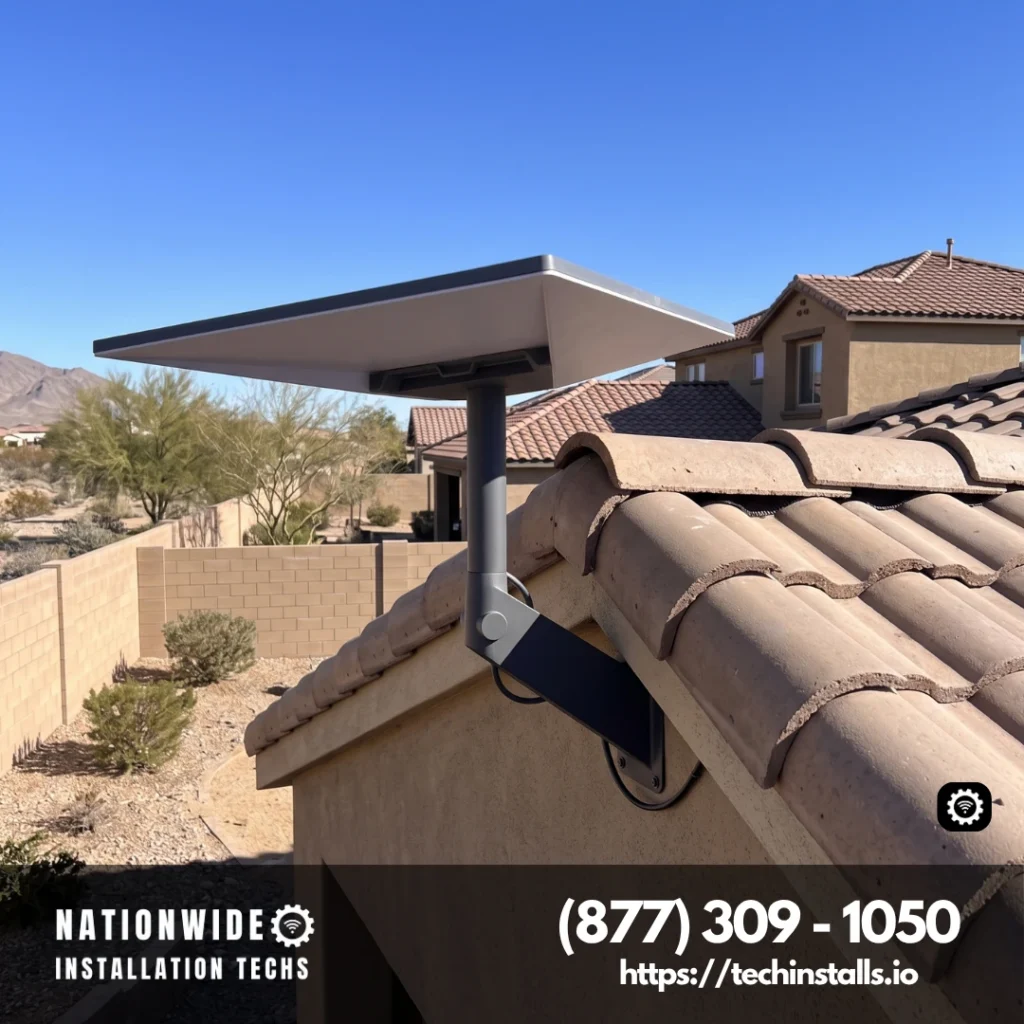
Most people who call us from Clark County have a specific situation in mind. Some live past the edge of the built-up valley where wired service simply stops. Others answer to an HOA that governs every roofline, own a coach or fifth wheel with no fixed address, or need a backup line that stays up when the primary drops. Starlink covers every one of those cases once it is installed properly. Take a speed test reading before our visit and one after the dish is aimed, and the two results tell you what the install delivered.
Heat Is the Real Design Constraint in Clark County
Summer here is not a condition to be worked around; it is the thing the install has to survive. Afternoon air temperatures past 105°F are routine from June into September, and the surface of a dark roof sitting under that sun runs far hotter than the air above it. Every material in the install lives in that environment for roughly a third of the year, every year, and then does it again.
What that does is specific rather than vague. Sealant that was never rated for the movement goes brittle and lets go. A cable jacket without proper ultraviolet resistance chalks, cracks, and then lets water in during the few weeks a year it actually rains. Fixings work loose over thousands of expansion and contraction cycles in a way they simply would not in a mild climate. None of it shows up in the first month, which is exactly why it is worth getting right on the first day instead of discovering it in year three.
So the decisions we make in this valley are heat decisions. Sealant rated for the thermal movement it will actually see rather than a general-purpose tube. Cable and clips specified for ultraviolet exposure rather than whatever is generic. Mechanical fixing rather than adhesive anywhere adhesive would be asked to hold through a Nevada August. We also aim and run a live speed test before we leave, in the conditions of the day, rather than handing over a job that was only ever verified in the cool of the morning.
Concrete Tile Roofs, and Why We Do Not Drill Them
Concrete tile covers the majority of roofs in the valley, and it is the main reason a Las Vegas job often uses a different mount than the owner pictured.
Tile is deliberately absent from our installation standard, which lists five mounting methods and excludes tile from every one. Nobody on our crews drills it, lifts it, or seals a bracket into it. Concrete tile cracks under point loads, and a cracked tile channels water down to the underlayment; the repair bill easily outruns the price of the install that caused it.
None of the options touch tile. A standard wall mount puts a bracket into the framing or block of a gable or side wall, so the wall bears the weight. An under-eave wall mount tucks up under the overhang where passers-by will not notice it, reaching past the fascia. The third option needs a level patch, and plenty of valley homes have one behind a parapet, over the garage or above a patio; there a ballasted non-penetrating mount holds the dish with weight and no hole anywhere.
The cable avoids the tile as well, dropping down a wall or following a parapet before entering through a wall hole we can seal from outside. Anyone proposing to screw a foot plate through tile is making it up as they go. Our roof check guide covers the full pre-install inspection.
The Dish Looks North, Which Is Not Where Most People Point
The dish looks north. It is worth saying plainly, because almost every homeowner we meet expects the opposite and the expectation sends people inspecting the wrong side of their own house.
In practice this works to our advantage. The valley is open, the housing is mostly low, and the Spring Mountains and Red Rock escarpment sit to the west rather than in the way. A single-story house in Summerlin, Enterprise or Centennial Hills will usually have a clean northern view from somewhere on the structure, and the survey becomes a question of which position gives the tidiest cable run rather than whether the job is possible at all.
The valley’s edges are different. Near the mountains at Blue Diamond and Mount Charleston, ridgelines can cut into the northern sky, and elevation shifts the angles in ways a valley-floor rule of thumb misses. In a two-story subdivision, the house directly north of yours matters more than anything else in view; if your roof cannot clear it, a casita or detached shop that can will host the dish and pass the connection back over a wireless bridge setup. Our free virtual survey resolves all of this for your exact roof before a date is booked.
HOAs, Design Review and a Plan the Board Will Approve
Homeowners associations govern a huge portion of Las Vegas homes, and the big master-planned communities such as Summerlin, Southern Highlands, Silverado Ranch and Aliante in North Las Vegas enforce their rooftop and elevation rules closely.
Your CC&Rs are between you and the association, and we will not guess at what they allow. Our contribution is an install designed to pass review easily: equipment kept away from the street-facing side whenever the house permits, a weighted mount in place of a drilled one wherever there is a flat section, and cable run neatly along the structure instead of hanging loose down the stucco.
Renters and condo owners face a simpler rule. The building’s owner must authorize the work in writing before we attach anything, and a spoken okay from the management office does not count. Get that request started before you book, since waiting on it is the most frequent reason a job in the valley gets pushed back a week.
Monsoon, Dust and Wind Loading
Las Vegas gets a little over four inches of rain in an average year, and a good share of it arrives in a handful of violent afternoons between July and September. That pattern is harder on an install than steady rain would be, because everything happens at once on surfaces that have been bone dry for months.
Monsoon cells arrive with abrupt gusts and walls of dust before any rain falls, so a mount that sits comfortably through a calm spring day faces much harsher loads in an August outflow. That is why mast height gets real discipline here: we fit the lowest mast that still clears whatever is in the way, because extra length magnifies the force on the fixing during the very weeks that test the install hardest.
Dust is the quieter problem. It gets into everything, it is abrasive, and combined with the ultraviolet load it ages exposed materials faster than most climates manage. Then the rain arrives all at once, which is precisely when a marginal seal or a cable entry without a drip loop gets found out. Neither failure is dramatic on the day it happens. Both are avoidable on the day of the install.
Coaches, Rigs and the Desert Past the Valley
Clark County has a large RV community, and much of it is local rather than tourist. With resort parks on the valley floor, campgrounds around Lake Mead, snowbirds who stay the winter and open desert beyond, a big share of our Nevada work bolts onto something with wheels.
Motorhomes, fifth wheels, travel trailers, camper vans and overland trucks all go through our RV Starlink installs, and pickups or work vans follow the same rules through our vehicle mount installs. Hardware bolts through to the frame or roof structure and never trusts a screw in a thin fiberglass skin. We tie the cable down at close spacing so washboard desert roads cannot shake it loose, and wire the dish to the house battery bank rather than the chassis battery. The job ends with the dish pointed and a live speed reading on your phone. Crews roll up with every bracket and connector on board, since the nearest parts counter may be an hour across the desert.
Past the built-up valley the case stops being about convenience at all. Out at Blue Diamond, Sandy Valley, Mount Charleston, Indian Springs and up the Moapa Valley toward Logandale and Overton, there is frequently no wired option worth having, and Starlink is not anybody’s second choice. That is the work this company was built on, and it is why we will drive a long way out of the valley for a single house.
Where We Drive Across the Valley, and What the Quote Covers
Across the valley we work everywhere: Summerlin, Lone Mountain and Centennial Hills to the west and northwest, Aliante and North Las Vegas, Sunrise Manor and Whitney to the east, Winchester and Paradise through the middle, Spring Valley and the Chinatown corridor, and south through Enterprise, Southern Highlands and Silverado Ranch.
Past the valley we cover Boulder City to the southeast, Blue Diamond and Sandy Valley to the southwest, Mount Charleston and Indian Springs to the northwest, Primm down at the state line, the Moapa Valley towns of Logandale and Overton to the northeast, and west over the county line to Pahrump in Nye County.
The drive never changes the price; the job does. A home starts at $385, and the total depends on which mount the roof allows (tile will decide that for you), whether a wall or under-eave spot needs extra cable to reach the right room, and whether a casita, shop or second structure joins the network. The virtual survey is free and checks your real sky before a date is set. An on-site visit runs $199 for anyone who wants a technician there first, and on a tile roof with no obvious flat area it usually pays for itself.
We usually get to you within about three days, and with the equipment already at the house and a clean survey, same-day completion is often possible. Nationwide Installation Techs is independent of Starlink: you own the hardware, the Starlink account is in your name, and we have no part in your subscription or monthly bill. We earn our money on installation alone, and our Starlink cost guide walks through every figure.
Frequently Asked Questions
No fastener ever goes into the tile; that is a firm rule, not a limitation of the crew. Instead the dish rides on a bracket anchored into framing or block, either on a wall or tucked under the eave, or it sits on a weighted base on whatever flat patch the house offers, and most valley homes have one. Your roof covering stays exactly as the roofer left it. Screwing a foot plate through tile is an improvisation we refuse to offer.
No, not in the way people expect. What the heat here really tests is the quality of the installation rather than the connection. The hardware manages its own thermal behavior and is built to operate in hot climates. What fails in this valley is the workmanship around it: sealant that was never rated for the thermal movement, a cable jacket without proper ultraviolet resistance, fixings that work loose over thousands of expansion cycles. Get those right on day one and a Las Vegas install is no less reliable than one anywhere else. Get them wrong and you will find out in year two or three.
Rarely, though it pays to settle it before booking. What your association permits is its call, not ours, so we will not predict the answer. We simply design the install to be easy to approve: nothing on the street side if the house allows it, weight instead of drilling where there is a flat section, and a neatly routed cable. Renters and condo owners also need the building owner’s written permission before anything is attached.
We recommend it, and it costs nothing. Most valley homes pass easily, and hearing that confirmed is worthwhile on its own. Since the dish faces north, though, a two-story house just north of you can be a bigger issue than anything you had in mind, and near the mountains the terrain itself blocks sky. The survey looks at your roof specifically and also identifies the mount position with the shortest practical cable run.
We do. Rural properties beyond the valley are exactly the customers this business was built for, and places like Sandy Valley, Blue Diamond, Indian Springs, Mount Charleston, Logandale and Overton often have no wired service worth buying. The drive adds nothing to the install price; it just affects scheduling. Tell us your location when you book the survey and we will set aside a proper slot instead of squeezing you between two city jobs.
We can, and we do it all the time. Motorhomes, fifth wheels, trailers, camper vans and overland trucks all get an anchored mount that never relies on the thin roof skin, snugly clipped cable, and power drawn from the house batteries instead of the starter. Our techs carry every part needed, which matters when the park is far from any supply store, and we finish with the dish aimed and a speed result in hand.
It puts real load on it. From July to September, storms push sudden gusts and dust ahead of any rain, so the forces on a mount in an August outflow are far higher than on a calm May afternoon. That is why we keep masts as short as the sightline allows; each extra foot adds leverage at the base. Those storms are also when a weak seal or a cable entry with no drip loop starts leaking, after months of heat have already worn it down.
Plan on roughly two hours of work at the house. We tend to schedule within three days of the survey, and a crew can frequently wrap up on that first visit when the kit is waiting and the survey turned up no surprises. When a Las Vegas job slips, the cause is almost never the equipment. It is usually an HOA review still pending, a tile roof that needs its off-tile mount position settled, or a remote address that deserves a dedicated trip.
About Nationwide Installation Techs
Nationwide Installation Techs LLC is a professional, insured satellite installation company operating in all 50 states, with over 3,000 installations completed and a 4.9-star Google rating from 100+ reviews. Our experienced technicians cover residential, commercial, RV and marine installations, along with mesh networking, point-to-point bridges and on-site repair. We are an independent installer: you own your hardware and hold your own service account, and our crews handle the mounting, sealing and setup.
Las Vegas sits within our Nevada Starlink installs; for other states, see locations we serve. Phone (877) 309-1050 to set a date.
Contact a Las Vegas Starlink Installer
Nationwide Installation Techs LLC
- Phone: (877) 309-1050
- Email: support@techinstalls.io
- Free Quote: Contact Us Form
Connectivity News & Updates

Starlink Installation for Construction Sites — Local, Insured Techs
Starlink installation for construction sites, in all 50 states, from...

Thor Four Winds Starlink Installation | We Come To You
Thor Four Winds Starlink installation means working around a domed...

Residential Starlink Installation — Nationwide and Insured
Residential Starlink installation starting at $385, nationwide. Nationwide Installation Techs...

Expert Starlink Installation for Yachts and Boats
Starlink installation for yachts and boats, nationwide. Nationwide Installation Techs...
Disclaimer: Nationwide Installation Techs LLC is an independent business and has no affiliation or official connection with Starlink, SpaceX, or any of their subsidiaries or affiliates. We are not associated with, authorized, endorsed, or sponsored by these companies in any capacity. For official information, please visit the Starlink and SpaceX websites at www.starlink.com and www.spacex.com. The names “Starlink,” “SpaceX,” and any related trademarks, logos, or imagery are the exclusive property of their respective owners.
Any references to “certified” or “certification” on this website refer exclusively to Nationwide Installation Techs LLC’s proprietary in-house technician certification program. This training and certification process was developed by our company based on the experience and installation methods of professional technicians who have collectively completed more than 3,000 successful Starlink installations while maintaining an overall 4.9-star customer review rating. It is not affiliated with, issued by, approved by, or endorsed by Starlink, SpaceX, or any of their affiliates.