

Milwaukee Starlink installer, Nationwide Installation Techs, (877) 309-1050. We cover the whole city, Bay View to the far north side, with insured technicians who also head out through Wauwatosa, the North Shore suburbs and the Lake Country towns around Pewaukee and Oconomowoc. If the kit is already at your door, the visit usually ends with the dish online that same day. Homes begin at $385. Businesses pay $750 a location, or $650 apiece once there are three or more. Motorhomes, cars, pickups and vans begin at $650, with a lower per-vehicle rate for three or more and for whole fleets, and boats and yachts begin at $750. Every install is backed by a one-year workmanship guarantee, and our 4.9-star Google rating stands on more than 100 reviews. Serving Milwaukee, WI and every community around it.
The draw of Starlink here is that it keeps nobody’s schedule but yours. Milwaukee hands us its own kind of puzzle. A large share of the housing here is more than eighty years old, a good part of it built as two units under one roof, and close to six in ten households rent rather than own. So the first questions on a job in this city are seldom about the sky. They are about which flat the service is for, who owns the outside walls, and whether the block sits inside a district where the city looks at anything new on a facade.
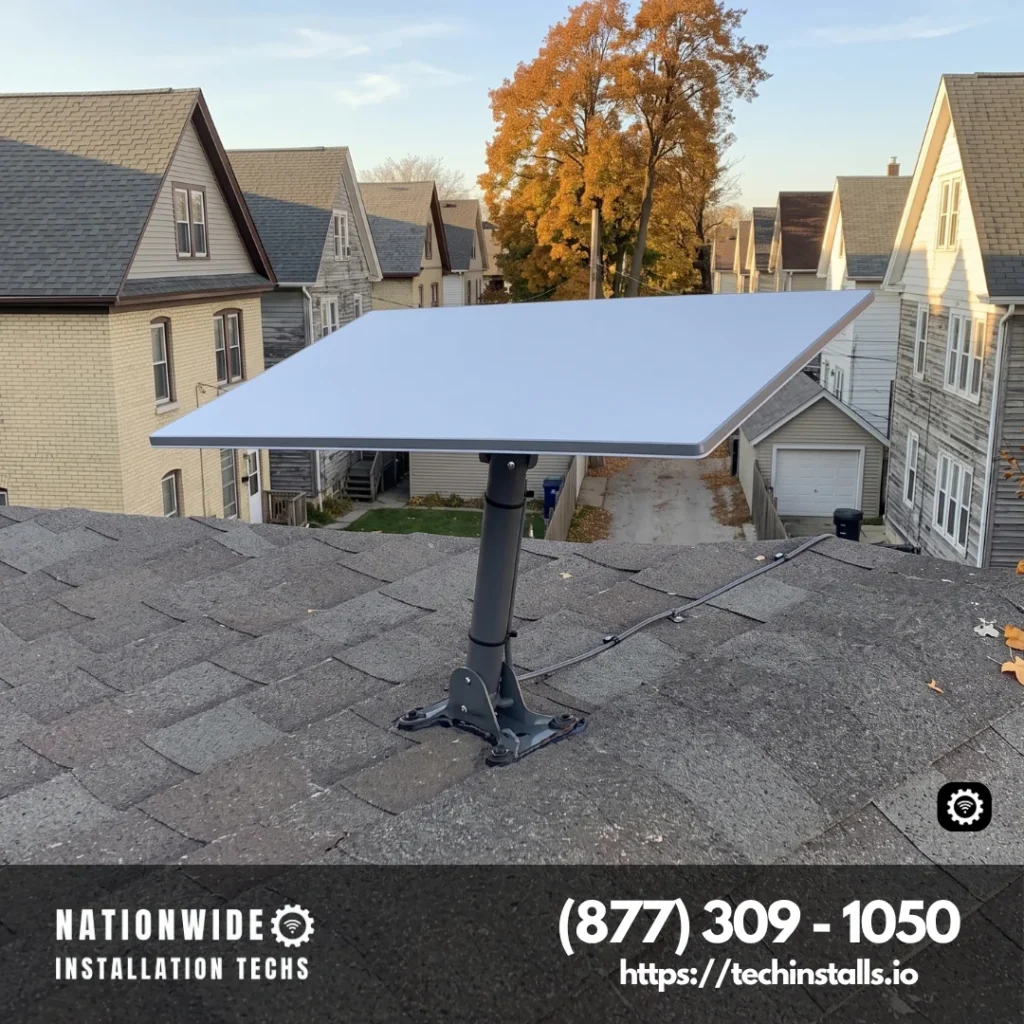
There is no install window to sit through, no wondering whether a line was ever pulled to your block, and when the lease ends the dish goes in the moving van with everything else. Take a Speedtest.net result on the connection the house has now and a second one after our technician packs up; those two numbers side by side are the plainest record of what you gained. A normal week in Milwaukee brings us a duplex where the owner lives downstairs, a Cream City brick house on a reviewed block that needs the dish out of view, a Bay View cottage boxed in by a taller neighbor, and a hobby farm in Washington County where the cable stopped a mile short. Order the kit, and while it is in transit, set up the free virtual survey; by the time the box lands, we already know where the dish is going.
Upstairs, Downstairs: Polish Flats and Two-Family Houses
Between about 1870 and 1920 Milwaukee’s working families built roughly ten thousand Polish flats, most of them on the south side. The idea was simple: lift a modest cottage on new footings and fit a second home into the half basement beneath it. Add the classic upper-and-lower duplex that fills block after block elsewhere in the city, and you have a housing stock where one roof very often shelters two separate households.
That shapes the job in a few specific ways.
- Each unit can have its own kit. A Starlink account belongs to one dish, so an upper flat and a lower flat that want separate service get separate hardware. Two dishes share a roof without trouble when we space them so that neither one sits in the other’s view of the northern sky.
- The lower unit’s cable comes in above grade. On a raised cottage the lower flat sits partly below the sidewalk, so the run comes down the wall, clipped every foot to foot and a half, and enters through a sealed grommet with a drip loop well above where snowmelt collects.
- The owner is often right downstairs. Many duplexes here are owner-occupied, which makes the written okay for the roof or an outside wall quick to get. We still need it in writing before anything is fixed to the building.
- A porch you rent alone is yours to use. Federal rules let a tenant put a dish in space under their sole use, like a private porch or balcony. The roof and the outer walls belong to the owner, so a mount on those waits for the owner’s signature.
Cream City Brick, Brewers Hill and the City's Design Review
The pale yellow brick that gave Milwaukee its Cream City nickname was fired from clay dug in the Menomonee Valley, and through the second half of the 1800s it went into houses, churches and warehouses all over town. Many of those buildings now sit in locally designated historic districts. Brewers Hill and Concordia are two of the best-known, and in districts like them an exterior change that needs a building permit also has to clear the Historic Preservation Commission, which issues a Certificate of Appropriateness for it. The city’s own preservation guidance is direct about dishes: keep them where the street cannot see them, preferably at the back of the house. The Historic Third Ward runs its own review through an architectural review board, which looks at nearly every exterior change there apart from paint.
That guidance lines up with how we would place a dish anyway. The dish faces north, and on most lots a rear roof plane or a back wall can give it a clean view of that sky without showing anything to the sidewalk. On a pitched rear roof we use a pivot mount set high, just under the ridge. On a rear or side wall we use a standard wall mount fixed into structure. Where a flat rear roof covers an addition, a non-penetrating ballasted base can sit there held by weight alone.
We write up the mount type, its position and the hardware so the owner can attach it to the application, and we put the job on the calendar after the approval comes through.
Ice Dams, Lake Air and 48.7 Inches of Snow a Season
The National Weather Service puts Milwaukee’s normal snowfall at 48.7 inches a season, and anyone who has lived near the shore knows the other half of the story: when the wind swings around off Lake Michigan, the temperature near the water can fall ten or twenty degrees in a few minutes. Every thaw after a heavy snow brings the same warning on the local news, because meltwater refreezes along the eaves and builds ice dams that push water back under the shingles.
For a dish, the eave line is the part of the roof to stay away from, and the way we work reflects that.
- The mount goes high. We fix the pivot mount close under the peak, far above the strip along the gutter where ice builds up, then seal it fully: a bead in each pilot hole, a line around the whole foot, a dab over every bolt.
- The cable comes in away from the ice. We pick an entry point on a wall rather than at the roof edge, and a drip loop hangs beneath it so meltwater drops away at the bottom of the curve rather than tracking along the cable into the wall.
- The dish clears its own snow. It melts snow off its face with the heat the antenna gives off while it runs, so what keeps it working through a lake-effect week is an open view, not a shovel. Nobody should be climbing an icy roof to brush it off.
Shorewood, Waukesha, Kewaskum: Milwaukee Starlink Installer Coverage
Inside the city we cover every neighborhood, and the ring around it starts close. Shorewood sits about four miles north-northeast of downtown, Whitefish Bay and Glendale roughly six miles north, Wauwatosa five to the west, West Allis five to the west-southwest, and Cudahy and Greenfield about six to the south-southeast and southwest.
A little further out, South Milwaukee is nine miles south-southeast and Oak Creek ten due south. Brown Deer lies ten to the north-northwest, Brookfield eleven west, New Berlin eleven west-southwest and Franklin twelve south-southwest. Mequon is thirteen miles north-northwest in Ozaukee County, Menomonee Falls fourteen to the northwest and Muskego fifteen to the southwest.
Past that, Waukesha and Pewaukee are about sixteen miles west, Germantown seventeen northwest, Cedarburg eighteen and Grafton twenty to the north, Racine twenty-two to the south-southeast, and Port Washington twenty-four up the shore. Delafield and Mukwonago are about twenty-five miles out to the west and west-southwest. At the edge of the map are West Bend, Hartford and Oconomowoc at around thirty miles, Burlington thirty-one to the southwest, Kenosha thirty-two to the south, and Kewaskum thirty-seven to the north-northwest.
Distance is not a line on the invoice. The address and the work it needs set the price, with the same terms in Milwaukee, Waukesha, Ozaukee, Washington, Racine and Kenosha counties alike.
Kettle Moraine Farms and Washington County Acreage
The calls change character once you are past the suburbs. North of West Bend toward Kewaskum, out across the Kettle Moraine and down into Walworth County, state broadband maps still show thousands of homes and farms the wired networks have not reached at speeds worth having. Most of these properties are more than one building: a house, a machine shed, a workshop, sometimes a second home for family.
One dish nearly always serves the lot. We put it on the building with the most open sky and the soundest place to fix a mount, then carry the signal to the others with a point-to-point wireless link: a small radio on each building, aimed at the other, and nothing buried in between. Across a frozen field that beats a trench, and in the glacial hills it is often the only sensible way to reach a shed down the slope.
Off-grid cabins and solar setups come up too. Budget 75 to 100 watts of steady draw for a Standard dish; that number is what your solar designer needs from us, and sizing the panels and batteries is their job, not ours.
After the Ash Trees: Reading a Sky That Keeps Changing
The emerald ash borer reached Milwaukee more than a decade ago, and the city set out to protect its street ash with treatment, some 28,000 trees by a 2016 count, while untreated and failing ash have come down across the county parks and in plenty of backyards. On a lot of blocks that changed the view from the roof. A house that sat in deep shade ten years ago may now look at open sky, and a young replacement tree on the terrace will spend the next twenty years growing back into it.
So the survey looks at two things: what blocks the dish today, and what will block it later. The Starlink app’s obstruction check shows the first. Reading which way a young maple or linden will spread, and putting the dish where its growth will not matter, covers the second. A little extra height or a move to the other side of the ridge now is cheaper than a second visit in five years.
Renting, Working From Home and Keeping a Second Line
Most of Milwaukee can order a wired connection. AT&T Fiber reaches a large part of the city and Spectrum’s cable covers almost all of it, and nearly nine in ten households subscribe to some form of home broadband. Starlink still earns its place here, for reasons that come down to how people actually live.
With so many households renting, a connection that moves with you counts for a lot. The kit, the account and the monthly plan are in your name, and a new lease across town means unplugging and setting up again rather than waiting on a transfer. Small businesses and anyone working from home tend to want a second path that does not share cable routes, cabinets or a repair queue with the first, which is what Starlink as backup internet is for. And some people simply want to compare monthly bills. Whichever applies, the survey gives you real figures for your own address to decide with.
What Goes Into a Milwaukee Quote
Every house quote opens at $385. What can raise it is specific to the property: a wall mount the historic review calls for, extra mast height to clear a neighbor, a long cable route down to a lower flat, or a link out to a shed or a barn. The remote sky survey costs nothing and happens before anyone is scheduled. Prefer to have someone on the property before committing? An on-site survey is $199, and on a spread-out rural lot it pays for itself.
The figure is fixed before a ladder goes up, so nothing changes once the work has begun. Booking usually lands within three days or so, and when the kit has arrived and the survey shows nothing unusual, we generally wrap up during that first visit.
General liability insurance covers every job, and mounting dishes is all our technicians do. The hardware and the subscription stay yours, paid to Starlink directly; our fee covers the installation and nothing else. Our installation cost guide goes through every price band in more detail.
Roof Repairs, Old Mortar and Other Jobs for Another Trade
Some of what we find on a Milwaukee roof belongs to another trade, and we would rather say so up front than leave you with a half-solved problem. Ice-dam damage, soft decking or a roof due for replacement go to a roofer first, because a mount on a roof about to be torn off is coming straight back down. Loose or crumbling mortar on an old brick wall is a mason’s job before it is a mounting surface. Slate and clay tile, which turn up on some of the older houses here, are never drilled: both shed water through overlapping pieces that split when a fixing goes through them, so those homes get a wall mount instead. Metal roofs keep their seams and their warranty, with the dish going on a wall or a ballasted base. Wiring for a solar or battery system belongs to a licensed electrician. And the historic application itself is filed by the owner, with our written mount details attached.
What Milwaukee Households Ask Before We Mount a Dish
Yes. Each household gets its own dish, router and account, and both dishes can share the roof as long as they are spaced so neither blocks the other’s view north. The upper unit’s cable usually comes straight in through the wall near the dish, and the lower unit’s run comes down the outside of the house to a sealed entry above grade. We can do both on the same visit.
Brewers Hill is a locally designated district, so an exterior change that needs a permit goes to the commission for a Certificate of Appropriateness first. The city’s own guidance on dishes is to keep them hidden from the street, at the back of the house where possible. Our survey finds a spot like that, and we put the details in a short written note for you to attach: which mount, where on the house, and what it is fixed with. Once the commission signs off, we schedule the visit.
Snow on the dish is handled by the dish itself: the antenna uses its own operating heat to melt snow off its face. What matters is where it sits. We mount it high, just under the ridge, clear of the eaves where ice dams build, and bring the cable in through a sealed wall entry with a drip loop. That keeps the dish working and keeps meltwater out of the house.
Federal rules generally let a renter install a dish in an area they use exclusively, such as a private porch or balcony, without drilling into the building. A non-penetrating base held by weight works well there if the porch has a clear view north. Anything on the roof or the outside walls needs the owner’s written permission first, and we will ask to see it before we start.
It is a good time to look. With the old tree gone, the sky over the house may be far more open than it was. We check the view as it stands today and also allow for the replacement tree on the terrace, placing the dish where that tree’s growth will not reach its line of sight for years to come.
Yes. One dish goes on whichever building has the cleanest view north and the best place for a mount, and the shed and workshop are linked to it by a point-to-point wireless bridge, a radio on each building aimed at the other. There is no trench to dig and nothing to freeze in the ground over winter.
Yes, along with Racine and Kenosha counties. Our technicians cover the whole ring from Shorewood and Wauwatosa out to West Bend, Oconomowoc, Burlington and Kewaskum. The price depends on the job, not the drive, so a farm forty minutes out pays the same as a house in Bay View for the same work.
Yes. Marine work starts at $750 and covers a mount chosen for a hull that pitches and rolls, stainless hardware, and a sealed cable run wired to the boat’s house batteries so the engine battery is never drained. Milwaukee County opens McKinley Marina from May 1 to October 31, which makes early spring the time to book if you want the boat online for its first weekend on the lake.
$385 is the starting point for a house, and it includes the mount, the cable, setup, aiming and our one-year workmanship guarantee. The total climbs only when the house needs more than that, such as a wall mount the design review prefers, more mast to clear a neighbor, a long run down to the lower flat or a radio link to a garage or shed. Businesses pay $750 per location, or $650 each across three or more; RVs, cars, pickups and vans start at $650; boats start at $750. Checking your sky remotely costs nothing, and a site visit ahead of the job is $199.
About Nationwide Installation Techs
Nationwide Installation Techs LLC puts up Starlink dishes in all fifty states, with insured technicians, more than 3,000 completed installs and a 4.9-star rating on Google. Homes, storefronts and offices, motorhomes, work vehicles and boats are routine for us, as are mesh networks for large houses, wireless links between buildings and repairs to installs someone else left loose. We never take over your Starlink account: the equipment and the plan belong to you, while the mount, the seal, the cable route and the aim are our responsibility.
Our Milwaukee jobs sit under the Wisconsin Starlink installation page, and from there the other states we cover are a click away. Bookings go through (877) 309-1050 any day of the week.
Contact a Milwaukee Starlink Installer
Nationwide Installation Techs LLC
- Phone: (877) 309-1050
- Email: support@techinstalls.io
- Free Quote: Contact Us Form
Other Ways Our Milwaukee Technicians Put Starlink to Work:
Connectivity News & Updates

Starlink Installation for Construction Sites — Local, Insured Techs
Starlink installation for construction sites, in all 50 states, from...

Thor Four Winds Starlink Installation | We Come To You
Thor Four Winds Starlink installation means working around a domed...

Residential Starlink Installation — Nationwide and Insured
Residential Starlink installation starting at $385, nationwide. Nationwide Installation Techs...

Green Bay Starlink Installer — Same-Day Service When Your Kit Is On Site
Green Bay Starlink installer, Nationwide Installation Techs, (877) 309-1050. Professional,...
Disclaimer: Nationwide Installation Techs LLC is an independent business and has no affiliation or official connection with Starlink, SpaceX, or any of their subsidiaries or affiliates. We are not associated with, authorized, endorsed, or sponsored by these companies in any capacity. For official information, please visit the Starlink and SpaceX websites at www.starlink.com and www.spacex.com. The names “Starlink,” “SpaceX,” and any related trademarks, logos, or imagery are the exclusive property of their respective owners.
Any references to “certified” or “certification” on this website refer exclusively to Nationwide Installation Techs LLC’s proprietary in-house technician certification program. This training and certification process was developed by our company based on the experience and installation methods of professional technicians who have collectively completed more than 3,000 successful Starlink installations while maintaining an overall 4.9-star customer review rating. It is not affiliated with, issued by, approved by, or endorsed by Starlink, SpaceX, or any of their affiliates.