

Orlando Starlink installer, Nationwide Installation Techs, (877) 309-1050. Professional, insured technicians serving Orlando, Florida and Orange County. If your kit is already on site, same-day service is often available. 4.9 Google star rating with 100+ reviews. Mobile installs start at $650, with discounts available for 3+ vehicles and mobile fleets. Yacht and boat Starlink installations start at $750. Residential installs start at $385. Commercial installs in Orlando start at $750, with discounts for 3+ locations. 1-year workmanship guarantee, by professional, insured technicians. Serving Orlando, FL and surrounding areas.
Orlando is a canopy city, and the canopy decides almost every install here. The neighborhoods people actually want to live in, College Park, Delaney Park, Audubon Park, Thornton Park and the streets around Winter Park, are shaded by live oaks that were mature before the subdivisions around them existed. Those trees are the reason the city looks the way it does and they are also the single most common reason a dish lands in a different place from the one the homeowner had in mind. The roof is rarely the hard part in Orange County. The forty feet of oak between your roof and the northern sky usually is.
Before you decide anything, and before you call us, run your own address on speedtest.net at the hour you actually use the connection rather than trusting a coverage map. A good deal of the metro is genuinely well served, and we will say so plainly. The calls that make sense here come from somewhere more specific: a lot with heavy canopy where wired service is fine but unreliable in weather, a property out past the edge of the built-up county, an association that controls what appears on a roof, a rig that is not at an address at all, or a second connection that has to hold when the first one drops.
Live Oaks, Line of Sight, and Why the Survey Comes First
The dish looks north. That is worth saying plainly in Orlando, because the mature canopy here does not care which direction you were hoping for, and skipping the sky read is guessing.
A live oak is a particular problem for satellite line of sight. It is not tall and narrow like a pine, it is broad and low and it spreads horizontally over the roof rather than standing beside it. A single oak on the north side of a College Park bungalow can take more sky than a row of pines would. Worse, it moves: the canopy that clears in February fills in by May, so an install aimed in winter without allowance for leaf-out is an install that degrades in spring.
So we read the sky over your specific roof before anyone commits to a date, and we account for how full that canopy gets once the trees leaf out for summer, not just how open the sky looks on the day we’re standing there. Where the main roof cannot see past the oak, the answer is usually a different position rather than a bigger mast: a rear roof plane, a detached garage, a pool house or a shed with clear sky, brought back to the house over a point-to-point wireless bridge. Where a modest increase in mast height genuinely clears the crown we will say so, and where it does not we will say that too, at the survey rather than from a technician already standing on your roof. What we check before anything goes on a roof is written up in full.
Shingle, Tile, and Which Mount Your Roof Forces On Us
Most of Orange County is asphalt composition shingle over a clean deck, and that is the straightforward end of the work. A pivot roof mount fixed into rafters, sealed properly at every pilot hole and around the base, with the shortest sensible cable run. It is the most common install we do and on a dry day it is a couple of hours.
The newer half of the metro is a different roof. Horizon West, Lake Nona, Windermere, Dr. Phillips and a good deal of the Osceola County growth run to concrete and barrel tile, and every mounting option in our playbook is built around keeping the fasteners off the tile entirely. There is no approved way for us to drill through tile, lift a tile field or flash a penetration into it, so we do not do it. A cracked tile is not a cosmetic problem, it is a water path, and in a climate that delivers fifty inches of rain a year that matters more here than it would almost anywhere else.
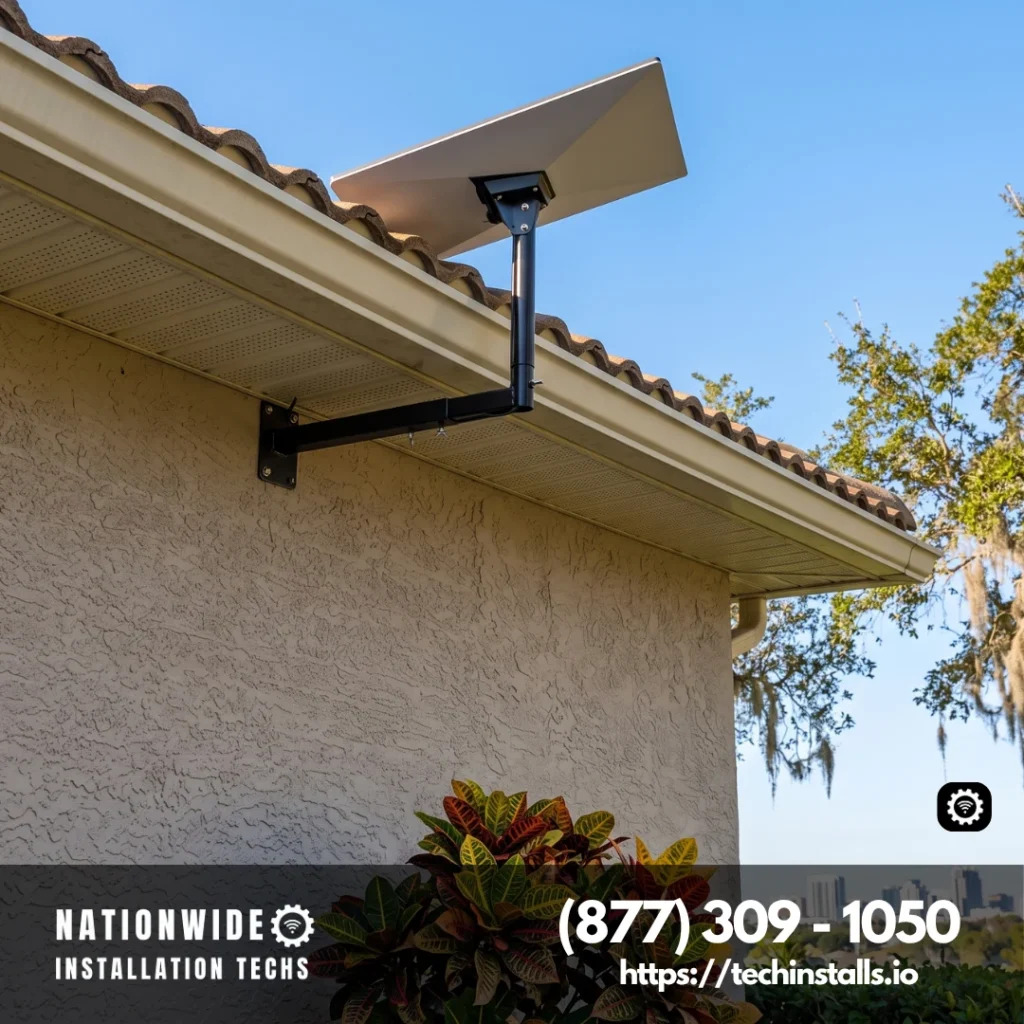
On tile the honest answers are the ones that keep the fixings off the roof covering entirely. A standard wall mount into solid framing or masonry takes the load on a wall rather than on the tile. An under-eave wall mount does the same thing tucked up beneath the overhang, out of sight from the street. And where the house has a flat or low-slope section, which many Florida houses do over a garage, a lanai or a patio, a ballasted non-penetrating mount sits on it under its own weight with no hole anywhere in the assembly.
The cable follows the same logic. It runs down a wall and enters the building through a wall penetration we can seal properly, rather than through a roof plane we cannot. If somebody offers to screw a foot plate through your tile, that is improvising rather than a method.
Associations, Architectural Review and Getting It Right the First Time
A very large share of Orlando housing sits inside a homeowners association, and in the master-planned communities, Lake Nona, Baldwin Park, Horizon West, Hunter’s Creek, Avalon Park and Windermere among them, the standards covering what appears on a roof or a street elevation are taken seriously.
We are installers, not your legal adviser, and we will not tell you what your particular association must or must not permit. What we will do is install in the way that gives the question its best chance of a straightforward answer: hardware kept off the street elevation wherever the house allows it, a rear roof plane or a side wall in preference to a front one, a ballasted mount rather than a drilled one wherever a flat section makes that possible, and a cable run that is properly routed rather than draped down a wall.
What clears these fastest is submitting a specific placement rather than a general request. We will give you the mount specification and a note of where it would sit, which is usually all a committee actually wants to see. If you are renting or in a condo the rule is firmer and much simpler: the property owner has to sign off in writing before we attach anything to the structure, and a leasing office saying it’s fine over the phone doesn’t satisfy that.
Lightning Alley, Afternoon Storms and What They Do to a Bad Install
Central Florida sits in the most lightning-dense corridor in the United States, and from June into September the afternoon storm is not an event, it is the schedule. Orlando takes a little over fifty inches of rain in an average year and a great deal of it arrives hard, fast and sideways.
That pattern punishes shortcuts in a specific way. Water driven horizontally finds a cable entry that was sealed for rain falling straight down. A drip loop is not a nicety here, it is the difference between water running off the low point and water tracking along the jacket and into the wall. So we give the cable a proper loop below the entry, seal the exterior penetration with a product rated for the movement and the ultraviolet load rather than whatever happens to be in the van, and we finish the interior with a wall plate instead of a bare hole.
Bonding and grounding matter more in this county than in most. A mast fixed to a roof in Lightning Alley should be bonded in line with the electrical code that applies to your property, and we will tell you at the survey where that lands rather than discovering it afterwards. We are installers rather than electricians, and where the correct answer is that a licensed electrician should make the bond, that is what we will say.
Ultraviolet is the quieter problem. Florida sun goes after cable jacketing, sealant and cheap plastic hardware long before it touches a mount, so we keep the exposed run short, secure it at close intervals so it is not flexing in a storm, and specify clips and cable rated for the exposure rather than whatever is generic.
Coaches, Boats and the Work That Is Not at an Address
Not everything we mount is attached to a building. Central Florida has a serious RV population and it is not only visitors. Between the resort parks around the attractions corridor, the sites out toward Clermont and Mount Dora, the winter residents who come down for the season and the working rigs, a good deal of our Florida work is bolt-anchored to something that moves.
RV Starlink installation runs on the same standard as everything else: a bolt-anchored mount rather than a fixing screwed straight through a thin roof skin, a cable run clipped tight with no sag, power taken off the house bank rather than left to flatten a starting battery, then aiming and a live speed test before we leave. Our technicians arrive with all the equipment the job needs, which matters when the rig is parked at a site with no parts store inside an hour.
Boats are a genuine part of the work here too, and Starlink installation for yachts and boats is one of our core service lines. There is water in every direction from this city, the chain of lakes through Winter Park and Conway, the St. Johns to the east, and the coast an hour either side. A boat mount has to solve a different problem than a roof mount does: the whole platform is rocking constantly, it sits wet or humid nearly around the clock, and treating it like a fixed structure is how the hardware fails early.
Starlink installation for cars and trucks covers work trucks, service vehicles and overland builds, and that is the other half of it here: trades running a van as a mobile office, contractors who need a connection on a site months before the service is in. Starlink installation for mobile fleets covers the same work at scale for operators running more than a handful of vehicles. Same method, same standard, and a live speed test before we leave.
Where We Drive Across Orlando, and What the Quote Covers
Across the city we work everywhere: College Park, Thornton Park, Delaney Park and Audubon Park through the core, Baldwin Park and Winter Park to the north, Conway and Belle Isle to the south, MetroWest and Dr. Phillips to the west, Lake Nona and the Medical City corridor to the southeast, and Avalon Park and Waterford Lakes out east.
Around it we cover the counties Orange runs straight into: north into Seminole County through Altamonte Springs, Oviedo, Winter Springs and Sanford, south into Osceola County through Kissimmee and St. Cloud, and west into Lake County through Clermont, Winter Garden and Mount Dora.
Residential installs start at $385, and what moves the number from there is the work at the far end of it: which mount your roof forces on us, and on a tile roof it will force one, whether the canopy pushes the dish to a detached structure and a bridge back to the house, how long and awkward the cable run turns out to be, and whether a second building has to come onto the connection. A virtual survey is free and reads the sky over your actual roof before anyone commits to a date. An on-site survey is $199 if you would rather have a technician physically at the property first, which under heavy oak canopy is frequently money well spent.
Typical scheduling is around 72 hours. If the kit is already at the house and the survey comes back clean, same day is often possible. We are an independent installer: you own the hardware and you hold your own Starlink account. We do not sell you the service plan, we do not open the account for you, and we do not take a cut of your monthly bill. What we sell is the install, and what a Starlink install actually costs is broken down in full elsewhere on the site.
Frequently Asked Questions
Usually yes, but the dish may not end up where you pictured it, and we will tell you that before booking. The dish looks north, and a broad live oak spreading over the roof takes more sky than people expect, so the first thing we do is read the actual sightline rather than guess from the street. Where the main roof cannot see past the canopy, a rear plane, a detached garage, a shed or a pool house with clear sky will carry the dish and come back to the house over a wireless bridge. The free virtual survey answers it over your specific roof, and it accounts for summer leaf-out rather than the thinner canopy you have in winter.
Not to it, no, and that is deliberate. Our install standard documents five mounting methods and none of them is a tile mount, so we do not drill tile and we do not lift it. The honest options are a standard wall mount or an under-eave wall mount into solid framing or masonry, or a ballasted non-penetrating mount where the house has a flat or low-slope section over a garage, lanai or patio. All three keep the fixings off your roof covering entirely. If somebody offers to screw a foot plate through tile, that is improvising rather than a method.
Rarely, and a properly bonded install is the reason. Central Florida has the highest lightning density in the country, so a mast fixed to your roof should be bonded in line with the electrical code that applies to your property, and we will tell you at the survey where that lands rather than leaving you to find out. We are installers rather than electricians, so where the correct answer is that a licensed electrician makes the bond, that is what we will say. What actually fails in this climate is more often a seal or a cable jacket that was never rated for Florida sun.
No, not in the way people expect. Heavy rain can soften throughput briefly while a cell passes overhead and it clears on its own, usually in minutes. What the summer storm season really tests is the workmanship: a cable entry sealed for vertical rain rather than horizontal, a run without a drip loop, adhesive asked to hold through a season of heat. Get those right on day one and an Orlando install is no less reliable than one anywhere else.
Usually not, but it is worth sorting before we book rather than after. We are not your legal advisers and we will not tell you what your association has to allow. What we will do is install the way that gives the question its best chance: hardware kept off the street elevation where the house allows it, a rear roof plane or side wall in preference to a front one, and a ballasted mount instead of a drilled one wherever a flat section makes that possible. We will hand you the mount specification and a note of where it would sit, which is usually what a committee wants to see.
Yes, and it is routine work for us. We handle motorhomes, fifth wheels, travel trailers, van builds and overland trucks with a bolt-anchored mount rather than a fixing screwed through a thin roof skin, a cable run clipped tight, and power taken off the house bank rather than the starting battery. Our technicians arrive with all the equipment the job needs, which matters when the site is out past Clermont with no parts store within an hour. We aim it and run a live speed test before we leave.
Yes, on the same terms and at the same price. We work north into Seminole through Altamonte Springs, Oviedo, Winter Springs and Sanford, south into Osceola through Kissimmee and St. Cloud, and west into Lake through Clermont, Winter Garden and Mount Dora. Crossing a county line does not change what you pay. What it occasionally changes is scheduling, so it is worth mentioning at the survey stage so the visit gets booked properly the first time.
Most residential installs are a couple of hours once we are on site. Typical scheduling is around 72 hours from the survey, and if your kit is already at the house and the survey comes back clean, same day is often available. What slows a job down here is rarely the hardware. It is a canopy that needs a second look before we commit to a position, a tile roof where we need to identify the right non-tile placement first, or an association question that has not been settled yet.
About Nationwide Installation Techs
Nationwide Installation Techs LLC is a professional, insured satellite installation company operating in all 50 states, with over 3,000 installations completed and a 4.9-star Google rating from 90+ reviews. Our experienced technicians cover residential, commercial, RV and marine installations, along with mesh networking, point-to-point bridges and on-site repair. We are an independent installer: you own your hardware and hold your own service account, and our crews handle the mounting, sealing and setup.
Your Orlando Starlink installer, serving Orlando, Orange County and the rest of Florida, plus every other state listed on our locations we serve page. Call (877) 309-1050.
Contact an Orlando Starlink Installer
Nationwide Installation Techs LLC
- Phone: (877) 309-1050
- Email: support@techinstalls.io
- Free Quote: Contact Us Form
Connectivity News & Updates

Orlando Starlink Installer — Same-Day Service When Your Kit Is On Site
Orlando Starlink installer, Nationwide Installation Techs, (877) 309-1050. Professional, insured...

Residential Starlink Installation — Nationwide and Insured
Residential Starlink installation starting at $385, nationwide. Nationwide Installation Techs...

Expert Starlink Installation for Yachts and Boats
Starlink installation for yachts and boats, nationwide. Nationwide Installation Techs...

Clearwater Starlink Installer — Same-Day Service When Your Kit Is On Site
Clearwater Starlink installer, Nationwide Installation Techs, (877) 309-1050. Professional, insured...
Disclaimer: Nationwide Installation Techs LLC is an independent business and has no affiliation or official connection with Starlink, SpaceX, or any of their subsidiaries or affiliates. We are not associated with, authorized, endorsed, or sponsored by these companies in any capacity. For official information, please visit the Starlink and SpaceX websites at www.starlink.com and www.spacex.com. The names “Starlink,” “SpaceX,” and any related trademarks, logos, or imagery are the exclusive property of their respective owners.
Any references to “certified” or “certification” on this website refer exclusively to Nationwide Installation Techs LLC’s proprietary in-house technician certification program. This training and certification process was developed by our company based on the experience and installation methods of professional technicians who have collectively completed more than 3,000 successful Starlink installations while maintaining an overall 4.9-star customer review rating. It is not affiliated with, issued by, approved by, or endorsed by Starlink, SpaceX, or any of their affiliates.