

Phoenix Starlink installer, Nationwide Installation Techs, (877) 309-1050. Professional, insured technicians serving Phoenix, Arizona and Maricopa County. If your kit is already on site, same-day service is often available. Residential installs start at $385.
Phoenix is the fifth-largest city in the country and it spreads across a flat desert basin rather than climbing anything, which is why most properties here start with an unusually clear view of the sky. The complications are not terrain. They are the roof you are standing on, the community rules that govern what can be seen from the street, and a summer that sits above 110°F for weeks at a stretch. A Phoenix address can mean a 1950s ranch with a sprayed foam roof in one of the central corridors, a tile-roofed two-story out in the newer north Valley subdivisions, a midtown condo, or a horse property on the edge of the irrigated ground south west of downtown. Those four jobs look nothing alike once the ladder comes off the truck.
Before you decide anything, run your own address on speedtest.net at the hour you actually use the connection rather than trusting a coverage map. Plenty of Phoenix is well served on paper. The people who call us are usually working around something more specific than a gap in the map: a community that will not allow equipment on a visible slope, a roof nobody should be drilling, a parcel past the edge of the wired footprint, or a second connection that has to stay up when the first one drops.
Summer Heat Decides the Materials and the Start Time
Phoenix runs above 110°F for long stretches of the summer, and that one fact shapes two separate halves of the job.
The first is materials. Cheap outdoor cable jacketing goes chalky and then brittle under Valley sun far faster than it does in a mild climate, and the same is true of budget sealant and stick-on cable clips, which soften, creep and eventually let go. A dark roof surface in July runs well above the air temperature, so anything left up there is being cooked daily for months on end. We use UV-stable cable, we secure the run mechanically instead of trusting adhesive to hold it, and we seal penetrations with a product rated for sustained high-temperature exposure. It costs a little more on the day. It is also the difference between a run that still looks right in five years and one that is sagging and cracked in two.
The second is scheduling. Rooftop work on a Phoenix afternoon in July is genuinely hazardous, both for the technician and for the roof surface itself, which can be soft enough to mark under a knee. From roughly June through September we book rooftop work early, first light to mid-morning, and we tell you that when you book rather than on the day. If an afternoon slot in August suits your calendar better, we will still say no and offer you six in the morning instead. That is a safety standard rather than a preference.
Barrel Tile and Flat Tile: Three Mounts, and None of Them Touches the Tile
Concrete and clay tile is everywhere in the Valley. Barrel tile across the stucco two-story stock, flat tile on a great deal of the newer subdivision building, and between them they make tile the single biggest factor in how a Phoenix install actually gets done.
Our written install standard documents five mounting methods and not one of them is a tile mount. There is no approved way for us to drill through tile, lift tile, or flash a penetration into a tile field, so we do not do it. A tile roof is a system: the tile sheds most of the water and the underlayment beneath it does the real waterproofing. A hole put through that underlayment by somebody who is not a tile roofer is a leak with a delay on it, and it will not announce itself until the first serious monsoon cell.
That leaves three answers, and between them they cover essentially every tile-roofed house we see here:
- A ballasted non-penetrating mount. Weight holds it down and nothing is fixed to the structure at all. It needs somewhere flat or low-slope to sit, which on a tile-roofed house usually means a patio roof, a section of flat roof behind a parapet, or the ground.
- A gable-end wall mount. The dish bolts into the framing of the gable wall, clear of the tile field entirely, and high enough on the wall to clear the ridge where the sightline needs it.
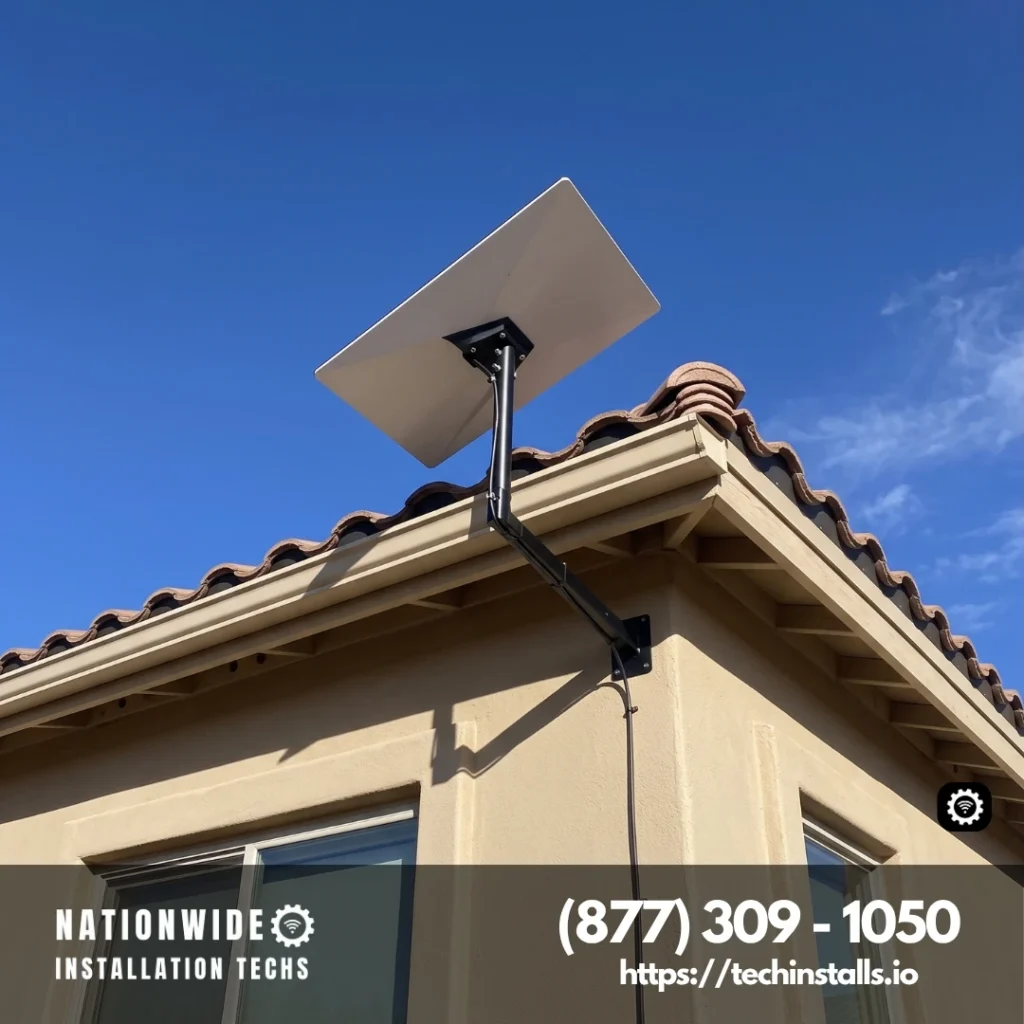
- An under-eave wall mount. An arm bolts into the wall below the soffit, into block or framing behind the stucco rather than the stucco skin alone, and reaches out past the gutter with a short vertical mast on its outer end that lifts the dish just clear of the roof edge. It is the lowest-profile of the three from the street, which also makes it the easiest one to get past a design review committee.
Which one you end up with depends on where the clear northern sky sits relative to your house and what the wall framing will actually take. That is what the free virtual site survey is for, because on a tile roof the wrong assumption is expensive.
Foam and Membrane Roofs Get Weight, Not Fasteners
A large share of Phoenix housing is flat or low-slope rather than pitched. Midcentury blocks through the older central neighborhoods, a lot of contemporary desert-modern building, and most of the light commercial stock. Those roofs are usually sprayed polyurethane foam under an elastomeric coating, or a single-ply membrane.
Both are waterproofed by one continuous unbroken surface. That is the entire design. Every fastener driven through it is a deliberate breach that then has to be detailed correctly, and detailing a foam or membrane roof is a roofing contractor’s trade rather than ours.
So on flat and low-slope roofs the answer is a ballasted non-penetrating mount. It sits on the surface, weight holds it in place, and the roof leaves the job exactly as watertight as it was when we arrived. We set it on a pad so the ballast is spreading its load rather than pressing into the coating, we keep it back from drains and scuppers so nothing changes about where water goes, and we route the cable clear of the low spots where water stands after a storm.
One practical note for foam: it is soft and takes a mark. We plan the walking route before carrying anything up, and given a choice we would rather set the mount near a parapet or a curb, where the substrate is better supported, than out in the middle of an open span. If your coating is close to the end of its service life, get it recoated first; otherwise we are setting a mount onto a surface that is about to be redone.
The HOA Answer Comes Before the Install Date
Most of the Valley’s newer housing sits inside a master-planned community with an association, and a fair number of the older neighborhoods have one as well. Architectural committees here commonly have something to say about exterior equipment visible from the street: where it may sit, how tall it may stand, what colour it is, and whether it may appear on a front-facing roof slope at all.
Sequence that before you book us rather than after, for two reasons.
The first is timing. A committee that meets monthly can turn a two-hour job into a six-week project, and an install date cancelled the night before helps nobody. The second is that knowing the constraint in advance changes what we quote. If the front elevation is off the table, the under-eave mount on a side wall or a ballasted mount tucked behind a parapet goes into the quote from the beginning instead of being discovered by a technician standing on your driveway.
Federal rules do limit what a private restriction can do to a small receiving antenna in an area you exclusively control, so it is worth knowing that before you assume the answer is no. But the document that governs your property is your own set of CC&Rs, and the conversation is with your association rather than with us. What we can do is hand you the mount specification and a clear note of where it would sit, which is usually all a committee actually wants to see before it says yes.
Rentals run on the same logic one level up. Written permission from the property owner comes first and we will need to see it before anything is fixed to the building. A verbal from a landlord is not that. A short written authorization naming the property and the work is.
What the Sky Over Phoenix Asks For: Anchoring, Sealing, and Not Much Else
For most of the year the sky here is about as easy as this work gets. Phoenix sits on a broad flat basin, sightlines run for miles, and the obstruction problems that dominate wooded markets barely register. The dish looks north, and on the majority of Valley lots there is simply nothing in the way of it.
Where we do lose sky it is almost always landscaping rather than land. A mature ficus, a stand of Mexican fan palms, or a big multi-trunk mesquite on the north side of the house will take out a sightline that the flat ground never would. Palms are the awkward case because they keep going up: a placement that clears the fronds this year may not in four, so we site for where that canopy is heading rather than where it is standing today. The other common one is a neighbour’s two-story, which is at least a fixed obstacle and straightforward to plan around once we know it is there. Where a roof genuinely cannot see north, a taller mast or a different building on the property usually can.
Then there is monsoon season, roughly June through September. Microbursts here produce very high localized wind for short periods and they bring blowing dust with them. Neither one hurts a properly mounted dish. What they punish is a lazy install: ballast weight that was estimated rather than specified, a wall mount anchored into stucco instead of into framing, a cable run held up by adhesive clips that have been baking since May, and a penetration sealed with whatever happened to be in the van.
So we overbuild the anchoring deliberately. Ballasted mounts get the full specified weight rather than an approximation of it. Wall mounts go into structure, every time. The cable is mechanically secured and given a drip loop so wind-driven rain has nowhere useful to travel, and the seal is a high-temperature product rather than a general-purpose one. As for the dust, it settles on the dish and the next rain deals with most of it. If you want it clean sooner, rinse it from the ground with a hose rather than a pressure washer.
Winter Visitors, Lock-and-Leave Houses and Rigs That Move
Phoenix gains a very large seasonal population between October and April, and it changes the shape of the work we do here.
Some of it is houses. A lock-and-leave property standing empty from May to October still needs a working connection the whole time for cameras, the thermostat, irrigation controllers and the pool equipment, and it needs one that comes back up by itself after a summer outage rather than waiting for somebody to fly in and press a button. We set those up to recover unattended, and we are happy to do the install while the house is empty if you can arrange access and confirm in writing who authorized the work.
Most of the seasonal work, though, is rigs. The long-stay parks across the East Valley and out toward Apache Junction and Casa Grande fill every winter, and a great many of those coaches want their own connection rather than a shared park network. That is a different job from a house. The mount is bolted to the rig, the cable entry has to be watertight and still serviceable later, and the power side has to suit how you actually camp. RV Starlink installation is one of our core service lines and we run it here constantly through the season.
The same applies to vehicles that are not RVs. Starlink installation for cars and trucks covers work trucks, service vehicles and overland builds, and the mounting discipline on those is much closer to the RV job than to the house job. Tell us which one you have when you call, because the hardware conversation is different from the first sentence. If you are running off a battery bank or solar, the figure to hand your electrician is 75 to 100 watts for the dish. Sizing the system is their trade, not ours.
Where a Phoenix Starlink Installer Drives, and What the Quote Covers
Phoenix is the middle of the Valley, so the ring around it is more or less the Valley itself, and almost all of it is a short run on a grid laid out for exactly that.
East and north east we work Scottsdale, Paradise Valley, Tempe, Mesa, Fountain Hills, Rio Verde and out as far as Apache Junction. South east through Gilbert, Chandler, Sun Lakes and Queen Creek. South and south west across Ahwatukee Foothills on the far side of South Mountain, Laveen, and down to Maricopa and Casa Grande. West through Tolleson, Avondale, Litchfield Park and Buckeye. North west through Glendale, Peoria, Sun City, El Mirage and Surprise. North up through Anthem, New River and Carefree. Further out we still go: Wickenburg to the north west, Florence to the south east, Gila Bend down in the south west corner of the county.
The drive does not change what you pay. Residential installs start at $385, and what moves the number from there is the work at the far end of it: which mount your roof forces on us, whether a taller mast is needed to clear a canopy, how long and awkward the cable run turns out to be, and whether a second building has to be covered. A virtual survey is free and reads the sky over your actual roof before anyone commits to a date. An on-site survey is $199 if you would rather have a technician physically at the property first, which on a multi-building lot or an awkward tile roof is frequently money well spent. You will have the figure before any work starts, and we do not requote from the top of a ladder.
Typical scheduling is around 72 hours. If the kit is already sitting in your hallway and the survey comes back clean, same day is often possible. We are an independent installer: you own the hardware and you hold your own Starlink account. We do not sell you the service plan, we do not open the account for you, and we do not take a cut of your monthly bill. What we sell is the install, and what a Starlink install actually costs is broken down in full elsewhere on the site if you want the detail first.
Frequently Asked Questions
Yes, but early. From roughly June through September we schedule rooftop work at first light and aim to be off the roof by mid-morning, because afternoon roof work in a Phoenix summer is a real safety problem for the technician and hard on the roof surface as well. We will not take an afternoon slot in August just because it suits a calendar. Booked early, the job runs exactly as it would in February. Typical scheduling is around 72 hours from the survey, and when your kit is already on site same day is often available. It simply means a six in the morning knock at the door.
No. We do not drill tile, lift tile, or cut into a tile field, and that includes routing a cable through it. Our install standard documents five mounting methods and none of them touches tile, so the cable stays off the tile too. It runs down a wall, under the eave, or along a parapet, and it enters the house through a wall penetration we can seal properly rather than through a roof plane we cannot. If the only route somebody can picture goes through your tile, that is a sign the mount is in the wrong place, not that the tile needs opening up.
Not if nothing penetrates it, which is exactly why we use a ballasted non-penetrating mount on foam. The warranty problem with a foam roof is almost always a breach of the coating, and a ballasted mount does not make one. It sits on the surface and weight holds it there. We set it on a pad so the load is spread rather than pressing into the foam, keep it well clear of drains, and plan the walking route before carrying anything up, because foam marks easily. If your coating is near the end of its service life, have it recoated first and then call us.
Get the approval first, or tell us the constraint now so we can quote around it. A committee on a monthly cycle can add six weeks to a two-hour job, and there is nothing gained by holding a date we may have to cancel. What clears these fastest is submitting a specific placement rather than a general request, so we will give you the mount specification and a note of where it would sit. An under-eave or rear-slope placement is what most committees are hoping to see. If the front elevation is off the table entirely, say so and we will design to that from the start.
Years, if the materials were chosen for this climate, and not long at all if they were not. Valley sun destroys cheap cable jacketing, general-purpose sealant and stick-on cable clips. They go chalky, then brittle, then they let go, and you are left with a sagging run and a seal that has shrunk back from the penetration. We use UV-stable cable, secure the run mechanically instead of trusting adhesive, and seal with a high-temperature product. Worth doing yourself once a year: walk outside and look at the cable run and the mount base. Anything cracked or drooping, call before monsoon rather than after.
Yes, with arranged access, and the empty months are often the better time to do it. A seasonal house needs the connection working precisely when nobody is there, for cameras, the thermostat, irrigation and the pool equipment, so we set it up to come back on its own after a summer power cut rather than needing somebody on site to restart it. Give us a key holder or a gate code, and confirm in writing that the person authorizing the work owns the property. We send photographs of the finished mount, the cable route and the seal so you can see the job before you fly back.
Possibly, but a taller mast is the second choice rather than the first. The dish looks north, so a palm on that side genuinely is in the way, unlike anything standing on your south elevation. The first move is to find a placement that already clears it: a different roof plane, the gable end, or a spot further off the trunk line, because a shorter mount is always the more durable one in monsoon wind. If a taller mast really is the honest answer we will say so and specify the anchoring to match. We also site for where the fronds will be in a few years, not only today.
Yes, and it is different work from a house install. An RV mount is bolted to the rig, the cable entry has to be watertight and still serviceable later, and the power side has to suit how you actually camp. The dish draws 75 to 100 watts, which is the figure to hand whoever sized your batteries or your solar. We work the winter-visitor parks around Mesa, Apache Junction and Casa Grande through every season. Tell us whether the rig stays parked all winter or travels while you are here, because that genuinely changes which mount and which hardware we recommend.
About Nationwide Installation Techs
Nationwide Installation Techs LLC is a professional, insured satellite installation company operating in all 50 states, with over 3,000 installations completed and a 4.9-star Google rating from 90+ reviews. Our experienced technicians cover residential, commercial, RV and marine installations, along with mesh networking, point-to-point bridges and on-site repair. We are an independent installer: you own your hardware and hold your own service account, and our crews handle the mounting, sealing and setup.
Serving Phoenix, Maricopa County and the rest of Arizona, plus every other state listed on our locations we serve page. Call (877) 309-1050.
Contact a Phoenix Starlink Installer
Nationwide Installation Techs LLC
- Phone: (877) 309-1050
- Email: support@techinstalls.io
- Free Quote: Contact Us Form
Connectivity News & Updates

Residential Starlink Installation — Nationwide and Insured
Residential Starlink installation starting at $385, nationwide. Nationwide Installation Techs...

Lake Havasu City Starlink Installer — Same-Day Service When Your Kit Is On Site
Lake Havasu City Starlink installer, Nationwide Installation Techs, (877) 309-1050....

Expert Starlink Installation for Yachts and Boats
Starlink installation for yachts and boats, nationwide. Nationwide Installation Techs...

Phoenix Starlink Installer — Same-Day Service When Your Kit Is On Site
Phoenix Starlink installer, Nationwide Installation Techs, (877) 309-1050. Professional, insured...
Disclaimer: Nationwide Installation Techs LLC is an independent business and has no affiliation or official connection with Starlink, SpaceX, or any of their subsidiaries or affiliates. We are not associated with, authorized, endorsed, or sponsored by these companies in any capacity. For official information, please visit the Starlink and SpaceX websites at www.starlink.com and www.spacex.com. The names “Starlink,” “SpaceX,” and any related trademarks, logos, or imagery are the exclusive property of their respective owners.
Any references to “certified” or “certification” on this website refer exclusively to Nationwide Installation Techs LLC’s proprietary in-house technician certification program. This training and certification process was developed by our company based on the experience and installation methods of professional technicians who have collectively completed more than 3,000 successful Starlink installations while maintaining an overall 4.9-star customer review rating. It is not affiliated with, issued by, approved by, or endorsed by Starlink, SpaceX, or any of their affiliates.